To avoid these ads, REGISTER NOW!

Trench footer transition to stem wall..

ph1gering

Well-known member
Joined
Nov 1, 2013
Messages
194
Location
Upstate, NY
Hey guys..

Been trying to figure out how I want everything done for the shop build coming this spring. Been getting quotes, the more i get the more i decided i'll be a lot more hands on for this.. Shops going to be 40x40 stick build...

Got access to everything i need and have done plenty of building etc, so not much scares me, but haven't done much concrete.

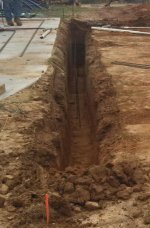
The one contractor was telling me that in upstate NY its typical to just do a trench foundation, 12" wide buck, go down 42" inches, rebar and pour. My question is if I tackle this myself, how do i transition from 12" footing wall to my stem wall and is it advisable to do this in 1 pour?

xt7a.jpg


Do I make a L shaped form (black part in my 6th grade drawing) to contain the concrete in the ground or do i not try this at all, just do two pours?

please poke holes in this plan!.. Open to all/any suggestions.. thanks.. I don't want to block it though...

thanks!!
--Craig
 
To avoid these ads, REGISTER NOW!

joes169

Well-known member
Joined
Sep 19, 2011
Messages
663
Location
WI
I've heard of this "trench pour" method before, but I can honestly say in 20+ years in the concrete/masonry trade, I've never seen it around here. I'm fairly confident it wouldn't pass inspection, unless the banks where lined with something like plywood or foam. Not to mention, the excavation would have to be perfect, not just the typical "close enough for footings".......
 
OP
P

ph1gering

Well-known member
Joined
Nov 1, 2013
Messages
194
Location
Upstate, NY
Talked to the contractor again today, he said he would bring that 6 inches above grade with a form. Let it dry then either block or form for stem wall and pour again.

Something like this: But with the hooks in the blocks or addition stem wall.
S1250E5B.GIF


I am not trying to go with this method, just trying to figure out if this guy knows what he is doing or if i should push for a more typical foundation. Shop will be 40x40 upstate NY so it has to be 42" or 48" inches deep or i could go with mono slab it is allowed.
 

wssix99

Well-known member
Joined
Mar 2, 2011
Messages
5,161
Location
Chicago, IL
Typically, your 12" footing would be X" high. You'd pour that, key the top of the footing for the stem, and then form and pour the stem separately. (The wider part of the footing takes a good bit of concrete, depending on the depth you need.)

I understand that the cost of forming the foundation can often be less than the cost of additional concrete to fill the irregular contours of the trench. The ability to pour directly in the trench will also depend on the properties of the soil around you.

I just poured a small footing and stem wall all in one pour. (an extension of an existing wall) It worked well, but the forms were a PITA to strip off because of the cap on top of the spread base. (This probably would have been easier if the forms were built like a quality cabinet, etc. but this is hard to do in a trench. That plywood cap extended in to the stem here and there and there were a lot of nails, etc. that had to be dealt with.) Even for a small job, I would have preferred to do it in two parts. I was under some time pressure, so I chose to try the faster route.
 

joes169

Well-known member
Joined
Sep 19, 2011
Messages
663
Location
WI
Ask the contractor what's going to happen when the frost starts picking at the wall as it heaves around the garage.............
 

joes169

Well-known member
Joined
Sep 19, 2011
Messages
663
Location
WI
Make sure you go below frost line to avoid this happening.

Even if the bottom of the excavation and walls is below the frost line, a wall like that can still heave. If the sides aren't smooth, the frost can find enough area to "pick away" at the walls and raise them out of the ground. This is the reason sono-tubes exist.

Also, a good foundation design includes a spread footing, which is lacking with the approach mentioned. Here in WI, that spread footing needs to extend a minimum of 4" wider than the wall in each direction..........
 

csp

Well-known member
Joined
Mar 23, 2010
Messages
5,719
Location
Franktown, CO
Around here all footers have to be formed. We do not just dig trenches and pour concrete in them for the reason that it can heave.

We pour our footers first with rebar sticking out to tie into the stem walls. Stem walls are also formed, top to bottom with at least 6" sticking out above grade to prevent water from entering and wood/building products from being in contact with the ground.
 
OP
P

ph1gering

Well-known member
Joined
Nov 1, 2013
Messages
194
Location
Upstate, NY
Got feelers out to several other contractors that are foundation/concrete only guys in the area for estimates. Although the first on that replied so far mentioned a trench footer, but i asked him specifically what the process is when he says trench.. So we'll see..
 
Last edited:
Joined
Oct 6, 2013
Messages
27
Location
Cincinnati OH
Usually if the soil is good enough to stand up for a trench, then frost heave usually is not an issue. I have designed many buildings with this type of footing, and have not had any issues crop up. Just have to make sure your soil profile is suitable for this.
 

gpflepsen

Well-known member
Joined
Sep 5, 2013
Messages
105
Location
NE
There is nothing wrong with doing a trench footing it the soil type will support it. I just put in trench footings. The top of the footing is practically at the same elevation of the rough grading done (~2" below finish grade). A skilled backhoe operator can cut the footing walls so they are smooth and straight, IF the ground can support itself. If you are in sand this will probably not work too well and you'll probably have to do traditional spread footings and a poured wall.

Directly on top of the footing will be a 12" x 6" framing sill (or stem wall) poured. You could probably rent the forms or make them yourself out of 3/4" plywood.

About 2" of compacted granular fill will go on top of the footing elevation, then a 5" concrete slab on that. This will give about 5" of stem wall above the finished floor.

The attached pic shows how neat and acceptable a trench footing can be. It is 12" wide and 42" deep.
 

Attachments

  • footings.jpg
    footings.jpg
    124.4 KB · Views: 143
  • Foundation.JPG
    Foundation.JPG
    26 KB · Views: 140

gpalmer77

Well-known member
Joined
Aug 15, 2012
Messages
515
Location
Mokena IL
My garage was poured with a trench footing and stem wall, in one pour...... 12" wide trench, 42" deep, belled out 4" each side at the bottom. Outside edge was formed pretty much even with the outside of the stem wall/curb..... bottom of the form was just under where the finished dirt would be, so the transition from form to trench is hidden by soil. They filled the trench with concrete, then quickly formed the inside form (about 8" deep) and kept placing concrete. Some concrete would obviously come out under the inside form, but they sloped it to the inside and the slump was sufficient for it not to run away. Slab was poured two days later and covered the inner slope of rough concrete, and about 4" of the inside formed stem wall, to leave 4" exposed.
 

ken.guiberson

Member
Joined
May 14, 2014
Messages
6
Location
Rochester, NY
Hi, I am facing a similar situation. I live in western NY. I have quotes for both a spread footing ($27K) and a trench foundation ($15K). As you can see the trench foundation quote is considerably less. Others in this thread have mentioned soil conditions. I have Collamer Silt Loam, according to the town. Is this suitable for a trench foundation?

Oh, in case you are wondering why both estimates are a bit high, my site is uneven so my stem wall will be 3' or so in the back.

Thanks!
 
To avoid these ads, REGISTER NOW!

volleyball

Well-known member
Joined
Aug 29, 2011
Messages
4,127
Location
NY, not NYC
The people to ask is your building dept who is going to approve or not the concrete. For NY, gravel and foam board will go a long way to limit frost heaving.
I like the idea of widening the bottom outside of the trench if that is allowed. That and foam board on the inside of the trench will go a long way.
 

Zeke

Well-known member
Joined
Aug 13, 2009
Messages
17,176
Location
Long Beach CA, the sewer by the sea.
Out here we sometimes use drywall in the trench for a smooth side or to just save on concrete. No reason to place a 14" wide footing if the plans call for 12". So if we have a small cave in we will put one or two sheets of drywall in there. We back the drywall with dirt or gravel as the pour fills in. Over time the drywall deteriorates and turns into soil leaving a smooth side to the concrete.

Mostly we don't worry about frost heave so trench filled footings are common. Here's the thing: if you want to transition to a smaller stem wall you can form that above the footing as long as the forms are down to grade level or a bit lower. No need for an "el". Just like a dog's water bowl with a reserve, the wet mud will not boil out of the trench.

We pour 18" to 2 feet at a time letting each course take up just a little before putting more mud on top. Makes for a lot of running around the site with the hose but eliminates blowouts. We have to use a **** load of steel.
 

volleyball

Well-known member
Joined
Aug 29, 2011
Messages
4,127
Location
NY, not NYC
Way different needs in NY than Ca. the L is for the wider footer. I never did a trench but I guess you could pour the footer. Then use foam and lumber to build a reverse form and back fill after the footer is inspected. So the need for concrete would be halved.
 

ken.guiberson

Member
Joined
May 14, 2014
Messages
6
Location
Rochester, NY
The trench foundation quote did include foam, but I'm not sure if this was just for the inside. I'll have to check.

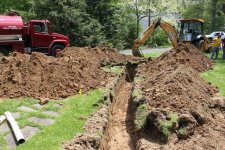
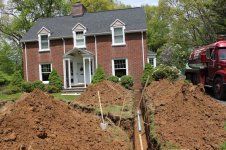
The quote also calls for 12" wide trench for a 1 story garage with attic storage. I would like to feel a bit more comfortable that this is appropriate for my site. Should I have the soil tested once the trench is made? Should I expect the contractor to verify soil strength using a Penetrometer? BTW, I just had my house hooked up to sewer. Here's a few pics of the trench. Any expert eyes have an opinion on the soil strength?

Thanks!
 

Attachments

  • IMG_4284.jpg
    IMG_4284.jpg
    153.2 KB · Views: 90
  • IMG_4287.jpg
    IMG_4287.jpg
    152.5 KB · Views: 88

readhead

Well-known member
Joined
Dec 8, 2012
Messages
6,180
Location
Durango, Co.
The advantage to a trench is time and money. For a footing, stemwall and slab there is a lot of dirt work and three seperate pours. We do a lot of metal buildings with mono pours. We grade a pad, trench for the piers and walls, put a form around the peremiter, place the steel and pour.
I am in cold and snow country and have never had any call backs. The hard part around here was finding someone to do this system. I finally came across a guy that moved here from California and understood what I needed.
You will buy more concrete but more than make up for it with less labor.
You should talk to your building department first. I had to show them what I wanted to do because they had never seen this type of foundation around here before. I had an engineer do a foundation plan that they approved. Now the building department has a typical detail that they hand out for this type of construction.
 
Last edited:

volleyball

Well-known member
Joined
Aug 29, 2011
Messages
4,127
Location
NY, not NYC
From the picture, it looks like you have a good shot at a successful trench. I do think I'd have some compacted gravel under the concrete.
If you try and go with a new system, new to the building dept, they will want an engineer to approve it and that eats into your "savings". So cost benefit may go out the window.
You should also find the thread where a guy had a pad poured on a similar hill and now suing his contractor. His wall was block but it can give you insight.
Readhead, I am curious, you have cold but do you have the moisture seeping into the ground where you are? The little I know of soil in the SW is that in many areas, the soil doesn't absorb much water which would cause heaving.
 

Beemer533

Well-known member
Joined
May 9, 2014
Messages
2,057
Location
Syracuse, NY
Why not just do a normal footer with rebar then form the walls with ICFs? No need to worry about forms at all then.
 

readhead

Well-known member
Joined
Dec 8, 2012
Messages
6,180
Location
Durango, Co.
Volleyball, we can have lots of different soil conditions in our area. Your'e right, we probably have less of a frost heave issue here but it does happen. The last two metal buildings have had footing, stemwall and slab construction. The next one will be a mono pour with void forms and grade beams between the piers.
We are very mindful of soil conditions around here. Every foundation has to be engineered. We can be in shale one day and clay the next.
As always we don't have all the info and I would suggest that the op talk with the building department to determine what direction he needs go.
 

volleyball

Well-known member
Joined
Aug 29, 2011
Messages
4,127
Location
NY, not NYC
We are both in agreement with the building dept. And in NY you have just about every soil condition except for quicksand, I think.
But most of it peculates so more likely to heave.
 

Kevin54

MEMBER EMERITUS
Joined
Jan 12, 2005
Messages
29,341
Location
Urbana, Ohio
Around here in Ohio, the "trench footer" is one of the most common to do. The trench will go down to frostline depth, then any loose dirt shoveled out by hand as you cannot have disturbed soil. All the soil has to be "undisturbed". Then the rebar is set on chairs, two rows, bent around the corners, wired up, then the footer is poured to a depth of 8" or a tad more. For my area 36" is the frostline. If it is much deeper, the block layers usually like something a little more than 12" wide so they have room to work.
 

joes169

Well-known member
Joined
Sep 19, 2011
Messages
663
Location
WI
Around here in Ohio, the "trench footer" is one of the most common to do. The trench will go down to frostline depth, then any loose dirt shoveled out by hand as you cannot have disturbed soil. All the soil has to be "undisturbed". Then the rebar is set on chairs, two rows, bent around the corners, wired up, then the footer is poured to a depth of 8" or a tad more. For my area 36" is the frostline. If it is much deeper, the block layers usually like something a little more than 12" wide so they have room to work.

That's entirely different than the topic being discussed here. What you've mentioned is often called "bank pouring, and it just means the footings themselves aren't formed. What the rest of the thread is discussing is pouring the entire trench against excavated earth, eliminating the footing all-together.

I've been at this a long time, and for the minimal cost and time savings, I think it's a bad idea............
 

TommyK

Well-known member
Joined
Mar 29, 2011
Messages
546
Location
CT
It's all about the soil bearing capacity and the load expected to be placed on it. A typical 20" wide spread footing allows sufficient safety factor for the variability of soils because most people aren't doing soil analysis for residential construction. If an Engineer says your soil doesn't need a spread footing then fine. However like Joes169 I would be concerned about the effects of frost.

The first question that needs to be answered is will the bottom of trench be on virgin ground? On a previously developed residential site and at a 42" footing depth it is definitely questionable.
 

Kevin54

MEMBER EMERITUS
Joined
Jan 12, 2005
Messages
29,341
Location
Urbana, Ohio
That's entirely different than the topic being discussed here. What you've mentioned is often called "bank pouring, and it just means the footings themselves aren't formed. What the rest of the thread is discussing is pouring the entire trench against excavated earth, eliminating the footing all-together.

I've been at this a long time, and for the minimal cost and time savings, I think it's a bad idea............

Around here, you do not hear the phrase "bank pouring". You do hear "trench footer" though. Your walls are your forms, and the footer is poured to the proper thickness.

There is also two ways that are done around here. One is to go to frostline. The other is to go down about a foot on the surface, dig out the trench, and pour your footers. Once that is done, the walls are laid up. After that, the center of everything is dug out, then you get your gravel inside as your fill on crawlspace, and what other dirt you have is distributed on the outside, so you end up being higher than the surrounding ground, and now have a footer down to frostline.
 
To avoid these ads, REGISTER NOW!
Top Bottom