To avoid these ads, REGISTER NOW!

Truss connector plates pulling out

zak77

Well-known member
Joined
Sep 18, 2014
Messages
1,351
Location
Monson, MA
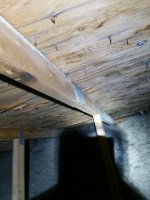
I went into my attic yesterday to take a couple pics for the roofing guy and i happen to notice that on one of the trusses, the connector plate was starting to pull out. Then i started looking at other trusses and a lot of the plates are pulling out. My plan is to press them back in but i'd like to do something to prevent this from happening again. Since these are only 2x4's i dont want to add a lot more penetrations so i was thinking of cutting some 1/4 plywood, happen to have a sheet kicking around, a little longer than the connector plates and use a couple screws to secure one on each side, staggering screws from side to side. This plywood would only be there to prevent pulling out of the plates.

Think this would work ok?

Also, anyone have a particular brand of asphalt shingles they prefer over others?
 
To avoid these ads, REGISTER NOW!

Stuart in MN

Well-known member
Joined
Sep 8, 2005
Messages
22,999
Location
Minneapolis
Something is causing those plates to pull out, they should come loose all on their own...have you had heavy snow loads on the roof this year?
 

readhead

Well-known member
Joined
Dec 8, 2012
Messages
6,175
Location
Durango, Co.
That is not good. I would be trying to figure out why they are coming apart rather than looking at a quick fix.
 

theoldwizard1

Well-known member
Joined
Feb 22, 2011
Messages
43,077
Location
SE MI
As long as the gap that the connector plate is holding together is not opening up (much) you are still in good shape.

1/4" plywood on each side is likely adequate as it's main purpose to to keep the plate in place and not add any strength. Through bolts and washer would be better.
 

Commendatore

Well-known member
Joined
Mar 5, 2015
Messages
179
Location
Central NC
If the plates are actually failing, you're at risk for collapse. Seems like it would be worth having someone qualified take a look.
 

Mattlt

Well-known member
Joined
Nov 30, 2005
Messages
1,382
Location
MN
I would contact the truss manufacturer, pronto. They tend to frown upon homeowner "fixes" to an engineered truss.

How old is the house?
 

MrSurly

Well-known member
Joined
Jan 15, 2014
Messages
1,671
Location
East Texas
Ironically you’ve casually mentioned a condition that *could be* a symptom of a pending failure due to overload..... and.... mentioned (quite heavy) asphalt shingles in your plans.
A re-think or at least investigation could be indicated.


Sent from my iPhone using Tapatalk
 
OP
Z

zak77

Well-known member
Joined
Sep 18, 2014
Messages
1,351
Location
Monson, MA
No heavy snow loads this year but 6-7 years ago we have a lot one season. Other than that i dont know why they're pulling out except for expansion and contraction of the wood over the years. The house is 30 years old and currently has 2 layers of shingles which will be stripped off and of course a new layer of shingles. I spoke to my friend who's a building inspector and he cant recall many issues of trusses coming apart but figured my plan was adequate, although yes the proper way to go about would be to get an engineer involved to come up with a proper fix.
 

readhead

Well-known member
Joined
Dec 8, 2012
Messages
6,175
Location
Durango, Co.
Truss's don't go bad. Something is causing the failure. You need to find out what is happening before the new shingles end up in your lap.
 

Kenstone1

Well-known member
Joined
Oct 2, 2015
Messages
734
No heavy snow loads this year but 6-7 years ago we have a lot one season. Other than that i dont know why they're pulling out except for expansion and contraction of the wood over the years. The house is 30 years old and currently has 2 layers of shingles which will be stripped off and of course a new layer of shingles. I spoke to my friend who's a building inspector and he cant recall many issues of trusses coming apart but figured my plan was adequate, although yes the proper way to go about would be to get an engineer involved to come up with a proper fix.

I don't see where you have answered the "are the joints pulling apart too" question yet.
If any of the joints have opened up the ceiling maybe be sagging but not noticed.
The sagging ceiling would need to be jacked up to close the gaps before any repair plates are installed.

I do know the metal strapping used to tie down/connect framing in new construction is sold in rolls and the proper length of the application can be cut at the job site.
It's perforated for screw/nails, I would find/buy a roll and cut the proper length for each joint and screw it in place, rather than buy individual plates.
If you're taking just a few plates pulling out, just buying individual plates might be a better option.
This would be way better than 1/4" plywood scraps.
jmo
:)
 
Last edited:
OP
Z

zak77

Well-known member
Joined
Sep 18, 2014
Messages
1,351
Location
Monson, MA
No, the joints are not pulling apart so that's why at the very least i want to get the plates back flush to the members before they start pulling apart. I'd like to keep them there so they do their job.

Metal strapping, hmmm i have some of that kicking around.
 

Bigblockyeti

Banned
Joined
Feb 1, 2018
Messages
2,550
Location
Upstate, SC
I would call your homeowners insurance company first. They'll gladly foot the bill for an engineer should one be deemed necessary vs. the calamity of a failed roof resulting in a destroyed structure, lost personal items and potential injury (or worse). They usually don't just do that, even on older trusses unless the roof system wasn't designed correctly to begin with or it's been overloaded.
 

MrSurly

Well-known member
Joined
Jan 15, 2014
Messages
1,671
Location
East Texas
I would suggest at a minimum that your plan to strip the roof of two layers of shingles and replaced with one is a really good idea and *could be* all the remediation needed.
I would definitely inquire of the truss maker for advice on the condition you see for their opinion before changing it.


Sent from my iPhone using Tapatalk
 
To avoid these ads, REGISTER NOW!

LB-1911

ALLIANCE MEMBER
Joined
Sep 24, 2011
Messages
5,742
Location
Northwestern Il.
I went into my attic yesterday to take a couple pics for the roofing guy and i happen to notice that on one of the trusses, the connector plate was starting to pull out. Then i started looking at other trusses and a lot of the plates are pulling out.


How far are they pulled out?

I've seen truss plates not totally pressed in tight on new truss.


Same question
 

readhead

Well-known member
Joined
Dec 8, 2012
Messages
6,175
Location
Durango, Co.
2.3.4.9 specifies that damage repair has to be designed by the truss manufacturer or an engineer. No activity should take place on or around the damage until the truss is repaired.
I don't think I would have a bunch of roofers on the roof until the damage has been inspected and repaired.
 

larry4406

Well-known member
Joined
Jan 27, 2006
Messages
19,039
Location
Northern Virginia
New construction guy here.

Attached is a generic repair detail we are issued when a truss connector plate has come loose or is missing.

YMMV and use at your own risk!

I have also had other new homes where due to waning of the material, less then full teeth engagement of all teeth in the plate have occurred. Our truss designer has then provided details showing how many teeth must engage at each connection. Rare occurrence for that.
 

Attachments

  • MII-Missing Plate Repair.pdf
    24.3 KB · Views: 108
OP
Z

zak77

Well-known member
Joined
Sep 18, 2014
Messages
1,351
Location
Monson, MA
truss.jpg

Just a reminder to everyone my first plan is to press the plates back into place so that isnt going to alter the integrity of the truss. Then i'm looking into how it happened and how to prevent it in the future. Plywood or metal strapping is not to be a structural part what-so-ever, it would only be in place to prevent the plate from coming out again, if i were to actually go that route.

Found this abstract about repairing pulled plates:

Partially embedded metal connector plates can occur in wood trusses when the plates are not properly pressed, when they “walk out” as the wood dries during service, or when there is a mismatch in member thickness. Current industry practice is to ignore the remaining strength of a partially embedded plate when making repairs. This assumption results in a large, overdesigned repair along with high material and labor costs. The project objective was to determine if a smaller clamped repair is sufficient to restore the strength of the partially embedded plate to the fully embedded connection strength. A total of 40 tension splice connections were fabricated from 2 by 6 members with 5 by 3 metal connector plates. The specimens included 10 fully embedded plates, 10 partially embedded plates, 10 partially embedded plates repaired with plywood gussets secured outside of the main 2 by 6 members (RC), and 10 partially embedded plates repaired with plywood gussets and light wood screws (RS). The average strength of the partially embedded RC specimens and partially embedded RS specimens were 87 and 108 percent of the fully embedded specimens' strength, respectively, whereas the unrepaired partially embedded plates achieved only 60 percent of the fully embedded specimens' strength. The results of the tests indicate that smaller screw-type gusset repairs are sufficient to return the strength of a tensile splice connection with a 1/16-inch partially embedded plate to its fully embedded plate capacity. Both the clamping action of the plywood gussets and the additional tensile capacity of the screwed plywood gussets were observed to contribute to the strength gains.
 
Last edited:

Kenstone1

Well-known member
Joined
Oct 2, 2015
Messages
734
truss.jpg

Just a reminder to everyone my first plan is to press the plates back into place so that isnt going to alter the integrity of the truss. Then i'm looking into how it happened and how to prevent it in the future. Plywood or metal strapping is not to be a structural part what-so-ever, it would only be in place to prevent the plate from coming out again, if i were to actually go that route.

Found this abstract about repairing pulled plates:

Partially embedded metal connector plates can occur in wood trusses when the plates are not properly pressed, when they “walk out” as the wood dries during service, or when there is a mismatch in member thickness. Current industry practice is to ignore the remaining strength of a partially embedded plate when making repairs. This assumption results in a large, overdesigned repair along with high material and labor costs. The project objective was to determine if a smaller clamped repair is sufficient to restore the strength of the partially embedded plate to the fully embedded connection strength. A total of 40 tension splice connections were fabricated from 2 by 6 members with 5 by 3 metal connector plates. The specimens included 10 fully embedded plates, 10 partially embedded plates, 10 partially embedded plates repaired with plywood gussets secured outside of the main 2 by 6 members (RC), and 10 partially embedded plates repaired with plywood gussets and light wood screws (RS). The average strength of the partially embedded RC specimens and partially embedded RS specimens were 87 and 108 percent of the fully embedded specimens' strength, respectively, whereas the unrepaired partially embedded plates achieved only 60 percent of the fully embedded specimens' strength. The results of the tests indicate that smaller screw-type gusset repairs are sufficient to return the strength of a tensile splice connection with a 1/16-inch partially embedded plate to its fully embedded plate capacity. Both the clamping action of the plywood gussets and the additional tensile capacity of the screwed plywood gussets were observed to contribute to the strength gains.
Thanks for the pics
Most plates are just to hold the joint in alignment like the joint to the left in your pic, as the most vertical member is in compression.
The **** joint centered in your pic is different in that it is more horizontal and more in tension than compression.
Have you thought about modifying a clamp with jaws that cover the plates (on both sides) that would push the plates back into the wood?
The clamp could even be a cheap bench vice with plates screw in place of the jaws, big enough to cover the truss plates.
good luck on your quest,
:)
 
Last edited:

bullnerd

Well-known member
Joined
Sep 17, 2012
Messages
5,690
Location
Jersey
Last thing I would do is call an engineer, (Except ssdave, he seems pretty level headed) What you want is to have a farmer friend look at it and tell you how to fix it for free and it will be better than the original truss! lol

Is there a chance, like readhead mentioned, if you have a moisture problem that the lumber is changing dimension more drastically than if it was a very dry situation? Causing the plates to eventually walk out.

There may not be a structural issue at all.

You have to look at more than just the plates.

Do you see any sag in the roof/ceiling from outside/inside?

My house was built in the 50's, the attic is so dry I don't think there is a tight joint anywhere, You can see the nail shanks through the spaces in some spots. The 2by material is basically petrified and the tongue and groove is definitely not where they put it when they built it.

So the moral of the story is....you need more info! lol!
 
OP
Z

zak77

Well-known member
Joined
Sep 18, 2014
Messages
1,351
Location
Monson, MA
The roof structure is straight and not bowing at all so there is no structural deformation as of now. I went into the attic when i got home yesterday and used a couple pieces of 2x4 and a c-clamp to see what'd happen if i tried to press them back in. I got to about 8 of them and it worked great. I just need to come up with a better design since trying to hold a couple 2x's on a truss and turn a c-clamp in a cramped attic got difficult. I'm going to see if i can get the original plans for the house which should include the truss paper work and if the company is still around i can contact them. Otherwise, i know of a local truss manufacturer that i can approach to see if they can help.

Everyone keeps mentioning the moisture issue which is why i am getting a new roof put on. When the house was built in 1990 they didnt put tar paper down, just shingles on decking. That roof lasted 11 years then they did a roof-over so it wasnt installed right to begin with. So once i get the plate issue straightened out, then i'll have the roof company strip and install a proper roof system, then i will at the very least monitor the plates. Unless i can have a proper fix for the issue drawn up then i will do what the engineer suggests.
 

GMCGarage

Well-known member
Joined
Jan 31, 2017
Messages
1,264
Last thing I would do is call an engineer, (Except ssdave, he seems pretty level headed) What you want is to have a farmer friend look at it and tell you how to fix it for free and it will be better than the original truss! lol

Is there a chance, like readhead mentioned, if you have a moisture problem that the lumber is changing dimension more drastically than if it was a very dry situation? Causing the plates to eventually walk out.

There may not be a structural issue at all.

You have to look at more than just the plates.

Do you see any sag in the roof/ceiling from outside/inside?

My house was built in the 50's, the attic is so dry I don't think there is a tight joint anywhere, You can see the nail shanks through the spaces in some spots. The 2by material is basically petrified and the tongue and groove is definitely not where they put it when they built it.

So the moral of the story is....you need more info! lol!

Yea, truss plates falling out of a load bearing truss is not a structural issue at all.

I would try super glue or duct tape. :lol_hitti:lol_hitti
 

Kenstone1

Well-known member
Joined
Oct 2, 2015
Messages
734
The roof structure is straight and not bowing at all so there is no structural deformation as of now. I went into the attic when i got home yesterday and used a couple pieces of 2x4 and a c-clamp to see what'd happen if i tried to press them back in. I got to about 8 of them and it worked great. I just need to come up with a better design since trying to hold a couple 2x's on a truss and turn a c-clamp in a cramped attic got difficult. I'm going to see if i can get the original plans for the house which should include the truss paper work and if the company is still around i can contact them. Otherwise, i know of a local truss manufacturer that i can approach to see if they can help.

Everyone keeps mentioning the moisture issue which is why i am getting a new roof put on. When the house was built in 1990 they didnt put tar paper down, just shingles on decking. That roof lasted 11 years then they did a roof-over so it wasnt installed right to begin with. So once i get the plate issue straightened out, then i'll have the roof company strip and install a proper roof system, then i will at the very least monitor the plates. Unless i can have a proper fix for the issue drawn up then i will do what the engineer suggests.

:beer: on the C clamp use :thumbup:
I have found vents/venting to be the answer to moisture/condensation issues, not tar paper
Ridge vent/off ridge vents/gable end vents/soffit vents, to name a few.
The shingle nails were always "frosty" when viewed during winter until I added off ridge and soffit vents.
:)
 
Last edited:

PugetDude

ALLIANCE MEMBER
Joined
Mar 13, 2013
Messages
22,275
Location
Superstition Mountains, AZ
Clamp the plates back into position with a few c-clamps, run 3-4 Simposn Screws in on opposing sides of the of the truss and the splices to keep them from backing out again, and focus on fixing that condensation issue..
 

bullnerd

Well-known member
Joined
Sep 17, 2012
Messages
5,690
Location
Jersey
Yea, truss plates falling out of a load bearing truss is not a structural issue at all.

I would try super glue or duct tape. :lol_hitti:lol_hitti

OK, I'll use bigger words so you can understand.

It might not be caused by snow, rain, extra shingles or some other fantom load that just appeared after 30 yrs like was mentioned.

It may be the moisture/drying cycle that is walking the plates out.

OP, said everything looks straight and no sagging.
 
Last edited:

matt_i

Well-known member
Joined
Mar 14, 2008
Messages
10,722
Location
SE Michigan
So I had a truss with a cracked 2x6 member from some kind of overload during the loading or unloading process. If you were an ortho doctor it would be like a greenstick fracture of a bone where the ends are still aligned and knitted. Of course on a new build so I had leverage with the trussco and lumberyard who represented them.

The trussco gave me a marked up stamped detail to repair the truss, gave me the materials free and a slight discount since I was doing the labor.

In essence it involved cutting an 8 foot 2x6, centering it over the broken part, then putting in nails 3" on center, staggered in a Z- pattern. The nail ends were to be clinched, meaning the 16d x 3-1/2" nail had 1/2" sticking thru and the end was pounded flat. Construction adhesive was not required but I used Loctite 8X polyurethane. Whoops I violated the stamped design....

It was a ton of nails, in 96", every 3" gets you around 32 nails each side. Enough to make my arm tired hammering the dang things in. The fix is supposed to repair the bending strength of the 2x6 as well as restore its axial load capability. The P.E., armed with the joint analysis from the original design, has a conservative load value for 1-nail-in-wood that they multiply by # of nails to give you a conservative rating on the sistered splice.

Typical disclaimer, I'm not a PE, I'm not going you pay your deductible, I had a bowl of Cheerios for breakfast, it was laced with frozen fruit, I know little to nothing about structures, etc.

Regarding the loose stitch plate, I would try to find a couple of steel plates of approx 1/2" thickness that cover the entire thing and the biggest C-clamp you can find, or alternatively, put 4 of them on the steel plates. Could also be pieces of channel. Apply the screw pressure and if the points aren't driven back in under the clamp force alone, use a heavy dead blow hammer to assist.
 
To avoid these ads, REGISTER NOW!
Top Bottom