To avoid these ads, REGISTER NOW!

Truss sizing

Maineshop

Active member
Joined
Nov 3, 2015
Messages
36
Location
Maine (Portland area)
Hi. I have a truss question. I can't find a definitive answer on it. If my walls are 24' wide, is it possible to use 26' trusses? The extra 12" on each side would be used as additional overhangs. I'm not sure how far back from the ~6" bearing point a truss can be placed on a wall. If the bearing point is indeed a very specific width, could that point be extended inward?

I would prefer if the "hire an engineer" folks hold their thoughts. I'm well aware of what a structural engineer does for a living.

Thanks for any personal experience or knowledge you may have.
 
To avoid these ads, REGISTER NOW!
OP
M

Maineshop

Active member
Joined
Nov 3, 2015
Messages
36
Location
Maine (Portland area)
Yes, I understand a manufacturer will make them correctly... I found a perfectly sized set of new 26' trusses for sale for an excellent price (with gable end walls @ my desired pitch). But I don't want to cut corners on the roof structure and end up with something unsafe, and/or dumb looking in the end. They are designed for similar snow load.
 

The Cobbler

Super Moderator
Staff member
Joined
Oct 24, 2013
Messages
25,902
Location
Niagara Region, Ontario, Canada
around here for inspection you would need the drawings that accompany the trusses( from the manufacturer) and they would have the o/a width of the building. if the inspector noticed a difference, likely they would not pass it. having said that, when I had my framing inspection, the inspector asked if I had the drawings, I had them in a folder & gave them to him, but he never looked at them .
As far as looking sillyu, I don't mind looking at larger overhangs, they seem to look more "rich"
 

1969

Well-known member
Joined
Jan 8, 2010
Messages
1,412
Location
East Coast
Maineshop........ whatever you do, DO NOT mention altering a truss in any manner. Should you do so here, the sky will fall, the earth will open up under you and you will probably cease to exist. You have been forewarned..............
 

ssdave

Banned
Joined
Apr 11, 2015
Messages
2,913
Location
Eastern Oregon
The bearing point of the truss is designed into the truss. I wouldn't offset it by a foot, you're likely to get some sag and the twisting moment could tear the plate fasteners apart. I was hired to do a forensic analysis and redesign of a truss roof that had been used this way once to create an "alcove" or porch in the house profile. The roof sagged, cracked the inside of the house, and we had to add some supports on the outside of the truss to support the correct bearing points on the trusses. It was a lot of work to get the truss jacked up and moved back into correct position, the inside of the house straightened out and repaired, and the correct supports added. Enough that 25 years later I still think it's not good to support trusses incorrectly. Those kind of things you recall for a long time afterwards.

It could be modified, but you'd have to know what you were doing. Essentially what you would need to do is make an "energy heel" truss out of it. It would be best to re-calculate the truss reactions and make sure they still work for the expected loadings. As much as you don't want an engineer, that would be the best route to go for doing this. At how cheap trusses are, I don't think it would be worth the professional fees.

I personally don't think it is worth it just to use some inappropriate trusses. I'd just buy the correct 24 ft ones. The savings can't be that much.
 

mmb617

Well-known member
Joined
Dec 5, 2010
Messages
4,424
Location
PA
I would prefer if the "hire an engineer" folks hold their thoughts. I'm well aware of what a structural engineer does for a living.

Love this comment! In my opinion, and this is only my opinion so take it for what it's worth, there is a certain segment on here who probably don't take a **** without first getting the proper permits/inspections/engineering consults. I could almost think they are contractors who want everybody to hire out everything. :eyecrazy:

But anyways. I can fully understand wanting to use what is available at an attractive price as I do that myself. However, while I'm no expert I know I'd be afraid to use those 26' trusses on 24' walls. It just stands to reason that the load bearing points would be thrown off and that can't be good. And I would also not even attempt to modify the trusses as I'm smart enough to know I don't have the knowledge to do that safely.
 

Kevin54

MEMBER EMERITUS
Joined
Jan 12, 2005
Messages
29,341
Location
Urbana, Ohio
Hi. I have a truss question. I can't find a definitive answer on it. If my walls are 24' wide, is it possible to use 26' trusses? The extra 12" on each side would be used as additional overhangs. I'm not sure how far back from the ~6" bearing point a truss can be placed on a wall. If the bearing point is indeed a very specific width, could that point be extended inward?

I would prefer if the "hire an engineer" folks hold their thoughts. I'm well aware of what a structural engineer does for a living.

Thanks for any personal experience or knowledge you may have.
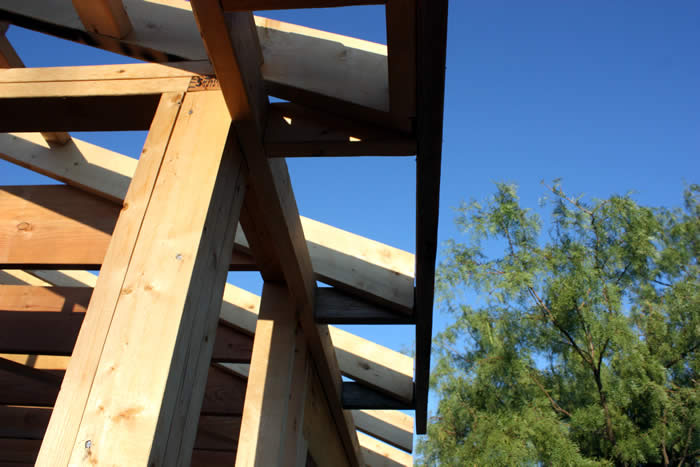
Yes and no. Normal trusses, or I should say most trusses are designed with a 1' overhang built into them. So if you have 24' wall span, you order 24' trusses with a 1' overhang. That way the bottom chord will sit on the wall for most support. If you order 26' trusses, you would most likely receive 26' trusses with a 1' overhang on each side. Then the bottom chord is sitting on the wall with n support above it, allowing it to potentially bow over the years from weight.

So make sure you order 24' trusses and specify the overhang you want. A lot of new houses are now going with 2' overhangs. So if you wanted a larger overhang, you would order 24' trusses with a 2' overhang each side. The truss manufacturer will then engineer and build the truss to those specs.

But never order a truss longer than what you actually need, because you will sacrifice some strength somewhere.
 

SARG

Well-known member
Joined
Jan 25, 2011
Messages
1,002
Location
Northeast
It's amazing how few folks actually read the posts & then provide answers that aren't relevant.
If I was building & found a deal on the trusses the OP mentions ... I would just install add'l supports at the contact points to transfer the load.
 

Falcon67

Well-known member
Joined
Jun 11, 2009
Messages
18,371
Location
Merkel, TX
LOL, if someone had given me a lead on 26' trusses, my shop would have been 26' wide.

Normally, the soffit area is formed in combination between the rafter tail length, rafter pitch and soffit material. So not necessarily the lower chord of a truss. But shade is shade.

Framing34.jpg
 
Last edited:

ssdave

Banned
Joined
Apr 11, 2015
Messages
2,913
Location
Eastern Oregon
It's amazing how few folks actually read the posts & then provide answers that aren't relevant.
If I was building & found a deal on the trusses the OP mentions ... I would just install add'l supports at the contact points to transfer the load.

I recognize that is what YOU would do, but have you considered what that does to the truss and/or building?

Would you alter the building to have additonal support at the correct place for the truss? Or add a brace to the truss at the support point? That's what I meant by the "energy heel" type truss.

What modifying the truss doesn't take into account if you just add another 2x4 at the support is that now you have a foot extra of cantilever over the eave. That changes the truss reactions, it may or may not be strong enough for either the snow load or the wind load on that extra eave width. In addition to modifying the support point with a block, you might have to beef up the cantilever portion, and add a strap to increase the uplift resistance strength. Without going back to the truss design, you're just guessing and hoping, though.

The potential savings, in my opinion, don't make it worth the risk. However, YOU can choose to do whatever you're comfortable with, and whatever your code official will allow.
 

Jess

Well-known member
Joined
Oct 22, 2006
Messages
430
Location
Vancouver Island, BC Canada
Its not uncommon around here to have 3' overhangs and sometimes more over doors and other areas. Your truss manufacturer has access to design programs that can do up what you want and will provide a truss certificate with the engineering stamp if you need one for permitting. It will meet your snow load requirements. They may suggest a few different options but you not need to hire an independent engineer for this. The design is built into the costing for your quote.
 
Last edited:

Smoker

Well-known member
Joined
Sep 4, 2009
Messages
167
Location
San Antonio
I guess it depends on the level of the deal.. but as stated properly engineered trusses, suited exactly to your building are not expensive at all. My beefy 30 x 30 attic trusses with all the dimensions I wanted AND girder design for the 40" attic stairway were $2400. Regular trusses were half that. I wouldn't mess around for the few hundred $.
 

Budman01

Well-known member
Joined
May 11, 2016
Messages
59
Location
Wabasso, Florida
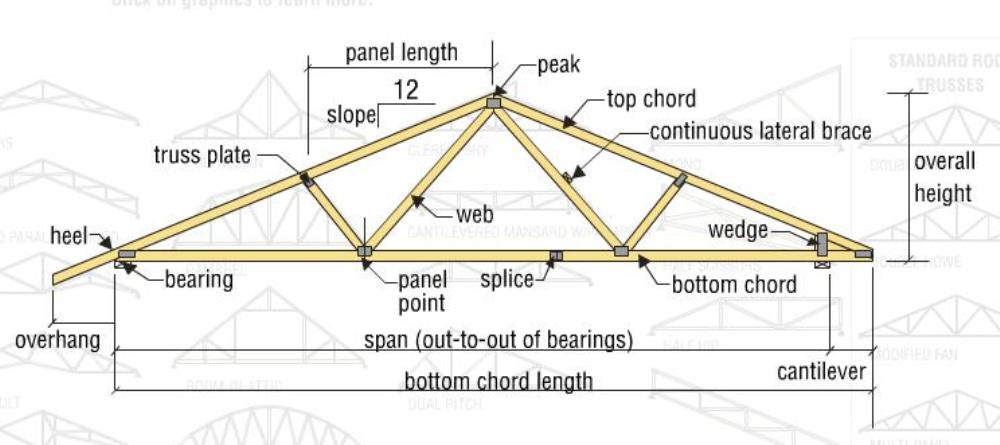
First: the 26' trusses can set on a 24' frame BUT they will need a new bearing point which may be no more than a 2x6 Wedge between top chord and bottom chord.......AND they will need to be re-engineered as such. The manufacturer will probably do this for a fee. It's just a cantilever, no big deal.
 

brownbagg

Well-known member
Joined
Mar 20, 2006
Messages
5,208
take your print to the truss mfg er and have them made for your bldg. There are really cheap, you not saving no money on use trusses that could be damage in transportation
 
To avoid these ads, REGISTER NOW!
OP
M

Maineshop

Active member
Joined
Nov 3, 2015
Messages
36
Location
Maine (Portland area)
Ha 69.... I know what you mean. I don't post on here, but I have been an avid reader for years.

I wouldn't be modifying the webs or cutting and chords. I'd just be adding to it.

We have "code" here, but it's all just default national code. Inspections occur after it's complete, if they decide to come take a look. Maybe I'll talk to the town and see.

Brownbagg.... My truss quote just came in at $3100 for the 32' gable section of my shop. I don't consider that "cheap". I can get these trusses for $1000. I hear what you're saying though and will certainly consider it.
 
OP
M

Maineshop

Active member
Joined
Nov 3, 2015
Messages
36
Location
Maine (Portland area)
First: the 26' trusses can set on a 24' frame BUT they will need a new bearing point which may be no more than a 2x6 Wedge between top chord and bottom chord.......AND they will need to be re-engineered as such. The manufacturer will probably do this for a fee. It's just a cantilever, no big deal.

Bud, Was thinking the same. Thanks for the reply.

I'll talk to them today about transport and get a better feel for how that part would fare.
 

dlcwent

Member Emeritus
Joined
Feb 24, 2014
Messages
8,427
Location
coastal maine
Maineshop, I can offer no help to your question. But I did want to welcome you to the GJ even though you've been a member for awhile. Glad to see another Mainer here.
 

ssdave

Banned
Joined
Apr 11, 2015
Messages
2,913
Location
Eastern Oregon
Standard overhang in NZ is 2ft (600mm)
Very rare to see anything less.
Seems 1ft is the norm in USA?

I wouldn't say that. I'd say most higher quality residential is 2 ft overhang. Sometimes 3. Low cost construction where they're trying to save every penny goes to 1 foot; it lowers the truss cost by a small amount and lowers the roof cost by about 5%.
 

Budman01

Well-known member
Joined
May 11, 2016
Messages
59
Location
Wabasso, Florida
Standard overhang in NZ is 2ft (600mm)
Very rare to see anything less.
Seems 1ft is the norm in USA?

Overhang in truss talk is anything past the bearing point, the truss is measured from bearing point to bearing point, or bearing wall to bearing wall, GENERALLY either end of the bottom chord. Overhang extends past the bearing point, generally sloping down, measured horizontally.
The point being discussed here is moving the bearing point towards the center of the truss one foot on both ends, this creates a "cantilever" (1 foot passes the bearing wall) of one foot on each end of the truss, for a 26' truss, the bearing surface on each end may be one foot, if so no foul, pitch determines this distance.
 

Jeepster04

Well-known member
Joined
Jun 25, 2013
Messages
3,098
Generally speaking, that 1' of overhang is going to be so small its likely it wont hurt a thing. It will induce a negative moment at that location in the truss since the bearing has been moved back. You could add 2x4's vertically to transfer the load but then the question is can the top cord take it.

Either way, Im getting ready to get some 38' truss made and my walls are going to be 30' apart. Ill have an 8' cantilevered overhang along one wall and a 1' overhang on the other. The two things they changed was making the top cord a 2x6 and adding a vertical 2x4 at the wall support. Ive always wanted a nice cantilevered overhang with no posts.
 

Kevin54

MEMBER EMERITUS
Joined
Jan 12, 2005
Messages
29,341
Location
Urbana, Ohio
Standard overhang in NZ is 2ft (600mm)
Very rare to see anything less.
Seems 1ft is the norm in USA?

1' USED to be the norm in the US for many, many, years, but in the last decade or so, it seems the "norm" is leaning towards 2' overhangs. Our house was built in '88 and the 2' overhangs were a special order. Now if you go to a lumber place and order trusses, they ask whether you want 1' or 2' overhangs.

Myself, I love the 2' overhangs all for the fact that we can leave some windows open on one side of the house when we have a hard rain. My wife hates them due to the fact that her plants never get watered under the overhang. :lol:

When I built my garage, I ordered my trusses with 1' overhangs as they were considerably cheaper than 2'. But today, there is only a few dollars difference between the two. If I were to build a brand new garage today, I would probably order 2' overhangs as I think they fit in better from an aesthetic standpoint. We still have a few contractors around though that will build a house with no overhang either on the front or on the gable end. I think it looks ridiculous.
 

aunsafe2015

Well-known member
Joined
Apr 2, 2016
Messages
436
Location
Northern VA
We still have a few contractors around though that will build a house with no overhang either on the front or on the gable end. I think it looks ridiculous.


Is no gable overhang a problem, or just an aesthetic preference? I'm building a garage in a tight space, right up next to minimum offset from property line, and overhangs count for offset purposes, so I'm thinking about doing no gable overhang...


Sent from my iPhone using Tapatalk
 
OP
M

Maineshop

Active member
Joined
Nov 3, 2015
Messages
36
Location
Maine (Portland area)
I called the seller earlier today and it turns out he does not have the paperwork which supposedly came with the trusses. I said "really, you lost the engineering paperwork?" "Yeah, must of tossed it along the way". I had to back out of that.

The good news is that I tried a new lumberyard and got a quote today for $900 less than my first quote. I wouldn't have thought that would be possible, but indeed I was not seeing things (delivered). That's a no-brainer.

I'll start a build thread soon. It will be a slow process.
 

ssdave

Banned
Joined
Apr 11, 2015
Messages
2,913
Location
Eastern Oregon
Is no gable overhang a problem, or just an aesthetic preference? I'm building a garage in a tight space, right up next to minimum offset from property line, and overhangs count for offset purposes, so I'm thinking about doing no gable overhang...


Sent from my iPhone using Tapatalk

No overhang is fine, but the reason for overhang is to keep water off the walls. At least put gutters on to keep the water from running down the siding.
 

Justanoldguy

Well-known member
Joined
Jun 1, 2008
Messages
3,673
Location
Atiamuri. Central North Island. New Zealand
Overhang in truss talk is anything past the bearing point, the truss is measured from bearing point to bearing point, or bearing wall to bearing wall, GENERALLY either end of the bottom chord. Overhang extends past the bearing point, generally sloping down, measured horizontally.
The point being discussed here is moving the bearing point towards the center of the truss one foot on both ends, this creates a "cantilever" (1 foot passes the bearing wall) of one foot on each end of the truss, for a 26' truss, the bearing surface on each end may be one foot, if so no foul, pitch determines this distance.

I completely understand it all without any explanation.
45+ years in construction here..
Thanks.
 
To avoid these ads, REGISTER NOW!
Top Bottom