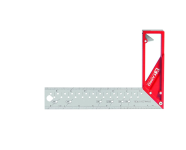
Carpenters use speed squares. Shop based woodworkers using power tools typically are getting things square by using machines that produce square. So I get it, they use solid steel engineer's squares to set up their machines. These excel due to their accuracy and the fact that every surface is square to every other.
Traditional try squares (the wooden ones with the steel blades) were really only ever designed to be square inside edge of the wood "stock" (where the brass was) to the TOP edge of the blade. The Stanley made ones were pretty good on the lower edge of the blade. But the top edge could be corrected (by filing, honing). But generally that's how try squares are.

Many woodworkers find machinists' "layout" squares convenient. The double squares at right are almost as square as the solid engineers' squares. The combination square at center was invented by Starrett in the mid 19th century as an all in one tool.
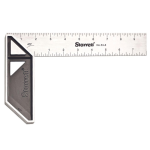
People choose Starrett because, unlike PEC, the accuracy of their tools is unquestioned. The venerable Starrett #20 engineers' square is truly a "master square" ground to .0002"/6". I forget what PEC claims, but others claim .0002"/1" which isn't really all that great if we trust it at all.
But beware, the #20 offered on Amazon are the China made ones and they are an order of magnitude less accurate. The Athol Mass made squares are many hundreds of dollars (larger ones could be $600, $800). Starrett doesn't state the accuracy of their double squares or combination squares, but those of us with master squares who have bothered to check find them to be dead on. Even used, eBay doubles and combinations are typically VERY square, which has sadly led to Starrett's decline. Their tools are made so well they will last many generations. I have no found wear to be an issue. I don't even really find debris in the slides to have much effect.
Why Starrett?
Starretts' blades are generally thicker than their competitors', which generally means you can't buy Starrett blades on eBay and use them in Mitutoyo or PEC heads. In use they have a little more heft and better balance. I find Starretts' blades desirable because the markings are so easy to read. There's just something about a Starrett ruler. The size of the marks, their depth and "brightness". Cheaper rulers are laser marked and just not that great. Last, you always need to check the ends of less expensive rules. Ends need to be ground perfectly square to the long edge and exactly at the zero point. Beware of rough, filed, or damaged ends.
Use of Adjustable Squares in the Woodshop:
- The adjustable squares can be set and used like gauges. This is really their chief advantage. So you can get a square line or a exact dimension at a known distance, and repeat that.
- With the blade not in its fully extended position, you get a bit better balance in use. If I dropped these tools on your bench, you'd do that without thinking as we all do.
- These are fairly delicate tools compared to the try squares in the OP. Sorry about the glare, the Die Maker's square (center) is only 2-1/2" long or so. Its an attractive piece for small work, but to be honest I don't use it that often. I bought it specifically for use on work in the milling machine and it excels at that because it is so compact.
Personally, I use the 6" combination square (with the 45 degree face, center) the most in the woodshop, followed by the 4" double square.
The original 12" combination square is a fixture in so many wood shops I've been in or seen, but my personal opinion is, it's too big, too blade heavy. The stock isn't long enough to get an accurate reference surface on wood and the balance of the tool is off. Ironically the smaller 6" version is better proportioned, in my opinion.
Summary, I'd go looking for a 6" Starrett combination square on eBay. You can find them cheap enough. All of mine came from eBay, and may need a good clean and a little touch up paint.
For the Starrett connoisseurs, the combination square in the pic is not the typical 6" combo. It was called the "junior" combo and is unique in that it has the hardened heads and uniquely uses the same blades as the 4" double square. The normal 6" combination square uses a unique blade that fits in nothing else I know about. That's the one I use in the woodshop, and this one stays in this drawer. The junior head is a little smaller than the normal 6" combo head.