works great if you're a plumber maybe.
modern gear is designed by engineers for power/weight (fuel efficiency) and compactness (volumetric efficiency). this means many recessed fasteners, smaller hardware, and stronger hardware per unit size.
All of that means you adjustable wrenches are useless for 99% of engine work, and in the other 1% they usually are functioning as smooth jaw pliers (not wrenches) to hold something still or to bend sheet metal without maring it.
I know this post above was being sarcastic, but its worth discussing in general why certain tools fit situtations better than others.
Today, some applications 1/4 is ascendant over 3/8, whereas 50 years ago, it was 3/8 being ascendant over 1/2 drive.
Recall, the snap-on nomenclature for 1/2 drive was originally "S" for standard drive. 3/8 was developed during the war to work in airframes and military applications where 1/2 was too clunky. After the war, most aerospace stuff moved on to 1/4 drive during the 1950s or 60s (think NASA,jets, space age, etc).
3/8 supplanted 1/2 drive only in automotive, and later DIY/home uses...which to most hobbyists is a disporportionate amount of the user case. There is also the economics of keeping 1 set of drive tools and not three...etc.
Which brings me back to the point that the use-cases are really what best determint tool selection. Economics has a second order imfluence, but mostly for home and hobby use, not as much for professional or industry uses where the true Economics are in a much larger context.




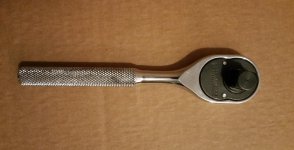
 ), and it barely fit. The 1/2" drive socket was about 1/2" longer than the 3/8" drive (wow, is this confusing...), and as it backed out, the ratchet was almost wedged against the bay.

