To avoid these ads, REGISTER NOW!

Trying to understand floor loading

Don1357

Well-known member
Joined
Apr 15, 2019
Messages
948
Location
Palmer, AK
I'm trying to make sense of the load information that came with the floor trusses... They span 23', are 20" OC, and the flooring is a full 1". According to the paperwork the trusses are rated to 40PSF. For starters I'm putting a 1974 Delta/Rockwell Unisaw smack in the middle of it, around 400 pounds, and that's just the beginning.

At what point do I start worrying about how much weight I'm putting up there?
 
To avoid these ads, REGISTER NOW!

mcbane

Well-known member
Joined
Jul 23, 2017
Messages
794
Location
California
Floor loads are for average load over the ENTIRE floor. Your floor can take a point load much greater than 40 psf. Imagine a 300 lb human standing with his feet together. Floor can take that. Your 400 lb saw is on at least 4 sq ft at the base, or only 100 psf as something of a point load

Don’t worry about it.


Sent from my iPhone using The Garage Journal mobile app
 
OP
D

Don1357

Well-known member
Joined
Apr 15, 2019
Messages
948
Location
Palmer, AK
Floor loads are for average load over the ENTIRE floor. Your floor can take a point load much greater than 40 psf. Imagine a 300 lb human standing with his feet together. Floor can take that. Your 400 lb saw is on at least 4 sq ft at the base, or only 100 psf as something of a point load

Don’t worry about it.


Sent from my iPhone using The Garage Journal mobile app

I get that. The whole 23' x 23' x 40psf should mean 21,160 pounds distributed around? I still feel squeamish about putting a few 400-pound machines here and there...
 

king nero

Well-known member
Joined
Dec 27, 2010
Messages
1,469
Location
Belgium
Think of it as a layer of water of 7.5" all over your floor.
That's equivalent of 40 psf.
 

matt_i

Well-known member
Joined
Mar 14, 2008
Messages
10,722
Location
SE Michigan
At what point do I start worrying about how much weight I'm putting up there?
When you get 18" of snow overnight :bounce:

Like any design there's some conservatism/safety factor built in.

Imo you should think carefully when placing a large point load thats stressing individual trusses more than others...or when you get close on average to 40psf.

If you aligned several machines such that they all were borne on 3-4-ish trusses then that would be something to think about.
 
OP
D

Don1357

Well-known member
Joined
Apr 15, 2019
Messages
948
Location
Palmer, AK
When you get 18" of snow overnight :bounce:

Like any design there's some conservatism/safety factor built in.

Imo you should think carefully when placing a large point load thats stressing individual trusses more than others...or when you get close on average to 40psf.

If you aligned several machines such that they all were borne on 3-4-ish trusses then that would be something to think about.

That's an easy calculation. On average it takes an inch of water to make 12 inches of snow so inch and a half, .054 pounds, times 144 for a square foot, 7.8 pounds per square foot. Not that the 10/12 roof pitch will be able to hold much...

Back to the original concern; on one end I'm thinking on having the table saw, planner (probably a 15" 4 post) and a 6" jointer, all along 2~3 trusses. On paper the floor should take it without breaking a sweat so probably I'm just being squeamish about it.
 

sberry

Banned
Joined
Jun 18, 2005
Messages
35,747
Location
Brethren, Michigan
Double the joist a few across the center. simply add a couple extra where a heavy machine is going to sit. Strength of the floor material itself has some effect on overall strength.
 
OP
D

Don1357

Well-known member
Joined
Apr 15, 2019
Messages
948
Location
Palmer, AK
Double the joist a few across the center. simply add a couple extra where a heavy machine is going to sit. Strength of the floor material itself has some effect on overall strength.

The floor is already built with the engineered trusses so that portion is as strong as it gonna get (short of me adding a column underneath). It has 1" OSB on top.

Speaking of the top, I don't know what I want to use for actual flooring material...
 

karoc

Well-known member
Joined
Dec 19, 2017
Messages
1,990
Location
Hemphill Tx
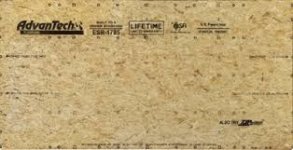
One of the types of OSB that guys here also use is AdvanTech,so I guess that all OSB is not equal. I always kinda wonder about humidity under flooring ,if over time will take its toll on OSB
 

Attachments

  • download.jpg
    download.jpg
    8.6 KB · Views: 25

bczygan

Well-known member
Joined
Nov 4, 2009
Messages
22,002
Location
DETROIT! Arsenal of Scrappers
A floor designed for a particular load per square foot is for an equally distributed load.

If you have a large point load, the structure should be designed for that.

A point load like a Unisaw is 600 hundred pounds distributed over about 4 square feet, so 150 pounds per square foot. But the structure is monolithic. Floor sheathing is glued and screwed to the framing and there is lines of bridging or blocking that further distribute the load. And depending on the design, the allowable deflection could be L/180, L/240, L/360, so the added load simply means more deflection in that area, and more spring in the structure, not failure. Now, a Bridgeport in the middle of a long span might be a different matter.

Bill
 
OP
D

Don1357

Well-known member
Joined
Apr 15, 2019
Messages
948
Location
Palmer, AK
One of the types of OSB that guys here also use is AdvanTech,so I guess that all OSB is not equal. I always kinda wonder about humidity under flooring ,if over time will take its toll on OSB

You are thinking about something more like particle board. OSB is slow to absorb moisture but then it is slower than plywood to release it. It will not deform in the face of water like particle board. Heck the contractor had to wait a few weeks for ceiling trusses to show up, the piles of OSB got rained on a few times, no damage. Like any other building material it has its place and is likely to fail it you use it where it doesn't belong.
 

spudley

Well-known member
Joined
Dec 27, 2016
Messages
702
Location
Northeast Wisconsin
Advantech is not particle board and is treated to be superior to regular OSB t&g flooring.

Regular OSB can handle a few rain events, especially if it's banded in a stack. Once on a building it should be covered asap.

Snow load should be inconsequential to floor truss loading.

How deep are your floor trusses?

Did your builder put in strongbacks (2x6's in the webbing perpendicular to the trusses)?
How many rows?
 
To avoid these ads, REGISTER NOW!

hefnerconstructionlc

Well-known member
Joined
Nov 1, 2016
Messages
665
Location
Kansas
As was said before you can strengthen the floor truss even though it's engineered by adding OSB glued and fastened to the side of the trusses. This will keep them from deflecting further and sagging. or you could just set it on the floor and see what happens and then you'll have your answer. 400 lb isn't very much.
 

sberry

Banned
Joined
Jun 18, 2005
Messages
35,747
Location
Brethren, Michigan
I agree with the above in a sense that if I knew I was going to point load wouldnt be adverse to some improvement in that area especially in the center of a span. Its not as strong as it can get, its as strong as it needs to be for that load. Inch osb is good in the sense that it will spread a lot of load farther than a 3/4. I have second floor over office and my joists are about minumum and they work super, cant feel it walking and the floor plan above it is open.
While on its own setting 400# in the middle of this isnt a great concern and it may never be,,,, its a machine, **** moves, sets around it, if these are working tools it all adds up vs storing some residential furniture. Notice gyms are on cement,,, 138 pound guy training for boxing shakes the place apart.
For starters I'm putting a 1974 Delta/Rockwell Unisaw smack in the middle of it, around 400 pounds, and that's just the beginning.

At what point do I start worrying about how much weight I'm putting up there?
You worry some about it now. You are already worried about it.
 
OP
D

Don1357

Well-known member
Joined
Apr 15, 2019
Messages
948
Location
Palmer, AK
At this point I figure I'll measure the as built height in the middle of the span and check every once in a while.
 

David C

Well-known member
Joined
Mar 10, 2014
Messages
157
Location
Northern California
In California code residential live load is 40PSF with no point load requirement
For light manufacturing live load is 125PSF with a 2000lb pt load requirement

If someone asked me to design a floor system for a wood shop I would use the light manufacturing requirement.

If you are intending to use your floor for a wood shop your trusses are probably under designed because residential live loads do not include heavy equipment.

The code requirements for deflection were not mentioned in your question. Often truss mfg will provide a structurally adequate design but the floor will feel bouncy. Some truss mfgs will suggest floor live load deflections less than that required by code (a stronger truss) to mitigate concerns and complaints. As you seem intent to use your described floor system for heavier equipment you might find the floor uncomfortably bouncy.

You mentioned you might add a floor covering over your floor ply (or flake board). You may wish to refer to the truss design to determine if the design dead load is sufficient to add additional floor covering materials. You might also wish to review the structural capabilities of your Proposed underpayment to verify that it can adequately support your actual loading. Structural panels will have a stamp on the panel indicating loads and span capacities. If there is no stamp the panel is not designed for structural use.
 

56Mark

Well-known member
Joined
Oct 26, 2014
Messages
359
Location
Fall Branch, TN
400 lb saw on 4+ sq ft. Not as bad as dancing with a fat gal. I don't think you have anything to worry about. If you are still concerned, what is under the trusses? Can you add a 2x or glue-lam beam and a couple of poles?
 

karoc

Well-known member
Joined
Dec 19, 2017
Messages
1,990
Location
Hemphill Tx
Myself very interested in this post cause I keep going back/forth on concrete or wood. Which right now both material are expensive but concrete is more. I always wanted the wooden floor cause think is better on joints and legs.Plus making the building with wooden floor would allow me to pay as I go which little at time. But having a hobby machine shop and wood shop I think that wooden floor is not in picture since having BP,14"SB and 11" Rockwell lathe plus all my other wwing machines. Time do all the extra framing for the flooring the cost of concrete not looking so bad:(
 

mcbane

Well-known member
Joined
Jul 23, 2017
Messages
794
Location
California
Ask the truss manufacturer for the truss point load capacity. The engineer for the truss almost certainly has a spec for point load that was part of the design. It is likely somewhere between 1000 and 2000 lbs.
 

sberry

Banned
Joined
Jun 18, 2005
Messages
35,747
Location
Brethren, Michigan
I am gonna build a woodshop upstairs and am starting with a unisaw in the middle,,, for starters,,, says a lot,,, but a lot of good shop design has the tools at the sides and the center open.
 

spudley

Well-known member
Joined
Dec 27, 2016
Messages
702
Location
Northeast Wisconsin
Maybe I missed it, but doesn't the weight of the Flooring material need to be factored in also?
A common "dead load" on floor trusses is 10lbs on top plate, (flooring) and 5lbs on bottom plate, (ceiling) in addition to the 40lb live load, so he likely has 55lb total. If the OP actually has 1" OSB that should be a little over 100lbs per 4x8' sheet which is a just over 3lbs per sq ft.

Might have been better for the OP to have spec'd some beefy trusses or girders knowing he had big machines.
 
To avoid these ads, REGISTER NOW!
Top Bottom