OldSchool500
Active member
I know you can separate the two outlets on a normal dual receptacle. Does this mean I am allowed to use each as a dedicated circuit? For example, 20A top, 20A bottom, shared neutral?

Definitely.You’ll break the bridge between the two right?
sorry, shared neutral?I know you can separate the two outlets on a normal dual receptacle. Does this mean I am allowed to use each as a dedicated circuit? For example, 20A top, 20A bottom, shared neutral?
Yes you can, but it must be a 20a receptacle and fed from a 2 pole cb, not a tandem cb.I know you can separate the two outlets on a normal dual receptacle. Does this mean I am allowed to use each as a dedicated circuit? For example, 20A top, 20A bottom, shared neutral?
Not the case with a MWBC.sorry, shared neutral?
do you plan on a 12ga wire carrying 40A?
ok it's got to be opposing legs. derp.Not the case with a MWBC.
look up shared neutral on MWBC.sorry, shared neutral?
do you plan on a 12ga wire carrying 40A?

To be pedantic, all devices on the same yoke (for a receptacle outlet and the like, that’s the two #6 screws holding it to the box) have to be disconnected simultaneously. A two pole breaker is the simplest way and probably cheapest, but two single pole with a handle tie will work too, and keeps them independently tripping. (This changed in the 2011 code cycle, so there are lots of non-tied mwbc in Chicago, where mwbc are used for the space saving in conduit. My house has 16 or 18 of them, almost every general use circuit is done this way. Many of them split up at the first box, to make best use of the existing conduit to the panel location, and make no sense otherwise. )Yes you can, but it must be a 20a receptacle and fed from a 2 pole cb, not a tandem cb.
This also helps in a garage if you have major equipment running close to limit of the circuit. The second outlet/circuit allows for a shop-vac or other small accessory tool, when running a 15A+ tool. Mine is set up so the top circuit handles all of the stationary "plug-in" 120 loads, and the bottom is for accessory use.This is likely obvious to everyone, but the advantage of running one's shop outlets circuits this ways is that one can switch out the 120V outlet for a 240V at any point in the circuit, so if that new grinder needs 240V, you can make it works pdq.
True, but at 2:36am, that was good enough.To be pedantic, all devices on the same yoke (for a receptacle outlet and the like, that’s the two #6 screws holding it to the box) have to be disconnected simultaneously. A two pole breaker is the simplest way and probably cheapest, but two single pole with a handle tie will work too, and keeps them independently tripping. (This changed in the 2011 code cycle, so there are lots of non-tied mwbc in Chicago, where mwbc are used for the space saving in conduit. My house has 16 or 18 of them, almost every general use circuit is done this way. Many of them split up at the first box, to make best use of the existing conduit to the panel location, and make no sense otherwise. )
Along with converting to 240, mwbc save wire, and they have just two current carrying wires. That is valuable for conduit systems. They also confuse the hell out of Harry Homeowner types, which
I ran all my shop receptacles like that. Not only can I make it a 240 receptacle but used less wire and had only 1 pull for two circuits.This is likely obvious to everyone, but the advantage of running one's shop outlets circuits this ways is that one can switch out the 120V outlet for a 240V at any point in the circuit, so if that new grinder needs 240V, you can make it works pdq.
?? It would always be the same or less amps on the neutral. Could actually be 0 amps on the neutral if both circuits had the same load.sorry, shared neutral?
do you plan on a 12ga wire carrying 40A?
?? It would always be the same or less amps on the neutral. Could actually be 0 amps on the neutral if both circuits had the same load.
The above is attempting to clarify both quotes. If I am wrong, please correct me.Yes you can, but it must be a 20a receptacle and fed from a 2 pole cb, not a tandem cb.
Just curious if you read the thread?Just curious why on earth you would want to do this ?
If this is in relation my my post on a MWBC on a tandem using the same leg for both, I thought I had pointed out that it was a very bad idea, and was trying to lay out the why.Just curious why on earth you would want to do this ?
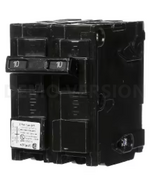
Single pole cb - One handle, attached to 1 phase, fits in 1 full-size slotThe above is attempting to clarify both quotes. If I am wrong, please correct me.
Besides the complexity of tying the handle together, wouldn't a single tandem be pulling both 20A circuits from the same leg, therefore not cancelling out along the shared neutral (my understanding is that the opposing legs allow the current to "cancel")? If someone were theoretically to do this (they would be making their lives infinitely more complicated), would the neutral need to be sized for 40A then?
My understanding is is why @mm08822 said not to use a tandem (aka two mini-breakers pulling from the same leg). Using two tandems and tying the inner or outer air together would be fine, as would using two single pole with a handle tie, or a double pole breaker.
Or did I screw up the verbage? I thought tandems were breakers with two handles, that physically fit into one breaker slot.



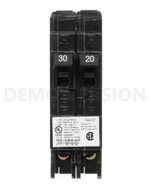


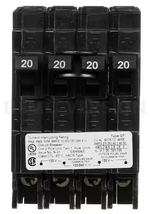 (connects like a quad)
This is what I was going to post next as a follow up to BillK , well actually the OP.If you're going to the trouble of running a 12/3 to a new box, make it a 2gang and put a duplex receptacle on each leg.
Single pole cb - One handle, attached to 1 phase, fits in 1 full-size slot
Double pole cb - One tied handle between 2 cbs, attached to "both phases", fits in 2 full-size slots
Just looking for clarification on the above statement about switching out a 2 phase divided 120V outlet for a 240V one: on this same MWBC there can be a mix of 240V and 120V receptacles?This is likely obvious to everyone, but the advantage of running one's shop outlets circuits this ways is that one can switch out the 120V outlet for a 240V at any point in the circuit, so if that new grinder needs 240V, you can make it works pdq.
Sure why not? As long as you stay within the load application of the circuit. The circuit or breaker don't care one way or another if you're plugging in 120 or 240.Just looking for clarification on the above statement about switching out a 2 phase divided 120V outlet for a 240V one: on this same MWBC there can be a mix of 240V and 120V receptacles?
Just looking for clarification on the above statement about switching out a 2 phase divided 120V outlet for a 240V one: on this same MWBC there can be a mix of 240V and 120V receptacles?
that is exactly how and why my shop is wired.This is likely obvious to everyone, but the advantage of running one's shop outlets circuits this ways is that one can switch out the 120V outlet for a 240V at any point in the circuit, so if that new grinder needs 240V, you can make it works pdq.
Yes there can but the breakers must open both circuits simultaneously. Basically, a 2 pole breaker.
The same applies with 2 circuits feeding one duplex receptacle.
Thanks both for the clarification. I wasn't questioning the concept as much as making sure I was reading the original comment from LopezBart correctly.Sure why not? As long as you stay within the load application of the circuit. The circuit or breaker don't care one way or another if you're plugging in 120 or 240.
Nm . TiredThanks both for the clarification. I wasn't questioning the concept as much as making sure I was reading the original comment from LopezBart correctly.
Interestingly, if I'm thinking about this correctly, if you have, say, a 10A load from a 240V appliance on the circuit and a 10A load from a 120V appliance elsewhere on the same MWBC, the double pole breaker is at capacity (or one side is). Whereas with only 120V appliances, the circuit could handle 20A through both poles for a total capacity of
You don't have 2 phase, 2 phase does exist in certain areas but is extremely obsolete.Just looking for clarification on the above statement about switching out a 2 phase divided 120V outlet for a 240V one: on this same MWBC there can be a mix of 240V and 120V receptacles?
The neutral carries the imbalance.look up shared neutral on MWBC.
loads cancel each other if equal
Of course you can... it just needs to be a double pole GFCI breaker. In this type of GFCI, tripping occurs when the difference between the current in the hot lines is not equal to the current in the neutral line.TIP! You can’t use a GFI BREAKER on a MWBC.
And you'll lose both circuits simultaneously!Of course you can... it just needs to be a double pole GFCI breaker. In this type of GFCI, tripping occurs when the difference between the current in the hot lines is not equal to the current in the neutral line.
Oh the humanity!And you'll lose both circuits simultaneously!
I meant to say SINGLE GFI……… Thanks and I fixed it!Of course you can... it just needs to be a double pole GFCI breaker. In this type of GFCI, tripping occurs when the difference between the current in the hot lines is not equal to the current in the neutral line.
You can't use a single breaker on a MWBC anyway. What am I missing?I meant to say SINGLE GFI……… Thanks and I fixed it!
Single pole gfi.......but you can use a single double pole gfciI meant to say SINGLE GFI……… Thanks and I fixed it!
It’s early!……. Gimme a break!Single pole gfi.......but you can use a single double pole gfci
Huh?Thanks both for the clarification. I wasn't questioning the concept as much as making sure I was reading the original comment from LopezBart correctly.
Interestingly, if I'm thinking about this correctly, if you have, say, a 10A load from a 240V appliance on the circuit and a 10A load from a 120V appliance elsewhere on the same MWBC, the double pole breaker is at capacity (or one side is). Whereas with only 120V appliances, the circuit could handle 20A through both poles for a total capacity of 40A.
You did. With 240V, 10A FLA, both L1 and L2 will have 10A current. Here's how your table should read (assuming PF=1):...Unless I misunderstood your post.
