To avoid these ads, REGISTER NOW!

Two ground bars in sub panel. Connect them? Split the ground wire?

gorms

Member
Joined
Oct 17, 2017
Messages
17
Location
San Jose, CA
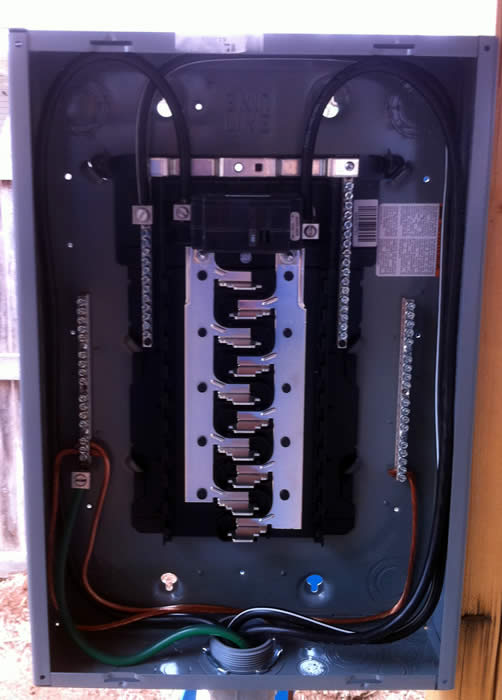
I am installing a Square D sub panel that came with no ground bars (only neutral bars). Im going to install a ground bar vertical on each side to cut down on wiring mess.

Do these 2x ground bars need to be connected with a strap? Or is the connection to the panel enclosure enough?

Is another option to split the ground wire in the feeder cable and send half to the left and half to the right bar? This seems easy and clean.


If it matters, I'll be buying:
2x Square D pk18gta (18 hole ground bar)
2x Square D lk100an (lug for up to 2/0 wire to connect feeder ground to bars)
The panel is a Square D 20/40 125A Homeline
 
To avoid these ads, REGISTER NOW!

colomboj

Active member
Joined
Sep 11, 2017
Messages
25
Location
Cornpatch USA
You only need to screw them into the can in the location already provided, and the metal of the can itself interconnects them. Take your ground wire to one of them. DO NOT SPLIT THE DAMN WIRE!
 
OP
G

gorms

Member
Joined
Oct 17, 2017
Messages
17
Location
San Jose, CA
You only need to screw them into the can in the location already provided, and the metal of the can itself interconnects them. Take your ground wire to one of them. DO NOT SPLIT THE DAMN WIRE!


Is splitting the wire a safety risk?
 

howpeculiar

Well-known member
Joined
Dec 23, 2014
Messages
77
Just wire teh ground to one of the bars, the case is your connection between the ground bars, assuming your box has an area for two ground bars.
 

Falcon67

Well-known member
Joined
Jun 11, 2009
Messages
18,371
Location
Merkel, TX
I did it because I'm ****, apparently. ;)

Power6.jpg
 

CGT80

Well-known member
Joined
Aug 29, 2014
Messages
861
Location
IE, SoCal, USA
It's illegal, and stupid.

It's too bad you couldn't answer the question, as I am also curious and others will find this thread later and they may find the info useful.

Illegal???? As in not to code?

With your long response, I'm just not picking up the details my brain is looking for. :lol_hitti
 

colomboj

Active member
Joined
Sep 11, 2017
Messages
25
Location
Cornpatch USA
Yes, as in not code compliant, and stupid. If we need to get into some technical stuff to satisfy your need for an answer here we go...

The safe current carrying capacity of a wire is a function of it's resistance and the resistance of the material is proportional to the cross sectional area. If you split the wire exactly in half you would effectively reduce the current carrying capacity to only 25% of the original value of the conductor. So that #6 that was rated to carry say 75 amps is now only good for 18.75 or something in that ballpark.
 
Last edited:

prostreetamx

Well-known member
Joined
Dec 19, 2016
Messages
222
Location
Las Vegas
My understanding of the grounding code does require that all ground bars in a panel must be connected together with a separate wire. We normally use #4 bare copper to do this. You can not use the box as a grounding conductor to connect the bars together. You must also scrape the paint off the surface where the bus contacts the panel. Our local inspectors would check this on a regular basis. A ground bar screwed to a painted panel just would not provide a proper ground.
 

colomboj

Active member
Joined
Sep 11, 2017
Messages
25
Location
Cornpatch USA
My understanding of the grounding code does require that all ground bars in a panel must be connected together with a separate wire. We normally use #4 bare copper to do this. You can not use the box as a grounding conductor to connect the bars together. You must also scrape the paint off the surface where the bus contacts the panel. Our local inspectors would check this on a regular basis. A ground bar screwed to a painted panel just would not provide a proper ground.

250.118, I believe that is the article, says you can use the can as a ECG and thus you do not need to run a separate wire from buss to buss. Now if you do run one it's not going to hurt anything at all, but you do waste a couple bucks and some time.

The ground screws provided by the manufacturer are all self tapping and will remove the paint as you install them, and once again it won't hurt anything to remove the paint.
 
To avoid these ads, REGISTER NOW!

prostreetamx

Well-known member
Joined
Dec 19, 2016
Messages
222
Location
Las Vegas
Proper grounding has always been an issue here in Las Vegas and the inspectors are really tough here when it comes to it. Our soil has very little if any moisture in it so every part of the grounding path is critical. I've done lots of commercial and residential panels here and we had to follow the directions from my previous post to get an inspection. Our supplemental local codes went from a pamphlet in the late 80's to a pretty thick booklet and most of it deals with temperature issues and grounding.
 

wyliesdiesels

Well-known member
Joined
Aug 14, 2012
Messages
19,983
Location
Modesto, CA
My understanding of the grounding code does require that all ground bars in a panel must be connected together with a separate wire. We normally use #4 bare copper to do this. You can not use the box as a grounding conductor to connect the bars together. You must also scrape the paint off the surface where the bus contacts the panel. Our local inspectors would check this on a regular basis. A ground bar screwed to a painted panel just would not provide a proper ground.

Care to cite a code?

Proper grounding has always been an issue here in Las Vegas and the inspectors are really tough here when it comes to it. Our soil has very little if any moisture in it so every part of the grounding path is critical. I've done lots of commercial and residential panels here and we had to follow the directions from my previous post to get an inspection. Our supplemental local codes went from a pamphlet in the late 80's to a pretty thick booklet and most of it deals with temperature issues and grounding.

Youre mixing up different things. Grounding electrodes and grounding conductors aka EGCs are different animals.

Electrodes are for suppression of lightning, to limit the voltage to earth, and shunt primary high voltage when primary lines contact secondary lines.

EGCs are for providing an effective low impedance fault current pathway.

Soil conditions have NOTHING to do with effective low impedance fault current pathways.

The earth is not to be used as a fault current pathway. So your comment about low moisture soil and every part of the grounding path is critical makes no sense.

It seems you dont know the difference between grounding electrodes and low impedance grounding conductors aka EGCs used for fault current pathways.

The can of an electrical panel is perfectly acceptable for use as a fault current pathway.

Your comment about needing a wire to tie ground bars sounds like a local amendment. However there is no requirement in the NEC for that so you will be looking a long while for that code.
 
Last edited:

dw1

Well-known member
Joined
Jan 26, 2015
Messages
1,335
Location
Ky
Yes, as in not code compliant, and stupid. If we need to get into some technical stuff to satisfy your need for an answer here we go...

The safe current carrying capacity of a wire is a function of it's resistance and the resistance of the material is proportional to the cross sectional area. If you split the wire exactly in half you would effectively reduce the current carrying capacity to only 25% of the original value of the conductor. So that #6 that was rated to carry say 75 amps is now only good for 18.75 or something in that ballpark.


Or you can use something like this, most panel manufacturers have them:
https://www.homedepot.com/p/GE-Power-Mark-Plus-Grounding-Lug-for-Load-Centers-TGL20CP/100153918

It will fit into to terminals and accept ****** wires that otherwise wouldn't fit
 

colomboj

Active member
Joined
Sep 11, 2017
Messages
25
Location
Cornpatch USA

Dagny

Well-known member
Joined
Jul 25, 2014
Messages
2,980
Location
Northern Wi.
I think he's talking about the grounding electrode conductor as there is a green covered wire coming from main.Don't change much code wise. I always tie the 2 together with a piece of solid the panels keep getting thinner as time goes on and more things are steel versus copper or brass. Everything seems more prone to rust around here.
 
OP
G

gorms

Member
Joined
Oct 17, 2017
Messages
17
Location
San Jose, CA
Thanks for the responses but I hope we can keep it factual and not “it’s stupid” for my benefit and anyone else with a similar question.

Related to my ground question, I looked inside my meter main combo and don’t see an obvious place for the ground wire in my SER cable I plan on running to the sub panel (3 large wires shown make their way to the sub panel). There is a lug for neutral and a smaller lug for earth ground (in this case looks like water main ground and not a ground rod). The conduit in the current install is the ground connection to this meter main enclosure but how would I proceed if I replace that with a ground wire? Drill and tap a lug to the enclosure?
 

Attachments

  • 5678FEE1-027E-480D-8388-2D7F1DDC40B7.jpg
    5678FEE1-027E-480D-8388-2D7F1DDC40B7.jpg
    15.2 KB · Views: 76
Last edited:
OP
G

gorms

Member
Joined
Oct 17, 2017
Messages
17
Location
San Jose, CA
Any ideas on this? This is a GE panel. Is there a double lug that will fit on this small ground bar?
 
Last edited:

wyliesdiesels

Well-known member
Joined
Aug 14, 2012
Messages
19,983
Location
Modesto, CA
Yes, as in not code compliant, and stupid. If we need to get into some technical stuff to satisfy your need for an answer here we go...

The safe current carrying capacity of a wire is a function of it's resistance and the resistance of the material is proportional to the cross sectional area. If you split the wire exactly in half you would effectively reduce the current carrying capacity to only 25% of the original value of the conductor. So that #6 that was rated to carry say 75 amps is now only good for 18.75 or something in that ballpark.

Where the heck did you pull these numbers out of?

#6 is rated for 65a and were specifically talking about a grounding conductor which, upon a ground fault condition, would carry several hundred if not several thousand amps, for split seconds, depending on the available fault current from the transformer...
 

wyliesdiesels

Well-known member
Joined
Aug 14, 2012
Messages
19,983
Location
Modesto, CA
Thanks for the responses but I hope we can keep it factual and not “it’s stupid” for my benefit and anyone else with a similar question.

Related to my ground question, I looked inside my meter main combo and don’t see an obvious place for the ground wire in my SER cable I plan on running to the sub panel (3 large wires shown make their way to the sub panel). There is a lug for neutral and a smaller lug for earth ground (in this case looks like water main ground and not a ground rod). The conduit in the current install is the ground connection to this meter main enclosure but how would I proceed if I replace that with a ground wire? Drill and tap a lug to the enclosure?

Is this SER running underground?

Any ideas on this? This is a GE panel. Is there a double lug that will fit on this small ground bar?

Does your panel still have the label?

Look for a GE catalog online. Should be able to find listed accessories.
 
OP
G

gorms

Member
Joined
Oct 17, 2017
Messages
17
Location
San Jose, CA
Is this SER running underground?


Does your panel still have the label?

Look for a GE catalog online. Should be able to find listed accessories.

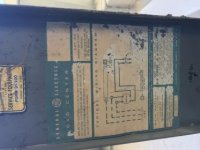
Yes here’s the label. It’s an older box and I did not find any literature on this model TL210MUF.
 

Attachments

  • 41FFF9E7-BBEF-4709-9206-DF5504F1FFF6.jpg
    41FFF9E7-BBEF-4709-9206-DF5504F1FFF6.jpg
    16.5 KB · Views: 38
To avoid these ads, REGISTER NOW!
Top Bottom