To avoid these ads, REGISTER NOW!

two new service panels - ? on branch circuits

kenny_ca

Member
Joined
Oct 23, 2018
Messages
15
Location
CA
i'm installing two new service meter combo panels and have a question regarding the entrance of the branch wires.
is it required to use a clamp to hold the wires going into the panels?
i was thinking of using a 2" conduit ****** and then feed all the branch wires through it.

also for the ground wire 4AWG, can i use just 2 ground rods to connect to both panels? if i can use just 2, how do I connect the ground wires to the two panels?
 

Attachments

  • IMG_7410.jpg
    IMG_7410.jpg
    74.7 KB · Views: 66
  • IMG_7413.jpg
    IMG_7413.jpg
    74.7 KB · Views: 47
To avoid these ads, REGISTER NOW!

Zeke

Well-known member
Joined
Aug 13, 2009
Messages
17,176
Location
Long Beach CA, the sewer by the sea.
I've not seen any 'clamps' on wires entering a panel via conduit. Watch your conduit fill requirements.

The ground must be continuous, not spliced anywhere. A pass-through ground rod clamp is used on the first rod. I guess you'll have to loop it in one of the panels. I actually don't know how that is done. Must be protected where exposed.

Others will add info.
 

jim111

Well-known member
Joined
Nov 18, 2015
Messages
93
Location
tx
Grounding electrode conductor from each panel to first rod, bonding jumper to second rod
 

mm08822

Well-known member
Joined
Jan 13, 2012
Messages
5,901
Location
NJ
No splices permitted unless permanent.

Easier way -
Come out of one panel connected to bonded neutral bar, loop thru clamp on first rod and then loop thru clamp on second rod, back to bonded neutral bar in second panel.

Both panels now have an unspliced connection to 2 grd rods.
 

Bert_

Well-known member
Joined
Dec 24, 2016
Messages
9,717
Location
NW Iowa
Grounding electrode conductor from each panel to first rod, bonding jumper to second rod

This is the way I read it.

Only the length from service to first rod is called the grounding electrode conductor and is required to be unspliced. The wire that connects the ground rods together is a bonding conductor and not a grounding electrode conductor. The bonding conductors are not required to be continuous like grounding electrode conductors are.

Regardless normally I would run a continuous wire from the service looped through the first rod to the second. But it would save some work to cut it and run a second wire to the second panel.
 
OP
K

kenny_ca

Member
Joined
Oct 23, 2018
Messages
15
Location
CA
I've not seen any 'clamps' on wires entering a panel via conduit. Watch your conduit fill requirements.

The ground must be continuous, not spliced anywhere. A pass-through ground rod clamp is used on the first rod. I guess you'll have to loop it in one of the panels. I actually don't know how that is done. Must be protected where exposed.

Others will add info.

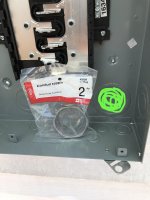
i was not planning to use any conduit, i was planning to knock out the hole (highlighted in green in the attached photo) of the back panel and use a conduit ****** to feed the wires inside the stud bay and into the crawl space. inside the crawl space is where i will have a splice box to pull all the branch circuits from the old panel that is located about 15 feet away from the new panel location. so
 

Attachments

  • IMG_7413 conduit.jpg
    IMG_7413 conduit.jpg
    77.5 KB · Views: 10
To avoid these ads, REGISTER NOW!
OP
K

kenny_ca

Member
Joined
Oct 23, 2018
Messages
15
Location
CA
This is the way I read it.

Only the length from service to first rod is called the grounding electrode conductor and is required to be unspliced. The wire that connects the ground rods together is a bonding conductor and not a grounding electrode conductor. The bonding conductors are not required to be continuous like grounding electrode conductors are.

Regardless normally I would run a continuous wire from the service looped through the first rod to the second. But it would save some work to cut it and run a second wire to the second panel.

thanks every one for your input. so the way i was planning to do it would be wrong. i was going to use one continuous wire from rod to rod, then up to the first panel, exit the first panel and then into the 2nd panel.

but what you all are saying is that each panel needs it's own run to the first rod. but on the rod to rod connection, i only need 1 wire between the two rods.

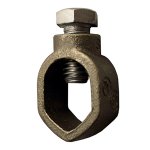
so my question then will be, can i double tap to the acorn on the first rod?
 
OP
K

kenny_ca

Member
Joined
Oct 23, 2018
Messages
15
Location
CA
if i can't double tap the connector, can i use more than one rod clamp?
 

Attachments

  • acorn.jpg
    acorn.jpg
    101.1 KB · Views: 4

mm08822

Well-known member
Joined
Jan 13, 2012
Messages
5,901
Location
NJ
This is the way I read it.

Only the length from service to first rod is called the grounding electrode conductor and is required to be unspliced. The wire that connects the ground rods together is a bonding conductor and not a grounding electrode conductor. The bonding conductors are not required to be continuous like grounding electrode conductors are.

Regardless normally I would run a continuous wire from the service looped through the first rod to the second. But it would save some work to cut it and run a second wire to the second panel.

You are correct the gec and bonding conductors can be separate wires. I've been looping thru the acorns for so long, its become habit and a mindset.

For a single service, the problem with using 2 acorns at the first rod (1 for gec and 1 for jumper) is there are now 2 needless possible connection failure points that could render the 2nd rod useless.
 

TRWham

Well-known member
Joined
Aug 11, 2017
Messages
1,961
Location
East Cobb County, Georgia
i was not planning to use any conduit, i was planning to knock out the hole (highlighted in green in the attached photo) of the back panel and use a conduit ****** to feed the wires inside the stud bay and into the crawl space. inside the crawl space is where i will have a splice box to pull all the branch circuits from the old panel that is located about 15 feet away from the new panel location. so

I guess you are running NM cable. If so, you will not be able to run multiple cables through that ****** and satisfy the requirement to secure each cable to the cabinet.
 
OP
K

kenny_ca

Member
Joined
Oct 23, 2018
Messages
15
Location
CA
I guess you are running NM cable. If so, you will not be able to run multiple cables through that ****** and satisfy the requirement to secure each cable to the cabinet.

yes.. all cables will be NM-B

how would you guys do this? i don't want anymore surface mounted conduits if i can avoid them.
 
OP
K

kenny_ca

Member
Joined
Oct 23, 2018
Messages
15
Location
CA
the city inspectors said i need to use clamps for each cable if using NM cables.
to use the conduit sleeve, i would need to buy wires for conduit use and install a pull can to change to NM wires.
i think i will drill some holes for the clamps and just run the NM cables direct to the panel.
 
To avoid these ads, REGISTER NOW!
Top Bottom