To avoid these ads, REGISTER NOW!

Two post lifting advice

Wood'nMetal

Well-known member
Joined
Jul 7, 2013
Messages
1,305
Location
PNW Oregon
Looking for wisdom and advice when using my twin post lift. I've purchased the ALI vehicle lifting guide but it's scope is limited.

Besides the normal, common sense safety stuff what other advice can you guys offer? For example, how do you find safe lift points when you don't have a guide? On a dually extended cab truck how do feel confident you've found a good safe lift position?

My lift is asymmetric so I'm not always sure where to place the arms in relation to the vehicle. I always give it a good bounce test a few inches off the ground!
 
Last edited:
To avoid these ads, REGISTER NOW!

brownbagg

Well-known member
Joined
Mar 20, 2006
Messages
5,208
i won't lift a long bed chevy on mine, I don't like how the frame is on them
 

JRC3

Well-known member
Joined
Jun 30, 2014
Messages
12,481
Location
Southwestern OH
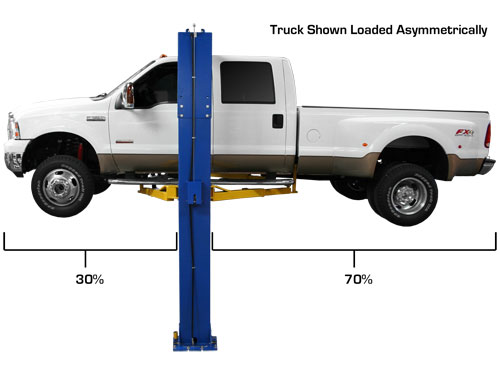
prov10_asy.jpg


Google Images is your friend. I probable use Images more than Web Google. A picture is worth a thousand words.

https://www.google.com/search?hl=en...ekp,kfds=i...0...1..61.img..0.0.0.hzCYEBmML_Q

https://www.google.com/imghp?hl=en&ei=0pzSVJa_OIOuggTumYJA&ved=0CAMQqi4oAg
 

75toolman

Well-known member
Joined
Jan 29, 2009
Messages
147
Use a tripod on long vehicles. IMHO asymmetrical lifts really aren't great for bigger trucks.
 

Anarius

Well-known member
Joined
Jan 15, 2015
Messages
212
Location
SE Michigan
Especially the short frame variants - I usually end up using the add-on adapters to grab the front of the leaf spring brackets. Once I get the truck to working height, I put a tri-pod style safety stand under the rear bumper and load it a little bit.

An extended cab dually? That would be rough. Are you sure your lift is rated for it?
 
OP
W

Wood'nMetal

Well-known member
Joined
Jul 7, 2013
Messages
1,305
Location
PNW Oregon
Especially the short frame variants - I usually end up using the add-on adapters to grab the front of the leaf spring brackets. Once I get the truck to working height, I put a tri-pod style safety stand under the rear bumper and load it a little bit.

An extended cab dually? That would be rough. Are you sure your lift is rated for it?

I agree and have the under lift stands to keep things stable. My lift is rated at 10k and my truck weighs in just shy of 9k full of fuel.

Funny that the picture posted earlier shows a 30/70 lift but on the Greg Smith site they have a video showing that 50/50 is best on longer, heavier rigs.
 

JRC3

Well-known member
Joined
Jun 30, 2014
Messages
12,481
Location
Southwestern OH
Funny that the picture posted earlier shows a 30/70 lift but on the Greg Smith site they have a video showing that 50/50 is best on longer, heavier rigs.

Maybe they mean something even longer than an ext pickup truck like a delivery van, box truck, flatbed, or limo or something. IDK

I'm amazed how little info there is out there for proper lifting; Especially for a midlift. My research is what led me here to GJ and how I found the forum.
 

Shadowdog500

Well-known member
Joined
Dec 7, 2009
Messages
9,825
Location
Down the shore
On heavy dually trucks I look up the empty axle weight for both axles and measure the wheelbase. Then I figure the CG with relation to the front tire and put the CG in line with the posts. Then I put the pads on the frame with a good spread front to back. I have a symmetric Mohawk Series1.

I don't have a pencil and paper handy so I will figure out the equation here.

Just use the last equation.


Equation 1
Front axle weight x front dist to CG = rear axle weight x rear dist to CG
Equation 2
Front dist to CG + rear dist to CG = wheelbase
So rear dist to CG = wheelbase - front dist to CG

Substitute:
Front axle weight x front dist to CG = rear axle weight x (wheelbase - front distance to CG)

Front axle weight x front distance to CG = rear axle weight x wheelbase - rear axle weight x front distance to CG

(Front axle weight + rear axle weight)x front distance to CG = rear axle weight x wheelbase

Front distance to CG= rear axle weight x wheelbase/(front axle weight + rear axle weight)
Use this last equation to find how far the CG is aft of the front axle.

I made a handy PowerPoint of the equation with a drawing that I keep with my lift point guide. I can try to upload it tomorrow.


Chris
 
Last edited:

rburke65

Well-known member
Joined
Nov 10, 2007
Messages
12,349
Location
Canfield, Ohio
No help here but even with my Mohawk I use 2 ? 60" .... 72" tri pod or jack stands under the vehicle .....just in case.
 

yuk

Well-known member
Joined
Nov 18, 2012
Messages
142
Location
Living in quiet rural Missouri.
With no load on my lift, the cylinders seem to "lean" to the south due to the difference is arm weights.
On heavier vehicles I try to get them a little more to the south and raise a few inches from the floor. Then put them down and move the vehicle north a few inches and try again. I contunue to do this untill the cylinders "lean" back to the north. At that time I am within a couple inches of being balanced.
Kind of a PITA but gives me piece of mind.
Then I note in the ALI book about that particular vehicle making notes also about fuel amount and like whats in the truck bed.
But all I am doing is family and friends stuff. It would be a little tougher running a shop....Time is money in a shop and there would be alot more vehicles coming through too!!
 

zkdiesel

Well-known member
Joined
Oct 6, 2013
Messages
8,278
Location
chicagoland cornfields
Maybe they mean something even longer than an ext pickup truck like a delivery van, box truck, flatbed, or limo or something. IDK

I'm amazed how little info there is out there for proper lifting; Especially for a midlift. My research is what led me here to GJ and how I found the forum.
No, they refer to the truck pictured is better on a sym
I have all styles of lift, won't lift that truck in picture on a asy. It is to unsafe and unbalanced. Seen failures of trucks flipping off the back
 

32roadster

Well-known member
Joined
Jan 19, 2006
Messages
87
Location
okla
The truck pictured above, should be pulled further forward. The weight should be about as close to 50-50 as possible for a truck. You will wear out certain parts rather quickly...specifically the collars that house the pins on the carriage....
 
To avoid these ads, REGISTER NOW!

APEowner

Well-known member
Joined
Oct 2, 2009
Messages
4,164
Location
Sunny, New Mexico
The truck pictured above, should be pulled further forward. The weight should be about as close to 50-50 as possible for a truck.

If that truck is empty then its probably pretty close to 50-50 the way it's shown. Those diesels are ridiculously nose heavy. The big problem with trucks is that they gain weight throughout their life from accessories and the stuff that the owners carry around in them. Just for kicks I weighed the small toolbox and the three Rubbermaid tubs that are always in my truck and they were just a tick under 500 lbs! All that's in there when the truck is what I think of as empty. Not only that I usually use a cargo bar to keep it near the tailgate. There's also 288lbs of fuel that may or may not be in it.
 

575cat

Well-known member
Joined
Dec 18, 2013
Messages
243
Allot of weight hanging on the *** end of that thing ,should be forward a bit .
 

Fantic

Member
Joined
Jan 2, 2015
Messages
18
Location
So. IL.
I have the GMC version of that truck with the Duramax. The center of weight is right at the front door handles.
 

Jagmandave

Well-known member
Joined
Nov 6, 2011
Messages
6,299
Location
Overland Park, Ks.
At school whenever possible, I have my students use the drive on lifts for the long pickemups, it's just safer. If they need a two post, we have a 10K rated in ground two post they use.

I'm never really comfortable with a big pickemup on a two post, and all ours save the in-ground are asymmetrical.
 

scooz14

Well-known member
Joined
Oct 27, 2012
Messages
123
ill lift a standard cab 3/4 ton, any bigger gets worked on on the ground.
 

APEowner

Well-known member
Joined
Oct 2, 2009
Messages
4,164
Location
Sunny, New Mexico
Really the thing is to try and figure out where the center of gravity is and then try to put it where it belongs on the lift you're using. Just because it's a long bed full size truck doesn't mean that you shouldn't lift it on an asymmetrical lift. As the pictures above indicate it's entirely possible to get the weight where it needs to be. In fact with an empty truck on a symmetrical lift it can be hard to find a spot to put the front lift arms with the truck far enough back.
 

Jagmandave

Well-known member
Joined
Nov 6, 2011
Messages
6,299
Location
Overland Park, Ks.
Exactly the problem, trying to find a good spot to put the arms that let the truck's weight be centered in the lift.

It's difficult on some shorter pick ups too, 4X4 Rangers for example.....it's hard to find a good spot anywhere on those that's outside the center of the frame.
 

rixtrix1

Well-known member
Joined
Aug 25, 2013
Messages
3,010
Location
Chandler, AZ (from west NE)
On heavy dually trucks I look up the empty axle weight for both axles and measure the wheelbase. Then I figure the CG with relation to the front tire and put the CG in line with the posts. Then I put the pads on the frame with a good spread front to back. I have a symmetric Mohawk Series1.

I don't have a pencil and paper handy so I will figure out the equation here.

Just use the last equation.


Equation 1
Front axle weight x front dist to CG = rear axle weight x rear dist to CG
Equation 2
Front dist to CG + rear dist to CG = wheelbase
So rear dist to CG = wheelbase - front dist to CG

Substitute:
Front axle weight x front dist to CG = rear axle weight x (wheelbase - front distance to CG)

Front axle weight x front distance to CG = rear axle weight x wheelbase - rear axle weight x front distance to CG

(Front axle weight + rear axle weight)x front distance to CG = rear axle weight x wheelbase

Front distance to CG= rear axle weight x wheelbase/(front axle weight + rear axle weight)
Use this last equation to find how far the CG is aft of the front axle.

I made a handy PowerPoint of the equation with a drawing that I keep with my lift point guide. I can try to upload it tomorrow.


Chris

With no load on my lift, the cylinders seem to "lean" to the south due to the difference is arm weights.
On heavier vehicles I try to get them a little more to the south and raise a few inches from the floor. Then put them down and move the vehicle north a few inches and try again. I contunue to do this untill the cylinders "lean" back to the north. At that time I am within a couple inches of being balanced.
Kind of a PITA but gives me piece of mind.
Then I note in the ALI book about that particular vehicle making notes also about fuel amount and like whats in the truck bed.
But all I am doing is family and friends stuff. It would be a little tougher running a shop....Time is money in a shop and there would be alot more vehicles coming through too!!

No, they refer to the truck pictured is better on a sym
I have all styles of lift, won't lift that truck in picture on a asy. It is to unsafe and unbalanced. Seen failures of trucks flipping off the back

If that truck is empty then its probably pretty close to 50-50 the way it's shown. Those diesels are ridiculously nose heavy. The big problem with trucks is that they gain weight throughout their life from accessories and the stuff that the owners carry around in them. Just for kicks I weighed the small toolbox and the three Rubbermaid tubs that are always in my truck and they were just a tick under 500 lbs! All that's in there when the truck is what I think of as empty. Not only that I usually use a cargo bar to keep it near the tailgate. There's also 288lbs of fuel that may or may not be in it.

I have the GMC version of that truck with the Duramax. The center of weight is right at the front door handles.

Really the thing is to try and figure out where the center of gravity is and then try to put it where it belongs on the lift you're using. Just because it's a long bed full size truck doesn't mean that you shouldn't lift it on an asymmetrical lift. As the pictures above indicate it's entirely possible to get the weight where it needs to be. In fact with an empty truck on a symmetrical lift it can be hard to find a spot to put the front lift arms with the truck far enough back.


Exactly the problem, trying to find a good spot to put the arms that let the truck's weight be centered in the lift.

It's difficult on some shorter pick ups too, 4X4 Rangers for example.....it's hard to find a good spot anywhere on those that's outside the center of the frame.

Equally as important as centering the trucks weight is to ALWAYS lower the vehicle to the safety catches before starting to work on it.
 

jfcasey

Well-known member
Joined
Jan 30, 2010
Messages
1,358
Location
New Hampshire
Exactly the problem, trying to find a good spot to put the arms that let the truck's weight be centered in the lift.

It's difficult on some shorter pick ups too, 4X4 Rangers for example.....it's hard to find a good spot anywhere on those that's outside the center of the frame.
On rangers I go to the frame in the front then use 6 inch extensions and go to the front spring perch. It's pretty stable.

Shorty tacomas are similar, but you don't need the extensions.
 

Jlbc212

Well-known member
Joined
Dec 7, 2013
Messages
1,530
Location
Northeast MA
Shadowdog500,
I've been watching this thread to see if you would remember and you did! Thanks!
I saved the two pages by saving the images on my IPad.
 
To avoid these ads, REGISTER NOW!
Top Bottom