To avoid these ads, REGISTER NOW!

Two stupid questions...

OctaneMotorsports

Well-known member
Joined
Feb 28, 2006
Messages
1,033
Location
Caledonia, Ontario, Canada.
Hey,

Today I was buying some new hardware for my kart, and I started thinking...

First of all, about washers. Now, most washers have a sharp (flat) edge on one side and a round (curved) edge on the other. Which side is supposed to come in contact with the surface, and which side is supposed to come in contact with the base of the nut? Does it even matter?

Secondly, how do lock washers work? I know what they're for, but it seems they apply pressure to the nut, but wouldn't that make them loosen faster if anything? Also, should I use a lock washer with nyloc nuts as extra security? They cost the same, so I'd might as well...unless they do more harm than good.

Thanks, I guess these are just two things I've always wondered but never asked. Well, now I'm asking lol.
 
To avoid these ads, REGISTER NOW!

barn9

Member
Joined
Jan 27, 2006
Messages
12
Location
Winfield, KS
I do not profess to be an authority by any means, but my thoughts are:
I usually put the flat side of the washer down because of surface contact. The rounded side down leaves that little bit of a gap for dirt, moisture, etc. to collect the way I look at it. That and when feeling around for hidden washer/nut combos, you run your fingers over a rounded edge instead of the sharp edge. Neither reason is probably any big deal actually, that's just the way I do it.

Lock washers keep tension on the opposing threads of the bolt and nut, making them LESS likely to loosen because of vibration, etc.

That's my take on the subject, someone may have something a little more technical to add though.
 

TER

Well-known member
Joined
Apr 3, 2006
Messages
56
Location
Austin, TX
imported_banzaitoyota said:
I highly recommend reading "screw to win" otherwise known as Carrol Smith's Nut Bolt and Fastener Handbook

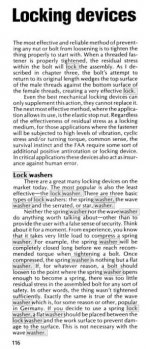
Thanks for the recommendation; I checked it out and put it on my list to buy. BTW here's what he had to say about lock washers:
 

Attachments

  • fastener.jpg
    fastener.jpg
    71.8 KB · Views: 84

l_bilyk

Well-known member
Joined
Mar 11, 2005
Messages
1,773
Location
Ontario, Canada
Looks to me as if Carrol Smith is saying that a spring washer does not exert any force on the nut once it is compressed. This does not sound right to me.
 
Last edited:

TER

Well-known member
Joined
Apr 3, 2006
Messages
56
Location
Austin, TX
l_bilyk said:
Looks to me as if Carrol Smith is saying that a spring washer does not exert any force on the nut once it is compressed. This does not sound right to me.

That surprised me too.
 

camarojoe

Well-known member
Joined
Oct 19, 2005
Messages
141
Location
PA
l_bilyk said:
Looks to me as if Carrol Smith is saying that a spring washer does not exert any force on the nut once it is compressed. This does not sound right to me.
Who's Carrol Smith anyhow, and what makes him an authority on lockwashers? :headscrat :D
 
To avoid these ads, REGISTER NOW!

Moosedog

Member
Joined
Apr 7, 2006
Messages
5
So if you need a flat under the spring lock to keep it from gouging into your part because that sharp edge bites in when you back it off and,,,( he said sharp edge bites)

The guy that wrote that book sounds like he bases off opinion instead of fact!

IMO
 
Joined
Feb 2, 2006
Messages
22
Location
Georgia
I have not read the book. But as a machinist I was taught that the rounded edge of the flat washer goes down the sharp edge goes against the nut or screw head. This keeps the burr on the sharp edge of the washer from marring the surface of the part, and also allows the washer to rest flat agains the part for full surface contact and correct torque on the fastener. Different lock washers work in different ways. Split (spring) washers provide tension between the nut and the screw. Star washers 'bite' into the material and increase friction. Nyloc nuts actually grip the threads of the fastener preventing back out. Using a lock washer and a nyloc nut is not needed, one or the other.
 

mike944

Well-known member
Joined
Jan 18, 2006
Messages
337
Location
Vernon, CT
I agree with most of the last link in principle (i didn't read every word)

Split lock washers only work, after the fastener has loosened enough to cause the spring washer's biting edges to dig in to the surface and the nut. The only thing they will do, is prevent an already-loosened nut from backing completely off. It doesn't have to loosen much for it to function, but usually even a small preload loss in a joint is significant.

I work as a design engineer in the aerospace industry, and here, lockwashers are strictly forbidden. All-metal self locking nuts are preferred, Nylock can be used in low-temperature applications (<200F) Safety wire is not preferred, because it is difficult and time-consuming to install, but it does provide adequate locking, if it's done correctly.

I usually agree with Carrol Smith on most things, and i agree that most lock washers are useless. However, if you must use a lockwasher, for whatever reason, i think his advice on placing a flat washer under a lock washer is misguided. A flat washer placed under a lock washer, will indeed prevent damage to the surface, but it's this "damage" that is actually how the locking function works.

All that being said, however, if i pull something apart, and it has a lock washer installed from the factory, when i reassemble it, i will reinstall the lock washer, just as the designer had intended. I don't usually second-guess them.
________
volcano review
 
Last edited:

TER

Well-known member
Joined
Apr 3, 2006
Messages
56
Location
Austin, TX
Coach James said:
If a bolt is fully torqued, the edges of the lock washer are paralllel to the surfaces so it cannot "bite" into the material.

Some engineers opinion on lock washers:

http://www.eng-tips.com/viewthread.cfm?qid=114051&page=1

Coach

This post in the above link makes sense:

Warpspeed (Automotive)
25 Aug 05 20:49
Perhaps the guiding principle should be, that in a high stress application where the nut can be properly torqued, the threads will self lock. The male threads stretch, and the female nut compresses slightly. This alone will lock a nut and is the proper way to do it.

But not all applications can be tightened with enough torque to create this natural thread locking phenomena. Electrical terminals come to mind, particularly with brass threads. And as already mentioned, mild steel screws through fiberglass panels, and similar very low force applications. There will always be insufficient clamping force to properly lock the nut, and where there is also vibration the result will be obvious.

Either star or split washers can work pretty darned well for low force threaded fasteners, but should be avoided like the plague in rigid high load applications.
 

mleichtle

Well-known member
Joined
Aug 10, 2005
Messages
223
Location
Wisconsin
They make good spacers on stupid lawn mower bolts, helps let the socket seat so ya don't round the flimsy thing.
 

TER

Well-known member
Joined
Apr 3, 2006
Messages
56
Location
Austin, TX
OctaneMotorsports said:
Hey,
*****
Secondly, how do lock washers work? I know what they're for, but it seems they apply pressure to the nut, but wouldn't that make them loosen faster if anything? Also, should I use a lock washer with nyloc nuts as extra security? They cost the same, so I'd might as well...unless they do more harm than good.
To bring this full circle to the original poster's point, here is evidence that lock washers may make it worse:
Work completed during the 1960's in Germany indicated that transversely applied alternating forces generate the most severe conditions for self loosening. The result of these studies led to the design of a testing machine which allowed quantitative information to be obtained on the locking performance of self locking fasteners. Such machines, often called Junkers machines in the literature - after it's inventor, have been used over the last twenty years by the major automotive and aerospace manufacturers to assess the performance of proprietary self locking fasteners. As a result, a rationalisation of the variety of locking devices used by such major companies has occurred. For example, conventional spring lock washers are no longer specified, because it has been shown that they actually aid self loosening rather than prevent it. There are a multitude of thread locking devices available. Through the efforts of the American National Standards Subcommittee B18:20 on locking fasteners, three basic locking fastener categories have been established. They are: free spinning, friction locking, and chemical locking.
(excerpted from this link also from Coach James' post ).
 

Scott

Well-known member
Joined
Dec 21, 2005
Messages
139
Location
Bothell, WA
camarojoe said:
Who's Carrol Smith anyhow, and what makes him an authority on lockwashers? :headscrat :D
I don't exactly know his title but I am pretty sure he was the chief race engineer on the Ford GT40 teams when they won LeMans in the 60's. He also was involved with the Dodge Viper teams when they won LeMans in the 90's. I think he was involved with pretty much every type of racing during his career.

And yes he was a very opinionated man. His experience came from an engineering background, but more so from empirical evidence from experience with race cars, so his opinions don't apply to all applications I am sure. His books are a great read though. He was the chief design judge for a college design competition I was invloved in, he ripped a lot of designs a new one!
 
To avoid these ads, REGISTER NOW!
Top Bottom