To avoid these ads, REGISTER NOW!

Tyvek above window?

honza.vosalik

Well-known member
Joined
Feb 27, 2016
Messages
882
Location
Missouri
I recently had a water come in from above one of my windows during a storm. After removing the top trim (inside of the house), I could see it coming on the tyvek. The tyvek is stapled to a 2x6 that's above the window frame. The house is a brick wall, then tyvek and then osb board, insulation. From what I understand the tyvek should not be stapled towards the inside of the house. Should I be trying to see how to even fix where the tyvek is attached? That would mean ripping out the brick wall I think. Where do I go from here?
I believe I found where the actual water intrusion happened in a brick transition and caulked it. I also had someone examine the walls with an infra red camera to see if there's any more issues, but everything is dry
 
Last edited:
To avoid these ads, REGISTER NOW!

larry4406

Well-known member
Joined
Jan 27, 2006
Messages
19,103
Location
Northern Virginia
Mason made a mistake it sounds like.

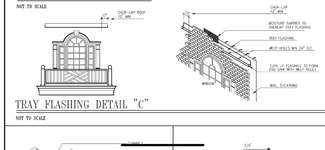
When the lintel is placed at the window head, the mason installs flashing on the lintel and tucks thus under the tyvek /slit as needed. Then puts weep holes at the brick to lintel joint.

This turns out all the water over the lintel and none passes down to the window.

Other approach is to imbed Z-flash in the bed joint above the window. Z-flash is still tucked under the tyvek.
 
Last edited:
OP
H

honza.vosalik

Well-known member
Joined
Feb 27, 2016
Messages
882
Location
Missouri
Mason made a mistake it sounds like.

When the lintel is placed at the window head, the mason installs flashing on the lintel and tucks thus under the tyvek /slit as needed. Then puts weep holes at the brick to lintel joint.

This turns out all the water over the lintel and none passes down to the window.

Other approach is to imbed Z-flash in the bend joint above the window. Z-flash is still tucked under the tyvek.
So the only way to fix this now is to open up the brick, put some kind of flashing there and then put the wall back together?
 

PoorUB

Well-known member
Joined
Mar 29, 2021
Messages
11,622
Location
Fargo, ND
When putting in a window I have always "X" cut the house wrap, and stapled it to the rough opening, all around, Set the window in caulk to the house wrap and flashing over the top edge of the window and under the siding, the more caulk.

If the window is going in to a brick or masonry wall then the window needs to be caulked well, all around. I replaced windows in my basment. I set them right in the concrete wall, put them in place with door shims and foamed them in. After the foam cured I pulled the shims and foamed the voids. Afterwards carefully trimmed the foam and caulked inside and out. Nothing holding the windows but foam and caulk. They are not going any where! I can hit them full fource from the garden hose and they do not leak.

Another point, I hate silicone, worst caulk ever. Many of the newer, engineered caulks are ten times better Silaflex LM for example.
 
OP
H

honza.vosalik

Well-known member
Joined
Feb 27, 2016
Messages
882
Location
Missouri
When putting in a window I have always "X" cut the house wrap, and stapled it to the rough opening, all around, Set the window in caulk to the house wrap and flashing over the top edge of the window and under the siding, the more caulk.

If the window is going in to a brick or masonry wall then the window needs to be caulked well, all around. I replaced windows in my basment. I set them right in the concrete wall, put them in place with door shims and foamed them in. After the foam cured I pulled the shims and foamed the voids. Afterwards carefully trimmed the foam and caulked inside and out. Nothing holding the windows but foam and caulk. They are not going any where! I can hit them full fource from the garden hose and they do not leak.

Another point, I hate silicone, worst caulk ever. Many of the newer, engineered caulks are ten times better Silaflex LM for example.
Thanks. I recaulked all around the windows too after this happened
 

PoorUB

Well-known member
Joined
Mar 29, 2021
Messages
11,622
Location
Fargo, ND
I recently had a water come in from above one of my windows during a storm. After removing the top trim (inside of the house), I could see it coming on the tyvek. The tyvek is stapled to a 2x6 that's above the window frame. The house is a brick wall, then tyvek and then osb board, insulation. From what I understand the tyvek should not be stapled towards the inside of the house. Should I be trying to see how to even fix where the tyvek is attached? That would mean ripping out the brick wall I think. Where do I go from here?
I believe I found where the actual water intrusion happened in a brick transition and caulked it. I also had someone examine the walls with an infra red camera to see if there's any more issues, but everything is dry.
So this is a wood frame with a full brick veneer?

There should have been flashing to the front of the window up the wall, under the house wrap.

Brink veneer is a bit of a pain as you can get water and moisture between the brick and sheeting.
 

larry4406

Well-known member
Joined
Jan 27, 2006
Messages
19,103
Location
Northern Virginia
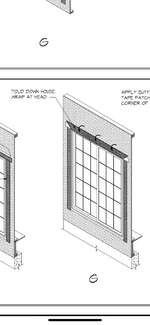
The WRB (Tyvek) overlaps the top window nailing fin; not wrapped into the jamb.

When there is a brick condition, the WRB overlaps the lintel not left behind it.

When there is an odd window such as an arch, an embedded tray or Z-flash is used.

I think you are removing masonry to fix this.

282EF039-3F43-4C54-AA2E-BCD01F51992C.pngBC4F8A34-983D-4625-A2C8-86E4FB89DFB1.png
 
OP
H

honza.vosalik

Well-known member
Joined
Feb 27, 2016
Messages
882
Location
Missouri
So this is a wood frame with a full brick veneer?

There should have been flashing to the front of the window up the wall, under the house wrap.

Brink veneer is a bit of a pain as you can get water and moisture between the brick and sheeting.
Yes, wood frame, OSB, tyvek, brick veneer.

Unfortunately I can't tell if there is a flashing (since there's no way I can see behind the brick).
 

PoorUB

Well-known member
Joined
Mar 29, 2021
Messages
11,622
Location
Fargo, ND
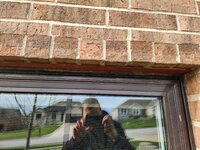
Outside picture
Well, that wasn't quite what I expected!

With that window recessed so far I wonder where the water came from? I hate to say it, but probably from well above the window, unless it ran down the outside of the bring and water tension carried it to the top of the window.
I might leave the trim off, or with a couple small trim screws so you can keep an eye on it. Trouble is some times these leaks need the perfect storm of the right amount of rain and wind from the right direction.
 
To avoid these ads, REGISTER NOW!

cgrutt

Well-known member
Joined
Mar 4, 2016
Messages
8,203
When putting in a window I have always "X" cut the house wrap, and stapled it to the rough opening, all around, Set the window in caulk to the house wrap and flashing over the top edge of the window and under the siding, the more caulk.

If the window is going in to a brick or masonry wall then the window needs to be caulked well, all around. I replaced windows in my basment. I set them right in the concrete wall, put them in place with door shims and foamed them in. After the foam cured I pulled the shims and foamed the voids. Afterwards carefully trimmed the foam and caulked inside and out. Nothing holding the windows but foam and caulk. They are not going any where! I can hit them full fource from the garden hose and they do not leak.

Another point, I hate silicone, worst caulk ever. Many of the newer, engineered caulks are ten times better Silaflex LM for example.
You should never pull housewrap into the framing structure, especially at the window header. House wrap is a drainage plane you want everything sheding water away from the structure. Even if you just wrap inside the sides of window it's still a bad idea because it can create an air gap and allow cold air exchange into house below caulking or foam. Windows should be installed and flashed followed by housewrap over the flashing. Lots of you tube videos on this.
 

larry4406

Well-known member
Joined
Jan 27, 2006
Messages
19,103
Location
Northern Virginia
Masonry has a nominal 1” air gap behind it. This is the drainage plane. Masonry is not impervious. Flashing needs to direct and steer water while weeps let it out.

Window flashing is wrong in my opinion.

I had success one time by injecting closed cell foam to seal off the air gap at a leaking door. We drilled holes thru the bed and **** joints above the leaking door and injected it. We drilled holes such to create a semi pitched slope with the injection. It stopped the leak without masonry removal. We did have pointup at the mortar joints where drilled. This was 10+ years or so ago; I’ve no idea the long term success of this method so can’t say I fully endorse it. We did it only because the brick was discontinued with acknowledgment by the customer (house was out of warranty but a courtesy repair by us).
 
OP
H

honza.vosalik

Well-known member
Joined
Feb 27, 2016
Messages
882
Location
Missouri
I think you may be correct. The water may be coming from much higher on the wall.
Yes, I think the water was coming from the transition where one kind of brick transitions to the other. I rrcaulked it there and in the last big storm 2days ago I didn't get any leak. I also tried to run water from garden hose and no leak ar this point.
 

jack stand

Well-known member
Joined
Feb 29, 2012
Messages
3,319
Location
Lakes Region Maine
Cutting the "X" and fastening to the bare window framing was the method printed on the tyvek wrapper 20 +/- years ago. That doesn't make it right, but it's initial purpose back then was air infiltration. We've done thousands of homes that way and I often wonder if they're still standing or the condition of the sheathing and sill plates. Then...... they came out with the tape and the methods changed.
 
OP
H

honza.vosalik

Well-known member
Joined
Feb 27, 2016
Messages
882
Location
Missouri
Cutting the "X" and fastening to the bare window framing was the method printed on the tyvek wrapper 20 +/- years ago. That doesn't make it right, but it's initial purpose back then was air infiltration. We've done thousands of homes that way and I often wonder if they're still standing or the condition of the sheathing and sill plates. Then...... they came out with the tape and the methods changed.
House was built in 2019
 

jack stand

Well-known member
Joined
Feb 29, 2012
Messages
3,319
Location
Lakes Region Maine
House was built in 2019
Yeah, that's not the right way anymore. Chasing a leak behind masonry is a tough one. Are there windows or doors anywhere above the leaky one? How was the transition from the brick to the stone handled? Is this "stone" what we call "lick and stick" (fake)?
Do both of these "soldier" courses (at the stone transition and around the window) have positive draining away from the wall?
This is where I'd start looking, it's the easiest, non destructive place to start. Some brick is surprisingly porous and it doesn't take much driving rain to have a problem, and a solid 10* outward pitch needs to be on all created ledges. (Soldier course)
 
OP
H

honza.vosalik

Well-known member
Joined
Feb 27, 2016
Messages
882
Location
Missouri
Yeah, that's not the right way anymore. Chasing a leak behind masonry is a tough one. Are there windows or doors anywhere above the leaky one? How was the transition from the brick to the stone handled? Is this "stone" what we call "lick and stick" (fake)?
Do both of these "soldier" courses (at the stone transition and around the window) have positive draining away from the wall?
This is where I'd start looking, it's the easiest, non destructive place to start. Some brick is surprisingly porous and it doesn't take much driving rain to have a problem, and a solid 10* outward pitch needs to be on all created ledges. (Soldier course)
As the very first picture shows, there's another window right above. I think the brick that looks like rock is not real rock but rather some sort of brick.

I redid the caulking around windows, the brick transition and every little hole I could find. I ran water from garden hose over it and we had another big storm and no leak.
What I'm not sure is if to call it good here since the water intrusion was stopped or try to figure out something with that (most likely) missing flashing.
 

cgrutt

Well-known member
Joined
Mar 4, 2016
Messages
8,203
@honza.vosalik sorry for your woes should definitely not be having these problems with a four year old house. I dont know anything about masonry or how to correct this but you might want to explore a replacement window this way they can cut the old (yeah I know not that old) window out, hopefully correct any issues with flashing/house wrap and install new window without diaturbing the brick. Got to think this would be much cheaper and potentially have better results than tearing that brick out. I know it's probably not what you want to hear but I think if you just put more caulk/foam on it you'll be redirecting water somewhere else and may have a major problem (in the form of rot and/or mold) a few years from now. Good luck.
 

cgrutt

Well-known member
Joined
Mar 4, 2016
Messages
8,203
Also make sure it's not coming from inside the house. Any pipes or bathroom/shower above that window? Could also be originating at roof and/or gutters. Water finds its own path...
 
OP
H

honza.vosalik

Well-known member
Joined
Feb 27, 2016
Messages
882
Location
Missouri
Also make sure it's not coming from inside the house. Any pipes or bathroom/shower above that window? Could also be originating at roof and/or gutters. Water finds its own path...
No, definitely no bathroom above. Roof is high, I can't see there. Might be something to explore if it ever leaks again.
 
To avoid these ads, REGISTER NOW!
Top Bottom