To avoid these ads, REGISTER NOW!

Under slab dust collection

Wiebster

Well-known member
Joined
Jul 18, 2015
Messages
194
Location
Rapid City, Sd
I’ve searched the threads but haven’t seen a discussion on running 6” dust collection pipes under a new slab. I’m fairly certain where my tools will sit in my new shop. Even if I’m off by a few feet, I would rather have short flex pipe than dust collection tubes hanging down everywhere from the ceiling. I was planning on using 6” sewer pipe for the runs with a ground wire. I’ve attached a rough idea of what I had planned. The brown lines would be the pipe runs. Any suggestions or experiences with this would be appreciated.
 

Attachments

  • IMG_0168.jpeg
    IMG_0168.jpeg
    785.1 KB · Views: 123
To avoid these ads, REGISTER NOW!

gizardlizard

Well-known member
Joined
Aug 29, 2019
Messages
729
Location
Madison, WI
Years ago, I spotted a bunch of power tools for sale on Craigslist. The guy selling was a retired builder. He took me in his shop and I saw flush mounted pvc caps everywhere. When I asked him about them, he explained he put in 6” pvc in the slab for all his wood working toys. Genius! He also ran 4” pvc thru the rim joist at a shallow angle with a few long sweep pvc elbows that went into his brine tank of the water softener. He had an adapter in the garage and would then dump salt pellets into his water softener from the garage. I liked that idea so much, I did it myself. That old dude was really an outside the box thinker.
 
OP
W

Wiebster

Well-known member
Joined
Jul 18, 2015
Messages
194
Location
Rapid City, Sd
Thank you for your input. Just wanted to make sure there wasn’t a gotcha that I wasn’t thinking about. IMHO nothing ruins a beautiful wood shop more than tubes hanging down everywhere from the ceiling…except lung cancer!
 

Chris705

Well-known member
Joined
Nov 1, 2012
Messages
834
Location
The Finger Lakes of NY
Charlotte Pipe, Sioux & Spears make large diameter flush plugs for pvc fittings. I assume one would place pvc pipe like typical plumbing pipe….. cover the openings well with plugs & duct tape and pour your concrete……?
 

GrayFlattop

Well-known member
Joined
Jan 18, 2018
Messages
1,051
Location
Chicago
Given the opportunity to build another shop, I would absolutely do this. But as long as I’m dreaming, I’d build a new shop with a full basement and hang the ductwork from the floor joists.

I just have to live within the shop I have and make it work. Not planning on moving, on the cusp of retirement - I’ve got to be responsible.
 

loganb

ALLIANCE MEMBER
Joined
Dec 29, 2011
Messages
5,615
Location
Omaha, NE
If money was no issue....I'd put a raised wood floor over slab to be kinder on the knees and back....but since budgets exist ergo floor mats are great.

I would add several extra runs and do as mentioned with a cap set an inch or so below surface with a locator pin/bolt/marker to tell you where it is when you need it.

I would add a couple spots for floor sweep locations...again can not use if you don't need it. A hookup by the wood storage rack for a planer would be handy. Although that does put possibly the biggest creater of chips farthest away which is less than ideal.
 

P0234

Well-known member
Joined
Aug 6, 2012
Messages
3,241
Location
NoVA
Google under slab vents for ideas of what not to do. As long as it's sealed PVC, I think you'll be fine though.
 

Sumboodie

Well-known member
Joined
Mar 20, 2021
Messages
10,735
Location
AK
Thank you for your input. Just wanted to make sure there wasn’t a gotcha that I wasn’t thinking about. IMHO nothing ruins a beautiful wood shop more than tubes hanging down everywhere from the ceiling…except lung cancer!
Lung cancer from sawdust?
 

jar944

Well-known member
Joined
Jul 26, 2010
Messages
5,951
Location
Northern VA
I'm not a fan of in slab DC piping.. unless you never plan on upgrading machines, or changing the layout (usually related.)

I've significantly rearranged the layout of my equipment (as I add, subtract and upgrade) every couple years.
 

cgrutt

Well-known member
Joined
Mar 4, 2016
Messages
8,356
I like the idea but would be concerned about pipes weakening the slab I'd get then fairly deep below gravel if possible but hopefully concrete guys will chime in if this is even an issue. You obviously won't have any access if they become clogged I'd add cleanouts like a sewer line. Not sure if this is possible or not but could you run three separate branches one down middle of garage and one down each side, add gates above grade before dust collector this way you could shut off 2/3rd of collection system when not needed and just keep branch open for equipment that you're working with. Possibly improve performance by minimizing any leakage at other tools. I'd also add a few additional ports for future tools or even an extra hose that you could use as a vac. If you're in a cold environment I'd consider adding foam insulation under slap as well. I'd research fire risk if dust somehow catches fire below grade and how you could put it out. Maybe a port at end of each run where you could insert a fire extinguisher? Just thinking outloud. Good luck.
 

aShop

Well-known member
Joined
Feb 4, 2023
Messages
212
Location
The Ozarks 6b
Some wood dust does cause cancer, like walnut.

I don't like the thought of not moving machines or having place you can't move a machine because of a dust port.
 

cretedog

ALLIANCE MEMBER
Joined
Mar 27, 2012
Messages
232
Location
North Dakota USA
I’ve searched the threads but haven’t seen a discussion on running 6” dust collection pipes under a new slab. I’m fairly certain where my tools will sit in my new shop. Even if I’m off by a few feet, I would rather have short flex pipe than dust collection tubes hanging down everywhere from the ceiling. I was planning on using 6” sewer pipe for the runs with a ground wire. I’ve attached a rough idea of what I had planned. The brown lines would be the pipe runs. Any suggestions or experiences with this would be appreciated.
Did this very thing when I built my shop 20 years ago or so. VERY glad I did. Works great and have never had a plug up- knock on wood.
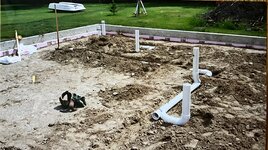
Drew a scaled floor plan of the shop and made scaled cut outs of the machines and moved them around on the plan for a month or two before finalizing the layout. Added some extra stub ups at strategic locations. 2 main runs of 4" pvc with ground wire, both stubbing up in a closet where a 2 or 3hp Jet dust collector sits. Blast gates at all floor stub ups. Only took myself and one of my boys a weekend to install. Well below the slab and no issues whatsoever with concrete cracking, etc. Will look for some old pics when I get time.
 
OP
W

Wiebster

Well-known member
Joined
Jul 18, 2015
Messages
194
Location
Rapid City, Sd
I'm not a fan of in slab DC piping.. unless you never plan on upgrading machines, or changing the layout (usually related.)

I've significantly rearranged the layout of my equipment (as I add, subtract and upgrade) every couple years.
This is probably my number one concern. But I don’t think I would change it so drastically that I wouldn’t be able to use flex pipe for the few feet I might shift tools. Most of my dust ports on tools are already near the floor. Still a concern for me though. Thanks.
 
OP
W

Wiebster

Well-known member
Joined
Jul 18, 2015
Messages
194
Location
Rapid City, Sd
Did this very thing when I built my shop 20 years ago or so. VERY glad I did. Works great and have never had a plug up- knock on wood.
Drew a scaled floor plan of the shop and made scaled cut outs of the machines and moved them around on the plan for a month or two before finalizing the layout. Added some extra stub ups at strategic locations. 2 main runs of 4" pvc with ground wire, both stubbing up in a closet where a 2 or 3hp Jet dust collector sits. Blast gates at all floor stub ups. Only took myself and one of my boys a weekend to install. Well below the slab and no issues whatsoever with concrete cracking, etc. Will look for some old pics when I get time.
I would love to see them if you find them. I’m not concerned about weakening the concrete as these will be in the dirt below, bade course, rigid insulation, and 5” of rebar reinforced concrete. What I am concerned about is getting an inferior concrete finish. Every time there is a projection through the surface it seems that it interferes with a nice flat surface. Hard to screed around, high spot or rough around the pipe. I’d like to keep everything at concrete height or slightly below, (just knock the thin layer away after it cures). If I get this detail the exact right height it should help the concrete guys by giving them a reference to screed from. Any details about how you did this and the type of fittings that would simplify the connection to the blast gates?
 

Black300zx

Well-known member
Joined
Apr 8, 2019
Messages
782
Location
Elkton, Md
I have zero experience w/ this, but some initial thoughts around maintenance come to mind:
  1. Will the slab be more-or-less at ground level, with the in-slab ducting being the low point? If water somehow gets into the ducting, will you have any means of effectively cleaning it out? Seems like any standing water that gets in the ducting would cause dust to clump and clog, which could be a nightmare to clean out. Condensation might even cause issues depending on your climate
  2. Similar to 1), I know that with my flexible ducting I occasionally will accidentally vacuum up something large that clogs up the works. If this happened with in-slab ducting, good access points would become critical. Maybe you've got this figured out already.
  3. I'd think that you'd REALLY need to think through manifold design since you've only got one shot. I imagine that there is some air velocity threshold that you need to maintain to prevent dust from settling out in corners, bends, etc. Maybe this is basic, routine dust collection design and you've got this down to a science already.
 
To avoid these ads, REGISTER NOW!

Spud McGee

Well-known member
Joined
Apr 11, 2022
Messages
405
I ran 6" for dust collection and a smaller PVC for a floor outlet to where I wanted to put my table saw. I didn't want to be walking over the dust collector hose like in my old garage.

The only drawback so far is it kinda locks you in to where your tools will go. Or at least, where the dust collection will connect.
That is the reason I didn't go all out with it. I just did the run for the dust collector to the table saw in the middle of the floor.

Here's a couple pictures. The 6" is sitting just barely under the dirt, so the horizontal run and most of the elbows are fully under the slab. It goes from the middle of the floor over to the corner where the dust collector can hide against the wall. Then there's a gray floor electrical box and PVC with a string through it. Right before the pour, that gets set back into place. Later, I used the string to pull my 12/2. Its enough to plug in the saw and a couple other things I may be using on the saw/outfeed table.

1695217562967.png


1695217902973.png
 
Last edited:
OP
W

Wiebster

Well-known member
Joined
Jul 18, 2015
Messages
194
Location
Rapid City, Sd
I have zero experience w/ this, but some initial thoughts around maintenance come to mind:
  1. Will the slab be more-or-less at ground level, with the in-slab ducting being the low point? If water somehow gets into the ducting, will you have any means of effectively cleaning it out? Seems like any standing water that gets in the ducting would cause dust to clump and clog, which could be a nightmare to clean out. Condensation might even cause issues depending on your climate
  2. Similar to 1), I know that with my flexible ducting I occasionally will accidentally vacuum up something large that clogs up the works. If this happened with in-slab ducting, good access points would become critical. Maybe you've got this figured out already.
  3. I'd think that you'd REALLY need to think through manifold design since you've only got one shot. I imagine that there is some air velocity threshold that you need to maintain to prevent dust from settling out in corners, bends, etc. Maybe this is basic, routine dust collection design and you've got this down to a science already.
I’ll glue the pipe so I don’t think water intrusion will be an issue. Not sure about condensation. I don’t have a dust collector picked out yet, so I would have to choose one that will work with what I install but I don’t think my layout is very complicated. I also know nothing about dust collectors and their systems however, I’m definitely not concerned about clogs. I have rental properties with all levels of sewer issues and no dust collector lines will ever compare to those nightmares. As I review future tools and look at my own, I think I will stick with 4” lines and maybe a 6” main trunk down the center to the dust collector.
 

Spud McGee

Well-known member
Joined
Apr 11, 2022
Messages
405
…and can I get by with 4” instead of 6”? The stuff is getting expensive!
I would say go 6, at least for the main trunk.

You can run a table saw on 4" if you have to, but try not to go smaller than the outlet on the back of the saw. Most smaller tools you can run on 2". For my CNC router, it really needs a 4" that splits off into dual 2".
 

Black300zx

Well-known member
Joined
Apr 8, 2019
Messages
782
Location
Elkton, Md
I’ll glue the pipe so I don’t think water intrusion will be an issue. Not sure about condensation. I don’t have a dust collector picked out yet, so I would have to choose one that will work with what I install but I don’t think my layout is very complicated. I also know nothing about dust collectors and their systems however, I’m definitely not concerned about clogs. I have rental properties with all levels of sewer issues and no dust collector lines will ever compare to those nightmares. As I review future tools and look at my own, I think I will stick with 4” lines and maybe a 6” main trunk down the center to the dust collector.
I was thinking more about spills and leaks that might run down into the ducts. I guess if you keep hoses hooked up to the outlets that should minimize that risk.
 

cretedog

ALLIANCE MEMBER
Joined
Mar 27, 2012
Messages
232
Location
North Dakota USA
I would love to see them if you find them. I’m not concerned about weakening the concrete as these will be in the dirt below, bade course, rigid insulation, and 5” of rebar reinforced concrete. What I am concerned about is getting an inferior concrete finish. Every time there is a projection through the surface it seems that it interferes with a nice flat surface. Hard to screed around, high spot or rough around the pipe. I’d like to keep everything at concrete height or slightly below, (just knock the thin layer away after it cures). If I get this detail the exact right height it should help the concrete guys by giving them a reference to screed from. Any details about how you did this and the type of fittings that would simplify the connection to the blast gates?

No issues with concrete finish. Shot the pipe in with a laser and glued a 4" coupling dead on at floor grade. Duct taped over. (Same with 3/4" pvc electrical conduit runs) Cut out the duct tape, pulled up ground wire and dropped in blast gate when ready to connect. Cheap Grizzly remote on-off on dust collector with fobs out in shop to turn on when needed. Like the Jet JCDC-2 and JCDC-3 type dust collectors.
 

Attachments

  • IMG_E0275.JPG
    IMG_E0275.JPG
    757.6 KB · Views: 96
  • IMG_E0276.JPG
    IMG_E0276.JPG
    891.6 KB · Views: 69
  • IMG_E0277.JPG
    IMG_E0277.JPG
    801.7 KB · Views: 63
  • IMG_E0278.JPG
    IMG_E0278.JPG
    688.5 KB · Views: 60
  • IMG_E0279.JPG
    IMG_E0279.JPG
    764.3 KB · Views: 64
  • IMG_E0280.JPG
    IMG_E0280.JPG
    715.6 KB · Views: 89
Last edited:

cvairwerks

Well-known member
Joined
Aug 12, 2016
Messages
7,246
Location
Within hearing distance of Texas Motor Speedway
We've had under slab air and vacuum systems at work for a few years when they reconfigured most of our production area. It's pretty much been abandoned for overhead due to clogging, moisture and other problems. The only place any of it is still in use is one of the paint shops for aircraft air and dolly power, where the floor around the aircraft must be kept clear. Got to be a big pain to get the under slabe stuff repaired as it required cutting 18" thick concrete.
 

cretedog

ALLIANCE MEMBER
Joined
Mar 27, 2012
Messages
232
Location
North Dakota USA
More pics
 

Attachments

  • IMG_0269.jpg
    IMG_0269.jpg
    881.2 KB · Views: 89
  • IMG_0268.jpg
    IMG_0268.jpg
    652 KB · Views: 84
  • IMG_0267.jpg
    IMG_0267.jpg
    631.5 KB · Views: 81
  • IMG_0266.jpg
    IMG_0266.jpg
    1 MB · Views: 79
  • IMG_0272.jpg
    IMG_0272.jpg
    643.1 KB · Views: 76

cretedog

ALLIANCE MEMBER
Joined
Mar 27, 2012
Messages
232
Location
North Dakota USA
More pics
 

Attachments

  • IMG_0270.jpg
    IMG_0270.jpg
    636.1 KB · Views: 73
  • IMG_0271.jpg
    IMG_0271.jpg
    985.1 KB · Views: 68
  • IMG_0273.jpg
    IMG_0273.jpg
    685.6 KB · Views: 62
  • IMG_0274.jpg
    IMG_0274.jpg
    633.6 KB · Views: 92

loganb

ALLIANCE MEMBER
Joined
Dec 29, 2011
Messages
5,615
Location
Omaha, NE
I also know nothing about dust collectors and their systems however

Bookmark this site and carve out some hours reading up...


Now it may get a bit overboard at times for some people on it...but in essence you need to keep air volume and air speed over certain levels for effective dust control. If you're going to do this, do it right and at a minimum 6" PVC for the mains but possibly 8" depending on the run and how many trunks you're pulling off. You're probably looking at a 5hp minimum collector...but if the budget allows a 7.5 HP unit, turned down when full flow not required via VFD would give more future proofing. I'd at least size the wiring for 7.5 or 10HP so if you put a smaller one in to begin with, an upgrade isn't hindered by utilities being undersized. Clogs and debris building up in the mains is a sign of either insufficient speed/volume or putting stuff in there that shouldn't go in there

Check out @tj675 build thread as he has some posts in the last 6-12 months showing how he built out his metal duct work system in his barn turned woodworking shop.
 
OP
W

Wiebster

Well-known member
Joined
Jul 18, 2015
Messages
194
Location
Rapid City, Sd
No issues with concrete finish. Shot the pipe in with a laser and glued a 4" coupling dead on at floor grade. Duct taped over. (Same with 3/4" pvc electrical conduit runs) Cut out the duct tape, pulled up ground wire and dropped in blast gate when ready to connect. Cheap Grizzly remote on-off on dust collector with fobs out in shop to turn on when needed. Like the Jet JCDC-2 and JCDC-3 type dust collectors.
Super helpful and exactly what I was thinking. Thank you, really appreciate it.
 
OP
W

Wiebster

Well-known member
Joined
Jul 18, 2015
Messages
194
Location
Rapid City, Sd
We've had under slab air and vacuum systems at work for a few years when they reconfigured most of our production area. It's pretty much been abandoned for overhead due to clogging, moisture and other problems. The only place any of it is still in use is one of the paint shops for aircraft air and dolly power, where the floor around the aircraft must be kept clear. Got to be a big pain to get the under slabe stuff repaired as it required cutting 18" thick concrete.
I could see that happening. I’m just a weekend warrior that is trying to avoid big mistakes on my dream build.
 

BombShelter

Well-known member
Joined
Nov 16, 2015
Messages
544
Location
State of Hockey
I see underfloor heat ducts up here get filled up with water, it can be a nasty smelly mess with the stagnant water. One of the better systems had a slope to a buried bucket where they had a small Water Giant Pump.

If the conditions are right, the pipe may crack and leak water. I'd probably upgrade from DWV to SCH 40 or even 80 just to make sure. I've worked on new buildings where they used DWV for outside underground conduit and it cracks from backfilling. A few weeks later, everything needs to be dug up and replaced.
 

Black300zx

Well-known member
Joined
Apr 8, 2019
Messages
782
Location
Elkton, Md
I could see that happening. I’m just a weekend warrior that is trying to avoid big mistakes on my dream build.
Just a thought - have you thought about the possibility of including formed trenches in the poured floor instead of actually encasing it in concrete? It would achieve your goal of in-floor dust collection while also allowing easy repair, maintenance or reconfiguration.
 

Spud McGee

Well-known member
Joined
Apr 11, 2022
Messages
405
Just a thought - have you thought about the possibility of including formed trenches in the poured floor instead of actually encasing it in concrete? It would achieve your goal of in-floor dust collection while also allowing easy repair, maintenance or reconfiguration.
That sounds like a nightmare for rolling around anything on casters. You'd end up stepping over the trench, just like you would step over a flexible dust hose draped on the floor the old fashioned way.
 

acer66

Well-known member
Joined
Dec 4, 2010
Messages
4,418
Location
Western North Carolina
That sounds like a nightmare for rolling around anything on casters. You'd end up stepping over the trench, just like you would step over a flexible dust hose draped on the floor the old fashioned way.
In commercial settings it is not unheard of to have utility trenches with removable covers for future needs.

If that makes sense in a setting like this is another story.
 

Black300zx

Well-known member
Joined
Apr 8, 2019
Messages
782
Location
Elkton, Md
That sounds like a nightmare for rolling around anything on casters. You'd end up stepping over the trench, just like you would step over a flexible dust hose draped on the floor the old fashioned way.
Fair points, guess it depends on his needs. I had removable covers in mind like mentioned above.
 
OP
W

Wiebster

Well-known member
Joined
Jul 18, 2015
Messages
194
Location
Rapid City, Sd
Fair points, guess it depends on his needs. I had removable covers in mind like mentioned above.
No, I don’t want to complicate the pour. The absolute worst case scenario is it collapses, fills with water, or doesn’t suit my needs and I just go with the overhead plan. I‘m planning on doing it though. I‘ll start a new thread soon and document what I have done. Thanks everyone for the input and pictures.
 

Black300zx

Well-known member
Joined
Apr 8, 2019
Messages
782
Location
Elkton, Md
No, I don’t want to complicate the pour. The absolute worst case scenario is it collapses, fills with water, or doesn’t suit my needs and I just go with the overhead plan. I‘m planning on doing it though. I‘ll start a new thread soon and document what I have done. Thanks everyone for the input and pictures.
Good luck!
 
To avoid these ads, REGISTER NOW!
Top Bottom