To avoid these ads, REGISTER NOW!

Under slab insulation

Tduby

Well-known member
Joined
Apr 5, 2016
Messages
496
Location
Da U.P.
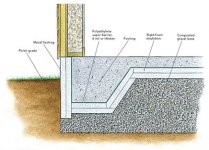
Ok I’m finally building my garage this spring and I want in floor heat. Do to the large amount and size of rocks I am looking at doing a monolithic slab. I’m contracting this out but I want to better understand how this should be done to make sure it done right. Looking at pictures online they always show a nicely angled sheet of insulation over a perfectly angled mound of gravel. This just doesn’t seem like it would work out in the real world or am I over thinking it?

Is 25psi foam strong enough for under the thickened edge or would higher psi be required? I’m thinking of 3 inches on sides bottom of thickened edge and the slope and 2 inches under the rest.
 

Attachments

  • 8E4B3FC2-9C87-4BE4-905A-35A29326679E.jpeg
    8E4B3FC2-9C87-4BE4-905A-35A29326679E.jpeg
    48.1 KB · Views: 145
To avoid these ads, REGISTER NOW!

Copymutt

Well-known member
Joined
Sep 3, 2016
Messages
3,381
Location
Colorado
I have poured two insulated, two layers of 1 1/2" polystyrene = 3". Happy with results. These were traditional pours, footer,stem wall, slab. Too much expansive clay here to mess with mono.
Jim
 

ConCretin

Well-known member
Joined
Jan 20, 2011
Messages
3,378
Location
Central Maine
That’s a good detail for a mono slab and you are right that it won’t look so perfect in the real world especially in the sloped section. As long as the insulation lies flat under the haunch and the slab, you’ll be fine. Just fit the insulation on the slope as well as you can.

2” of insulation is adequate. More insulation is obviously better but the cost adds up more quickly than the benefit. 25 psi is all you need. The loads imposed by the structure and anything you are likely to put on the slab just aren’t very high.

I’d place a couple #5 bars in the bottom of the haunch and use rebar or a heavy gage WWF in the slab.

Btw, if you want to protect the structure from frost completely, extend the insulation out an additional 4’ horizontally.

Good luck with your build!
 
Last edited:

joe--h

Well-known member
Joined
Jan 30, 2013
Messages
535
EPS is treated to repel insects, ants will eat the other stuff.
 

climb.on

Well-known member
Joined
Apr 13, 2015
Messages
501
Location
Minnesota
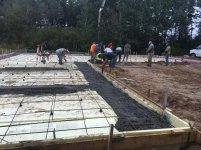
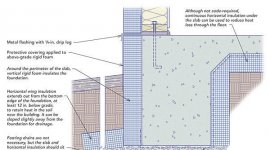
Mine wasn't laid down nice and pretty. You'll want "wing" insulation extending out horizontally, from the bottom edge of the footer, IF you want to protect from frost. Google "FPSF - Frost Protected Shallow Foundation." I went 4' out with 2" of foam around the entire perimeter.

You'll get more value for your insulating dollar by adding insulation on the vertical permitter of the slab. It's exposed to air and a wider range temperatures. I did 4" there. 2" everywhere else.
 

Attachments

  • IMG_5531.jpg
    IMG_5531.jpg
    151.9 KB · Views: 132
Last edited:

matt_i

Well-known member
Joined
Mar 14, 2008
Messages
10,717
Location
SE Michigan
Another way to look at it is 25lb/sq-in * 144 sq-in/ft = 3600 lbs/sq-ft. (or psf)

Which is more than a typical soil can bear without shifting. I've always heard 2000psf is max unless you pile down to bedrock or the like.
 

rburke65

Well-known member
Joined
Nov 10, 2007
Messages
12,349
Location
Canfield, Ohio
And even at 15 psi foam that figures to 2,160 lads. Per square foot! Really? What are you going to put on you floor that is going to crush that?
 
To avoid these ads, REGISTER NOW!
OP
T

Tduby

Well-known member
Joined
Apr 5, 2016
Messages
496
Location
Da U.P.
I realize under the slab 25 psi is over kill I just wasn’t sure about under the thickened edge if higher psi was required
 

6768rogues

Banned
Joined
Nov 28, 2007
Messages
4,524
Location
Western NY
I would insulate vertically at the wall lines to below the frost depth in your area and put no insulation under the floor. The amount of heat that will go down through your floor will be negligible and will prevent freezing. I have seen designs such as your drawing that let frost go under the insulated floor and heave the floor.
 

climb.on

Well-known member
Joined
Apr 13, 2015
Messages
501
Location
Minnesota
I would insulate vertically at the wall lines to below the frost depth in your area and put no insulation under the floor. The amount of heat that will go down through your floor will be negligible and will prevent freezing. I have seen designs such as your drawing that let frost go under the insulated floor and heave the floor.

Negligible? I guess I we have different definitions of negligible. Let's say the ground is roughly 45 degrees. You have concrete that is a poor insulator in constant contact with 45 degree earth year round. I don't think the heat loss would be negligible. Heck, it would be significant if he wasn't doing in floor heat. But he is, and it would be pretty bad.

I agree with you on the vertical insulation - that's very important. Also, the reason for the horizontal wing insulation, is so you don't have to bleed (i.e. waste) heat into the ground to keep in from freezing.
 

Attachments

  • fpsf.jpg
    fpsf.jpg
    57.5 KB · Views: 63

ConCretin

Well-known member
Joined
Jan 20, 2011
Messages
3,378
Location
Central Maine
There are several approaches to insulating a mono slab.

For a heated structure especially with radiant heat, Climb.on is correct - you absolutely want to insulate the bottom and sides of the slab. The heat loss from ground contact particularly around the edges where you are fighting the frost would not be negligible.

To protect an unheated structure from frost movement, you want to insulate under the slab and extend it out 4' from the building face. This will retain the natural heat from the ground and keep frost out from under the slab.

I would extend the insulation at the perimeter of a heated structure in the same manner to keep the frost from working it's way under the slab, particularly under any plowed areas.

An alternate approach for an unheated structure is to forego the insulation completely and let the slab 'float'. With a properly constructed slab and base, the movement is negligible and won't cause any issues. I have a 32 x28 constructed this way that performs just fine in our frost intensive conditions.

Once you determine your goals you can design your insulating system accordingly.
 
Last edited:

dfiler2

Well-known member
Joined
Dec 15, 2014
Messages
2,858
Location
NW Minnesota
Without insulation under the slab you will be heating the ground. I've read statements where people say things like "heat rises, anything that goes into the ground will come back up", not true. Hot air rises, radiant heat, like the sun, goes out evenly in all directions. Don't leave out the insulation if you plan to heat and especially if you plan to use in-floor radiant heat.
 

mxz1998

Member
Joined
Jan 8, 2016
Messages
5
The heat that goes into the ground is less than you would think. I live in the Northern part of Canada. Frost usually goes down 6-8 ft here. Slabs are always poured without insulation under it to keep the frost out. Insulation is vertical at the walls and then out horizontally.
 
To avoid these ads, REGISTER NOW!
Top Bottom