To avoid these ads, REGISTER NOW!

Underground sprinkler PSI rsting

younghandyman

Well-known member
Joined
Dec 18, 2017
Messages
87
I am working on installing my underground sprinklers.

When I went to home depot, I saw speinklers there that were rated at 25 psi, and they could use up to 3 gpm. If the water supply from the spigot is rated at 70 psi, and I feed that directly to the sprinkler, won't that cause the water to turn into a mist rather than a spray?

If I put a pressure regulator right at the spigot, that would solve the issue at the first sprinkler but wouldn't that cause issues at subsequent sprinklers on the same zone as pressure drops through the pipes? How do I get around this?


Sent from my iPhone using Garage Journal
 
To avoid these ads, REGISTER NOW!

snyder

Well-known member
Joined
Dec 18, 2008
Messages
545
Location
Baltimore md.
Once your sprinkler valve opens and the water pops the heads up your pressure will drop.
We have to use a booster pump to up our pressure to 100 psi. This let's a zone of 7 heads operate.
 

Shiftless

Well-known member
Joined
Mar 9, 2014
Messages
14,558
Location
East Bay SFO
How many heads are you running at once off of the same valve? How many feet of pipe are you planning to install?

The last system I designed and installed, I had a loop design where the valve fed both ends of the system. That loop design helps equalize pressure when you have more than just a few heads.

Also, realize that pressure loss is related to pipe size. Most residential systems can use 3/4 inch with half inch risers.

Most problems can be solved by installing more valves with fewer heads per valve.

At home, I use a 40 psi pressure reducer.
 
Last edited:

LS6 Tommy

Well-known member
Joined
Dec 27, 2013
Messages
26,162
Location
Northern NJ
I am working on installing my underground sprinklers.

When I went to home depot, I saw speinklers there that were rated at 25 psi, and they could use up to 3 gpm. If the water supply from the spigot is rated at 70 psi, and I feed that directly to the sprinkler, won't that cause the water to turn into a mist rather than a spray?

If I put a pressure regulator right at the spigot, that would solve the issue at the first sprinkler but wouldn't that cause issues at subsequent sprinklers on the same zone as pressure drops through the pipes? How do I get around this?


Sent from my iPhone using Garage Journal

You can't run in the ground sprinklers off the spigot. You have to have a vacuum breaker and backflow preventer.

Tommy
 

burleyfarm

Well-known member
Joined
Feb 19, 2009
Messages
401
Location
Northern Michigan
You may already know this but you have to calculate how many gallons per minute your water source provides so you can calculate the number of heads and the size nozzle that is installed on each head. More information is needed to really help you out. As an example are you using rotors or spray heads? Are you going to install a drip system? Depending on the size of your system you’re going to need either manual or electrically operated valves and as stated before you’re going to need a backflow preventer or whatever your local municipality requires


Sent from my iPhone using Tapatalk
 

usa#1

Well-known member
Joined
Jul 30, 2008
Messages
392
Really? My system set up that way for 35 years. 6 zones 20 some heads. Should I panic?


I've done several of them that way. As long as the sillcock has built in backflow and anti siphon protections I don't think there is a problem. Not much difference in supplying water to underground piping vs a garden hose setup using a tractor or other type temporary irrigation setup. Building inspector told me if the inground irrigation system wasn't permenantly connected to water supply he didn't care. I didn't want to pay a $3500-4000 tap fee so i just used a short hose from sillcock to connect to the irrigation system connection located in a inground valve box I installed below the sillcock. Only problem is if your sewer rate is based on water usage you are paying sewer service fees on water not entering the sewer.
 
OP
Y

younghandyman

Well-known member
Joined
Dec 18, 2017
Messages
87
How many heads are you running at once off of the same valve? How many feet of pipe are you planning to install?

The last system I designed and installed, I had a loop design where the valve fed both ends of the system. That loop design helps equalize pressure when you have more than just a few heads.

Also, realize that pressure loss is related to pipe size. Most residential systems can use 3/4 inch with half inch risers.

Most problems can be solved by installing more valves with fewer heads per valve.

At home, I use a 40 psi pressure reducer.


My flow rate is about 9.2 US gallons per minute or 7.8 imperial gallons per minute. I'll use enough sprinklers on each zone to consume all the water that is flowing. I live in the Toronto area and I am looking at Orbit popup sprinklers. Is the flow rate requirement listed on sprinklers in US or imperial gallons?

Sorry, I am a rookie with this stuff. What is a pressure reducer? Are you referring to a regulator (similar to an air compressor) that reduces the water pressure?


Sent from my iPhone using Garage Journal
 
OP
Y

younghandyman

Well-known member
Joined
Dec 18, 2017
Messages
87
I've done several of them that way. As long as the sillcock has built in backflow and anti siphon protections I don't think there is a problem. Not much difference in supplying water to underground piping vs a garden hose setup using a tractor or other type temporary irrigation setup. Building inspector told me if the inground irrigation system wasn't permenantly connected to water supply he didn't care. I didn't want to pay a $3500-4000 tap fee so i just used a short hose from sillcock to connect to the irrigation system connection located in a inground valve box I installed below the sillcock. Only problem is if your sewer rate is based on water usage you are paying sewer service fees on water not entering the sewer.


I have it coming from a spigot and have this installed first. I measured my flow rate, just need to know if my water supply pressure is higher than what is needed by the sprinkler head, will that cause issues with the spray pattern?

https://www.homedepot.ca/product/wa...ViuDICh1LcAhtEAQYASABEgL2jvD_BwE&gclsrc=aw.ds


Sent from my iPhone using Garage Journal
 

usa#1

Well-known member
Joined
Jul 30, 2008
Messages
392
I have it coming from a spigot and have this installed first. I measured my flow rate, just need to know if my water supply pressure is higher than what is needed by the sprinkler head, will that cause issues with the spray pattern?

https://www.homedepot.ca/product/wa...ViuDICh1LcAhtEAQYASABEgL2jvD_BwE&gclsrc=aw.ds


Sent from my iPhone using Garage Journal


Just install an adjustable pressure regulator upstream of the sillcock. You can adjust it to fine tune your system if need be If you are using drip irrigation as one of your zones, that zone will need to operate at a lower pressure. Put the pressure regulator for the drip zone in the valve box with its control valve.
 

stingry

Well-known member
Joined
Oct 14, 2006
Messages
732
Location
Western Nebraska
Since you are new to this, I would suggest that you download the Rainbird landscape sprinkler design manual and read it. It has everything you need to design and install a sprinkler system. Installing a underground sprinkler system is not hard but you need to know what you are doing to be successful. Good luck.
 

Shiftless

Well-known member
Joined
Mar 9, 2014
Messages
14,558
Location
East Bay SFO
Since you are new to this, I would suggest that you download the Rainbird landscape sprinkler design manual and read it. It has everything you need to design and install a sprinkler system. Installing a underground sprinkler system is not hard but you need to know what you are doing to be successful. Good luck.

That is excellent advice.
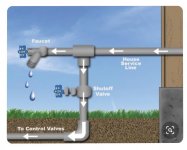
Here is how I made the connection at my house. Do some jurisdictions charge a connection fee of thousands of dollars to do something like this? After the shut off valve, I put in the anti siphon solenoid valves then the pressure regulators.

Stingry is right...it’s not hard. For me, the hardest work by far was the trenching.
 

Attachments

  • 8FF4FD69-3FCE-4B98-9285-43CB57D9BE93.jpg
    8FF4FD69-3FCE-4B98-9285-43CB57D9BE93.jpg
    63.2 KB · Views: 94
Last edited:
OP
Y

younghandyman

Well-known member
Joined
Dec 18, 2017
Messages
87
Just install an adjustable pressure regulator upstream of the sillcock. You can adjust it to fine tune your system if need be If you are using drip irrigation as one of your zones, that zone will need to operate at a lower pressure. Put the pressure regulator for the drip zone in the valve box with its control valve.


Will reducing the pressure also reduce the flow rate?


Sent from my iPhone using Garage Journal
 

LS6 Tommy

Well-known member
Joined
Dec 27, 2013
Messages
26,162
Location
Northern NJ

Shiftless

Well-known member
Joined
Mar 9, 2014
Messages
14,558
Location
East Bay SFO
I don’t know how he did it, but for me, I put a 5 gallon bucket under the hose bib running full throttle and timed how long to fill up. That’s not precise, but it will give a good approximation.

That’s the maximum flow rate. Once pipes and sprinkler heads are hooked up you’ll get less. No way around that.
 

yeldogt

Well-known member
Joined
Jan 2, 2012
Messages
18,184
Rainbird/hunter/Toro ... they all of charts that have pressure and flow. You may need to reduce the pressure depending on the heads .... it's easy to figure out.
 

ALinCarolina

Well-known member
Joined
Dec 29, 2014
Messages
758
Location
NC Piedmont
Also, it depends on whether your heads are rotors or spray heads.
By spray heads I mean the skinny little popups that spray continually in different patterns. Over powering rotors is not that bad but over pressurizing spray heads will cause too much aerialization and waste of water being evaporated.
Spray heads put out a lot of water per sq ft per minute and need a shorter run time.
You also need to balance size of nozzles to match your total GPM and remember to vary the size of nozzles depending on degree of rotation. For instance, a 360 degree rotation needs a bigger nozzle than one that is only rotating 90 degrees.
 
To avoid these ads, REGISTER NOW!

stingry

Well-known member
Joined
Oct 14, 2006
Messages
732
Location
Western Nebraska
I don’t know how he did it, but for me, I put a 5 gallon bucket under the hose bib running full throttle and timed how long to fill up. That’s not precise, but it will give a good approximation.

That’s the maximum flow rate. Once pipes and sprinkler heads are hooked up you’ll get less. No way around that.

since the OP did not respond, I will comment on your method. Just filling a bucket from the faucet and timing it will only give you the flow rate to atmoshere. This is highly inaccurate and will lead to bad decisions on how many heads can be ran. To more accurately calculate the flowrate available at any given pressure something like this can be used.

View media item 104598
to use: attach to the faucet, turn on full, adjust the valve to get the pressure you want the heads to run at, measure the water flow by running into a 5 gallon bucket and timing how long it takes to fill the bucket. This will give you GPM at a certain pressure. Using this information, you can calculate how many heads you can run at that pressure.

In my opinion, this is the most important step in designing a sprinkler system. Get it wrong and you will end up with too many heads and poor performance or not use the optimal amount of heads, resulting more circuits than you need.

Hope this helps
 
OP
Y

younghandyman

Well-known member
Joined
Dec 18, 2017
Messages
87
I don’t know how he did it, but for me, I put a 5 gallon bucket under the hose bib running full throttle and timed how long to fill up. That’s not precise, but it will give a good approximation.

That’s the maximum flow rate. Once pipes and sprinkler heads are hooked up you’ll get less. No way around that.


I used a bucket. Now I have the flow rate and I'll have measured the static pressure by tonight, my understanding is that I just have to pick pipe sizes that will give a safe water velocity. The bigger the pipe, the lower the water velocity. I would also need a pressure regulator to reduce the pressure if it is too high.

If each sprinkler consumes three gallons per minute and my flow rate is 6, I can only put two per zone.


Sent from my iPhone using Garage Journal
 
OP
Y

younghandyman

Well-known member
Joined
Dec 18, 2017
Messages
87
Rainbird/hunter/Toro ... they all of charts that have pressure and flow. You may need to reduce the pressure depending on the heads .... it's easy to figure out.


Can heads operate at slightly lower psi than listed? As pressure drops after it goes through the first sprinkler in a line, will the second sprinkler have enough?


Sent from my iPhone using Garage Journal
 
OP
Y

younghandyman

Well-known member
Joined
Dec 18, 2017
Messages
87
That is excellent advice.
Here is how I made the connection at my house. Do some jurisdictions charge a connection fee of thousands of dollars to do something like this? After the shut off valve, I put in the anti siphon solenoid valves then the pressure regulators.

Stingry is right...it’s not hard. For me, the hardest work by far was the trenching.


I will likely put a T on the spigot itself, install the pressure regulator and anti siphon valve rather than run a separate pipe as that would involve calling a plumber. Only my spigot is sticking out in my backyard, everything else is in my basement which is being constructed at the moment and I don't want to touch anything there for inspection reasons.


Sent from my iPhone using Garage Journal
 

rlitman

Well-known member
Joined
Oct 18, 2010
Messages
24,642
Location
Long Island
That's a vacuum breaker, but code still requires a backflow preventer. I'm not sure if there's one made to screw onto a regular hose bibb/spigot.

Code depends on your location. In any case, so long as the vacuum breaker is at the highest point of the system, a vacuum breaker is sufficiently safe.
 
OP
Y

younghandyman

Well-known member
Joined
Dec 18, 2017
Messages
87
As I was reading about pressure, flow and water velocity, had one question. If reducing pipe size at a given static pressure does nothing but increase pressure loss due to friction and i crease water velocity to a potentially unsafe level, why use a smaller pipe at all? Sounds counter intuitive to me since as a DIY-er if you have a small space, it would just be easier to buy one size of pipe and use that instead?

Also, is the static pressure at my spigot/regulator the starting point for determining the dynamic pressure at the sprinklers? Would I subtract all the pressure losses per 100 ft of pipe plus any turns to arrive at the pressure available at my sprinklers?


Sent from my iPhone using Garage Journal
 

Shiftless

Well-known member
Joined
Mar 9, 2014
Messages
14,558
Location
East Bay SFO
Using a smaller pipe to save a few bucks is a bad idea. Pressure drop.
Most everybody uses 3/4 inch pipe for distribution and half inch for risers.

There are online calculators for determining pressure drop losses for different size pipes at given flow rates.

Stingry:
Your set up is much better for figuring out flow rate for designing systems. As I said in my post, the bucket under the spigot is the maximum flow rate and once pipe and heads are hooked up, the flow rate will be less. How much less depends on several variables.
 
Last edited:

stingry

Well-known member
Joined
Oct 14, 2006
Messages
732
Location
Western Nebraska
Using a smaller pipe to save a few pennies is a bad idea. Pressure drop.
Most everybody uses 3/4 inch pipe for distribution and half inch for risers

To the OP

Do this and you will be fine. Don’t worry about friction loss in the piping, it is neglishable. Once you determine a flow rate in gpm at a certain pressure, you can then choose your sprinkler heads. Let’s say you have 6 gpm at 40 psi, then you can look at the specs for the head you want to use. From the specs, you can determine the gpm and spray radius for the head. If it requires 3 gpm, then you are correct in needing two heads.
 
OP
Y

younghandyman

Well-known member
Joined
Dec 18, 2017
Messages
87
since the OP did not respond, I will comment on your method. Just filling a bucket from the faucet and timing it will only give you the flow rate to atmoshere. This is highly inaccurate and will lead to bad decisions on how many heads can be ran. To more accurately calculate the flowrate available at any given pressure something like this can be used.


View media item 104598


to use: attach to the faucet, turn on full, adjust the valve to get the pressure you want the heads to run at, measure the water flow by running into a 5 gallon bucket and timing how long it takes to fill the bucket. This will give you GPM at a certain pressure. Using this information, you can calculate how many heads you can run at that pressure.


In my opinion, this is the most important step in designing a sprinkler system. Get it wrong and you will end up with too many heads and poor performance or not use the optimal amount of heads, resulting more circuits than you need.


Hope this helps


Thanks! I will use this method.


Sent from my iPhone using Garage Journal
 
OP
Y

younghandyman

Well-known member
Joined
Dec 18, 2017
Messages
87
To the OP


Do this and you will be fine. Don’t worry about friction loss in the piping, it is neglishable. Once you determine a flow rate in gpm at a certain pressure, you can then choose your sprinkler heads. Let’s say you have 6 gpm at 40 psi, then you can look at the specs for the head you want to use. From the specs, you can determine the gpm and spray radius for the head. If it requires 3 gpm, then you are correct in needing two heads.


Perfect! Thank you. [emoji4] Now I just need to test my flow at the pressure the heads will need to operate.


Sent from my iPhone using Garage Journal
 

stingry

Well-known member
Joined
Oct 14, 2006
Messages
732
Location
Western Nebraska
I will likely put a T on the spigot itself, install the pressure regulator and anti siphon valve rather than run a separate pipe as that would involve calling a plumber. Only my spigot is sticking out in my backyard, everything else is in my basement which is being constructed at the moment and I don't want to touch anything there for inspection reasons.


Sent from my iPhone using Garage Journal

How big is your yard? Do you intend on using electric valves and a manifold? If you are going to have several circuits and electric valves, I would highly suggest that at this point you have your plumber tap into your main line coming into the house for your sprinkler system. This would give you much more flow than is available from the spigot.
 

Shiftless

Well-known member
Joined
Mar 9, 2014
Messages
14,558
Location
East Bay SFO
“ Don’t worry about friction loss in the piping, it is negligible”

This might not be correct.

Water flowing through pipe at a fast rate has significant friction.

I looked up pressure loss for half inch and 3/4 inch pvc schedule 40 pipe.

I used the online calculator from Engineering Toolbox.

Pardon me for going a bit nerdy on this subject but once you glue up and bury the pipes, it’s not easy to upsize pipes.

I assumed 10 gal/minute flow and didn’t add anything for fittings which further restrict flow.

For 100 feet of 1/2 inch pipe, with water flowing at 10 gal/min. the pressure drop would be 35.5 Psi

For 100 feet of 3/4 inch pipe, the pressure drop is much less...6.3 psi.

And the velocity of the water in the half inch would be 11.3 ft/sec
In the 3/4 it would be 6.3 ft./sec which is only a bit past the recommended design max of 5 ft./sec.
 
Last edited:

stingry

Well-known member
Joined
Oct 14, 2006
Messages
732
Location
Western Nebraska
“ Don’t worry about friction loss in the piping, it is negligible”

This might not be correct.

Water flowing through pipe at a fast rate has significant friction.

I looked up pressure loss for half inch and 3/4 inch pvc schedule 40 pipe.

I used the online calculator from Engineering Toolbox.

Pardon me for going a bit nerdy on this subject but once you glue up and bury the pipes, it’s not easy to upsize pipes.

I assumed 10 gal/minute flow and didn’t add anything for fittings which further restrict flow.

For 100 feet of 1/2 inch pipe, with water flowing at 10 gal/min. the pressure drop would be 35.5 Psi

For 100 feet of 3/4 inch pipe, the pressure drop is much less...6.3 psi.

And the velocity of the water in the half inch would be 11.3 ft/sec
In the 3/4 it would be 6.3 ft./sec which is only a bit past the recommended design max of 5 ft./sec.

Perhaps I should have been more clear. Friction loss is real and needs to be considered but what I meant was that it’s negligible because a properly designed system makes it so. That’s why we use 3/4 line and if making really long runs, 1” line.
 

Shiftless

Well-known member
Joined
Mar 9, 2014
Messages
14,558
Location
East Bay SFO
It’s good that you clarified your first statement. Neither one of us wants a less experienced person to get the wrong idea and install pipe of the wrong size.
 

Attachments

  • B66002BC-FF57-423F-9889-C0C20BE39F84.jpg
    B66002BC-FF57-423F-9889-C0C20BE39F84.jpg
    41.1 KB · Views: 12

LS6 Tommy

Well-known member
Joined
Dec 27, 2013
Messages
26,162
Location
Northern NJ
Code depends on your location. In any case, so long as the vacuum breaker is at the highest point of the system, a vacuum breaker is sufficiently safe.

Irrigation sprinklers fall under IPC, which is the standard nationwide. Yes, I know local AHJs don't have to adopt it, but I've never seen one that didn't. Again, I'm just throwing it out there, I'm not trying to judge the OP.


Tommy
 
Last edited:
OP
Y

younghandyman

Well-known member
Joined
Dec 18, 2017
Messages
87
How big is your yard? Do you intend on using electric valves and a manifold? If you are going to have several circuits and electric valves, I would highly suggest that at this point you have your plumber tap into your main line coming into the house for your sprinkler system. This would give you much more flow than is available from the spigot.


Still deciding whether or not to do it this way, or just have a quick disconnect hose at the spigot that will power the different zones and turn it on/off manually.


Sent from my iPhone using Garage Journal
 
OP
Y

younghandyman

Well-known member
Joined
Dec 18, 2017
Messages
87
Measured the water pressure today, it's 90 psi of static pressure. I would have to use a pressure regulator to drop the pressure down to whatever the sprinkler heads need, and then remeasure the flow rate at the pressure to get an accurate measurement of how many sprinklers I can have on each zone.

I'm looking at Orbit sprinklers, are the GPM requirements on that sprinkler in US or imperial gallons?

Now I'd have to pick the right pipe size that wouldn't cause the flow velocity to exceed safe amounts.

The water pressure regulators at home depot are expensive!


Sent from my iPhone using Garage Journal
 

rlitman

Well-known member
Joined
Oct 18, 2010
Messages
24,642
Location
Long Island
Measured the water pressure today, it's 90 psi of static pressure. I would have to use a pressure regulator to drop the pressure down to whatever the sprinkler heads need, and then remeasure the flow rate at the pressure to get an accurate measurement of how many sprinklers I can have on each zone...

What? No.

Only the valves and plumbing upstream of them see the static pressure. The pressure drop from 90 to the heads should be sufficiently safe, so long as you have enough heads on each zone and a good plumbing design.
 
OP
Y

younghandyman

Well-known member
Joined
Dec 18, 2017
Messages
87
What? No.

Only the valves and plumbing upstream of them see the static pressure. The pressure drop from 90 to the heads should be sufficiently safe, so long as you have enough heads on each zone and a good plumbing design.


So if I understand correctly, I start at 90 psi, and calculate all the pressure losses through the system to the sprinkler heads based on the pressure loss tables. If my calculated pressure at the heads is still too high, then I would need a regulator, otherwise I can just plumb it as is without a regulator.


Sent from my iPhone using Garage Journal
 
To avoid these ads, REGISTER NOW!
Top Bottom