

You are using an out of date browser. It may not display this or other websites correctly.
You should upgrade or use an alternative browser.
You should upgrade or use an alternative browser.
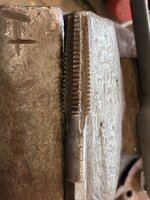
Unfamiliar tap and die markings.
- Thread starter Hal
- Start date


RTM
Well-known member
The Wells brothers catalogs may help. Quick glance didn’t turn anything up
Guess Answer below
I remember hearing of an “over” tap, where it was for repairing a buggered hole, so it might be a 5/8-11 tap, but 1/32 larger diameter. Not sure if you bought an over bolt after using that. Part of why they made adjustable dies, to fix a shaft.

I remember hearing of an “over” tap, where it was for repairing a buggered hole, so it might be a 5/8-11 tap, but 1/32 larger diameter. Not sure if you bought an over bolt after using that. Part of why they made adjustable dies, to fix a shaft.
Last edited:
Stubby1743
Well-known member
I've never seen a tap marked like that but could the 1/32 be the thread pitch?
RoninB4
Well-known member
-There are over-sized taps. They're used to compensate for coatings, hardening of material, chrome/zinc applications, etc. They're designated with GH numbers from 1-7 in specific intervals of basic size + the oversized amount. The largest I've worked with is GH-7, which is .003-.0035 above basic size. There are supposed to be specially made taps that go above GH-7 but I've never heard of one that's 1/32 larger than basic size. Is it possible? I suppose so as there's always been a market for special taps and thread forms but it's an application I've never run into and question why a coating would need to be that thick.
-Check the thread pitch (threads per inch) to see if it's even a standard for that diameter.
-Check the thread pitch (threads per inch) to see if it's even a standard for that diameter.
I suspected they were oversized they are all standard pitch for the sizes. What puzzles me is that a general repair shop would have a complete set of oversizes. They were in a wooden box, with a die stock, but no tap handle.
Also in the box, completely unrelated, were a set of Budd wheel wrenches, and a badly abused 3/4 drive slide handle.
Also in the box, completely unrelated, were a set of Budd wheel wrenches, and a badly abused 3/4 drive slide handle.
1/32 would be 32 threads per inch. Marking says 5/8, 1/32, 11. So 5/8x 11. Standard pitch, checked with a gage.I've never seen a tap marked like that but could the 1/32 be the thread pitch?
RoninB4
Well-known member
-You still haven't mentioned measuring the OD of the tap to confirm/deny the alleged oversize by 1/32.1/32 would be 32 threads per inch. Marking says 5/8, 1/32, 11. So 5/8x 11. Standard pitch, checked with a gage.
OccupantRJ
Well-known member
Hell, I machined for 30 years and thought 1/2-12, 5/16-27, and .767-27 were already odd enough.
When I posted this, it hadn’t occurred to me to check the OD. I haven’t been back to the shop since. I will check later this morning a and post back.-You still haven't mentioned measuring the OD of the tap to confirm/deny the alleged oversize by 1/32.
That’s what I thought at first, but the thread pitches don’t match any pipe thread that I know of.Looks like a pipe tap.
rustyzman
Well-known member
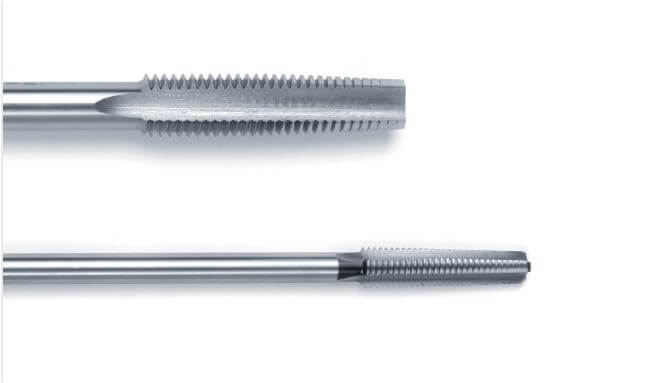
The profile of that tap looks like a Nut Tap. Long tapered lead in for production tap threading of nuts. Very low torque thread cutting because of that long lead in taper.
 threadingtoolsguide.com
1/32 might be the diameter change from full thread depth to the start of the thread on that tap. That looks much too coarse to be a thread pitch for that tap, assuming that it is 5/8 diameter. The pitch looks closer to .100" or 1/10.
Now for some clarity, according to a little research here, that is a Very Old tap.
Wells Brothers & Co. was incorporated in 1879.
That changed to Wells Brothers Co. in 1888.
That tap is older than 1888 and newer than 1879.
That very much pre-dates the Unified Thread system (UNC, UNF, UNS, etc.)
5/8-10 is no longer a standard thread in the Unified Standard. That size and tap was from the days of everyone making whatever they felt was correct for the application.
A quick measurement of the OD at the thickest portion and at the very end will probably say a lot.
What exactly is a nut tap? threadingtools Guide
What a nut tap? ✅ When is it used? ✅ Nut taps are used to produce nuts with ISO standard metric threads ✅ Nut taps have a very long lead-in (2/3 of the thread length) ✅ are used for thread depths up to 1.5 x nominal diameter in short through holes ✅
threadingtoolsguide.com
1/32 might be the diameter change from full thread depth to the start of the thread on that tap. That looks much too coarse to be a thread pitch for that tap, assuming that it is 5/8 diameter. The pitch looks closer to .100" or 1/10.
Now for some clarity, according to a little research here, that is a Very Old tap.
Wells Brothers & Co. was incorporated in 1879.
That changed to Wells Brothers Co. in 1888.
That tap is older than 1888 and newer than 1879.
That very much pre-dates the Unified Thread system (UNC, UNF, UNS, etc.)
5/8-10 is no longer a standard thread in the Unified Standard. That size and tap was from the days of everyone making whatever they felt was correct for the application.
A quick measurement of the OD at the thickest portion and at the very end will probably say a lot.
RTM
Well-known member
Winner winnerThe profile of that tap looks like a Nut Tap. Long tapered lead in for production tap threading of nuts. Very low torque thread cutting because of that long lead in taper.
The 1889 Catalog shows these


I thought it said 10 at the top of your photo?Marking says 5/8, 1/32, 11. So 5/8x 11. Standard pitch,
5/8 1/32 10 is what my eyes see.
rustyzman
Well-known member
Interesting with the oversize. That is Seriously over sized at 1/32". I could see that if a nut was meant to be hot dip galvanized, perhaps.