To avoid these ads, REGISTER NOW!

Unknown Machinists Devise. Never Seen Anything Like It.

PeterPeter

Well-known member
Joined
Apr 30, 2019
Messages
176
Location
Newburyport
This week I went on a wild goose chase for a couple of jumbled boxes of wrenches priced at $100 (big Williams combos, SuperAdjustables, etc) I had been trying to purchase for five days. Finally, nailed down a time/place, and drove over an hour after messaging my ETA. All good, right? Nope. Much to my dismay, this message came up when I pulled into the parking lot of a large, 19th century mill complex:

”Ok, it’s a mix of tools at this point just to be clear, it may not be exactly what’s pictured but you can go through and make a pile of what’s there”

*Sigh*

Nothing of any particular significance was left.

So, in a desperate effort to make some lemonade, (and to quell my burning desire to throttle the PO) I dropped a double sawbuck on this curious devise:

IMG_2058.jpegNicely built, oaken locked box with key.
IMG_1581.jpegHmm. Interesting.
IMG_1580.jpegWell, no calibration needed, that’s nice
IMG_1578.jpeg
Justwhattheheckisit?
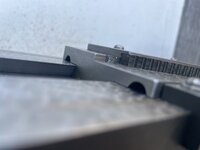
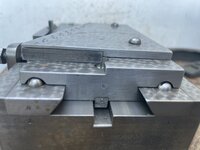
Beautiful machining, heavy cast box, smooth, freely adjustable carriage on a dovetail way. A purpose built machine with no discernible markings, and no discernible use. Here’s some details:
IMG_2052.jpegIMG_2053.jpegIMG_2054.jpegIMG_2057.jpegIMG_1588.jpegIMG_1587.jpeg

I always believed in the old saw, ‘when you see something you’ve never seen before, and you like it, buy it.’ So, how did I do? What will I do with it? Lemonade, or lemon?


Peter, Peter, lemon eater?
 
To avoid these ads, REGISTER NOW!

RoninB4

Well-known member
Joined
Jul 22, 2020
Messages
3,489
Location
Under My House
-A rather curious item you have there. The construction clearly shows a lot of effort and machining that went into the design/execution. Dovetails, engine turning on flat surfaces, and overall appearance suggests a level of precision used as a setting gauge for a particular machine. But the presence of fractional markings (instead of decimal notation) in 1/16 divisions, and the screws (round head/flat blade screwdriver) aren't what would be commonly used in machine tooling. It's a curious mix of attention to details and poor choices in fasteners. If it was a rough setting gauge then why the rack-and-pinion drive for the sliding portion? Parts of it appear to be from low carbon cold rolled steel (CRS) but there appears to be (can't tell from the photos) ground setting surfaces. I've been a toolmaker (retired) for over 40 years, seen a lot of things left over from the last century. I can even determine what something was used for even if I've never used it, purpose built speaks to function. This one can't be laid on either side as a height setting gauge. This one stumps me. It sorta has the look of something made by an older toolmaker that worked in some factory where they wanted a setting gauge so he made one. You being in Mass. means it could have been from any number of manufacturing operations. No name also suggests it was shop made.
 
Last edited:

RoninB4

Well-known member
Joined
Jul 22, 2020
Messages
3,489
Location
Under My House
Engine turning or hand scraped?
-Zoom in on the next-to-the-last photo and it looks like fully circular marks, that would be engine turning. Nothing seen on the dovetails where hand scraping would be present, ball end mill marks used near the gear rack. Hand scraping has tell-tale marks that are different with each person, Nike logo being common. Circular marks are almost always engine turning, can't really produce circular marks with hand scraping just by the tool/technique that's used. Perhaps I'm wrong and you could educate me?
 

neophyte

Well-known member
Joined
Apr 23, 2012
Messages
9,571
Location
Pennsylvannia
-A rather curious item you have there. The construction clearly shows a lot of effort and machining that went into the design/execution. Dovetails, engine turning on flat surfaces, and overall appearance suggests a level of precision used as a setting gauge for a particular machine. But the presence of fractional markings (instead of decimal notation) in 1/16 divisions, and the screws (round head/flat blade screwdriver) aren't what would be commonly used in machine tooling. It's a curious mix of attention to details and poor choices in fasteners. If it was a rough setting gauge then why the rack-and-pinion drive for the sliding portion? Parts of it appear to be from low carbon cold rolled steel (CRS) but there appears to be (can't tell from the photos) ground setting surfaces. I've been a toolmaker (retired) for over 40 years, seen a lot of things left over from the last century. I can even determine what something was used for even if I've never used it, purpose built speaks to function. This one can't be laid on either side as a height setting gauge. This one stumps me. I sorta has the look of something made by an older toolmaker that worked in some factory where they wanted a setting gauge so he made one. You being in Mass. means it could have been from any number of manufacturing operations. No name also suggests it was shop made.
Fractional graduation would might be used for setting up machinery for producing items sized in fractions.
 
OP
P

PeterPeter

Well-known member
Joined
Apr 30, 2019
Messages
176
Location
Newburyport
-A rather curious item you have there. The construction clearly shows a lot of effort and machining that went into the design/execution. Dovetails, engine turning on flat surfaces, and overall appearance suggests a level of precision used as a setting gauge for a particular machine. But the presence of fractional markings (instead of decimal notation) in 1/16 divisions, and the screws (round head/flat blade screwdriver) aren't what would be commonly used in machine tooling. It's a curious mix of attention to details and poor choices in fasteners. If it was a rough setting gauge then why the rack-and-pinion drive for the sliding portion? Parts of it appear to be from low carbon cold rolled steel (CRS) but there appears to be (can't tell from the photos) ground setting surfaces. I've been a toolmaker (retired) for over 40 years, seen a lot of things left over from the last century. I can even determine what something was used for even if I've never used it, purpose built speaks to function. This one can't be laid on either side as a height setting gauge. This one stumps me. I sorta has the look of something made by an older toolmaker that worked in some factory where they wanted a setting gauge so he made one. You being in Mass. means it could have been from any number of manufacturing operations. No name also suggests it was shop made.
The custom locked box, and Calibration Not Required sticker seems commercially produced. I mean, if it was shop made, why would either be necessary?
 

RoninB4

Well-known member
Joined
Jul 22, 2020
Messages
3,489
Location
Under My House
Fractional graduation would might be used for setting up machinery for producing items sized in fractions.
-That had come to mind when I considered the purpose but I mentioned fractional notation more as a contrast to the rest of the build features. Besides dimensional lumber there's not much that I can think of that uses fractional notation in manufacturing. Before somebody suggests dry wall, plywood, piping, or other construction products it should be noted that fractions are only used on the consumer/advertising end as a grouping. The actual numbers used during the manufacturing process are in decimal notation unless somebody can provide an example I haven't thought of.

-Can't see this being used for dimensional lumber either as the range of 1/8 to 1-7/16 in 1/16 increments doesn't seem very useful either. Since I can't positively identify this object I may not know what I'm talking about either.
 

RoninB4

Well-known member
Joined
Jul 22, 2020
Messages
3,489
Location
Under My House
The custom locked box, and Calibration Not Required sticker seems commercially produced. I mean, if it was shop made, why would either be necessary?
-Speculation here: The box looks like it may be older than the object and could have been a re-purposed item from something else. The lock may have been added, careful examination under magnification might reveal some clues if you know what to look for. The sticker may have been available during a quality certification program like QS 9000. Stickers like that were readily available during the trials for certification.
 

YesIHaveAHammer

Well-known member
Joined
Jun 1, 2025
Messages
796
I'll make some amateur observations, might trigger some further thoughts by others.

Has a box, so maybe for occasional use?

Few loose bits in the box bottom left.

Just one mounting hole and no adjustment or way to set zero.

Open bottom, probably laid on flat surface.

Two screws on the small sliding part with the tab appear to be for calibration. So the sticker maybe saying this is calibrated already and the user shouldn't need to.

There doesn't appear to be a way of attaching a tool to it, so perhaps purely a measurement device. But then why have a hand wheel. It could be some kind of pusher or stopper that contacts another component of the machine.

Measurement is at zero when the carriage is wound all the way to the right/down.

The movement range of the carriage is much larger than the range of the measurement scale.

Bolted clamp on the right could be for clamping the carriage in a fixed position, once the measurement has been set by placing an item (like the screw pictured) in between the scale and the raised tab.
 

AEAdam

Well-known member
Joined
May 27, 2023
Messages
2,729
Location
SE PA
Not an expert, and just guessing: I think it’s a tool for a grinder. Looks like the dial on the side moves the carriage back and forth across that rack (guessing the dial is the pinion) and due to the taper that translates that move into a precise side to side movement.

The markings are what have me puzzled. I feel like something is held against each of those saw teeth marked with blue dykem. The piece’s other end is machined, maybe with a tooth? Then the carriage is moved and the piece relocated for another tooth/feature.

You wouldn’t need the markings if it was just a precision y axis or tapering jig.

Could be instead of teeth, it’s engraving 1/16” markings in some sort of ruler or scale. That makes sense to me. It’s not for grinding but some sort of engraver.

Now we have to figure out what sort of tool is only marked to 1-7/16”. Maybe it’s for something like die makers square or some fine adjustment scale like on a jewelers lathe.
 

WWheeler

Well-known member
Joined
Jun 23, 2015
Messages
4,105
Location
Middleofnowhere USA
I would post this over on practicalmachinist.com, in the antique tools section.

+1 on this. It's got me curious.

-To the OP: If you do submit a photo to Practical Machinist could you post the replies or a link to them when you do get an answer? Would appreciate it.


I found it, and looks like it has them stumped so far also ...


I LUV this first reply there ...

That's really cool, probably the nicest one I've seen in 50 years. It's also the only one I've seen, and I don't have a clue what it was used for!

LOL! I'm hopeful someone figures it out.
 
To avoid these ads, REGISTER NOW!

YesIHaveAHammer

Well-known member
Joined
Jun 1, 2025
Messages
796
Key piece of information the OP included in their practical machinist post:

The machine was secured to the box, and not easily removed, and so I assume it was meant to be used secured in the box.

Supporting that, the left hand bottom side of the box is dropped, presumably to give access to the wheel.
 

Nutria

Well-known member
Joined
Jun 23, 2015
Messages
797
Location
Eastern Sierra
Fascinating. Beautiful machining and construction. And no one has said, "saw set."
 
Last edited:

AEAdam

Well-known member
Joined
May 27, 2023
Messages
2,729
Location
SE PA
Where did you buy it? Any chance this is from Athol MA? This could be older than it looks. The box and sticker suggests this was not just some random shop made tooling. If I’m close, this would likely be something from a factory like Starrett, or Brown and Sharp, or one of the countless others in New England.

Again, the linear movement of the diall/hand wheel produces a very accurate step in the y axis, like an indexer. This is something no manual and mill or grinder can do on their own.

I think the reason for the markings is that each of the lines engraved would be different lengths based on the setting. So the machinist would need to know the difference between a 1/16th hash mark, and an 1/8, 1/4, 1/2.

What does it say on the key fob? I can’t quite make it out.
 
Last edited:

gho100

Well-known member
Joined
Feb 27, 2014
Messages
74
Could it be an accessory tool for a metal lathe? Maybe something like a watchmakers lathe?
 

YesIHaveAHammer

Well-known member
Joined
Jun 1, 2025
Messages
796
Further observations:

The teeth are not square. So it does not convert measurement/movement 1:1 from the X and Y axis.

The component parts of the dovetail are marked with numbers (seen in the end-on photo). Suggests not a one-off, as does the custom designed box.

The bolt is only part threaded, so no. Might be an attachment point for some other tool or accessory.
There's a recess on the inner side of the bracket. It could be used to attach this device as an accessory to a larger machine. Presumably temporarily given we now know this thing lived in its wooden box permanently.
 
Last edited:

BCreekDave

Well-known member
Joined
Dec 17, 2015
Messages
206
Location
Dayton, OH
Perhaps a device for setting a large artillery piece, like a range finder or something. Used in conjunction with a scaling table or something.
 

RoninB4

Well-known member
Joined
Jul 22, 2020
Messages
3,489
Location
Under My House
The company still exists - ask them? https://www.whbagshaw.com/contact-us/

The machines and processes will have evolved, but their knowledge of making pins probably stands them with a better chance than anyone.
+1 on contacting the company and include photos in the e-mail. If they were the only tenant in the old building then they might be best qualified source to know what it was for. Although anybody that used it retired a long time ago I can see it tweaking the curiosity of some current employees or management. Also agree that they may want to buy it back to display in their lobby, lots of companies like to do stuff like that.
 
OP
P

PeterPeter

Well-known member
Joined
Apr 30, 2019
Messages
176
Location
Newburyport
The company still exists - ask them? https://www.whbagshaw.com/contact-us/

The machines and processes will have evolved, but their knowledge of making pins probably stands them with a better chance than anyone.
I did buy it from the company, but the person who sold it to me didn’t know anything about it. If you go through the site, you’ll see it is still owned by a Bagshaw, so there is a chance they’ll know.
 
To avoid these ads, REGISTER NOW!
Top Bottom