30-30remchester
Well-known member
- Joined
- Aug 20, 2011
- Messages
- 251
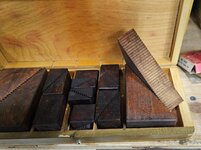
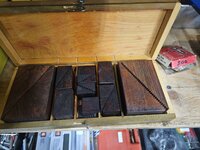
Saw these at the local Re-Sore. Made of wood. Haven't a clue what these are used for. Guesses?


-Just a WAG but if you needed to clamp a nice piece of wood to the machine table would you want to use metal ones to contact it? I'd prefer the clamp was made from wood so there's less chance of marks/dents. Sure a standard metal type would do if you used a protective shim but some production cabinet shops (old traditional ones) might have preferred these. I've never seen a set either so that's just my speculation. They're unique, useless to me, but still interesting.Why in the world would a person need wooden step blocks?
Wouldn't these be used more like a set of adjustable parallels, seems like the two outside pairs (in the eBay ad) are 3W. So each would be resting on multiple teeth as you set a height, up to a certain height. ETA: There are 4 pairs of 2W, can’t see the rest in the ebay ad. In the OP pic, looks like the 4 small ones are all the same also.Without the matching serrations on the end of the clamp itself, these are just risers, you'd be resting on just one tooth and that would probably break off under pressure.
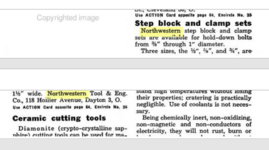
-Yes they can be used that way and the metal versions often are in machine shops. What I was trying to explain, without going into too much splainin, is that they're far more fragile than even a cheap Chinese metal version. The wooden ones in the OP photo are nice but they're only the step blocks for $20, still needing the clamp, center stud, and nut. There's plenty of new full sets made from metal going for under $50 with free shipping. A used set would even be considerably less. The wooden step blocks may even have cracks in them, if they're 60 years old, that could compromise structural integrity. I think they're pretty cool but I wouldn't want to use them before checking integrity and how rare they might be. They may not be worth much (very likely) but it would bother me to ruin one of the few surviving examples.Wouldn't these be used more like a set of adjustable parallels, seems like the two outside pairs (in the eBay ad) are 3W. So each would be resting on multiple teeth as you set a height, up to a certain height.
-Yep that would allow them to be used as you described. Would like to congratulate you on seeing the possibility of the design.ETA: There are 4 pairs of 2W, can’t see the rest in the ebay ad. In the OP pic, looks like the 4 small ones are all the same also.
-Since I've not seen another set I can't say for certain but I can't imagine them being used on anything other than a flat surface for clamping whether it's on a bench or machine. If you do find another application I'd be interested in seeing it. I'm fully confident that I don't know everything I probably should.I have not taken the time to look up the name in vintage literature to see how they might be been used, but as WW tools, maybe not for machines.
Suggest: "Wooden Machinist's Step Blocks?"What an informative thread title!
It would be great if one were to edit and revise it to help other members in search of similar information in the future.
^ I've sent the OP a note and requested they update the thread title in order that users in the future will be able to find it with a Google search. Otherwise this sort of information is lost to obscurity.What an informative thread title!
It would be great if one were to edit and revise it to help other members in search of similar information in the future.
When has that excuse prevented most of us from buying something as cool as that old set?Dang that was fast "mngundog". They are asking $20 for the set. I sure don't have any use for them.

Suggest: "Wooden Machinist's Step Blocks?"
I hear you loud and clear.If you have ever seen an oil rig drilling two miles deep, I can and have operated such machinery. However, can't for the life of me figure out how to post link, type with more than one finger, or get an email on my phone. Just learned how to post pictures. By next century I should know how to access my voicemails.