To avoid these ads, REGISTER NOW!

Upgrading 1950s house electrical and installing sub panel in detached garage

knobby97

Member
Joined
Jan 3, 2013
Messages
11
Location
San Antonio, TX
Well I recently moved from SC to TX, and bought a home that was built in 1951 and has a detached 2 car garage about 30 feet from the main structure.

The house still has 3 phase run from the pole, even after I had the electric company change out the lines from the pole due to a bad neutral and unbalanced 120v legs. The wiring in the house was a nightmare, which I have slowly been chipping away at. Originally the mains from the meter ran into a wire gutter, where it was spliced and going to 3 panels and 2 disconnects. The house was wired with 12 awg copper with no ground. The original panel had been replaced with a 16 mini slot, main lug, GE panel. Who ever installed the panel ran it from an old 60A 3 phase disconnect box, with no high leg, and then ran 4 awg to power the panel. There were also 2 other sub panels installed on the side of the house, next to the gutter and meter, that have breakers for the pool, dryer, disposal/dishwasher, range, microwave, and an enclosed porch. There was also another old 3 phase disconnect that was powering the outside unit for the HVAC, that was wired off the 220v leg, 1 120v leg, and a neutral. Not sure why it was hooked up this way, but have since corrected it with 2 legs of 120v and a neutral. The best part is how the entire garage is run off of the kitchen lighting circuit, which is 12/2 with no ground that someone decided to put a 30a breaker on it.

I have since removed the splices in the electrical gutter, the 2 3 phase disconnects, 1 sub panel, and installed a 200a main panel next to the meter, and upgraded the wiring from the meter to the panel with #3 stranded copper. I left the 220v leg disconnect at the meter, as I don't any point to running 208v single phase to anything at the moment. The main panel currently has one old grounding rod installed and is also grounded to the cold water pipes.

So enough back ground, here is my current plan:

Everything will be moved into the 200a panel, which will feed the sub panel in the house off of a 60a breaker and another 60a sub panel to the garage.

A second copper grounding rod will be added to the main panel via 6 awg solid copper.

The wiring to the in home sub panel will be changed to 6/2 NM-B. From my understanding I will not need to run a separate ground to the in home sub panel, since the main panel is bonded and the sub panel is in the same structure.

The garage sub panel will be run with 3 x 6 awg stranded THHN and 1 x 10 awg stranded THHN for the ground. This will all be run in buried 1.25 conduit. The garage panel will not be bonded and will have its own 2 copper grounding rods on the separate bar for the grounds. The garage panel will have a 60a main disconnect (as well as the main panel), and will power 1 220v 30a plug (6 awg), 1 110v 30a plug (10 awg), interior lighting circuit (12 awg), interior outlet circuit (12 awg), exterior lighting circuit (12 awg), and one dedicated 20a circuit for a fridge (12 awg).

I'm also about 3/4 the way complete with grounding all of the main home outlets back to the interior sub panel. Just used green jacketed 12 awg solid for all of the grounding.

Here are my questions:

Am I missing anything above?

Is there anything I can do with the single phase 220v leg? Could I use it and the neutral to get 208v single phase to power a ductless mini HVAC system?

Is running 6/2 to the interior sub panel ok, or do I need 6/3? I hoping 6/2 is fine as I already have 125 ft of it.

Any other concerns or things to look out for in older home wiring?

Any help is greatly appreciated.
 
To avoid these ads, REGISTER NOW!

Mustang51js

Well-known member
Joined
Jan 24, 2014
Messages
1,734
Location
Haskell nj
You need a 6/3 romex because in your sub panel you have to separate the ground and nuetrals, same thing with your garage sub panel,you have to take out the bonding screw for both panels. The ac will work with the 220v with out any issues. Pipe needs to be at least 18 inches in the ground. And the #6 for the ground rods is supposed to be a continuos wire from the panel to both rods without any breaks,so you may need to do your main panel ground wire over if you are adding a ground rod. A lot of places are adding intersytem bonding connections which is just a ground bar that gets mounted outside on the ground rod wire coming down your house and it's for the phone company and cable company to run their grounds to.
 

ddawg16

Well-known member
Joined
Jul 11, 2008
Messages
21,005
Location
S. California
3ph? Are you sure? It is extremely rare to see 3ph to residential.

On those disconnects....was it possible it was actually 240Vac and they were using a 3ph disconnect to break the 2 120Vac lines AND the neutral?

A 3ph load center is pretty obvious....

Can you post pics?
 

theoldwizard1

Well-known member
Joined
Feb 22, 2011
Messages
43,198
Location
SE MI
3ph? Are you sure? It is extremely rare to see 3ph to residential.

On those disconnects....was it possible it was actually 240Vac and they were using a 3ph disconnect to break the 2 120Vac lines AND the neutral?

A 3ph load center is pretty obvious....

Can you post pics?

If you can see the bus bars !
 
OP
K

knobby97

Member
Joined
Jan 3, 2013
Messages
11
Location
San Antonio, TX
I'm sure it's 3 phase from the pole. Here's the recently changed out new wire to the house that the power company put in. I asked if they could remove the 3 phase wire and put in regular single phase, but they stated that they couldn't due to my house being in the historic district.

IMG_0922_zpse831083c.jpg


Here's the meter:

IMG_0923_zps185b1301.jpg


IMG_0924_zps20cbaa82.jpg


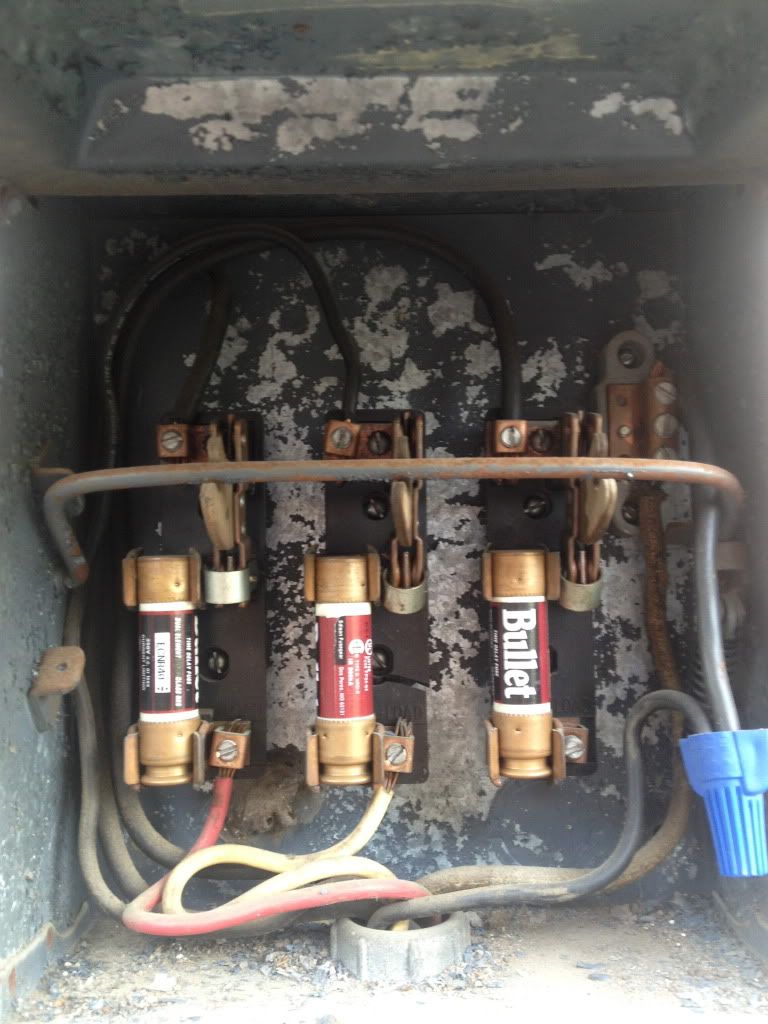
This is the old 3 phase disconnect that was running a single phase 220v leg, 120v leg, and a neutral to power the outside HVAC unit:

IMG_0620_zps6ff9968f.jpg


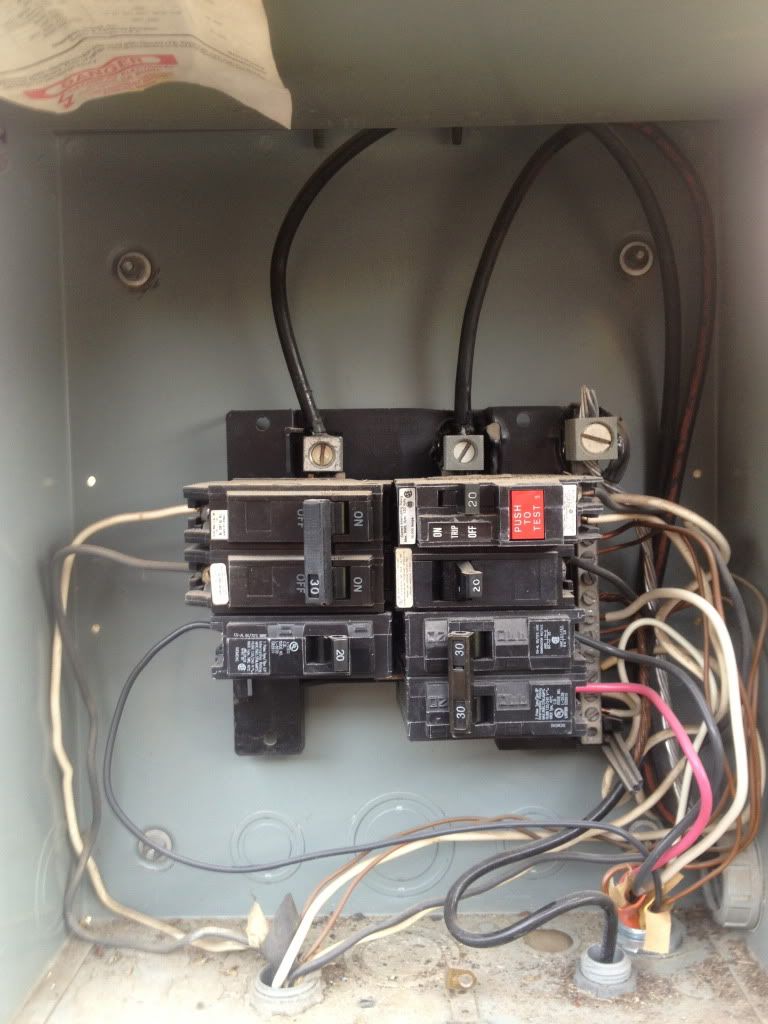
Here are the 2 original exterior sub panels that were on the house when I bought it. One sub panel was run from the other one, and fed by AL wire.

IMG_0617_zps4fa6bb3d.jpg


IMG_0618_zpsf06ee66c.jpg


The AL wire used to power this sub was obviously too small for the 50 amp breaker that was powering it.

IMG_0616_zps334d71ff.jpg


IMG_0624_zps44c44024.jpg


This panel was removed and the majority of the breakers were moved into the new 200a panel.

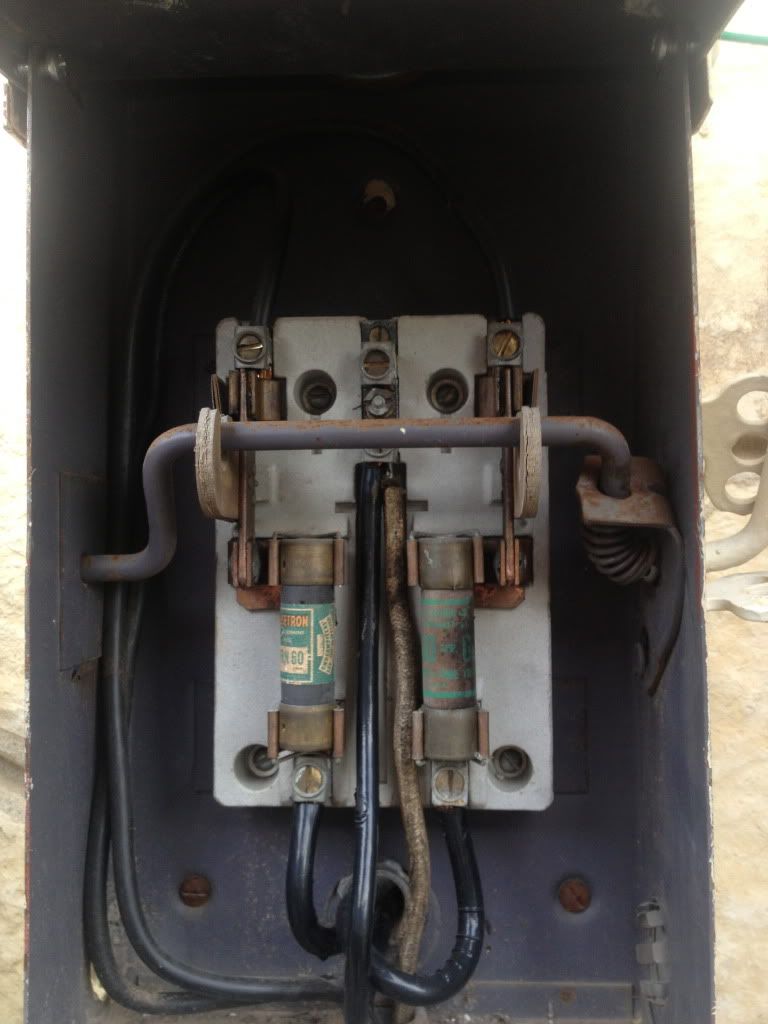
I was incorrect on the original disconnect feeding the interior panel, as it is single phase:

IMG_0621_zps05630d48.jpg


This disconnect was also removed and the breaker was moved to the 200a panel.
 
OP
K

knobby97

Member
Joined
Jan 3, 2013
Messages
11
Location
San Antonio, TX
You need a 6/3 romex because in your sub panel you have to separate the ground and nuetrals, same thing with your garage sub panel,you have to take out the bonding screw for both panels. The ac will work with the 220v with out any issues. Pipe needs to be at least 18 inches in the ground. And the #6 for the ground rods is supposed to be a continuos wire from the panel to both rods without any breaks,so you may need to do your main panel ground wire over if you are adding a ground rod. A lot of places are adding intersytem bonding connections which is just a ground bar that gets mounted outside on the ground rod wire coming down your house and it's for the phone company and cable company to run their grounds to.

So there need to be additional ground rods installed for an interior panel that is in the same structure as the main panel? Or do I just need to separate the grounds from the neutral in there interior panel? If I do need to run 4 wires to the interior panel, then I guess I'll just add an additional 6 awg wire to the 6/2 romex and just run it in some conduit for the 15 ft run.

I guess my question regarding the power for a future mini split HVAC was can it be run with 208v, which would be the 220v single phase high leg and the neutral.
 

Mustang51js

Well-known member
Joined
Jan 24, 2014
Messages
1,734
Location
Haskell nj
Yeah you don't need a separate ground rod for each panel, I mentioned that because I thought you said you were adding a ground rod to the main service. As far as the 6-2 the issue you would have by running a separate wire in a different pipe is that it would be the nuetral in that pipe. You can't use the bare ground in the romex as a nuetral because it does carry current back. If your going to run pipe anyway then just use the 6-2 rx and take the outer insulation off and then you can add a hot leg in that pipe. I'm not following on the havc thing because I thought you had the high leg removed,and usually the havc doesn't use a nuetral. I would try and use the two 120v legs instead of the high leg if you still have it hooked up.
 

Mustang51js

Well-known member
Joined
Jan 24, 2014
Messages
1,734
Location
Haskell nj
Yes you would need to separate the grounds and nuetrals in the sub panels. The nuetral will have a bar that is not bonded to the panel frame,usually it comes with a green screw and that screw has to be removed
 
To avoid these ads, REGISTER NOW!
OP
K

knobby97

Member
Joined
Jan 3, 2013
Messages
11
Location
San Antonio, TX
Yeah you don't need a separate ground rod for each panel, I mentioned that because I thought you said you were adding a ground rod to the main service. As far as the 6-2 the issue you would have by running a separate wire in a different pipe is that it would be the nuetral in that pipe. You can't use the bare ground in the romex as a nuetral because it does carry current back. If your going to run pipe anyway then just use the 6-2 rx and take the outer insulation off and then you can add a hot leg in that pipe. I'm not following on the havc thing because I thought you had the high leg removed,and usually the havc doesn't use a nuetral. I would try and use the two 120v legs instead of the high leg if you still have it hooked up.

There is currently 1 grounding rod already installed at wired to the new main panel, I was adding the second rod to bring it up to date.

I'm tracking on adding the hot leg to the 6/2, was going to use some red 6 awg I had left over from another project.

I have the 220v leg disconnect at the home side of the meter, but can hook it back up if it's needed.

Yes you would need to separate the grounds and nuetrals in the sub panels. The nuetral will have a bar that is not bonded to the panel frame,usually it comes with a green screw and that screw has to be removed

Was already planning on running 4 wires to the panel in the garage, and since its a separate structure I was adding 2 new grounding rods for that panel.

Will be adding the separate ground bar to the interior panel and removing the bonding screw, as whomever installed it didn't do either.
 

Mustang51js

Well-known member
Joined
Jan 24, 2014
Messages
1,734
Location
Haskell nj
There is currently 1 grounding rod already installed at wired to the new main panel, I was adding the second rod to bring it up to date.

I'm tracking on adding the hot leg to the 6/2, was going to use some red 6 awg I had left over from another project.

I have the 220v leg disconnect at the home side of the meter, but can hook it back up if it's needed.


Was already planning on running 4 wires to the panel in the garage, and since its a separate structure I was adding 2 new grounding rods for that panel.

Will be adding the separate ground bar to the interior panel and removing the bonding screw, as whomever installed it didn't do either.

I wasn't sure if you were talking about just adding a red thhn taped to the 6-2 rx,if you were then that's what I was saying about putting it in pipe and removing insulation from the 6-2. Legally your not supposed to have a break in the ground wire going to the ground rods,alot of people will add a small piece from one rod to the other and comes loose over time. So you would need to remove old wire and run a new one from panel to both rods without a break. And then the same for the garage panel, but you don't need all 4 together if you know what I mean. The intersytem bonding bar is just an extra thing around $15 to help the cable and phone guys install a ground to there stuff
 
OP
K

knobby97

Member
Joined
Jan 3, 2013
Messages
11
Location
San Antonio, TX
I wasn't sure if you were talking about just adding a red thhn taped to the 6-2 rx,if you were then that's what I was saying about putting it in pipe and removing insulation from the 6-2. Legally your not supposed to have a break in the ground wire going to the ground rods,alot of people will add a small piece from one rod to the other and comes loose over time. So you would need to remove old wire and run a new one from panel to both rods without a break. And then the same for the garage panel, but you don't need all 4 together if you know what I mean. The intersytem bonding bar is just an extra thing around $15 to help the cable and phone guys install a ground to there stuff

We're on the same sheet about adding the red 6 awg to the wires from the 6/2.

I'm tracking on the no break in the grounds, or in my case the 2 sets from 2 different panels which will be in complete different locations.

Actually the cable/phone guys just grounded their boxes to the electrical gutter/trough since they're right next to it.

New question; what does the code say regarding main lug versus main disconnect for a separate sub panel in the same structure? My interior panel is fed by a 60a breaker in the main panel but has all of the old housing circuits in it, which equals 9 slimline breakers. Does this panel need a main disconnect like my garage panel, or is it fine?
 

Mustang51js

Well-known member
Joined
Jan 24, 2014
Messages
1,734
Location
Haskell nj
Your fine the way it is, the only reason you needed the main in the garage is because it's over six breakers and it's a separate building,since the other panel is in the house you only need the breaker in the main panel.
 

pattenp

Well-known member
Joined
Jun 4, 2008
Messages
10,175
Location
Virginia - USA
It's a violation of NEC to strip off the outer sheathing of Romex and use the wires as individual conductors in conduit. The inner wires do not carry the proper identifying markings. Only the sheathing on the Romex has the required identification markings.

But obviously you can do what you want.

Yeah you don't need a separate ground rod for each panel, I mentioned that because I thought you said you were adding a ground rod to the main service. As far as the 6-2 the issue you would have by running a separate wire in a different pipe is that it would be the nuetral in that pipe. You can't use the bare ground in the romex as a nuetral because it does carry current back. If your going to run pipe anyway then just use the 6-2 rx and take the outer insulation off and then you can add a hot leg in that pipe. I'm not following on the havc thing because I thought you had the high leg removed,and usually the havc doesn't use a nuetral. I would try and use the two 120v legs instead of the high leg if you still have it hooked up.
 
Last edited:

Mustang51js

Well-known member
Joined
Jan 24, 2014
Messages
1,734
Location
Haskell nj
It's a violation of NEC to strip off the outer sheathing of Romex and use the wires as individual conductors in conduit. The inner wires do not carry the proper identifying markings. Only the sheathing on the Romex has the required identification markings.

But obviously you can do what you want.

Well I would think it's better to do that than running the rx in there with a separate wire taped to it
 
To avoid these ads, REGISTER NOW!
Top Bottom