To avoid these ads, REGISTER NOW!

Upgrading hex keys (Allen wrenches)

To avoid these ads, REGISTER NOW!

jvitez

Well-known member
Joined
Nov 30, 2009
Messages
2,429
Location
Big Sky Country, Canada
Agree that hex sockets can be far more useful in certain circumstances, but when you need/want to use a regular hex key:

https://www.wihatools.com/hex-tools/standard-hex/nickel-plated-long-arm-l-keys

I have a set of PB Swiss slotted Swissgrip screwdrivers which are amazing (thank you GJ!), but I can order Wiha online from Canada, PB Swiss only from the US or Europe with attendant costs.

I'm eternally fascinated by the gears in the holder........ :)
 

Attachments

  • Wiha 1.jpg
    Wiha 1.jpg
    88.2 KB · Views: 123
  • Wiha 2.jpg
    Wiha 2.jpg
    94.4 KB · Views: 102

designer485

Well-known member
Joined
Jan 12, 2010
Messages
546
Location
Orange County, CA
I tend to use hex tools quite a bit. Here is a sampling of most of the 5mm hex tools that I have in my box.

i-wktXvPz.jpg


Top to Bottom

Craftsman USA 5mm Short 3/8 Drive Socket
Wiha 5mm T-Handle
Craftsman 5mm Handle (Ball End) - Being Replaced by the Eklind
Eklind 5mm Balldriver T Handle
Craftsman USA 5mm Balldriver Long 1/4 Drive Socket
Bondhus 5mm Balldriver L Wrench
Bondhus 5mm Balldriver Long Hex Bit
Wera Short 5mm Hex Plus L Wrench
Bondhus Pro Hold 5mm Bit Insert in a Craftsman USA 5mm 1/4 Drive Socket
Craftsman USA 5mm Short 3/8 Drive Socket
Wiha 5mm Hex Bit (For 1/4 Bit Holders)


I use T-handles most often when working on my mountain bikes. That 5mm Craftsman has been lots of use and I'm looking forward to replacing them with the Eklinds. For anything on the cars, I grab one of sockets or bit inserts. Furniture assembly usually gets a hex bit along with the ratcheting screwdriver or Milwaukee M12 screwdriver.

I am a big fan of the Bondhus hex tools and have been happy so far with the Craftsman USA bit sockets. I am a bit disapointed in the Bondhus pro hold socket inserts, the first time I used the 6mm, it pulled out of the socket after loosening the bolt. The hex was perfect, but the press fit is a bit weak. I only have the 5mm Wiha, so not to much to comment of that one. The hex is great and fits very well, but the handle is just so-so. I just got the short set of Wera hex plus wrenches, but I have heard great things about them and ordered a set.

My latest go to is the Bondhus balldriver hex bit in the Wera 1/4 driver holder attached to the Snap-On 1/4 T-handle. It feel great in the hand and is super easy to spin fastener out.

My least used hex tools in the garage are the standard L keys, but I only have a set of L keys my mobile bag due to space. Different tools for different needs. As I said before, with all of these options the T handle is going to be the first tool that I grab for.

i-mTdDvzM.jpg


i-KkchP4H.jpg


i-Xvx3Cpr.jpg
 

American Locomotive

Well-known member
Joined
Jan 8, 2017
Messages
10,929
Location
Rhode Island
Used Wera Hex Plus every day at my old job. Loved the set the with the color-coded plastic over the handles that I ended up buying my own for home. They are much stronger and far more rigid than normal hex keys.
 

Locker537

Well-known member
Joined
Sep 25, 2016
Messages
488
Location
Massachusetts
I reached out to them a while back and the COO is Taiwan. For this style hex wrench, I think ones from Beta, PB Swiss or USAG are nicer. People seem to praise the ones from Silca as well but I don't know the COO of those.

Thanks for the info.

While I'd prefer to buy USA made, especially at that price point, Taiwan stuff tends to impress me.

The USAG ones look pretty nice as well.

As others have noted, I tend to use bit sockets instead, especially for applications where I need to torque to spec.
 

designer485

Well-known member
Joined
Jan 12, 2010
Messages
546
Location
Orange County, CA
Thanks for the info.

While I'd prefer to buy USA made, especially at that price point, Taiwan stuff tends to impress me.

The USAG ones look pretty nice as well.

As others have noted, I tend to use bit sockets instead, especially for applications where I need to torque to spec.

I am not knocking the Park Tool versions, I have been happy with everything I own from them. If it didn't know about Beta or PB Swiss, I would have no issue buying the Park set.

I really like the fact that the Beta versions have forged tips instead of using hex extrusions.
 

pizza

Well-known member
Joined
Dec 4, 2019
Messages
1,739
Location
Midwest, USA
as far as i'm concerned...

keys: wera hex-plus
sockets: mac/facom RBRT/OGV

honorable mention: pbswiss and bondhus keys

/thread

:lol:

I find it baffling that anyone would spend any money on them. You get them for free with every random thing you buy and then you immediately toss them because it's a garbage tool. I like my hands too much to put them through using them.

A socket + ratchet is better in every way. And you can probably get a full set of sockets + a ratchet for the price of those PB Swiss keys as nice as they are. Now... I did happen to spy some PB Swiss sockets... And those are pretty exciting.

PB-Swiss-Hex-Bit-Sockets.jpg

you throw those away because pretty much every free tool included as an assembly aid is garbage. they're included to reduce the incidence of product return by morons who don't own tools :)

free screwdrivers and free wrenches also go right in the garbage.

hex key sets are useful. they're a compact, single-purpose, all-in-one hex driving system. they can hit deeply recessed fasteners. insert the stubby end, and you get plenty of torque. also, do you have a 1.5mm or 2mm hex socket? i use those tiny hex keys to adjust little set screws and stuff, although i suppose you could also use tiny hex precision screwdrivers.

and check this out:

100° angle provided the clearance against the transmission housing, and the stubby length meant no hassling with the hard cable line:


<a data-flickr-embed="true" href="https://www.flickr.com/photos/ccassan/49691523883/in/dateposted-public/" title="PB SWISS 2212L Series 100° Angle Key"><img src="https://live.staticflickr.com/65535/49691523883_058a9139ae_c.jpg" width="610" height="800" alt="PB SWISS 2212L Series 100° Angle Key"></a><script async src="//embedr.flickr.com/assets/client-code.js" charset="utf-8"></script>

hex sockets are nice though. someday, i'd like to have a RBRT / OGV set.


grp-socket.jpg
 

RoninB4

Well-known member
Joined
Jul 22, 2020
Messages
3,483
Location
Under My House
Standard "L" hex keys are most commonly used in industrial applications, particularly where socket drivers and ratchets won't fit. I used to carry a 3/16 and 5/32 hex keys around all day at work for the tooling/fixtures I used all day. A ratchet/driver would be far too clumsy/heavy to walk around with all day. As for shortening the keys, it's a regular practice in machine shops when the end of the key gets rounded. Free hex keys are indeed throw-away items, a free hex key is NOT made with good quality steel or heat treated properly. By all means use whatever suits you, I use socket drivers, "T" handles, and "L" keys every day per the application. Home use doesn't see the variety of applications very often or needs the sensitivity for fine adjustment of delicate mechanisms a single key offers.
 
Last edited:

134k

Well-known member
Joined
Oct 1, 2017
Messages
100
100% agree. If you do machine maintenance and repair, L keys are a standard use tool.

I always find it funny that people who don't do your job, are always bewildered by why you don't do it their way, or use "their" tools.

I'll gladly spend $70 on a good set of hex keys over a set of hex sockets and day.

Sent from my Pixel 2 XL using The Garage Journal mobile app
 

Flared Base

Well-known member
Joined
Dec 14, 2020
Messages
97
Location
CA
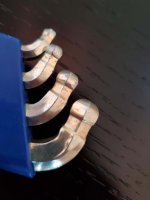
I recently bought an Ebay listing for some used Snap-on tools. I was mainly interested in the ratchets, but hex keys were also included. When I received my order, I was really surprised with the hex key workmanship. It looks like they shear a hex bar, machine the wobble ends into them, and then bend them. The problems I see with this is that they don't clean up the ragged end after being sheared, and the working end of the hex is deformed from the bending operation. Those 'flaws' might not affect the usefulness of the tools, but it certainly won't help anything. Also, tools don't need to look like jewelry to work, but for the premium that Snap-on in known for charging, I would have had higher expectations.

Just my 2 cents.
 

Attachments

  • 20201221_153455 annotated.jpg
    20201221_153455 annotated.jpg
    46.5 KB · Views: 74
  • 20201221_153455 (1).jpg
    20201221_153455 (1).jpg
    42.2 KB · Views: 70
  • 20201221_153247.jpg
    20201221_153247.jpg
    61.3 KB · Views: 79

RoninB4

Well-known member
Joined
Jul 22, 2020
Messages
3,483
Location
Under My House
I used to work for Eklind Tool and was part of the "ball" driver project when Bondhus was the only one offering them in 1995. I understand what the OP is saying about the deformation and inconsistency of the flats but it's part of the process to some degree. The hex stock comes coiled and is fed into a punch press that shears to length and does/does not bend to an "L". The ball shape on the long arm is put on after (at Eklind anway) in another machine called a Profilator that's similar to a lathe with live tooling. The scraggly end from the "shear" is part of die clearance and there's no way to alter that ragged end unless a clean up cut is taken prior to the ball creation, which increases the cost.

Having a ball on the short arm is just odd to me and I can't really imagine wanting to use it that way. The ball is always weaker than the rest of the key due to less material in cross section. Eklind used to make hex keys for Blue Point (Snap-On line) and those may be from Eklind if there's an "ET" stamped on the long arm.

The bulged deformation is simply part of the bending process because the metal in compression on the inner radius has to go somewhere so it bulges that way as it's gripped in the pressure pad of the die.

The inconsistency of the flats is likely due to run-out in the collet and/or spindle itself. While the first machine (for creating the ball) was being built in Germany I tested the run-out and found it out of spec (+/- .0015) to what Eklind wanted. Different bearings were required to achieve Eklind specs and the machine had to be rebuilt. Other makers may not use these type of bearings (more expensive) and the result is more run-out that shows up as inconsistent flat widths. The collet that holds the key while the ball is machined may contribute to this as well, hard to say without seeing the machinery.

I'm sorta inclined to agree that high priced tooling should look good. To me, hex keys are perishable tooling that will eventually get f*cked up so I don't buy from Snap-Off.

Probably more info than anybody ever wanted to know. I'll return to my seat in the back row now...
 
Last edited:

M6erfan

Well-known member
Joined
Dec 6, 2014
Messages
10,170
Location
'Merica!
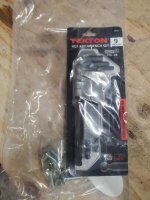
I found it a bit amusing this week, I got a free set of hex keys thrown in with something that required assembly. It was a full set of Tekton, with a holder, thrown in as "free, throw-away after you assemble the item" tools. Yes, the Tekton that the import fan boys here worship. I didn't even open them, just went to my toolbox and got a ratchet and sockets to use.

Those PBS sockets look cool, but just curious, is there a size marking anywhere?
 
Last edited:
To avoid these ads, REGISTER NOW!

bonneyman

Well-known member
Joined
Apr 22, 2010
Messages
8,757
Location
Desert SW
If I understood correctly, the OP in that topic wanted to discuss sockets as well as keys.

I've accumulated keys from Allen USA, Eklind USA, Bondhus USA, Wera and others. I don't know about now but back when I bought them, they were often inexpensive. At local brick and mortar stores, they were often clearanced. The Wera hex-plus set is around $6 regular price. It's the short set.

If there's clearance, I prefer to use bits and a bit holder or bit ratchet. I've been happy with the USA-made bits that I picked up at Menards for $9 (after 11% off).

Thumbs up on the Hex-Plus. It's on my short list of must-buys.
 

ChevyEFI

Well-known member
Joined
Sep 2, 2012
Messages
8,695
Location
Phoenix, AZ
Those PBS sockets look cool, but just curious, is there a size making anywhere?
Yes.

The picture above shows V6-210/5 and V10-210/5
V6 is 1/4" drive,
V10 is 3/8" drive,

-210 is short series socket,
-211 is long series,

/5 is 5mm.
 

RoundedNut

Well-known member
Joined
Aug 8, 2018
Messages
239
Location
driveway
...It looks like they shear a hex bar, machine the wobble ends into them, and then bend them. The problems I see with this is that they don't clean up the ragged end after being sheared, and the working end of the hex is deformed from the bending operation. Those 'flaws' might not affect the usefulness of the tools, but it certainly won't help anything. Also, tools don't need to look like jewelry to work, but for the premium that Snap-on in known for charging, I would have had higher expectations...

Hex keys are the cheapest tools you can get from any brand. PB Swiss keys may be expensive and nice but not as expensive and nice as their drivers.

One step above in price and usability are T-handles or other plastic moldings like flags. Above those are bits and bit sockets. Bits from less than an inch long to more than 6 inches are the most universally usable and low cost if you already have the drivers/ratchets. I prefer bits with bit sockets reserved for tough applications like bicycle pedals.

As for Snappy, I've seen them rebrand Eklind keys, with the usual 200-300% markup above the Eklind retail price. This markup does not increase the quality ;)
 

Flared Base

Well-known member
Joined
Dec 14, 2020
Messages
97
Location
CA
I used to work for Eklind Tool and was part of the "ball" driver project when Bondhus was the only one offering them in 1995. I understand what the OP is saying about the deformation and inconsistency of the flats but it's part of the process to some degree. The hex stock comes coiled and is fed into a punch press that shears to length and does/does not bend to an "L". The ball shape on the long arm is put on after (at Eklind anway) in another machine called a Profilator that's similar to a lathe with live tooling. The scraggly end from the "shear" is part of die clearance and there's no way to alter that ragged end unless a clean up cut is taken prior to the ball creation, which increases the cost.

Having a ball on the short arm is just odd to me and I can't really imagine wanting to use it that way. The ball is always weaker than the rest of the key due to less material in cross section. Eklind used to make hex keys for Blue Point (Snap-On line) and those may be from Eklind if there's an "ET" stamped on the long arm.

The bulged deformation is simply part of the bending process because the metal in compression on the inner radius has to go somewhere so it bulges that way as it's gripped in the pressure pad of the die.

The inconsistency of the flats is likely due to run-out in the collet and/or spindle itself. While the first machine (for creating the ball) was being built in Germany I tested the run-out and found it out of spec (+/- .0015) to what Eklind wanted. Different bearings were required to achieve Eklind specs and the machine had to be rebuilt. Other makers may not use these type of bearings (more expensive) and the result is more run-out that shows up as inconsistent flat widths. The collet that holds the key while the ball is machined may contribute to this as well, hard to say without seeing the machinery.

I'm sorta inclined to agree that high priced tooling should look good. To me, hex keys are perishable tooling that will eventually get f*cked up so I don't buy from Snap-Off.

Probably more info than anybody ever wanted to know. I'll return to my seat in the back row now...


Thank you so much for the reply. I really appreciate hearing from an inside source about how things are made, especially how nuanced details show up in the final product.

I went back and took a look at the hex keys based on what you said.

1. I didn't see an "ET" stamped on the long arm. Just the size and USA with a tiny hexagon trade mark. However, Eklind has a set with the same sizes and similar looking holder. The main difference seems to be the Eklind ones are black instead of silver. https://www.eklindtool.com/double-ball.html

2. It's interesting what you said about the profiling of the balls, and that the tolerances of the machinery could contribute to the appearance of the 'flats' not being symmetric. I guess I should have added in my post that the balls on the long arms looked symmetric, so I was guessing the bending must have deformed the tools and created the flats since that seemed like the only difference to me.

3. The ball on both ends seemed odd to me as well, for the same reason that you listed. However, Eklind's website says, "The ball tip on the short arm is thicker providing extra strength" Measuring my tools, the 'throat' of the ball end is .345", and on the long end it is .295" on the 10mm wrench. Also the profile of the long arm doesn't really have any flats on it. My guess is that they cut the same profile on both ends of the tool, but the short arm end has a offset that leads to a lack of clean up, creating the flats. The flats on the short arm match the rest of the hex stock at .394, but the largest I can measure on the ball of the long arm is .388, which works out to ~.003 minimum material removed on the long ball profile, which by coincidence matches the total tolerance range you stated.


Thanks for you input. I didn't notice all of the details until your post. These still seem a bit odd to me, and Snap-on wants ~$50 for them which is more than I would spend on what is a perishable tool. However, it came with an Ebay listing for some ratchets that I did want and now I know a little more about them than before, so at least their sentimental value is higher than before.
 

RoninB4

Well-known member
Joined
Jul 22, 2020
Messages
3,483
Location
Under My House
Well I'm sorta relieved that I didn't bore the entire audience to sleep with the technical information. Not that many people, besides another toolmaker, is interested in a long winded explanation of process. Even my GF's just feign interest in things I've done. Some more info:

1) The hex keys from Eklind were made from a somewhat special steel (8650 IIRC) and a heat treating process that makes them that color, done purposely to set them apart from other brands. The silver colored ones likely have some sort of flash plating done to make them shiny.

2) The neck diameter is set with the cutting program and can be whatever the spec-of-the-moment is. You've measured it so the short arm neck is thicker but I still fail to grasp why the ball is even on that end. Very often I want the hex aligned with the axis of rotation for the fastener and a ball doesn't align unless you hold it that way. Furthermore, on a really stubborn or over-used socket head cap screw (SHCS) I'd want all the contact I could get from the hex flats, not a thin band from the ball flats. The ball driver is meant for spinning the fastener out AFTER you break the torque.

3) The hexagon mark could very well mean somebody else is making them for Snap-On. Contracts change and so do suppliers. Perhaps only the shiny keys are made by somebody other than ET. I've been gone from Eklind since 1997 so things may have changed a bit, especially if Howard Eklind is no longer alive and he probably isn't.

4) Re-branding is a common practice among manufacturers, often called "house branding" and is only a stamp change in the press that takes 10 minutes. The stamp can change the brand and even the identity of where it was made. I have personally changed a "Made In USA" stamp for "Hecho En Mexico" on a product while at a company in Chicago. Yes it ***** to know that.

I also have dozens more technical tidbits of information and excruciatingly boring details regarding the manufacturing of hex keys, machinery, stamping dies, and metal working that are available for the asking......but you'll be sorry if you do ask. Hope everybody is doing well. A Happier New Year to us all.
 
Last edited:

Muckin_Slusher

Well-known member
Joined
Apr 1, 2017
Messages
465
Location
Abitibi
Question for all those saying allen keys are "cheap enough to be included" with things like furniture.

Can you show me an example where the included wrench is CR-V steel, and not cheese grade chinesium to go along with the cheese grade bolts?
 

cmandp

Well-known member
Joined
Dec 22, 2011
Messages
1,271
Location
New Jersey
I will add my two cents. I started using Allen wrenches in a machine shop. They really are the go to on machinery like others have said and given valid reasons for. I do remember using hex sockets on ratchets/breaker bars for large sizes that had the clearance and needed a lot of torque to remove or tighten. We also had Allen wrenches that were shortened for particular tasks. I myself also fixed the ends of Allen wrenches that were worn by grinding them.

My experience on vehicles though is different. You don't need bit sockets necessarily, but you do need bit sockets for use on a ratchet/impact to make the job easier. Caliper bolts come to mind, those would be miserable with just a standard Allen wrench. You'd need a cheater pipe to loosen them and then you're stuck spinning the bolt a partial turn then removing, repositioning the wrench and reinserting, all while the bolt is facing away from you. Doable but not the easiest. There is also the issue of rusted socket head fasteners that makes things harder. There's no way I'm walking a rust seized bolt back and forth without a ratchet if I can help it.

The free Allen wrenches you get with flat pack furniture, etc. are not comparable. They are one time use, not to mention the hardware on those are low torque and often soft with a poorly formed hex as well.

So to me there are two camps here and the usage is just different: stationary machinery were the bolts are usually clean even oily and automotive/truck (probably heavy equipment too) where you're working in more confined spaces and with seized fasteners.
 

macgee

Well-known member
Joined
Jan 11, 2014
Messages
2,834
Location
Sepulveda Pass, CA
Why not go with USA made, tried and proven Bondhus?

I have a machine shop and use hex L-keys everyday. I've owned PB Swiss, Wiha and Eklind sets and chosen to use Bondhus as my daily users. I Love PB Swiss as a company but found there hex keys measure smaller than Bondus allowing less contact than Bondhus and only come in extra long length. The bondhus measure well and pretty consistent with a mic. Wiha's I had were too big and were always struggling to fit in socket, they were a pain.

Bondhus have been holding up very well being used everyday, I use the gold hard coated ones and black finish. They're priced so well compared to PB Swiss and Wiha sets that I don't worry if I need to order another set or lose one.

Also happy to support a USA made company putting out a good product and priced competitively.

Here's the link to ones I use. Ball end only on the long end.

Fractions:

https://www.amazon.com/Bondhus-37937-Balldriver-L-wrenches-GoldGuard/dp/B000E7ZQHQ/ref=pd_bxgy_img_2/145-5762326-5813310?_encoding=UTF8&pd_rd_i=B000E7ZQHQ&pd_rd_r=36fb00f8-a19e-4555-83c4-ddc2b62f5160&pd_rd_w=kHe22&pd_rd_wg=HY5AS&pf_rd_p=bd257e40-8799-42ac-88d0-f76e0faf3886&pf_rd_r=DJ35MA31TPP61923C775&psc=1&refRID=DJ35MA31TPP61923C775

Metric:

https://www.amazon.com/Bondhus-38099-GoldGuard-Ballpoint-L-Wrench/dp/B000E7ZQIA/ref=pd_bxgy_img_3/145-5762326-5813310?_encoding=UTF8&pd_rd_i=B000E7ZQIA&pd_rd_r=4b7e86f4-be98-47d7-8f8a-0005cacfa464&pd_rd_w=jq0ky&pd_rd_wg=z5TQu&pf_rd_p=bd257e40-8799-42ac-88d0-f76e0faf3886&pf_rd_r=7P81VX477391E8G1ERXY&psc=1&refRID=7P81VX477391E8G1ERXY


PS> I will say that PB Swiss socket hex's are the best in the world.
 
Last edited:

Bradc1989

Well-known member
Joined
Oct 30, 2019
Messages
162
Location
Middle tn
Well I'm sorta relieved that I didn't bore the entire audience to sleep with the technical information. Not that many people, besides another toolmaker, is interested in a long winded explanation of process. Even my GF's just feign interest in things I've done. Some more info:

1) The hex keys from Eklind were made from a somewhat special steel (8650 IIRC) and a heat treating process that makes them that color, done purposely to set them apart from other brands. The silver colored ones likely have some sort of flash plating done to make them shiny.

2) The neck diameter is set with the cutting program and can be whatever the spec-of-the-moment is. You've measured it so the short arm neck is thicker but I still fail to grasp why the ball is even on that end. Very often I want the hex aligned with the axis of rotation for the fastener and a ball doesn't align unless you hold it that way. Furthermore, on a really stubborn or over-used socket head cap screw (SHCS) I'd want all the contact I could get from the hex flats, not a thin band from the ball flats. The ball driver is meant for spinning the fastener out AFTER you break the torque.

3) The hexagon mark could very well mean somebody else is making them for Snap-On. Contracts change and so do suppliers. Perhaps only the shiny keys are made by somebody other than ET. I've been gone from Eklind since 1997 so things may have changed a bit, especially if Howard Eklind is no longer alive and he probably isn't.

4) Re-branding is a common practice among manufacturers, often called "house branding" and is only a stamp change in the press that takes 10 minutes. The stamp can change the brand and even the identity of where it was made. I have personally changed a "Made In USA" stamp for "Hecho En Mexico" on a product while at a company in Chicago. Yes it ***** to know that.

I also have dozens more technical tidbits of information and excruciatingly boring details regarding the manufacturing of hex keys, machinery, stamping dies, and metal working that are available for the asking......but you'll be sorry if you do ask. Hope everybody is doing well. A Happier New Year to us all.

Love the technical posts on the process as well as the insider view.

I also vote bondhus. I recently tried a set from a company called metric blue. Admittedly, I tried them because they were a little more pricey, so they had to be better right? So they come in and I open them up and they’re stamped........bondhus. Only difference is that they were coated with some blue coating that I actually found to be somewhat more slippery than usual when oil got on them. Not a great thing when you work in industrial maintenance as a multi craft tech. I will say the coating has seemed to be more durable than bondhus’s own gold or silver coating. Worth the extra $15 (yes I paid $30 for a metric set of Allen wrenches)? I’d say no
 

bwringer

Well-known member
Joined
Jan 1, 2013
Messages
10,248
Location
Indianapolis
As ever on GJ, the real answer for "which tool" is "ALL THE TOOLS!".

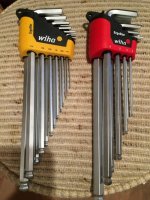
Sometimes a hex key is the only thing that will fit, or the fastest, easiest way to get something done. Sometimes it's a ball end long on a socket. Sometimes you need that weird sorta half ball end configuration to get just the right angle. Sometimes there's room for a T-driver.

As long as engineers don't talk to other engineers, they're going to put socket head bolts in the dumbest possible places. Fortunately, there are several excellent quality brands to choose from, and I have several in my arsenal. There's also lots of junk, but the good stuff is so cheap there's no reason to put up with it.

One thing I haven't seen mentioned is that different high-quality brands can often fit slightly different in different fasteners. This issue can really affect things in the very small sizes, 4mm and below.

So if you're confronting something tiny that could put up a fight, grab everything you have in that size, try them all, and use the tightest fit. Sometimes it'll be a cheapie that just happens to be slightly over tolerance and fits the cheapie bolt juuuuuuust right. Sometimes it'll be the Wera or PB Swiss.

So that's why I have several brands and kinds of hex tools in the toolbox from teensy L-keys to 19mm impact sockets; hex fasteners are very common on motorcycles so you have to be ready for just about anything.
 

matt_i

Well-known member
Joined
Mar 14, 2008
Messages
10,722
Location
SE Michigan
Two times the plastic coated Wera will let you down.

- when there's a clearance hole for a hex key and its maybe .020"/0.5mm over the nominal distance between the points of the hex, and the plastic tube simply wont fit. To be fair its time for an XL flat-ended bit and not the ball-end but sometimes you try to work with what you have available.

- when the plastic tube/sleeve gets jammed in the holder and the steel body gets pulled out. Eventually the plastic tube can get lost and the wrench is a very loose floater that can drop out.

So I don't want to trash their product, its a very good one, but I've come across those limitations in heavy industrial work over years of service.

Wiha makes a color-coated hex-only version I just got in and want to get more time with. My only gripe with the PB swiss is their fractional set doesn't include a 3/8" wrench that I use a lot. Bondhus makes color coated versions as well, probably the lowest quality coating but I don't think that matters long-term, the steel in the tool is very good.
 

RoundedNut

Well-known member
Joined
Aug 8, 2018
Messages
239
Location
driveway
...
So I don't want to trash their product, its a very good one, but I've come across those limitations in heavy industrial work over years of service.
...

This board seems to be mostly auto and industrial stuff but there are electronic and other areas where hex fasteners are used.

Regular (screw)driver handles are good/popular for electronics and radio control hobbies. And my electric guitar has a hex cap screw with a set screw inside of it. These tools have long shafts of the appropriate diameter, i.e. 2mm hex up to 100mm long.

So those Wera keys won't fit even before the plastic sleeve. And they're rather long, which is good for reach but not great for tight spaces.

But I think they are okay for the average Joe to get an affordable trendy tool for straightforward use cases like Ikea furniture.
 

larry_g

Well-known member
Joined
Apr 28, 2007
Messages
16,867
Location
oregon
One thing I haven't seen mentioned is that different high-quality brands can often fit slightly different in different fasteners. This issue can really affect things in the very small sizes, 4mm and below.

So if you're confronting something tiny that could put up a fight, grab everything you have in that size, try them all, and use the tightest fit. Sometimes it'll be a cheapie that just happens to be slightly over tolerance and fits the cheapie bolt juuuuuuust right. Sometimes it'll be the Wera or PB Swiss.

So that's why I have several brands and kinds of hex tools in the toolbox from teensy L-keys to 19mm impact sockets; hex fasteners are very common on motorcycles so you have to be ready for just about anything.

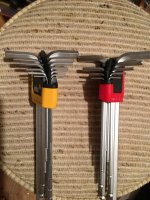
Having been in a similar job where everything was socket head screws I many times ground the end of the hex key to remove the champher that is put there to remove the burr and aid in the insertion of the tool in the hex. A gentle touch with a abrasive stone or grinding wheel will give you flat bottom and gain you that little bit of extra insertion length you may need to turn the screw without stripping the head. Use a magnifying lens to examine what you have and you may be surprised at the condition of the tool.

lg
no neat sig line
 
To avoid these ads, REGISTER NOW!
Top Bottom