To avoid these ads, REGISTER NOW!

Upgrading older package heat pump with solid state contactors & relays?

cagey

Member
Joined
May 16, 2023
Messages
12
Location
on the 5000' contour line in SE AZ
I've recently (9 months ago) purchased a home with two 24 year old 14 SEER Ruud RJMA 4-Ton R22 package heat pumps running on 240VAC on the roof. Even though they lack state of the art efficiency, thus far (thru most of a winter and most of a summer) they seem to be performing well. As a testament to either their inherent reliability or good maintenance: the only one I've needed to open up (to replace a couple of failing relays) still has its original compressor, outdoor fan motor and 3-terminal capacitor.

Anyway, at time of purchase, I had these units inspected by an HVAC company. Among the upsells offered was upgrading to a "solid state contactor". Months later I got to thinking about what I can DIY to improve the long term reliability of my units (which would also minimize future rooftop visits), and the contactor seems to be a primary "wear part" thus target for upgrading. A Google search for "solid state contactor HVAC" doesn't return any devices designed with this application in mind (i.e. that have roughly the same form factor as the 40A mechanical HVAC ("definite purpose") contactors in my units, but with semiconductor devices replacing the mechanical contacts). The product that shows up consistently in my search results is the Emerson White Rodgers 49M11-843 Sure Switch, however this is not literally a solid state contactor but rather a mechanical contactor with additional solid state control circuitry that (among other thing) purports to prolong the life of its internal mechanical contacts. Is the Sure Switch "as good as it gets" when it comes to contactor upgrades for units like mine? If so, any comments on their reliability?

Similarly, one of the relays I recently replaced (another "wear part") is a 90370 (90-370) which seems to be a commonly used 24VAC primary, 240VAC secondary 8A continuous inductive SPDT relay. As with the contactor, I haven't found a true solid state drop-in replacement for this relay. Am I looking for something that doesn't exist?
 
  • Like
Reactions: lmg
To avoid these ads, REGISTER NOW!

nadogail

Well-known member
Joined
Jan 23, 2009
Messages
31,931
Location
Coronado, CA
I have found the people at Automation Direct very helpful when I needed Transformers, Contactors, or Relays.

I first became aware of them when at a previous employer I needed to source a PLC, they had "Good Stuff" at very reasonable prices.
 
OP
C

cagey

Member
Joined
May 16, 2023
Messages
12
Location
on the 5000' contour line in SE AZ
I'm no hvac expert, but I'd have a cap, contactor and fan motor on the shelf. Leave it be and replace when needed
Agreed. The two relays I've already replaced were replaced from spares I'd put in inventory. Spare fan motors I don't have yet (due to cost and only recently pinning down their exact part numbers), but I have spare contactors, a 90-370 relay, a sequencer relay, and a couple of the caps (I'm missing one, so a good reminder for me to close that gap). Thanks.

I have found the people at Automation Direct very helpful when I needed Transformers, Contactors, or Relays.

I first became aware of them when at a previous employer I needed to source a PLC, they had "Good Stuff" at very reasonable prices.
Added to my list of sources to contact. Thanks.
 

fitter30

Well-known member
Joined
Jun 23, 2019
Messages
2,967
Location
Peace Valley,mo
Sure switch is a 1 pole contactor with time delay for power failure and has low voltage protection. A electronic thermostat has a setting in programming for compressor time delay usually from 3-5 minutes if programmed in. If your looking for a solution for s longer lasting contactor Just increase the amp rating of the contractor if there's room. Have a 40 amp raise it to 50 amp.
 

danski0224

Well-known member
Joined
Jan 29, 2005
Messages
13,376
Location
Near Naperville, IL
Sure switch is a 1 pole contactor with time delay for power failure and has low voltage protection. A electronic thermostat has a setting in programming for compressor time delay usually from 3-5 minutes if programmed in. If your looking for a solution for s longer lasting contactor Just increase the amp rating of the contractor if there's room. Have a 40 amp raise it to 50 amp.
It also closes the contacts on the "high" side of the cycle.

It makes a difference. I have one.
 

u3b3rg33k

Well-known member
Joined
Dec 18, 2017
Messages
4,047
well, if I was gonna throw a zero crossing SSR on heat strips, I'd leave the factory relay in for safety, then run the SSR off the temp controller and set it to 140F or so. that'd minimize power use while guaranteeing warm air out of the vents, and not forfeit any factory safeties.

SSRs can fail ON, but I usually see them fail off. then again relay contacts can weld "on" too.

ideally you could use a mechanical relay as a safety and do your switching with an SSR, and never present any arcing load to the contactor. you'd want to make sure that the contactor was rated for such use, as most require a "wiping current" to keep them clean.

I'd want anything used to be "listed" for the application. throwing off-the-shelf SSRs in front of a motor may not perform as you expect.

are we into the weeds enough?
 

fitter30

Well-known member
Joined
Jun 23, 2019
Messages
2,967
Location
Peace Valley,mo
It also closes the contacts on the "high" side of the cycle.

It makes a difference. I have one.
With 16.6 milliseconds per 1 cycle with 1000ms in 60 cycles can't see a $52 Sure switch having that type of electronics in it. Looked at their literature didn't see that info. Two different timers and brown out protection.
 

danski0224

Well-known member
Joined
Jan 29, 2005
Messages
13,376
Location
Near Naperville, IL
OP
C

cagey

Member
Joined
May 16, 2023
Messages
12
Location
on the 5000' contour line in SE AZ
Sure switch is a 1 pole contactor [...]
That's an interesting subtopic in its own right: I did some investigation in past months regarding why a 1-pole contactor would (aside from it's presumed lower cost) ever be preferable to a 2-pole in this application, and the best I could come up with was that it's needed to power a compressor's crankcase heater (should it have one). I've tentatively concluded that my compressor (Copeland scroll ZR46K3-PFV-230) does not have a crankcase heater, however the factory Wiring Diagram for my unit shows a 1-pole contactor (aside: yet the currently installed contactor, a (non-OEM) "C230A", seems to be a 2-pole (aside: it's label says for 240VAC "FLA=30, LRA=180, RES=40". Amazon tells me the Packard C230A is a nominal "30A" contactor, thus I assume the "nominal" rating maps to "FLA" rating. Thus my in-inventory nominal 40A contactor represents an upgrade over the status quo...).
Sure switch is a 1 pole contactor with time delay for power failure and has low voltage protection.
These are upgrade features for me, but I'm not sure how valuable given the compressor has survived 24 years already.
A electronic thermostat has a setting in programming for compressor time delay usually from 3-5 minutes if programmed in.
My thermostat has such a setting and I've set it to max (5 minutes). When I bought the house it was set to 2 minutes(!)
[Sure Switch] makes a difference. I have one.
I assume you mean your senses can perceive a difference during operation (which I'd guess means turn-on/-off sounds different with the Sure Switch)?
I'd want anything used to be "listed" for the application. throwing off-the-shelf SSRs in front of a motor may not perform as you expect.
Yeah, I concluded thus. After starting this topic, I found some links on another forum site ("HVAC Talk") to Crydom/Sensata SSRs, but I wasn't confident about finding product matching my application (the majority seemed to be 1-pole SSRs, and mostly having DC-driven control circuits).
 
To avoid these ads, REGISTER NOW!

PoorUB

Well-known member
Joined
Mar 29, 2021
Messages
11,622
Location
Fargo, ND
If you look at the wiring, often a one pole contactor is used and with the capacitor and the way the unit is wired it trickles a tiny bit of power through the motor windings to act as a crankcase heater.
 
OP
C

cagey

Member
Joined
May 16, 2023
Messages
12
Location
on the 5000' contour line in SE AZ
If you look at the wiring, often a one pole contactor is used and with the capacitor and the way the unit is wired it trickles a tiny bit of power through the motor windings to act as a crankcase heater.
Fascinating! In case anyone who can discern the telltale signs of such a lashup is interested taking a look, the best online-accessible wiring diagram I can find for my specific heat pump is on page 38 of this document.
 
OP
C

cagey

Member
Joined
May 16, 2023
Messages
12
Location
on the 5000' contour line in SE AZ
To gain a little closure on the compressor crankcase heater (CCH) sub-topic: from this 2008 hvac-talk topic:
According to Copeland no CCH is required on any single phase unit. It is required on some 3 phase units, and should be energized 12 to 24 hours prior to initial start up, as not to damage bearings. This CCH rule does change as the compressors increase in size. I have worked on 60 ton units with no CCHs. It would be advised to add them in some cases.

For the most part though if a piece of equipment does not have one, and it was engineered not to have one, it doesn't need one.
and (from a different poster on page 2 of the topic):
According to A training class I attended hosted thru Copeland CCHS are [n]ot required on any of there single phase compressors. Three phase scrolls require a CCH if they are over 10LBS and do not have a suction accumulator. Not sure why the preach that they need a CCH and dont install it from the factory........

A 3 phase scroll has enough torque to break scroll on start up if the compressor is full of liquid.
As with most forum topics, opinions will vary, and that's certainly true of the above-referenced hvac-talk topic, but as far as I'm concerned, the above 3rd hand Copeland training statements, in combination with 24 years of operation, makes for "case closed" for my single phase heat pump.

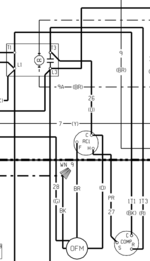
Regarding the sub-sub-question of how a 1-pole contactor might allow a small amount of heating current thru the compressor motor windings when the contactor is deenergized, I don't see such a path in my particular unit:
Compressor.Contactor.snip.png
path Contactor.L1 -> Contactor.T1 -> COMP.C is always closed, but from there I don't see how a path to Contactor.L3 is closed when the contactor is deenergized (and the compressor does not appear to have a direct grounding wire (and I believe a ground wire should never be used to carry non-ground-fault current anyway?)).
 

fitter30

Well-known member
Joined
Jun 23, 2019
Messages
2,967
Location
Peace Valley,mo
Posted the question of the Sure Switch in the electrical forum a d how Emerson would time the closer of the contacts at 0 vac once closed there wouldn't be a arc and did the same on opening the contact would be the same.
Crankcase heater the only purpose is to drive any refrigerant out of the oil in the off cycle to keep dilution down. In this Copeland lit posted in fine print the scroll variable speed didn't need one they use the windings powered by dc voltage 50 watt heater Page 2.
 

u3b3rg33k

Well-known member
Joined
Dec 18, 2017
Messages
4,047
inverters can also single phase the compressor for crank-case heat without the add-on parts complexity.
 
OP
C

cagey

Member
Joined
May 16, 2023
Messages
12
Location
on the 5000' contour line in SE AZ
Crankcase heater the only purpose is to drive any refrigerant out of the oil in the off cycle to keep dilution down. In this Copeland lit posted in fine print the scroll variable speed didn't need one they use the windings powered by dc voltage 50 watt heater Page 2.
Also relevant for my (single-speed R22) compressor: https://www.copeland.com/documents/...copeland-scroll-compressors-en-us-1570846.pdf From pg 3:
Crankcase Heat - Single Phase

Crankcase heaters are not required on single phase compressors when the system charge is not over the 120% limit shown in Table 5. A crankcase heater is required for systems containing more than 120% of the compressor refrigerant charge limit listed in Table 5. This includes long line length systems where the extra charge will increase the standard factory charge above the 120% limit.
I'm pretty sure a package unit such as mine would always have a refrigerant system charge << 120% limit.
 

u3b3rg33k

Well-known member
Joined
Dec 18, 2017
Messages
4,047
shoot, if I had a package unit the first thing I'd do would be to slap an economizer on it!
 

PoorUB

Well-known member
Joined
Mar 29, 2021
Messages
11,622
Location
Fargo, ND
shoot, if I had a package unit the first thing I'd do would be to slap an economizer on it!
I have thought about an economizer on my house HVAC. Really it wouldn't pay for most people as the air is too humid until the temps are cooler and then the house doesn't need AC.
 
OP
C

cagey

Member
Joined
May 16, 2023
Messages
12
Location
on the 5000' contour line in SE AZ
shoot, if I had a package unit the first thing I'd do would be to slap an economizer on it!
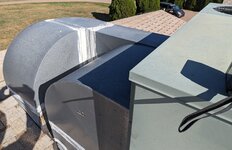
I believe my ducting precludes:
PXL_20230817_152051254_ducts_crop.jpg
I'm pretty sure the duct that's closer the the camera (flowing from the house into the package unit) mounts right where the economizer would be installed (with house ducting connecting to the bottom of the package).
I have thought about an economizer on my house HVAC. Really it wouldn't pay for most people as the air is too humid until the temps are cooler and then the house doesn't need AC.
Agreed. Also it's not that much of a hassle to shut off the heat pump and open a few windows for crossflow.

I might consider an economizer when (if) we replace the heat pumps (assuming the ducts don't preclude...).

OTOH https://www.reddit.com/r/hvacadvice/comments/120pvt4

edit: also we live in SE AZ where for a large portion of summer we're experiencing North American monsoon which moderates high temps with the downside being high humidity.
 
Last edited:

u3b3rg33k

Well-known member
Joined
Dec 18, 2017
Messages
4,047
you can pick up a used JADE economizer (enthalpy capable) on ebay for pennies on the dollar. new the controllers are pretty pricey.

they make residential economizer boxes (basically a single damper diverter box). very space efficient, if you don't have to cut 2x 20" x 20" holes in your home. or you can get a sheet metal guy to cut in dampers. need a snorkel off the top so it's not sucking in rain or whatever.

my house sits in full sun all the time so I have AC calls much later into the season. plus there's the option of fitting a switch to the DCV input and using it as a whole house fan. I'm a big fan of fresh air, and windows aren't automated. i'll keep dreaming.
 

fitter30

Well-known member
Joined
Jun 23, 2019
Messages
2,967
Location
Peace Valley,mo
Most residential units don't need cooling below about 50°. Factory economizers are wired with a two stage cooling thermostat. If in econ mode 1 stage brings it on, 2nd stage if called on shuts the econ off brings on the compressor and a low ambient control varies condenser fan speed to control head pressure.
 

PoorUB

Well-known member
Joined
Mar 29, 2021
Messages
11,622
Location
Fargo, ND
you can pick up a used JADE economizer (enthalpy capable) on ebay for pennies on the dollar. new the controllers are pretty pricey.

they make residential economizer boxes (basically a single damper diverter box). very space efficient, if you don't have to cut 2x 20" x 20" holes in your home. or you can get a sheet metal guy to cut in dampers. need a snorkel off the top so it's not sucking in rain or whatever.

my house sits in full sun all the time so I have AC calls much later into the season. plus there's the option of fitting a switch to the DCV input and using it as a whole house fan. I'm a big fan of fresh air, and windows aren't automated. i'll keep dreaming.
Sure, but if you understand enthapy you don't want to cool your house with outside air until the outside temps hit about 55F. Of course this depends on the region, generally southern states can ventilate at a higher outdoor temp. If you ventilate with humid air all you have done is fill your home with humidity and when you decide to run your AC it has all that humidity to remove before it will do a decent job of cooling the home. Not many homes need AC when it is 55-60F outside.

A good economizer control monitors temp and humidity. You can not go on temp alone unless you just shoot for the cooler outdoor temp. Around here we always used 55F as a chance over temp. (I forget the specific numbers) Data shows that about 90% of the time we are safe to ventilate at 55F, but at 60F it falls off quickly, maybe safe to ventilate 50% of the time.
 

u3b3rg33k

Well-known member
Joined
Dec 18, 2017
Messages
4,047
it also depends on how cold you keep your house.

right now it's 66F/70% outside, and 76F/53% inside. perfect conditions for it.
 
To avoid these ads, REGISTER NOW!
Top Bottom