To avoid these ads, REGISTER NOW!

Upright 60 Gal Compressor bottom cap inspection advice?

j3y_w4lk3r

Member
Joined
Mar 13, 2023
Messages
11
Sorry to beat the same dead bush with a different stick, but it’s what I’m good at. I took a video of the inside of the bottom of my upright 60 gallon compressor with my endoscope, and I’m trying to get some feedback on how safe y’all think this is, it’s pretty cruddy in there, but I’ve been using this thing for years with no issues. I’m assuming the bottom cap is thicker than the sidewall? If so I’m thinking it’s still good, just super cruddy in the bottom. I should also mention this compressor had no air filter on it when I bought it, and this dude lived out in apache junction, so maybe it just compressed a bunch of dusty air into it, plus the moisture, creating this dirt like **** on the bottom? Here’s the video, don’t mind my ridiculous commentary, I wasn’t planning to upload this anywhere at first.
Thanks for any and all feedback !
 
Last edited:
To avoid these ads, REGISTER NOW!

Citation

Well-known member
Joined
Jan 20, 2016
Messages
3,223
Location
Indy
Keep using it. If/when you get a pin hole leak scrap the tank. The tanks are engineered to fail with a leak vs a burst (leak before break). People get in trouble when they fix the leaks. BTW, an after cooler with drain may help reduce the washer in the bottom of the tank.
 

strutaeng

Well-known member
Joined
Dec 12, 2011
Messages
2,287
Location
Dallas, TX
It's really hard to tell from that screen but probably okay. Rust expands like 10x as much as steel, so often, things look way worse. I'd say try to clean the crud out and then look again.

How old is the tank? Does it have an ASME tag? They list the wall thickness on the tag. A while ago I checked this tank I have from the early 90s with ultrasound instrument I had access to at my previous employer, and it was pretty close to the spec. IIRC, the tank also looked kinda crummy.
 
OP
J

j3y_w4lk3r

Member
Joined
Mar 13, 2023
Messages
11
Thanks everyone, the tank is supposedly from 1984, here’s that tag on the side4E7097B8-A2AE-41CD-88C2-19BB819E60A2.jpeg
It says the shell is .166 thickness, but does that mean the caps are also that thick? Or are they thicker to compensate for expected rust? I’ve tried a few things to clean out the bottom, but to no real avail, the 1/4 NPT drain fitting on the bottom makes it tricky to get anything in there, tried vacuuming from it, blowing air into the side port, I’m thinking I might try pouring some liquid down into it from the side port? Maybe like acetone or just water? Let me know what you guys think! I’m honestly just trying to get this thing back in service to finish painting my 03 GT, plan after that is to sell it for cheap, let the new owner know of it’s condition, & get a new one !
 
To avoid these ads, REGISTER NOW!
OP
J

j3y_w4lk3r

Member
Joined
Mar 13, 2023
Messages
11
Keep using it. If/when you get a pin hole leak scrap the tank. The tanks are engineered to fail with a leak vs a burst (leak before break). People get in trouble when they fix the leaks. BTW, an after cooler with drain may help reduce the washer in the bottom of the tank.
I hear that often, I just hope it rings true for me haha. I’ve learned thankfully to never ever weld on pressure vessels, so a pinhole forming would absolutely be the last time it’s ever used. Also, what did you mean by reduce the washer ? Thanks for the tips!
 

Under_Pressure

Well-known member
Joined
May 13, 2014
Messages
115
Location
NE Wisconsin
Head thickness is given as .133 it looks like from that data plate. There is not necessarily a lot of consistency in exactly what the thickness markings on a data plate designate, especially going back almost 40 years. They are not required by ASME or the National Board, so the code doesn't spell out what values must be used. They primarily stem from certain jurisdictions (particularly CA) requiring that the head and shell "thickness" be stamped on the data plate. I have seen this done most commonly as the nominal material thickness for a rolled shell and the minimum thickness after forming for a formed head, but .166 shell thickness here is kind of an oddball so I don't know what they used- maybe just design thickness. Before UT thickness inspection was cheap and easy and portable, the exact number was pretty much academic since there wasn't an easy way to non-destructively check the actual thickness of a tank- the thickness designation was basically a reference so you knew about how thick of a tank you were dealing with. Nowadays it can cause all kinds of heartache because every inspector can poke around and check thicknesses to their heart's content even though that's not really how it's supposed to be done.

For your case, if you somehow checked the thickness (with UT or whatever) and it was at or above those numbers, you are ok from a wall thickness perspective. If it is below those numbers, you may still be OK if the tank was designed with a corrosion allowance, but you would need the U-1A form (which you probably don't have, and MAYBE could be obtained from the manufacturer if they are still around or the National Board if you were so inclined).
 
OP
J

j3y_w4lk3r

Member
Joined
Mar 13, 2023
Messages
11
Alright so uhhh.. yeah. Here’s the result of me flushing the tank with water, probably 300 times. 02856F21-65C2-4B6C-B8D4-8EF8DA0039E5.jpegThe sudden influx of water flow coming down on the bottom cap took out a ton of crud. I used the garden hose into the side port of the tank, I would add some water, let it fill a tiny bit, then use tweezers to unclog the drain thread hole as the water drained, then add water again. Did this a million times until almost nothing was coming out. A lot of it just looks like dirt rather than rust, but there’s definitely a good amount of rust included too. I figured water would be safest to use since for a hydro test they fill it with water anyway. Let me know your thoughts ! Lol
 

sdowney717

Well-known member
Joined
Mar 17, 2010
Messages
964
It wont just explode and rip apart, when they leak they develop a pinhole. Exploding is reserved for extreme overpressure of a vessel in good shape on the entire surface bottom. A rusting bottom selectively pit rusts much worse in various smaller spots, it is those smaller spots that give way to the pressure, not the entire tank. And even if a seam suddenly ripped but you know the weld is thicker than the base metal, the force is all down to the floor, just won't happen. Use it till it leaks. Not much different than leaking water heater. No one replaces them till they leak. This is not a steam boiler.
 

MacMcMacmac

Well-known member
Joined
Oct 21, 2014
Messages
1,591
Location
canada
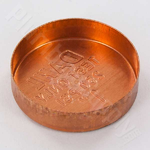
This is a copper pressure test cap designed to work up at 250psi. Ask yourself if your steel tank is thicker than that, if your welds are stronger than a solder joint, and if you are going anywhere near 250psi.

1679144804902.png
 
To avoid these ads, REGISTER NOW!
Top Bottom