To avoid these ads, REGISTER NOW!

Use a 240v British tool in US

vartz04

Well-known member
Joined
Feb 17, 2009
Messages
1,882
Location
LaSalle County IL
So I have a chance to get a festool domino for cheep but it's a U.K. Unit. 240 v. How hard would it be to get this to work here? I just want to figure out what the costs would be to do it right so I can see if it's worth it.
 
To avoid these ads, REGISTER NOW!
OP
V

vartz04

Well-known member
Joined
Feb 17, 2009
Messages
1,882
Location
LaSalle County IL
a 220 feed and the correct plug


Well I have that. Just would need an extension cord and to unplug my heater when using. No issue with the different frequencies?

Basically just would need to chop the plug off the tool and put a new one that matches my outlet in? Seems too easy.
 

Rossco

Well-known member
Joined
Jun 29, 2011
Messages
873
Location
Great White North
If you wanna run 240V single phase here in North America you need to feed 120V to both the Hot & Neutral. Make sure it's 50/60hz compatible.
 

6PTsocket

Well-known member
Joined
Mar 12, 2014
Messages
4,593
If you wanna run 240V single phase here in North America you need to feed 120V to both the Hot & Neutral. Make sure it's 50/60hz compatible.
You just burned down his house. The neutral is tied to ground and for purposes of this discussion , it is ground. The 120 VAC in one leg flows first from the ground to hot and then the other way. The other hot does the same thing but at exactly the opposite time so the voltage between the two hots is 240 volts. 240 volt devices do not use the neutral at all. They do have a safety ground connection, just like a 120 volt device that is not double insulated. As we all know, the tool will work without the ground prong. Do not confuse this with three phase power where the AC legs are 60 degrees out of phase with each other. If you grab 120 volts off this, you do use the neutral between any of the three legs and neutral. Between any two of the three legs, you get 208 volts, not 240. I do this for a living. The question still remains how tolerant the tool is of the 10 hz frequency change. That varies; consult the manufacturer.

Sent from my SM-G900V using Tapatalk
 

Rossco

Well-known member
Joined
Jun 29, 2011
Messages
873
Location
Great White North
You just burned down his house. The neutral is tied to ground and for purposes of this discussion , it is ground. The 120 VAC in one leg flows first from the ground to hot and then the other way. The other hot does the same thing but at exactly the opposite time so the voltage between the two hots is 240 volts. 240 volt devices do not use the neutral at all. They do have a safety ground connection, just like a 120 volt device that is not double insulated. As we all know, the tool will work without the ground prong. Do not confuse this with three phase power where the AC legs are 60 degrees out of phase with each other. If you grab 120 volts off this, you do use the neutral between any of the three legs and neutral. Between any two of the three legs, you get 208 volts, not 240. I do this for a living. The question still remains how tolerant the tool is of the 10 hz frequency change. That varies; consult the manufacturer.

Sent from my SM-G900V using Tapatalk

Don't call 911 yet. I meant at the appliance. Just like you have described above.

So instead of a Hot and cold. Just run two 120 hot wires to the UK plug.
 
Last edited:

6PTsocket

Well-known member
Joined
Mar 12, 2014
Messages
4,593
Don't call 911 yet. I meant at the appliance. Just like you have described above.

So instead of a Hot and cold. Just run two 120 hot wires to the UK plug.
Correct. Now we are on the same page. When I heard hot to neutral I saw smoke and glowing wires. Sorry I misread what you were trying to say. To be honest I know little about European wiring though I have been there. I suspect that they have a 220 hot and a neutral rather than two hots like we have here for 220.

Sent from my SM-G900V using Tapatalk
 

Rossco

Well-known member
Joined
Jun 29, 2011
Messages
873
Location
Great White North
Correct. Now we are on the same page. When I heard hot to neutral I saw smoke and glowing wires. Sorry I misread what you were trying to say. To be honest I know little about European wiring though I have been there. I suspect that they have a 220 hot and a neutral rather than two hots like we have here for 220.

Sent from my SM-G900V using Tapatalk

No worries. I should have been more specific like your post was / is.

Yeah I grew up in the UK. Its 240v single phase and a Neutral. Most if not all Plugs have a 5-13amp fuse inside the plug. Seems to be the only difference. The fused connection is the hot (Brown) and the other prong is Netural (Blue) the ground is yellow & green. Also most if not all sockets require the longer ground pin to open the flaps covering the main power outlets on the socket.

I wired a 240V UK socket into my shop a while back to run my UK technics Stereo. Believe me when I say I turned the breaker on with a broom handle he he
 
Last edited:

6PTsocket

Well-known member
Joined
Mar 12, 2014
Messages
4,593
No worries. I should have been more specific like your post was / is.

Yeah I grew up in the UK. Its 240v single phase and a Neutral. Most if not all Plugs have a 5-13amp fuse inside the plug. Seems to be the only difference. The fused connection is the hot (Brown) and the other prong is Netural (Blue) the ground is yellow & green. Also most if not all sockets require the longer ground pin to open the flaps covering the main power outlets on the socket.

I wired a 240V UK socket into my shop a while back to run my UK technics Stereo. Believe me when I say I turned the breaker on with a broom handle he he
The whole world is on 220-240 except North America and Japan. They are on 100 volts. Those 220 plugs sure come in a lot of different configurations from country to country. With the wide use of switching power supplies in electronic gear they work anywhere and automatically correct the voltage so you only have to use an adapter plug. They are actually cheaper to build because they get rid of the big, heavy, expensive 50 or 60 hz step down transformer. Even the wall worts are made that way now.

Sent from my SM-G900V using Tapatalk
 

Infinia

Banned
Joined
Oct 2, 2016
Messages
845
Location
SoCal
Buy a voltage step down / up transformer appliance, this will simply halve or double the hot wire voltage you plug it into. 120V > 240 ( buy at least double to triple the claimed wattage as your tool ) Look for CSA or UL safety markings, CE doesn't count here. Do not buy "all in one converters" thingys.
North America uses 240V 2 phase, you could fabricate a custom extension cord but I wouldn't ( It would cost about the same and may still have problems ) . UK has single phase fuses in their power cords so you would need 2, one for each phase . UK is 230V nominal, so you maybe a little hotter on voltage depending on your mains voltage. The frequency difference is usually not a problem unless it has AC motors or internal clocks.
 
Last edited:

Dave455

Well-known member
Joined
Mar 19, 2013
Messages
5,817
Location
Sussex, England
vartz - are you looking at buying it new from a u.k. supplier? If so they can probably supply you a 110v one just as easily!
 

[memphis]

Well-known member
Joined
Sep 30, 2016
Messages
129
Buy a voltage step down / up transformer appliance, this will simply halve or double the hot wire voltage you plug it into. 120V > 240 ( buy at least double to triple the claimed wattage as your tool ) Look for CSA or UL safety markings, CE doesn't count here. Do not buy "all in one converters" thingys.
North America uses 240V 2 phase, you could fabricate a custom extension cord but I wouldn't ( It would cost about the same and may still have problems ) . UK has single phase fuses in their power cords so you would need 2, one for each phase . UK is 230V nominal, so you maybe a little hotter on voltage depending on your mains voltage. The frequency difference is usually not a problem unless it has AC motors or internal clocks.

USA 210-240v is not two phase
 
To avoid these ads, REGISTER NOW!

Infinia

Banned
Joined
Oct 2, 2016
Messages
845
Location
SoCal
I think the proper term is "split phase".

thanks , yes as most everyone knows 2x 120V out of phase 180* now he's going to nitpick V tolerance ranges Lol
my point being there's no neutral in 240V must use 2 pole breakers / fuses.
 
Last edited:

6PTsocket

Well-known member
Joined
Mar 12, 2014
Messages
4,593
USA 210-240v is not two phase
memohis, you are correct it is not 2 phase. It is single phase 240 AC. The neutral is not used for 240 applications. I have a good one for you. I lived in an old apartment, built around 1940. There were two hot legs in the fuse box. Across them I only had 208. Could they have actually, have fed me 2 legs of 3 phase with other apartments using the third phase in various combinations to balance the load,1 and 2, 1and 3, 2 and 3? I bought a 208 to 230 step up transformer to get the most out of my window air conditioner that was rated 208/230 with adjusted BTU for each voltage. I guess it could have been just very low 240 but that is a lot.

Buy a voltage step down / up transformer appliance, this will simply halve or double the hot wire voltage you plug it into. 120V > 240 ( buy at least double to triple the claimed wattage as your tool ) Look for CSA or UL safety markings, CE doesn't count here. Do not buy "all in one converters" thingys.
North America uses 240V 2 phase, you could fabricate a custom extension cord but I wouldn't ( It would cost about the same and may still have problems ) . UK has single phase fuses in their power cords so you would need 2, one for each phase . UK is 230V nominal, so you maybe a little hotter on voltage depending on your mains voltage. The frequency difference is usually not a problem unless it has AC motors or internal clocks.


Sent from my SM-G900V using Tapatalk
 

6PTsocket

Well-known member
Joined
Mar 12, 2014
Messages
4,593
Infinia you are correct that our 240 has rwo hot legs and if you want fusing at the appliance, you need 2 fuses just lke you need a 2 pole power switch. That brings up a good point. 220 hand tools from outside North America probably only have a single pole power switch so the tool would still have high voltage to ground past the switch when not running. I still wouldn't bother with a transformer if I had 240 available. 220, 230, 240 are thrown around interchangeably when describing the power source. That would not concern me. If you want a transformer for isolation, you have to ve careful which one you buy because many of them are autoformers and only have a single 220 volt winding with a tap at 120. I reversed the plug and socket connections on one for somebody that had bought a USA appliance to Europe trans former but wanted to use it here to run a European appliance. There were only three wires on the transformer.

Sent from my SM-G900V using Tapatalk
 

Infinia

Banned
Joined
Oct 2, 2016
Messages
845
Location
SoCal
When I give advice (public forums ) I do so with upmost safety in mind. What you may chose to do in your garage is up to you. ( and your insurance investigator).. Custom extensions need to be "rated" for the branch circuit they are plugged into. (note 240/30A is potentially a whole lot of energy ) In the USA it's the end users responsibility. ( since the UK is a nanny state they force all e-cords to have the right fuses and quantity installed, when modified for USA's 240V it's not automatically safe. Appliances should be safe too the only way to be sure is by having a qualified or licensed third party sign. (note a CE mark doesnt do this )
 
Last edited:

Infinia

Banned
Joined
Oct 2, 2016
Messages
845
Location
SoCal
. If you want a transformer for isolation, you have to ve careful which one you buy because many of them are autoformers and only have a single 220 volt winding with a tap at 120.

Sent from my SM-G900V using Tapatalk

'isolation' is not needed here, its single phase: black (brown) remains hot.
neutral is white (blue) 'bonded' to SE by law. Don't modify it. That is another reason for staying away from 240 branch circuits.
They are all auto-formers. "Isolation" is another class and price range.
 
Last edited:

theoldwizard1

Well-known member
Joined
Feb 22, 2011
Messages
43,173
Location
SE MI
Voltage and frequency are different.

The voltage is close enough it MAY not matter, but then again ...

The frequency would make motor run about 20% faster. Again, this MAY not matter. What is the motor driving ? Is it capable of running 20% with no damage ?
 

woody 73

Well-known member
Joined
Apr 14, 2009
Messages
11,545
Location
The Great State Up North
First off don't you boys dare ask me any electrical question because I am color blind and I never work with electricity for a good reason...But you can ask me tool questions 24/7; I hope you guys enjoy my tool stories.

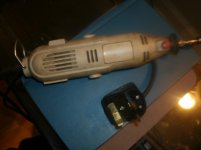
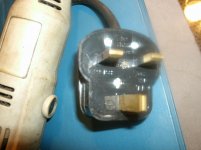
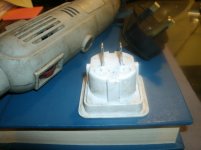
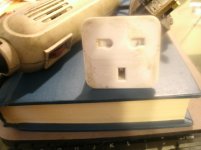
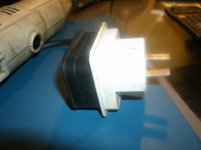
Ok where was I in my thinking, some time back my in-laws bought me a 240 dremel tool, of course it would not work in the states until one day my wife was at the airport and found the following attachment and now it works (sort of) only in the fast speed as the other speeds will not work.

Hope it helps you out...
 

Attachments

  • GEDC2302.jpg
    GEDC2302.jpg
    141.9 KB · Views: 15
  • GEDC2303.jpg
    GEDC2303.jpg
    132.6 KB · Views: 14
  • GEDC2304.jpg
    GEDC2304.jpg
    133 KB · Views: 16
  • GEDC2305.jpg
    GEDC2305.jpg
    137 KB · Views: 18
  • GEDC2311.jpg
    GEDC2311.jpg
    136.1 KB · Views: 14
  • GEDC2317.jpg
    GEDC2317.jpg
    126.9 KB · Views: 15
  • GEDC2318.jpg
    GEDC2318.jpg
    134.7 KB · Views: 14

Virgil Cain

Well-known member
Joined
Feb 26, 2011
Messages
406
You just burned down his house. The neutral is tied to ground and for purposes of this discussion , it is ground. The 120 VAC in one leg flows first from the ground to hot and then the other way. The other hot does the same thing but at exactly the opposite time so the voltage between the two hots is 240 volts. 240 volt devices do not use the neutral at all. They do have a safety ground connection, just like a 120 volt device that is not double insulated. As we all know, the tool will work without the ground prong. Do not confuse this with three phase power where the AC legs are 60 degrees out of phase with each other. If you grab 120 volts off this, you do use the neutral between any of the three legs and neutral. Between any two of the three legs, you get 208 volts, not 240. I do this for a living. The question still remains how tolerant the tool is of the 10 hz frequency change. That varies; consult the manufacturer.

Sent from my SM-G900V using Tapatalk

There is 120 degrees between phases on a three phase power system, not 60. 3 x 120 = 360 degrees, i.e. one complete cycle.
 

Bricol

Member
Joined
Oct 3, 2015
Messages
10
Woody, all you seem to have there is a UK to US adaptor - so its still only running 110V and not the 240V it supposed to have. Those adaptors are sold over here in a twin pack with one that will allow us to plug stuff into mainland Europe sockets. Small capacity step up transformers are sold over here to allow us to run smaller European stuff over in the US - tell your inlaws to pay a visit to Maplins - http://www.maplin.co.uk/p/100va-us-uk-step-up-transformer-up90x

As for the OP - in the UK we also use 110V tools via an isolating transformer for industrial/trade use. That means I can use a US spec Dewalt grinder (with the underside handle switch that I like) over here using one of them. It also means you can usually buy, as already mentioned above, 110V versions of most power tools. It'll just run a little faster over there - like my US grinder runs a little slower over here.
 

6PTsocket

Well-known member
Joined
Mar 12, 2014
Messages
4,593
Woody, all you seem to have there is a UK to US adaptor - so its still only running 110V and not the 240V it supposed to have. Those adaptors are sold over here in a twin pack with one that will allow us to plug stuff into mainland Europe sockets. Small capacity step up transformers are sold over here to allow us to run smaller European stuff over in the US - tell your inlaws to pay a visit to Maplins - http://www.maplin.co.uk/p/100va-us-uk-step-up-transformer-up90x

As for the OP - in the UK we also use 110V tools via an isolating transformer for industrial/trade use. That means I can use a US spec Dewalt grinder (with the underside handle switch that I like) over here using one of them. It also means you can usually buy, as already mentioned above, 110V versions of most power tools. It'll just run a little faster over there - like my US grinder runs a little slower over here.
The real small capacity stuff is not always a transformer but more like a 220 volt lamp dimmer or speed control that has been pre adjusted to produce the equivalent of 120 volts. I have one. They are somewhat load sensitive but the output is screw adjustable.

Sent from my SM-G900V using Tapatalk
 

Milton Shaw

Well-known member
Joined
Feb 11, 2011
Messages
4,838
Some one mentioned that Japan and USA were the only ones on 240 60 cycle. That was part of the problem Japan had after the earthquake/flood. The east coast of Japan is 240/60 cycle USA style electricity but the West cost of Japan is 250/50 cycle. They do not have a national electric grid like the USA and Canada do. The east coast of the country could not use the electricity from the west coast. That was one of the reasons they had so much trouble after the earthquake.
 

6PTsocket

Well-known member
Joined
Mar 12, 2014
Messages
4,593
I was under the impression that Japan's AC line is 100 Volts, 60 hz. After your claims of 230 at 50 hz in some locations and 60hz in orhers, I just Googled it and got numerous hits confirming 100 volts, 60 hz as the Japanese standard. One article mentioned a small amount of 230 distrbution. I remember years ago working on Japanese Hi Fi equipment that had power transformers that had primaries that could be wired for 100, 120 and 230 volts. The 100 volts was listed as the Japanese configuration. The articles i just looked at even described their plug configuration.

Sent from my SM-G900V using Tapatalk
 

John in OH

Well-known member
Joined
Jun 2, 2007
Messages
2,444
Location
SE Ohio & Eastern Virginia
I assume that a "festool domino" is a joiner?? First, assuming it is rated for 240v ...... the real issue here isn't voltage as much as frequency, ie., 50Hz European vs. 60 Hz US. Essentially, the joiner motor will run 20% faster on 60 Hz line frequency than on 50 Hz. If the tool is rated for 50/60 Hz, no problem. But, if not so rated, maybe a problem?????
 
Last edited:

6PTsocket

Well-known member
Joined
Mar 12, 2014
Messages
4,593
The Festool domino is unique to that company. It drills a hole and then expands it into a slot creating a mortose with round ends. The same is done on the piece to be joined. Then a floating tenon goes into the two mortises. Like any mortise and tenon joint it is far stronger than a biscuit or a dowel. The floating tenon is the domino. I would check with Festool if I had any doubts. They are far too expensive to risk damage

Sent from my SM-G900V using Tapatalk
 
To avoid these ads, REGISTER NOW!
Top Bottom