To avoid these ads, REGISTER NOW!

Using copper alumn. Finned water pipe for air system?

steelman351

Member
Joined
Jun 16, 2013
Messages
9
Hello all.
Been a while sense my last visit. Glad to see page still going strong.
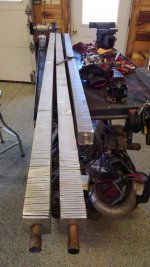
I gutted an old farm house that had hot water heat with 3/4 copper pipe with the full length alumn. Fins to heat the room. Kept 100 ft to use as my air dryer in my shop. Before soldering I tried finding the working pressure. Found the K,L,and M ratings but the M has a wall thickness of .035. this pipe has a wall of .020. the type M is good for 500 psi. But it's 30% thicker. So is it safe to assume that .020 is good for 300psi? Even at 250 I would use it but anything less and I'm worried of rupture.
The tubing I'm trying to use is
3/4 ODx .020 wall. The max pressure of my system is 150.
Thank you for any help.
Jim
 
To avoid these ads, REGISTER NOW!

Kaizen

Well-known member
Joined
Jan 9, 2015
Messages
6,948
Location
New England
Recent discussion on this if you can find it. Someone quotes stats


Sent from my iPhone using Tapatalk
 

59 wagon man

Well-known member
Joined
Oct 25, 2010
Messages
1,589
Location
hollywood fla
the baseboard tubing is extremely soft not made for any kind of pressure. you can get the finned pipe made out of steel if that is what you want
 
To avoid these ads, REGISTER NOW!

metlmunchr

Well-known member
Joined
Sep 10, 2011
Messages
1,280
The thinnest wall fin tube for HW baseboard on the market today has a working pressure rating of 200 psi @ 250*F. You'll find all brands of HW baseboard have the same wall thickness tube.

The manufacturers don't make the tubing, but rather purchase it from Cerro and other manufacturers of copper tube. The tubing is a special in that its made undersized and the fin tube mfgr slides it thru the fins and then runs a mandrel thru it to expand the OD to 7/8" and lock the fins in place.

The copper tube is thin to allow for the fastest heat transfer to the fins. I looked up the heat transfer rate for fin tube vs 3/4" M copper last time this came up, and the finned tube will shed 6X as much heat as a bare copper tube in still air for the same length.

I just checked a piece I have in the garage that's no more than 10 yrs old, and it is .875 OD and .830 ID, so the wall would be .0225, or basically the same as what the OP has. Remember, the working pressure rating of 200 psi is a fraction of the burst pressure, and is a pressure at which you can safely use the tubing on a continual basis.

FWIW, I checked the wall thickness of this same piece in replying to a previous thread and may have overstated the wall thickness then. Its hard to get an accurate measurement by simply checking the wall with a caliper as any distortion at the end of the tube will give a false (too thick) reading. I checked the ID this time using a telescopic gage an inch or so down into the tube, and then checked the OD in the same area, and got much more consistent readings.

Also, to get the benefit of convection cooling via the fins, the tube needs to run horizontal. Doing one of those up and down franzinator things will drastically reduce the heat transfer rate as there will be no air flow across the fins.
 
OP
S

steelman351

Member
Joined
Jun 16, 2013
Messages
9
Thank you to all. Helpful as I could not find any usable information in any of the engineering books or website.
I was not comfortable averaging percentages.
Ill probably make up a destructive test pcs today for a piece of mind.
Thank you.
 

Attachments

  • KIMG1230.jpg
    KIMG1230.jpg
    86.5 KB · Views: 30
To avoid these ads, REGISTER NOW!
Top Bottom