To avoid these ads, REGISTER NOW!

Using Ground as a Neutral at a Distant Sub Panel

Jimt1000

Member
Joined
Aug 1, 2020
Messages
18
Location
D'Hanis, Texas
I have a ranch in S. Texas that was originally developed in the early 1900's. When electrical service came to the rural areas, the ranch was "electrified". Many items are not up to code and I'm slowly going through updating panels, services, etc. I came across a new problem and need to ask the following:

At a remote pump house providing water from an above ground cistern fed by an old windmill, the original electrical install (c. 1950's) to the pump house from another sub panel, which is connected to another sub panel, which is, in turn, fed by the main service panel, has only three wires in the electrical service - two hot legs (120v each) and one ground wire. So, two hots and a ground feeds the remote pump house. The 3/4 HP pump, 240v, is powered by the two hot wires and the pump is grounded by the ground wire. No problem. Now, the original install also placed a 120V receptacle in the pump house for misc., as needed, 120V power. This 120V receptacle, with no ground, was wired using one incoming hot leg and the GROUND as the NEUTRAL. I know that they should have run a dedicated neutral and ground wire separately all the way back to the main service panel, but all they ran was the two hots and a ground wire to this sub panel. It would be a LOT of work to install a dedicated neutral wire to this subpanel. Furthermore, the pump house has functioned now for about 60+ years without a problem and the receptacle is seldom used in the pump house.

Given the breakers are failing/cracked/old and the sub panel itself, is about to rust off the pump house wall, can I just rebuild the sub panel and receptacle using the same wiring (i.e. ground as neutral)? I think this is in violation of the code, but it's worked fine for ever. I'm assuming the reason why there is no shock when using the receptacle, even though you touch the panel (which is connected to the ground), is because the "return" current is being routed back through the ground wire, ultimately, to the main panel, which is a better conductor that a human touching the sub panel in the well house.

OR, could I set another ground rod at the well house sub panel and then create another ground/neutral bus in the sub panel to serve as the neutral for the receptacle. Any solution is easier than running a dedicated neutral to the well house.

Sorry for the long question; any help or advice is appreciated. Thanks.
 
To avoid these ads, REGISTER NOW!

American Locomotive

Well-known member
Joined
Jan 8, 2017
Messages
11,070
Location
Rhode Island
You could re-do it safely without running a dedicated neutral wire by installing a 240v > 120v step-down transformer for the outlet and eliminating the sub-panel.

Or just eliminate the outlet and sub-panel if the only thing in there is a pump.
 
Last edited:

Bert_

Well-known member
Joined
Dec 24, 2016
Messages
9,821
Location
NW Iowa
That was a legal install. Running a separate ground was a recent change. I would have no problem replacing the panel and using the existing feed. I would make sure there is a ground rod. The neutral MUST be bonded to ground with a 3 wire feed.

A picture would probably help us make a recommendation.
 
Last edited:
OP
J

Jimt1000

Member
Joined
Aug 1, 2020
Messages
18
Location
D'Hanis, Texas
Thanks for the replies... A 240 - 120 step down transformer would be easy; good solution. But, Bert, I like the idea of putting a ground rod at the sub panel and then bonding the sub panel along with creating a neutral at the sub panel, if I'm understanding you correctly, too. So, let's see if I have this correct, I'd place a ground rod at the well house where the sub panel is; run a ground wire from the rod into the sub panel itself and bond the sub panel to the new ground rod; and then make a ground/neutral bus in the sub panel which I would connect the incoming service ground wire to along with using this as the neutral to serve the 120V receptacle. Would this still be to code? Sorry I can't provide any pics as I'm not down at the ranch now. Thanks
 

Terry D

Well-known member
Joined
Mar 25, 2015
Messages
2,202
Location
St. Louis, MO.
This is the way it was done before the code change in 2005, I believe. You have to treat it the same way as the power comes in you main panel. If you would put a ground rod(s) out there. Main thing is that everything is bonded together. Your grounding electrode conductor must terminate on the neutral buss or ground buss, and the bonding screw or strap must be installed. As for as any 120 volt loads coming out of the panel, you would run a separate neutral and equipment ground to it. They would be connected together at the neutral buss in the panel, but kept separate at the receptacle or other loads. That is still considered a neutral you have in there now, not a ground. There is no reason for a transformer
 
Last edited:

wyliesdiesels

Well-known member
Joined
Aug 14, 2012
Messages
20,130
Location
Modesto, CA
I have a ranch in S. Texas that was originally developed in the early 1900's. When electrical service came to the rural areas, the ranch was "electrified". Many items are not up to code and I'm slowly going through updating panels, services, etc. I came across a new problem and need to ask the following:

At a remote pump house providing water from an above ground cistern fed by an old windmill, the original electrical install (c. 1950's) to the pump house from another sub panel, which is connected to another sub panel, which is, in turn, fed by the main service panel, has only three wires in the electrical service - two hot legs (120v each) and one ground wire. So, two hots and a ground feeds the remote pump house. The 3/4 HP pump, 240v, is powered by the two hot wires and the pump is grounded by the ground wire. No problem. Now, the original install also placed a 120V receptacle in the pump house for misc., as needed, 120V power. This 120V receptacle, with no ground, was wired using one incoming hot leg and the GROUND as the NEUTRAL. I know that they should have run a dedicated neutral and ground wire separately all the way back to the main service panel, but all they ran was the two hots and a ground wire to this sub panel. It would be a LOT of work to install a dedicated neutral wire to this subpanel. Furthermore, the pump house has functioned now for about 60+ years without a problem and the receptacle is seldom used in the pump house.

Given the breakers are failing/cracked/old and the sub panel itself, is about to rust off the pump house wall, can I just rebuild the sub panel and receptacle using the same wiring (i.e. ground as neutral)? I think this is in violation of the code, but it's worked fine for ever. I'm assuming the reason why there is no shock when using the receptacle, even though you touch the panel (which is connected to the ground), is because the "return" current is being routed back through the ground wire, ultimately, to the main panel, which is a better conductor that a human touching the sub panel in the well house.

OR, could I set another ground rod at the well house sub panel and then create another ground/neutral bus in the sub panel to serve as the neutral for the receptacle. Any solution is easier than running a dedicated neutral to the well house.

Sorry for the long question; any help or advice is appreciated. Thanks.
No a ground rod does not establish a low impedance fault current pathway. Grounding electrodes and EGCs/ground wires are 2 different animals.

Is the water line metallic? If so, then you will need 4-wires.

A detached structure also requires 2 grounding electrodes regardless of 3-wire or 4-wire feeder

You could re-do it safely without running a dedicated neutral wire by installing a 240v > 120v step-down transformer for the outlet and eliminating the sub-panel.

Or just eliminate the outlet and sub-panel if the only thing in there is a pump.

He would still need the subpanel since he needs 1 circuit for the pump and 1 for the transformer.

That was a legal install. Running a separate ground was a recent change. I would have no problem replacing the panel and using the existing feed. I would make sure there is a ground rod. The neutral MUST be bonded to ground with a 3 wire feed.

A picture would probably help us make a recommendation.

Not legal if the water line is metallic. Never was. The code that allowed 3-wire feeders specifically stated that there can be no other parallel metallic pathways.
 
Last edited:

wyliesdiesels

Well-known member
Joined
Aug 14, 2012
Messages
20,130
Location
Modesto, CA
Thanks for the replies... A 240 - 120 step down transformer would be easy; good solution. But, Bert, I like the idea of putting a ground rod at the sub panel and then bonding the sub panel along with creating a neutral at the sub panel, if I'm understanding you correctly, too. So, let's see if I have this correct, I'd place a ground rod at the well house where the sub panel is; run a ground wire from the rod into the sub panel itself and bond the sub panel to the new ground rod; and then make a ground/neutral bus in the sub panel which I would connect the incoming service ground wire to along with using this as the neutral to serve the 120V receptacle. Would this still be to code? Sorry I can't provide any pics as I'm not down at the ranch now. Thanks

Youre not creating a neutral at the subpanel. The neutral is the wire in the feeder. Neutral return current does not transfer much on ground rods because the earth is a poor conductor.

The neutral is also carrying the ground.

The reason for the grounding electrodes is to shunt lightning.

This is the way it was done before the code change in 2005, I believe. You have to treat it the same way as the power comes in you main panel. If you would put a ground rod(s) out there. Main thing is that everything is bonded together. Your grounding electrode conductor must terminate on the neutral buss or ground buss, and the bonding screw or strap must be installed. As for as any 120 volt loads coming out of the panel, you would run a separate neutral and equipment ground to it. They would be connected together at the neutral buss in the panel, but kept separate at the receptacle or other loads.

Code change was in 2008....
 
OP
J

Jimt1000

Member
Joined
Aug 1, 2020
Messages
18
Location
D'Hanis, Texas
Thanks for the replies and info... Of note, the water lines coming out of the well house are all PVC (i.e. non-metallic). Thanks again as the above replies gives me the info I need to proceed. Thanks again to all for the quick and informative replies. Regards
 

Bert_

Well-known member
Joined
Dec 24, 2016
Messages
9,821
Location
NW Iowa
The wire feeding this has a neutral not ground. You would bond the ground to the neutral.

This is assuming it wasn't fed with something like UF. If that's the case then it was never legal to have 120 off it.
 

theoldwizard1

Well-known member
Joined
Feb 22, 2011
Messages
43,433
Location
SE MI
Given the breakers are failing/cracked/old and the sub panel itself, is about to rust off the pump house wall, can I just rebuild the sub panel and receptacle using the same wiring (i.e. ground as neutral)?

3 wire systems were not more likely to cause shock hazards. Separating was originally done for very dry location, but it was found to improve lightning protection. There are millions of homes and other structures that are built exactly like your situation, and you don't hear anything about people being shocked or home being burned down.

Most "codes" (not just NEC) allow so leeway for "grandfathered" situation. Minor upgrades (like just adding a breaker) probably would not require a new sub panel and feeder wire. The call is up to the inspector.

If the work is not going to be inspected, just install a new box and leave ground and neutral bonded at the box.
 

theoldwizard1

Well-known member
Joined
Feb 22, 2011
Messages
43,433
Location
SE MI
I like the idea of a fused disconnect (like for a A/C compressor). Probably not legal to connect a transformer to the output in addition to the pump. Safety would depend on the size of the fuses (20A max) and I would use a 20A GFCI outlet labeled "no equipment ground".
 

wyliesdiesels

Well-known member
Joined
Aug 14, 2012
Messages
20,130
Location
Modesto, CA
The wire feeding this has a neutral not ground. You would bond the ground to the neutral.

This is assuming it wasn't fed with something like UF. If that's the case then it was never legal to have 120 off it.

The OP should really provide some pics before we proceed on speculating any further. It could very well be 2 wire w/ gr UF. Ive seen that many times feeding pump houses with 120v outlets. really bad wiring....

3 wire systems were not more likely to cause shock hazards. Separating was originally done for very dry location, but it was found to improve lightning protection. There are millions of homes and other structures that are built exactly like your situation, and you don't hear anything about people being shocked or home being burned down.

Totally incorrect. They ARE more likely to cause shock hazards due to the bonded neutral in the subpanel. If the neutral feeder develops a bad connection and someone touches the enclosure standing on concrete or touching a metallic water line, the neutral return current can flow through them due to the bond.... the CMPs recognized this and so they changed the code in 2008. The same was recognized for 3-wire dryer and stove receptacles. So code changed in 1996 mandating 4-wire receptacles for those...

lightning had nothing to do with isolating the neutral.

Most "codes" (not just NEC) allow so leeway for "grandfathered" situation. Minor upgrades (like just adding a breaker) probably would not require a new sub panel and feeder wire. The call is up to the inspector.

If the work is not going to be inspected, just install a new box and leave ground and neutral bonded at the box.

wiring should be done properly regardless of whether there will be an inspection... smh

also, we dont know if the wiring to the panel was done properly (insulated neutral or bare), if bare then its a ground and not a neutral and thus the outlet should not be there.
 

klassenl

Well-known member
Joined
Feb 20, 2016
Messages
716
Location
Southern Alberta
Totally incorrect. They ARE more likely to cause shock hazards due to the bonded neutral in the subpanel. If the neutral feeder develops a bad connection and someone touches the enclosure standing on concrete or touching a metallic water line, the neutral return current can flow through them due to the bond....

If, if, if. If this. If that. If someone comes along and pulls the cover off and touches the energized parts they might die.....if....if.....if.

When you play the if game long enough nothing is safe.
 

wyliesdiesels

Well-known member
Joined
Aug 14, 2012
Messages
20,130
Location
Modesto, CA
If, if, if. If this. If that. If someone comes along and pulls the cover off and touches the energized parts they might die.....if....if.....if.

When you play the if game long enough nothing is safe.

you can mock all you want, but as a service electrician, i have seen failed neutrals and energized plumbing, washing machine chassis, etc that WAS shocking people because of the bonded neutral that had failed upstream.
 

sberry

Banned
Joined
Jun 18, 2005
Messages
35,747
Location
Brethren, Michigan
I agree, only one way to do this right. Agree with the concept that it needs to be done as if it was going to be inspected.
Had someone with a truck the other day,,, says,,, we dont need inspection. I said,,, true you dont but because its exempt from that doesnt mean you are exempt from the rest of it, needs legal tires and lights.
you can mock all you want, but as a service electrician, i have seen failed neutrals and energized plumbing, washing machine chassis, etc that WAS shocking people because of the bonded neutral that had failed upstream.
I was in an old house a while back, failed short circuit , wouldnt have blown a fuse and a knob and tube wire pulled out during a hatchet plumb job laid right across the pipe to the bathtub, half inch more and a bare wire would have laid on the pipe.
 

mike93lx

ALLIANCE MEMBER
Joined
Dec 9, 2013
Messages
38,287
Location
Richmond, VA
why do you need 120v there? if it is for service, I would abandon plans for 120 and just run cordless tools. Clean up the wiring in the pump house, add ground rods and move on.

for the cost of running a new feeder, you could probably buy several new cordless tools, or even a small 2kw inverter generator that would be useful for other stuff as well.
 
OP
J

Jimt1000

Member
Joined
Aug 1, 2020
Messages
18
Location
D'Hanis, Texas
Thanks for all the responses folks... Good information and this will help me journey forward. BTW, I need to have the 120V receptacle in the pump house to serve a heating element line in those very few instances of freezing weather. The overall discussion above of the 3 wire vs 4 wire is very interesting and makes me wonder on this history of the evolution of the NEC on this subject (which I'm going to become more educated on). Regardless, given the long-standing history of this pump house function well without any troubles and certainly not endangering me or anyone else servicing the pump and piping (all PVC) in the pump house now for 60+ years, I think I'll simply rebuild the sub panel and receptacle like it exists now. As recommended above, I'll be sure the have a good bonded connection in the sub panel (ground/neutral bond with panel) and leave it alone. Thanks again for all the input - great discussion.
 
To avoid these ads, REGISTER NOW!

wyliesdiesels

Well-known member
Joined
Aug 14, 2012
Messages
20,130
Location
Modesto, CA
Thanks for all the responses folks... Good information and this will help me journey forward. BTW, I need to have the 120V receptacle in the pump house to serve a heating element line in those very few instances of freezing weather. The overall discussion above of the 3 wire vs 4 wire is very interesting and makes me wonder on this history of the evolution of the NEC on this subject (which I'm going to become more educated on). Regardless, given the long-standing history of this pump house function well without any troubles and certainly not endangering me or anyone else servicing the pump and piping (all PVC) in the pump house now for 60+ years, I think I'll simply rebuild the sub panel and receptacle like it exists now. As recommended above, I'll be sure the have a good bonded connection in the sub panel (ground/neutral bond with panel) and leave it alone. Thanks again for all the input - great discussion.

What kind of wire feeds the pump house?
 

Vicious_Cycle

Well-known member
Joined
Jan 11, 2006
Messages
360
Location
Chardon, OH
Not sure if this would be safe and code compliant, but maybe one of you in the know would be willing to educate me.
Why couldn't the OP drive a ground rod at the pump house and use it to ground the subpanel and the 120v outlet, and NOT bond the neutral and ground together at the subpanel?
 

mike93lx

ALLIANCE MEMBER
Joined
Dec 9, 2013
Messages
38,287
Location
Richmond, VA
Not sure if this would be safe and code compliant, but maybe one of you in the know would be willing to educate me.
Why couldn't the OP drive a ground rod at the pump house and use it to ground the subpanel and the 120v outlet, and NOT bond the neutral and ground together at the subpanel?

Read wylie's posts and you should understand
 

wyliesdiesels

Well-known member
Joined
Aug 14, 2012
Messages
20,130
Location
Modesto, CA

theoldwizard1

Well-known member
Joined
Feb 22, 2011
Messages
43,433
Location
SE MI
... wiring should be done properly regardless of whether there will be an inspection... smh
First, a lot of it depends on the inspector and what he will allow to be grandfathered. Should adding a new branch circuit by installing a tandem (proper manufacturer) be allowed. How about 2 circuits ? How about 4 ?

Second, the above example was at 70+ year old house that had no grounds in the original wiring. The load center had been upgraded in the 80s to a QO, but was full. A kitchen remodel with up to code wiring required 4 new circuits and replace the load center, feeder from the meter, proper ground rods would have been a budget breaker.

The house was sold a few years later and I assume it was inspected with its 4 tandem breakers. (Segue - Older (pre-90s?) QO load centers do not accept the current QO tandem breaker. They have been out of production for years, but NOS are still available.)
 
OP
J

Jimt1000

Member
Joined
Aug 1, 2020
Messages
18
Location
D'Hanis, Texas
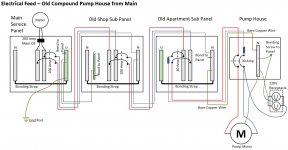
Folks, after going back to the Ranch this past week, I took the covers off the multiple sub panels and the main, took pictures, and was able to construct the attached schematic diagram of the wiring I have going to the Pump House sub panel. Again, this has been added on and modified starting back in the late 50's.

I'd appreciate y'alls having a look at this sketch. The Main Service Panel feed to the Old Shop Sub Panel looks good to me (i.e. in accordance with current code), but when we go from the Old Shop to the Old Apartment sub panel, we're using a 3 wire feed (2 hots and a neutral) and at the Old Apartment sub panel, the ground, neutral, and panel are all bonded together but there is no ground rod. From the replies to this thread, it seems that prior to the code being changed in circa 2005/2008, this was OK as long as a ground rod (or grounding system) was installed at the sub panel.

My next issue is that from the Old Apartment sub panel to the Pump House sub panel there are two hots and a bare copper wire feeding the Pump House. Therein, the bare copper wire is connected to the neutral bus bar which is bonded to the panel. So, at the Pump House, the neutral and ground are combined or bonded, but without any external ground rod or grounding system. Furthermore, the 120V outlet within the Pump House is served off one of the hot feeds and the neutral and grounds are fed off the same bus bar (which is bonded to the panel). The Pump motor ground (and pump frame) is well bonded back to the panel as I did check for the complete bonding of all equipment in the Pump House.

Now, this system has been working for over 50+ years without a problem and we've had plenty of tests of pump failures, etc. whereby we've done lots of pump replacements, etc. without any problems. BTW, the Pump House has NO metallic water lines (PVC only) and is isolated from the other structures. In fact, every panel is in a separate, detached, structure.

So, while functional and it works, is this all to code? If not, can I get the system to code by simply installing a ground rod at the Old Apartment panel and bonding that new ground rod to both the Neutral and Ground bus bars? What about the feed to the Pump House considering the bare copper wire acting as the neutral feed? While not to code now, was it ever to code? Can I get it to code by installing a ground rod at the Pump House panel similarly to the condition at the Old Apartment sub panel?

Lastly, this is a working ranch in a very remote location and all the electrical work has never been, and will never be (at least not in the near future) inspected for compliance. Having said that, I want to be sure it is safe AND functional. Safety is the key word here too.

Thanks for your insight, thoughts, and replies. Regards
 

Attachments

  • Pump House from Main Feed.jpg
    Pump House from Main Feed.jpg
    141.7 KB · Views: 86

theoldwizard1

Well-known member
Joined
Feb 22, 2011
Messages
43,433
Location
SE MI
So, while functional and it works, is this all to code? If not, can I get the system to code by simply ...
Not to code and there is no "simple" (low cost) way to make it code compliant !

The goal is to get a 120V outlet at the pump house. My biggest concern is running that outlet piggybacked on to a 30A breaker/fuse. Sure a dead short will trip it, but a 25A load will melt the outlet or connecting wires.

Given the breakers are failing/cracked/old and the sub panel itself, is about to rust off the pump house wall, can I just rebuild the sub panel and receptacle using the same wiring (i.e. ground as neutral)?
Spend a few dollar more and buy 4-6 place weather resistant breaker box. Use 30A 240V breaker for the pump and single 15A 120V breaker for the outlet.

A ground rod for the motor case and the ground pin on the 120V outlet is not a bad idea, but you need a box that has separate ground and neutral bars (no bonding strap - I think this is pretty much standard these days).
 
Last edited:

MrSurly

Well-known member
Joined
Jan 15, 2014
Messages
1,671
Location
East Texas
A possible simpler solution: Replace the pump with a 120V unit sized for your wire and re-purpose the existing wire in 120 volt duty, complete with a proper hot/neutral and ground that is already in place.

maybe reduced pump effectiveness, but safer/cheaper.


Can reach code compliance without much trouble. GFCI duplex receptacle, get rid of two bonding straps and move on to another project.
 
Last edited:

wyliesdiesels

Well-known member
Joined
Aug 14, 2012
Messages
20,130
Location
Modesto, CA
Folks, after going back to the Ranch this past week, I took the covers off the multiple sub panels and the main, took pictures, and was able to construct the attached schematic diagram of the wiring I have going to the Pump House sub panel. Again, this has been added on and modified starting back in the late 50's.

Ok lets break it down here....

I'd appreciate y'alls having a look at this sketch. The Main Service Panel feed to the Old Shop Sub Panel looks good to me (i.e. in accordance with current code),...

It is actually INCORRECT. You have a 4-wire feeder here but the neutral bus is bonded to the can. This is a no-no!!! :shocking:

Since its 4-wire, you can remove the bond to the neutral bar. This is an easy fix.

but when we go from the Old Shop to the Old Apartment sub panel, we're using a 3 wire feed (2 hots and a neutral) and at the Old Apartment sub panel, the ground, neutral, and panel are all bonded together but there is no ground rod.From the replies to this thread, it seems that prior to the code being changed in circa 2005/2008, this was OK as long as a ground rod (or grounding system) was installed at the sub panel.....

Ok this is where details are important. Since the old shop subpanel and old apartment subpanel are in different structures, the 3-wire feeder is up to code if wired PRE-2008 (not 2005) as long as there are no parallel metallic pathways such as water and gas lines, communication lines, etc.

The part you said about grounding system and ground rods has nothing to do with the code allowing 3-wire feeder to detached. the EGC in this case is ran over the neutral and the grounding electrodes are required regardless. Keep in mind, the grounding electrodes do not establish an EGC, they are for shunting lightning.

My next issue is that from the Old Apartment sub panel to the Pump House sub panel there are two hots and a bare copper wire feeding the Pump House. Therein, the bare copper wire is connected to the neutral bus bar which is bonded to the panel......

This is definitely not to code and never was. The bare conductor CANNOT be used as a neutral. This creates a shock potential and needs to be corrected immediately.

So, at the Pump House, the neutral and ground are combined or bonded, but without any external ground rod or grounding system. Furthermore, the 120V outlet within the Pump House is served off one of the hot feeds and the neutral and grounds are fed off the same bus bar (which is bonded to the panel). The Pump motor ground (and pump frame) is well bonded back to the panel as I did check for the complete bonding of all equipment in the Pump House.

There needs to be grounding electrodes on this panel since its detached but this DOESNT fix the bare neutral shock hazard issue. Remember, grounding electrodes are not a substitute for the low impedance pathway for fault current known as an equipment grounding conductor/EGC.

Only way to fix this is by either A) switching pump and panel to 120v only, moving 1 ungrounded/hot conductor to neutral bar and bare conductor to ground bar OR B) running a new 4-wire feeder.

Personally, I would run a new 4-wire feeder and keep the 240v pump.

Now, this system has been working for over 50+ years without a problem and we've had plenty of tests of pump failures, etc. whereby we've done lots of pump replacements, etc. without any problems. BTW, the Pump House has NO metallic water lines (PVC only) and is isolated from the other structures. In fact, every panel is in a separate, detached, structure.

You've just gotten lucky here and not touched something that is energized at the same time as touching something that is grounded.

So, while functional and it works, is this all to code? If not, can I get the system to code by simply installing a ground rod at the Old Apartment panel and bonding that new ground rod to both the Neutral and Ground bus bars?

NO! Adding a ground rod there will not fix the other code issues. You actually need TWO grounding electrodes at each panel since they are all detached.

Keep in mind, the 3-wire feeder to that panel is up to code since 3-wire feeders were legal pre-2008.

What about the feed to the Pump House considering the bare copper wire acting as the neutral feed? While not to code now, was it ever to code? Can I get it to code by installing a ground rod at the Pump House panel similarly to the condition at the Old Apartment sub panel?

NO! that was NEVER to code. And NO adding a ground rod will NOT fix the bare neutral issue. You are misunderstanding what a ground rod does. A ground rod does NOT change the lack of insulation on a neutral conductor. You need to do one of the options i mentioned above. There is no way around this.

Lastly, this is a working ranch in a very remote location and all the electrical work has never been, and will never be (at least not in the near future) inspected for compliance. Having said that, I want to be sure it is safe AND functional. Safety is the key word here too.

Thanks for your insight, thoughts, and replies. Regards

Regardless of whether there is an inspection or not, the wiring should still be done properly and it is not. You have a dangerous shock hazard present that needs to be correct especially with animals present.
 
Last edited:

wyliesdiesels

Well-known member
Joined
Aug 14, 2012
Messages
20,130
Location
Modesto, CA
Not to code and there is no "simple" (low cost) way to make it code compliant !

The goal is to get a 120V outlet at the pump house. My biggest concern is running that outlet piggybacked on to a 30A breaker/fuse. Sure a dead short will trip it, but a 25A load will melt the outlet or connecting wires.

Spend a few dollar more and buy 4-6 place weather resistant breaker box. Use 30A 240V breaker for the pump and single 15A 120V breaker for the outlet.

A ground rod for the motor case and the ground pin on the 120V outlet is not a bad idea, but you need a box that has separate ground and neutral bars (no bonding strap - I think this is pretty much standard these days).

This is totally incorrect. A ground rod is NOT a substitute for an EGC/equipment grounding conductor. Connecting the frame of a motor or the ground screw on an outlet to a grounding electrode is dangerous advice. Both of these need to go to the ground bus or neutral bus (if main service or 3-wire feeder) of the panel. :shocking:
 

wyliesdiesels

Well-known member
Joined
Aug 14, 2012
Messages
20,130
Location
Modesto, CA
A possible simpler solution: Replace the pump with a 120V unit sized for your wire and re-purpose the existing wire in 120 volt duty, complete with a proper hot/neutral and ground that is already in place.

maybe reduced pump effectiveness, but safer/cheaper.


Can reach code compliance without much trouble. GFCI duplex receptacle, get rid of two bonding straps and move on to another project.

Bonding strap needs to remain on the panels with 3-wire feeders
 

theoldwizard1

Well-known member
Joined
Feb 22, 2011
Messages
43,433
Location
SE MI
This is totally incorrect. A ground rod is NOT a substitute for an EGC/equipment grounding conductor.
Never said it was. Never meant to IMPLY it was !

Connecting the frame of a motor or the ground screw on an outlet to a grounding electrode is dangerous advice. Both of these need to go to the ground bus or neutral bus (if main service or 3-wire feeder) of the panel. :shocking:

Look, we all know the OP is NOT going to make his electrical service "code compliant". That is life on a farm/ranch. My suggestion for using a ground rod was "it is better than nothing" if he plans to use the ground wire back to the previous panel as a neutral.
 

theoldwizard1

Well-known member
Joined
Feb 22, 2011
Messages
43,433
Location
SE MI
Given the breakers are failing/cracked/old and the sub panel itself, is about to rust off the pump house wall,

You could re-do it safely without running a dedicated neutral wire by installing a 240v > 120v step-down transformer for the outlet and eliminating the sub-panel.

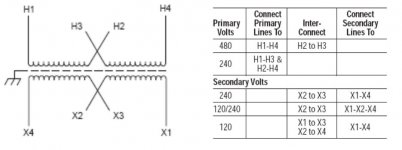
I just re-read this whole thread for about the 3rd or 4 time. Am Loco has a good suggestion, but I would start by replacing the old sub panel with a new 4-6 slot (8-12 breaker) wired for 240V ONLY (no neutral) ! Run the pump off of a new 30A 240V breaker. Run the transformer off of a second 15A 240V breaker. The output of the transformer is the hot and neutral for the outlet.

Acme Electric T253011S Dry-Type Distribution Transformer - Amazon $100 (ignore the description on Amazon - from the manufacture "Low Voltage Distribution Transformer - Single Phase, 240x480 - 120/240V, 1.5kVA")
 

Attachments

  • Capture.jpg
    Capture.jpg
    43.7 KB · Views: 8
Last edited:

Bert_

Well-known member
Joined
Dec 24, 2016
Messages
9,821
Location
NW Iowa
I just re-read this whole thread for about the 3rd or 4 time. Am Loco has a good suggestion, but I would start by replacing the old sub panel with a new 4-6 slot (8-12 breaker) wired for 240V ONLY (no neutral) ! Run the pump off of a new 30A 240V breaker. Run the transformer off of a second 15A 240V breaker. The output of the transformer is the hot and neutral for the outlet.

Acme Electric T253011S Dry-Type Distribution Transformer - Amazon $100 (ignore the description on Amazon - from the manufacture "Low Voltage Distribution Transformer - Single Phase, 240x480 - 120/240V, 1.5kVA")

View attachment 1041354

If I am reading this right, 240V would go in on A and C and 120 would come out on X1 and X2 or X3 and X4. DO NOT GROUND X2 or X3 !

Ground is ground for everybody going back to the previous sub panel.

Probably still not "code compliant" because neutral and ground are NEVER bonded. Use a GFCI outlet. It will trip if there is a difference in current flow between X1 (120V hot) and X2 (120V neutral).

I've done that a couple times when the pump feed was 240v 2wire, no neutral or ground.

Description looks fine to me on that transformer :dunno:
You would wire X1 and X3 together, then X2 and X4 together. That would give you 120v at full capacity. One side needs to be bonded to ground. That side will be the neutral.
 

wyliesdiesels

Well-known member
Joined
Aug 14, 2012
Messages
20,130
Location
Modesto, CA
Never said it was. Never meant to IMPLY it was !

Look, we all know the OP is NOT going to make his electrical service "code compliant". That is life on a farm/ranch. My suggestion for using a ground rod was "it is better than nothing" if he plans to use the ground wire back to the previous panel as a neutral.

It is better than nothing?

No its not. Its actually worse than doing nothing because its a waste of money. It does nothing to accomplish what the OP needs nor does it do anything at all other than lead someone to falsely believe it did something.

Connecting a ground rod to a motor frame or ground screw on an outlet is stupid and dangerous advice. It doesnt provide fault current protection. End of story.

I just re-read this whole thread for about the 3rd or 4 time. Am Loco has a good suggestion, but I would start by replacing the old sub panel with a new 4-6 slot (8-12 breaker) wired for 240V ONLY (no neutral) ! Run the pump off of a new 30A 240V breaker. Run the transformer off of a second 15A 240V breaker. The output of the transformer is the hot and neutral for the outlet.

Acme Electric T253011S Dry-Type Distribution Transformer - Amazon $100 (ignore the description on Amazon - from the manufacture "Low Voltage Distribution Transformer - Single Phase, 240x480 - 120/240V, 1.5kVA")

View attachment 1041354

If I am reading this right, 240V would go in on A and C and 120 would come out on X1 and X2 or X3 and X4. DO NOT GROUND X2 or X3 !

Ground is ground for everybody going back to the previous sub panel.

Probably still not "code compliant" because neutral and ground are NEVER bonded. Use a GFCI outlet. It will trip if there is a difference in current flow between X1 (120V hot) and X2 (120V neutral).

That would be a separately derived system and therefore one would bond neutral output on transformer. Ive done this before and there is no issue with it.

Tie X1 to X3 and X2 to X4. one is hot leg, one is neutral.
 
Last edited:
OP
J

Jimt1000

Member
Joined
Aug 1, 2020
Messages
18
Location
D'Hanis, Texas
To All:
Many thanks for the detailed information... I see I have some work ahead of me. I need to take this information provided (again, thanks gents) and develop a roadmap or plan to accomplish a conversion of this system to a safe install.
I'll revert back once I've studied the info herein more.
Best Regards, Jim
 
To avoid these ads, REGISTER NOW!
Top Bottom