To avoid these ads, REGISTER NOW!

VCT on slopes

93 Vette

Member
Joined
Mar 14, 2005
Messages
18
Location
Ellicott City, MD
Hi,

I currently have VCT down in my garage. I have had it down for about a year now a love it. I'm moving next month and the house I'm buying has a 3 1/2 car garage. The problem is that the current owner had the builder raise the concrete floor in certain areas to be level with the floor in the house. They did this to allow their daughter who uses a wheelchair to easily be able to go from the garage into the house. My question has to do with VCT on these sloped surfaces. Do you think that the tile can take the transistion from level to sloped and from sloped up to level again without cracking. It's not a major transition but more of a slight transition. I know that I can warm up the tile during installation but I wonder if it will start cracking once it is room temperature again and being walked or driven on. What does everyone think?

Thanks for everyone’s help with this one.
 
To avoid these ads, REGISTER NOW!

OldCarGuy

Well-known member
Joined
Nov 29, 2005
Messages
2,000
Location
Ohio
I have used Armstrong industrial 1\8” grade vinyl tile in a similar manner without any long-term problems cropping up. I first softened then up in an oven making them rather flexible before I laid them down.
 
OP
9

93 Vette

Member
Joined
Mar 14, 2005
Messages
18
Location
Ellicott City, MD
OldCarGuy said:
I have used Armstrong industrial 1\8” grade vinyl tile in a similar manner without any long-term problems cropping up. I first softened then up in an oven making them rather flexible before I laid them down.

Thanks. That is exactly what I wanted to hear and thanks for the tip about using the oven.

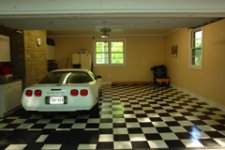
Here is a bad picture of my current garage from a year ago after laying the tile. I'll have to post some more recent photos at some point.
 

Attachments

  • VCT Garage Floor.jpg
    VCT Garage Floor.jpg
    40.5 KB · Views: 110

boiler7904

Well-known member
Joined
Apr 4, 2006
Messages
3,414
Location
NW IN
VCT has a bit of memory to it meaning that it wants to move back to its neutral position if flexxed. My guess is that the VCT will eventually seperate from the concrete creating a void if installed the way you are describing. If a void is created, repeated loading (walking, rolling wheels, etc.) will eventually crack the tile. If you want to put the tile on the ramp, why not cut the tiles and **** them together at the transition point(s) so that there is less chance of eventual flexing. The cutoff from one side of the transition becomes the piece for the otherside. If you're using one color, the pattern would not be thrown off. Either method will throw a pattern off eventually. One other thing, level VCT can get pretty slippery when wet, pitched VCT on a ramp could become a nightmare.
 
Last edited:

Itzkwik

Well-known member
Joined
Mar 19, 2006
Messages
539
Location
Montpelier, VA
As others have said, as long as there are no voids under the tiles, you won't have a problem with them cracking. I've put down a lot of VCT and never had a problem with cracking if installed correctly. Use a propane or mapp torch to heat the tiles on the back side when you are ready to lay them. They will easily conform to the surface you are putting them on. Makes them much easier to cut as well. Check with your local tile store too. You can get better adhesive than they sell at the box stores.
 
To avoid these ads, REGISTER NOW!
OP
9

93 Vette

Member
Joined
Mar 14, 2005
Messages
18
Location
Ellicott City, MD
That was the other way I thought about doing it- cutting the tiles at the transition so that it wouldn't be such a dramatic curve for the tile.

The VCT being slippery on the sloped portion was my other concern. I figure I could maybe put some rubber mats down on those sections to reduce that a little.

Thanks for your reply.
 
OP
9

93 Vette

Member
Joined
Mar 14, 2005
Messages
18
Location
Ellicott City, MD
Itzkwik said:
As others have said, as long as there are no voids under the tiles, you won't have a problem with them cracking. I've put down a lot of VCT and never had a problem with cracking if installed correctly. Use a propane or mapp torch to heat the tiles on the back side when you are ready to lay them. They will easily conform to the surface you are putting them on. Makes them much easier to cut as well. Check with your local tile store too. You can get better adhesive than they sell at the box stores.

Thanks Itzkwik - Your comments make me feel even better about tackling the floor in my new garage. Thanks for the tip about the better adhesive. I'll check it out.

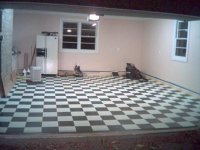
Here is another picture of my current garage. I thought I had more on my home computer but I guess I don't. I guess I need to take some more before I move next month.
 

Attachments

  • Garage.jpg
    Garage.jpg
    54.5 KB · Views: 80

camarojoe

Well-known member
Joined
Oct 19, 2005
Messages
141
Location
PA
Sorry, but I'm gonna have to say I don't think it will take any type of transition like that, at least not right in the middle of a tile... you may be able to cut it so 2 tiles **** together at the start of the slope, but each individual piece of tile needs to be on a very flat surface. I found that even smooth concrete with any type of slight bump will cause the tile to crack wherever the bump is. I had slightly sloped drains in my floor, and had to fill them up level with cement because there was no way the tile was gonna follow the gradual slope without cracking. The rule of thumb for VCT is the flatter and smoother the subsurface, the better it works.
 
OP
9

93 Vette

Member
Joined
Mar 14, 2005
Messages
18
Location
Ellicott City, MD
camarojoe said:
Sorry, but I'm gonna have to say I don't think it will take any type of transition like that, at least not right in the middle of a tile... you may be able to cut it so 2 tiles **** together at the start of the slope, but each individual piece of tile needs to be on a very flat surface. I found that even smooth concrete with any type of slight bump will cause the tile to crack wherever the bump is. I had slightly sloped drains in my floor, and had to fill them up level with cement because there was no way the tile was gonna follow the gradual slope without cracking. The rule of thumb for VCT is the flatter and smoother the subsurface, the better it works.

Thanks for your reply. I may have to do what you suggest and **** two tiles or one cut tile up against each other at the start of the slope to make it work. Thanks.
 
To avoid these ads, REGISTER NOW!
Top Bottom