To avoid these ads, REGISTER NOW!

Ventillation in an energy efficient garage

wssix99

Well-known member
Joined
Mar 2, 2011
Messages
5,156
Location
Chicago, IL
This thread is to document my journey and toil to tweak the ventilation in my energy efficient garage. Hopefully the experience will help others going with a highly insulated/heated garage. If anyone has suggestions on how I can better use my equipment at hand (before I make any additional HVAC or other investments), I'm definitely open to suggestions.


The situation:
My garage is an attached ICF garage, (8" core) slab-on-grade, with 2" of insulation under the slab, a radiant floor, R-22 insulated doors, 14' wood truss ceiling (with open cell foam insulation), and a HRV for CO ventilation.

View media item 34970
20150525GarageOpen-vi.jpg


Setting out to build the house, we wanted to keep the garage as heat-efficient as possible. Our first winter with the garage fully trimmed-out has been great! Setting the heat for 50 degrees, we've spent around $5-15 a month to heat the garage. (depending on the month) Our first summer... has been absolute hell. This heat-efficient strategy has backfired royally and the temperatures have shot up to 90-100 degrees in the garage, even when its 70 degrees outside! (To add insult to injury, it's been humid as hell, also.) I checked outside with our thermal camera and the garage ICF walls are radiating at least 2 degrees warmer than the rest of the house at night...
animated-smileys-devil-008.gif


In our design, we did not account for all the excess heat and humidity the cars bring in when parked after running around the world. (It turns out to be a lot of heat!) The garage is holding on to that heat and the HRV is doing its job/not letting go of it.

We've been racking up a huge electric bill this summer by running dehumidifiers in the garage in an attempt to get some control over the humidity situation, to no avail. We aren't making a dent - but are making about 3 gallons of fresh water every day.

I've been stressing out all summer about needing to install a mini-split next summer, but may have an alternative that seems to be working...
 
Last edited:
To avoid these ads, REGISTER NOW!
OP
W

wssix99

Well-known member
Joined
Mar 2, 2011
Messages
5,156
Location
Chicago, IL
I looked closer at the HRV, a Lifebreath RCN95, which we sized for CO elimination. (We currently run it whenever the lights are on.) The lights are controlled by the garage door openers and the wall switches, so we get fresh air whenever the space is occupied or for 10 minutes after a car leaves the garage.

View media item 63233
With 100 degree air in the garage, 80 degree air outside, it was returning 98 degree air to the space = not good. As can be seen in the following comparison of our garage HRV exhaust vent to that of an F35 jet, our garage is (obviously) hotter than hell.

F35:
View media item 63229
Our Garage:
View media item 63230View media item 63231
I found that I could remove the heat exchanger module, which I have to clean every season anyway, and replace it with a piece of sheet metal to divide the exhaust and supply side of the fan box.

Heat Exchanger:
View media item 63236
From there, all I had to do was rig up some additional metal to hold the air filters in place and we can now by-pass the heat-exchanging feature of the HRV.

Divider and Filter Holder:
View media item 63237
We saw immediate results and the air being vented inside came down to 90 degrees right away. (I expect that is mostly due to the duct work in the ceiling still being very hot.) Either way - I'll take the 10 degree differential over the 2 degree differential all day long and hope for more improvement in the coming days.

We are now running the fan box (without the heat exchanger) 24 hours a day and the temperature has already come down 5 degrees after the first 3 days of constant running. Hopefully the improvement will continue until we can reach ambient temperatures and humidity outside - but I expect it will take a couple of weeks for us to cool the concrete mass walls in the garage. (They really like to hold on to the heat!)
 
Last edited:
OP
W

wssix99

Well-known member
Joined
Mar 2, 2011
Messages
5,156
Location
Chicago, IL
I should probably also mention that one of the reasons why one wall is not drywalled is that we anticipated some after-the-fact engineering and experimentation in this area. (So, adding controls and other utilities to support making the space comfortable will be easy to do, if we need to.)

If the temperatures come down to comfortable levels in the next few weeks, I am planning on:
- For Summer: Running the HRV off of a programmable control and then temporarily overriding that program (with a relay) to high-speed ventilation during the comings-and-goings of cars (for CO control) or when the space is occupied (for comfort). I expect running the fans fully over night in the cooler air will help keep the mass walls as cold as possible and get the most benefit throughout the day. I expect we'll probably also need to start the active venting in the afternoon when cars start coming home.
- For Winter: Turing off the programmable control during the winter, when the heat-exchanger is in the HRV, and then only relying on the relay override for ventilation when cars are moving for the lights are on.
 
Last edited:

Ole Slewfoot

Well-known member
Joined
Feb 22, 2016
Messages
5,098
Location
Freedom, CA
the timed run on your exhaust fan isn't optimal.
You can get a temp/co2 controller from a hydroponic supply, although you will probably need to reverse the CO2 output.

Also shadecloth can take big bite out of your solar hit.
 

RobSmith

Banned
Joined
Feb 5, 2009
Messages
562
Location
NSW Australia
Go to some of those greenie, save the planet sites that make solar powered heaters and coolers... you will find an airflow system that costs peanuts.
 

Modern Jess

Well-known member
Joined
Jan 2, 2011
Messages
1,362
Location
Bay Area, California
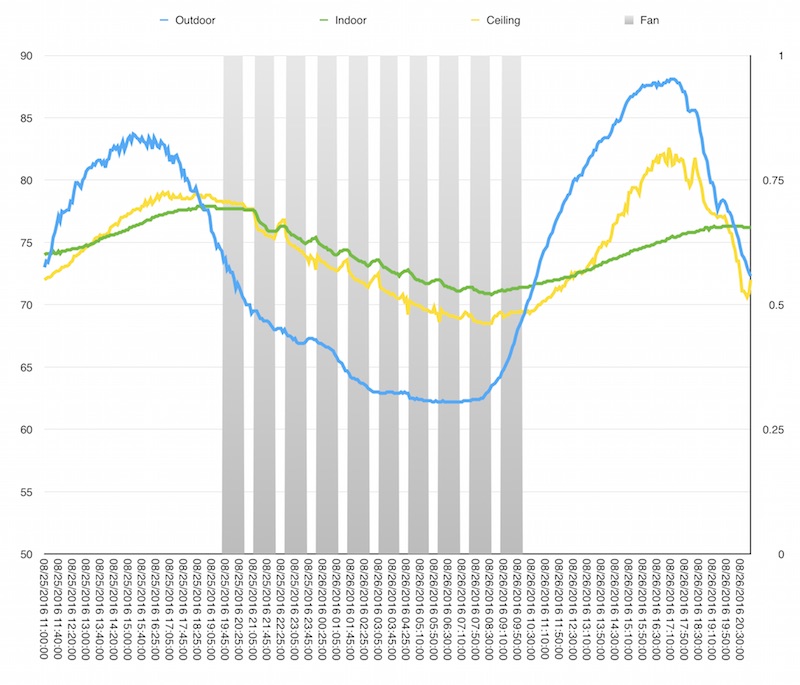
Here's why I mentioned data logging. This graph is a snapshot of the outdoor, indoor, and ceiling temperatures in my shop. The gray bars are when the automated fan is running. I have it programmed in a run/stop/run pattern in order to be able to see and evaluate how effective it is.

My shop has good insulation and no heating or cooling whatsoever. Just ventilation fans. The fans are hooked up to an automatic system that I built and programmed myself. The fans switch on whenever there is a favorable temperature delta between inside and outside in order to take advantage of the natural temperature swings. In cooling mode (which it is at the moment) it will typically switch on at night as it starts to cool off, bringing cool night air into the shop. In the winter, I switch it to heating mode, and it switches on during the day when it warms up. This balances out the temperature in the shop, generally keeping it in a range that is comfortable.

The system isn't perfect -- during sustained hot spells, the shop is still too warm. And during the really cold days of winter (which, to be honest, aren't all that cold out here in California) I will sometimes drag a small space heater into the shop. Still, overall there's a noticeable improvement.

shoptemp-8.27.jpg
 

theoldwizard1

Well-known member
Joined
Feb 22, 2011
Messages
43,109
Location
SE MI
If the temperatures come down to comfortable levels in the next few weeks, I am planning on:
- For Summer: Running the HRV off of a programmable control and then temporarily overriding that program (with a relay) to high-speed ventilation during the comings-and-goings of cars (for CO control) or when the space is occupied (for comfort). I expect running the fans fully over night in the cooler air will help keep the mass walls as cold as possible and get the most benefit throughout the day. I expect we'll probably also need to start the active venting in the afternoon when cars start coming home.
- For Winter: Turing off the programmable control during the winter, when the heat-exchanger is in the HRV, and then only relying on the relay override for ventilation when cars are moving for the lights are on.

I know you are tracking your energy consumption. Please report back when you have more data !

If you can not get the garage cool enough in summer, this is a perfect place for a mini-split. Set the thermostat at 80-85 for summer and as low as it will go for winter.
 

LS6 Tommy

Well-known member
Joined
Dec 27, 2013
Messages
26,162
Location
Northern NJ
That Lifebreath unit should not INCREASE the supply air as it should be cooling the incoming air through heat exchanger, dumping the excess heat into the exhaust air.

HRV's don't work well in the summer without A/C , either...

Tommy
 

cookiemech

Well-known member
Joined
Feb 25, 2016
Messages
79
Location
West Newton, PA
OK, I've been reading this thread and maybe I'm just not understanding . . . so take this for what you're paying for it :)

I have a 30 x 50 ft detached garage with 9'2" ceiling. 2 x 6 walls that I carefully insulated with fiberglass rolls and a truss roof with as much fiberglass as can reasonably fit above the ceiling. I finished the walls using Homasote, not drywall, because the joints don't need to be finished like drywall (just used silicone caulk) and because it adds a bit of R value (also only weighs about 38 pounds per sheet, much lighter than drywall). Homasote is also a sound deadener, and I don't hear any outside sounds unless they originate outside the overhead doors.

In winter I run my high-efficiency two-stage gas furnace that can produce up to 58,000 Btu/hr and keep the temperature at a constant 61°F all winter. I spend less than $350 to heat it the entire winter.

Since the garage is partially (maybe 1/3) below grade, it doesn't tend to become too hot in summer. If it does and I'm working out there, I just turn on the thru-wall air conditioner I installed (about 24,000 Btu/hr) and it's down to 70°F in less than an hour. Never gets much above 80°F anyway without running a/c.

I run an energy recovery ventilator all the time (made by Aprilaire, model 8100) to keep the air fresh, since I have several motorcycles that do not have evaporative emission canisters. Also I have two small dehumidifiers at opposite ends of the garage, each set at 50%, to keep the relative humidity at or below 50%. I monitor RH using a separate gauge, and it always stays at or below 50%.

In addition, I have a humidistat wired with a relay to shut down the ERV if RH rises significantly above 50% (say 53%). That can happen if it rains, for example. But even on a very humid day without rain, it doesn't shut down the ERV.

In the scheme of things, I don't find that my energy costs are unreasonable for keeping this rather large garage comfortable and dry. Dehumidifiers are probably the biggest energy suckers, but I am not aware of any other technology to keep the RH down. Obviously it is important to make sure that there are no drainage problems around the garage, which I have done.
 
OP
W

wssix99

Well-known member
Joined
Mar 2, 2011
Messages
5,156
Location
Chicago, IL
Thanks everyone for the interest in this tread! The ICF walls make the problems here much more complex than a typical building - we all deserve "propeller beanie" flair next to our avatars for participation on this one. (Note to Internet Brands and Moderators - need to have propeller beanie flair developed...)


For the uninitiated, the ICF assembly is a mass wall (in my case 8" of reinforced concrete) surrounded by around 3" of polystyrene insulation on both sides. So, there is a large thermal mass (https://en.wikipedia.org/wiki/Thermal_mass) effectively in a giant Styrofoam "coffee cup." These walls act like giant radiators, storing up heat and then slowly releasing it. (Because they are in the "coffee cup" of Styrofoam.) You can think of these/my walls as giant heat batteries.

The core of the wall is always a certain temperature, balanced between the average ambient temperature outside of the building and the air conditioned temperature inside the building. Heat will flow from the warmer area to the cooler area. The combination of the thermal mass and the insulation creates an effect where the temperature of the wall changes very slowly. The wall still has a R value, (for my walls, they are R27+) and heat still moves through it like any other R27 wall, but the concrete stores up so much heat with its thermal mass that the heat gain/loss between day and night levels out. The HVAC systems in an ICF house don't see as much stress as the sun goes up/down due to this effect - they don't have the day time peak for cooling loads and night time peak for heating loads, can thus be downsized, and run more consistently across a 24 hour period.


In the case of my garage, I have two problems that I need to tackle at the same time:
- I need to change the temperature of the air. (this is easy)
- I need to control the temperature of my walls. (this is hard)

I could put in an air conditioner and make my air in the garage 50 degrees right now and still wouldn't be comfortable - because the ICF walls wrapping the garage are like 14' high 90+ degree radiators. You can feel them... even when all the doors are open and cool air is blowing through.

^ A good illustration of this is when we were building the shell of the house. On the first cold snap in the fall, I walked in to the garage to find one of our plumbers wrapped around one of the pillars between my garage doors. (It looked like he was ******* my garage...) After a delicate greeting, I was able to understand that he was holding on to my garage for the heat. The ICF walls were still radiating 60-70 degree heat, (stored up from the warmer weeks before) even though it was freezing outside and inside the building. He was walking by, felt the heat, and decided to cozy up to my garage during his break.


As I look forward to seeing if I can keep the garage cool with fans vs. air conditioning, my target temperature is 75 degrees. Unless we are in a heat wave, this is the average day/night temperature for my area and what my walls should radiate if the garage was totally empty. (Ignoring the effects of my ceiling, which should be close to the same temperature from the air conditioned space above, and the effects of my slab-on-grade which... I'm just ignoring. The slab should **** away some heat and try to be 55 degrees like the ground below, but it is also insulated and will move heat slowly. The surface area of the floor is also a lot less than the walls.)

Theoretically, if I can get the heat brought in from the cars taken out, then the walls should not heat up and they should help keep the space cool. (Currently, I let them get hot this summer - and they are keeping things hot.)

Lots of great questions and suggestions. I'll post back some more later tonight. (We are doing some interior stair work today and I'll be back when the wife is ready to give up on tread installation for the weekend...)
 

TooMuchHair

Well-known member
Joined
May 25, 2014
Messages
64
Wow! This is completely different than I have been experiencing with my 60'x60" ICF shop. A few differences, I have pink fiberglass blown in the attic to R-60. After a great deal of research I chose to go with a 4 ton Ruud heat pump, and to NOT insulate below my slab, but I do have footings below the frost line and ICF blocks all of the way down to that footing. I have only run my heat pump when I am in the shop working during the day. It keeps it 70 effortlessly year round, and the temp barely varies in the off hours.
As far as feeling the heat of your ICF walls, are you touching the foam to feel this heat?
I had an ICF salesman pull a section of his ICF unit out of a freezer in their lunchroom, it instantly feels warm, it is reflecting your body heat.
I am very curious if my frost walls and no insulation under my floor are really stabilizing my temps that much to be so different from your situation. I know, I'm running A/C but my bills are SO low that there has to be some other factor. I'm just north of St. Louis Mo by the way.
 
OP
W

wssix99

Well-known member
Joined
Mar 2, 2011
Messages
5,156
Location
Chicago, IL
What kind of overnight temperature swing do you get in the summer? Are you doing any kind of data logging?

We get 10-30 degree swings. (I'm 2 miles from Lake Michigan, so depending on the water temperature and wind direction, we can get some wild temperature drops. (One of the best things about Chicago that few people know about - our "lake" is really the size of other people's "seas".)

No data logging as of yet. I'm not sure if I have enough time to run this experiment to ground this summer (and fully cool the mass walls) but may do something next year if we continue the experiment. (We are hoping to get an electric car in the next year, so that may foul this up a bit - to my benefit. That will be one less warm engine coming and going from the garage.)

I really wanted to put temperature sensors in the ICF walls at different points throughout the house and at different points in the wall cross section. As we got in to the construction, doing that was just too complex (hard to work around) and expensive to pull off. (I was also the other post-pour construction would have destroyed the sensors and/or leads.)

I do have a differential temperature control for another part of the house and one of the outcomes here may be to install another one for the garage. This control would trigger the HRV whenever the outside temperature is lower than the inside temperature and/or cut-out any other HVAC devices I might install. That's a ways down the road and I haven't even gotten around to installing my first control in the laundry room. (Some bad decisions were made while I was out of town and our radiant floor pumps and heat exchangers were put in my laundry room - so it's a sauna when the radiant floors are on. So I need to get excess heat out of that room when it gets above a certain differential compared to the hallway, etc. ...Still really pissed about that one. The top of my list for first renovations to the new house is to get this plumbing in the utility room where it belongs!!!)


the timed run on your exhaust fan isn't optimal.

The timed run on the fan is optimal - for CO elimination. When we sized the fan, we did so according to ASHRAE equations/methods for CO elimination in garages, taking in to consideration this 10 minute fan run when cars come and go.

So one of the questions to solve here is: Is the 75CFM fan unit (inside the HRV) enough to do this other job/duty of cooling the garage in the summer with ambient air?


You can get a temp/co2 controller from a hydroponic supply, although you will probably need to reverse the CO2 output.

Also shadecloth can take big bite out of your solar hit.

I'm not a fan of CO controls. In my experience, they are balky, expensive, and don't last long. IMO - Chemical controls like CO controls really blow. Since the sensors die out over time, I think of them more like a canary in a bird cage where you don't have to feed the canary or clean the cage. The canary eventually dies and then you have to get a new one... One of my goals with the house is to die in it - so I also don't want to have to get on a ladder every couple of years (or pay someone else to do it) to change out the CO controls on the ceiling.

My solar heat gain is minimal. I only have one wall with exposure and its the one with my garage doors on it, so I can't do anything for shading. Per my points about the mass wall above, the cooling at night should allow any gained solar heat to escape. My big source of heat and humidity are the cars.

I do have a small fixed window, (on the other side of the room, opposite the HRV) but it gets no direct sun. Getting the operable awning windows with the automatic openers probably would have helped this particular problem but would be a security concern where I live.


If you can not get the garage cool enough in summer, this is a perfect place for a mini-split. Set the thermostat at 80-85 for summer and as low as it will go for winter.

The mini-split has always been our fall back plan. Before going that route, (and taking on the larger electric bill) I want to make sure that using cool outside air (at strategic times) and the heat battery characteristics of the ICF wall won't also do the same job.
 
Last edited:
OP
W

wssix99

Well-known member
Joined
Mar 2, 2011
Messages
5,156
Location
Chicago, IL
That Lifebreath unit should not INCREASE the supply air as it should be cooling the incoming air through heat exchanger, dumping the excess heat into the exhaust air.

HRV's don't work well in the summer without A/C , either...

Tommy

The HRV does the same thing in the summer as it does in the winter. It takes the hot air from inside and transfers that heat to the fresh air coming inside.

My problem is that it's wonderful outside, sometimes 70 degrees and hotter than hell inside, 100 degrees while it's 70 outside. Opening the doors doesn't even help much because of the radiative effect of the walls. (I think this will improve if I keep the air in the garage more consistently cool and in sync with the outside air.)
 

ItsNemo

Well-known member
Joined
Mar 5, 2016
Messages
4,805
Location
Canada
Have you thought about using some sort of radiant barrier on the ICF walls to keep the heat out of them or out of your shop?
 
OP
W

wssix99

Well-known member
Joined
Mar 2, 2011
Messages
5,156
Location
Chicago, IL
OK, I've been reading this thread and maybe I'm just not understanding . . . so take this for what you're paying for it :)

I have a 30 x 50 ft detached garage with 9'2" ceiling. 2 x 6 walls that I carefully insulated with fiberglass rolls and a truss roof with as much fiberglass as can reasonably fit above the ceiling. I finished the walls using Homasote, not drywall, because the joints don't need to be finished like drywall (just used silicone caulk) and because it adds a bit of R value (also only weighs about 38 pounds per sheet, much lighter than drywall). Homasote is also a sound deadener, and I don't hear any outside sounds unless they originate outside the overhead doors.

In winter I run my high-efficiency two-stage gas furnace that can produce up to 58,000 Btu/hr and keep the temperature at a constant 61°F all winter. I spend less than $350 to heat it the entire winter.

Since the garage is partially (maybe 1/3) below grade, it doesn't tend to become too hot in summer. If it does and I'm working out there, I just turn on the thru-wall air conditioner I installed (about 24,000 Btu/hr) and it's down to 70°F in less than an hour. Never gets much above 80°F anyway without running a/c.

I run an energy recovery ventilator all the time (made by Aprilaire, model 8100) to keep the air fresh, since I have several motorcycles that do not have evaporative emission canisters. Also I have two small dehumidifiers at opposite ends of the garage, each set at 50%, to keep the relative humidity at or below 50%. I monitor RH using a separate gauge, and it always stays at or below 50%.

In addition, I have a humidistat wired with a relay to shut down the ERV if RH rises significantly above 50% (say 53%). That can happen if it rains, for example. But even on a very humid day without rain, it doesn't shut down the ERV.

I think the mass wall and effects of the thermal mass are biggest differences between our situations.


In the scheme of things, I don't find that my energy costs are unreasonable for keeping this rather large garage comfortable and dry. Dehumidifiers are probably the biggest energy suckers, but I am not aware of any other technology to keep the RH down. Obviously it is important to make sure that there are no drainage problems around the garage, which I have done.


I probably should have also mentioned that the house was constructed to be upgradable to be zero carbon in the future. (I have no intention in actually going there... unless there is an economic return for me to do so. Right now, my POCO doesn't by back electricity from the populace, so there is no incentive for me to invest in any electricity generation. -> But we are extremely energy efficient.

I'm spending $75 a month to run the dehumidifier in the garage this summer, which is a relative killer given that it costs $100-$150 a month to cool the other 5300 square feet of the house! (Geothermal heating and cooling inside.)

^ So that's probably the big deal/challenge here. Not so much the actual dollars that are going out of my pocket (although that's important) but the relative cost of cooling the garage compared to the rest of the house. If I can cool my 5300 square feet of living space for $150 a month and need to pay the same amount to cool my 925 square foot garage, then I will have totally failed as a human being.
 
OP
W

wssix99

Well-known member
Joined
Mar 2, 2011
Messages
5,156
Location
Chicago, IL
Did I miss the size of the garage...? 14' side wall height? Thanks

I missed it. The garage is 37 X 25, so I have 925 square feet and 13,000 cubic feet of air to change.

My HRV (on high speed, which is 75CMF) will do a complete air change of the garage every 3 hours.

I lack the thermodynamics background to figure out how much air is needed to cool a 200 degree V8 engine to 80 degrees, so if anyone has that off the top of their head, that would be helpful!
 
OP
W

wssix99

Well-known member
Joined
Mar 2, 2011
Messages
5,156
Location
Chicago, IL
As far as feeling the heat of your ICF walls, are you touching the foam to feel this heat?
I had an ICF salesman pull a section of his ICF unit out of a freezer in their lunchroom, it instantly feels warm, it is reflecting your body heat.

Not touching the foam, but I know what you mean. Just the foam block will act just like a giant coffee cup. Once you have the concrete/thermal mass inside it's a totally different animal.

I don't know if your ICF guy had concrete in the block (I imagine it would be hard to get in/out of the freezer like that!) but I wouldn't think you'd really feel one block in a room. A big large wall with heat in it is an impressive thing.


I am very curious if my frost walls and no insulation under my floor are really stabilizing my temps that much to be so different from your situation. I know, I'm running A/C but my bills are SO low that there has to be some other factor. I'm just north of St. Louis Mo by the way.

This would definitely work to your advantage. Heat will flow faster through the pathways of least resistance. The 55 degree ground, with few barriers between the air and the ground will **** that heat up from your space. Very little heat will go through your R60 ceiling and your walls (assume the R value is in between R0 and R60) would also be somewhere in between regarding performance.
 
OP
W

wssix99

Well-known member
Joined
Mar 2, 2011
Messages
5,156
Location
Chicago, IL
Have you thought about using some sort of radiant barrier on the ICF walls to keep the heat out of them or out of your shop?

That's what the Styrofoam on the ICF blocks are for. They slow down the heat transfer from the environment to the core and vice versa.

My heat problem isn't the outside. (That's confirmed by how inexpensive it is for me to cool the rest of my entire house, which is 5X the size of the garage.) I think the source of my crazy heat are car/truck engines that come and park in the garage. That heat comes in and the construction of the garage won't let go of it to the outside.

^ My back-of-the-napkin guess is that each time a car parks in the garage, we're adding 10kBTU to the space.

My wife drives a lot more frequently than I do, so a simple solution would be to keep the wife out of the garage entirely, but I don't think that will go over well...
 
To avoid these ads, REGISTER NOW!

theoldwizard1

Well-known member
Joined
Feb 22, 2011
Messages
43,109
Location
SE MI
One of the best things about Chicago that few people know about - our "lake" is really the size of other people's "seas".
YOUR lake !! When did Chicago move to Michigan ?


A few years back a friend of a friend from a different state was visiting the west coast of Michigan (east side of Lake Michigan). When they went to the beach they wanted to know why they could not see Wisconsin ! :lol_hitti
 

theoldwizard1

Well-known member
Joined
Feb 22, 2011
Messages
43,109
Location
SE MI
In the case of my garage, I have two problems that I need to tackle at the same time:
- I need to change the temperature of the air. (this is easy)
- I need to control the temperature of my walls. (this is hard)

Moving air cools faster (convection versus radiation), but you have to have some place to send the heat to !
 

Firebrick43

Well-known member
Joined
May 12, 2015
Messages
13,999
Location
West central Indiana
Can you not put in a whole house fan to use in the summer and use the beg only in the winter? The hole house can would automatically come on when outside temps fall below inside temp and shut off when they cross again the other way. Therefore draining your heat battery. To bad you didn't bury a couple of hundred feet of PVC pipe when you built the house to pull air through and cool it.
Running an hrv is futile once you have done an atmosphere change or two to bring in fresh air. If the heat exchanger is working well, and considering the fan motor is generating heat, well Bobs your uncle.


You might as well run a mini split. A dehumidifier is an air condition that dumps it heat right back into the room as well as the heat produced by the motor and compressor. A high seer minisplit probably will cost less to run, and do just as well removing humidity.

Your average combustion engine only converts 40 percent of its energy(at best) into mechanical motion. 60 percent is rejected heat. Half or 30 percent is exhaust heat and the other half is heat into the cooling system and driveline components due to friction(rear end/transmission/driveshaft joints. Saying it takes 20 min to reach operating temp take you MPG rating and figure how many gal of fuel you burn driving 20 min. Since some of the exhaust heat soaks into exhaust system figure 50 percent of that heat is coming into the garage with the vehicle. A gallon of gasoline has 122000 btu per gallon. If you vehicle gets 20 mpg and it takes 20 miles to warm (@60mph) up to full temp, therefore 61000 bts will be heat soaked into the vehicle as a rough estimate. Of course a lot of thing effect that such as metal used to construct the engine(cast iron not giving its heat up as fast as aluminum) transmission type(automatic having more heat) or even transmission oil system capacity. So conservatively even with a mini split it would take 3 hours to remove the heat from one v8 car/truck, maybe two hours for a smaller car.
 
Last edited:

gnpenning

Well-known member
Joined
Jan 25, 2015
Messages
2,754
Location
I have more questions than answers.
Great info Firebrick. I have ICF with radiant. I'm in a totally different environment than you. My night temps even on 90 deg days will go down into the low 60's. Right now into the 50's. Also I can leave doors open, lower crime area. This means I can open windows and doors at night and close them in the am and only pick up a 4 to 5 deg increase during the day. I only bring in one truck at the end of the day so much less heat gain. Keeping the mass cool really helps.
As you know and Firebrick mentioned your ERV can only pump out as much hot air as the you have coming in. You need a source of cool in coming air to replace what you are trying to pump out. ICF's just are to tight to do this with out some plan.

It sounds as if you have living space above the garage. If not how are you removing the attic heat? I use a thermostatic fan for mine, it pulls cool air from the shaded east side and push out the hot air to the west side. It helps alot.

I'm interested in what you find that works for you.
 
OP
W

wssix99

Well-known member
Joined
Mar 2, 2011
Messages
5,156
Location
Chicago, IL
A few years back a friend of a friend from a different state was visiting the west coast of Michigan (east side of Lake Michigan). When they went to the beach they wanted to know why they could not see Wisconsin ! :lol_hitti

Yea, the "lake" prefix really throws people off. We get drunk tourists that jump in from time to time and want to swim to the other side. (not knowing its 27 miles across)


YOUR lake !! When did Chicago move to Michigan ?

Given the scale of the body of water and importance of certain geographical features, I will be forwarding a petition to change Lake Michigan's name to the "Sea of Chicago."
 
OP
W

wssix99

Well-known member
Joined
Mar 2, 2011
Messages
5,156
Location
Chicago, IL
Can you not put in a whole house fan to use in the summer and use the beg only in the winter? The hole house can would automatically come on when outside temps fall below inside temp and shut off when they cross again the other way. Therefore draining your heat battery.

That's essentially what I have right now. See post #2. I took out the heat exchanger and replaced it with a custom partition and filter holder - so now my HRV functions as a small whole-house fan or attic fan. I started this thread just as I've kicked it on to see if I can cool down the walls. We'll see how she does in a couple of weeks...


To bad you didn't bury a couple of hundred feet of PVC pipe when you built the house to pull air through and cool it.

I did better than that. I put 400' straight down:

View media item 63331
Due to the building/HVAC codes being way behind the times and not being able to account for ICF construction, we were forced to put in a larger geothermal unit than we needed. (although our engineer was as conservative as he could be.) We also only needed 350' of well, but went the full 400' because the driller had that much drill pipe and the additional cost was minimal since he didn't need to move his rig and set up for another bore. So... we have excess capacity in our geothermal well. I could hook up a cooling unit to the well - no problem, but my expectation is that the cost of doing that will be very large in comparison to putting in a mini-split. (The electrical usage should be similar.)


You might as well run a mini split. A dehumidifier is an air condition that dumps it heat right back into the room as well as the heat produced by the motor and compressor.

Great point, I have been neglecting the effect of that dehumidifier creating heat also! It gets unplugged today!!!


If you vehicle gets 20 mpg and it takes 20 miles to warm (@60mph) up to full temp, therefore 61000 bts will be heat soaked into the vehicle as a rough estimate. Of course a lot of thing effect that such as metal used to construct the engine(cast iron not giving its heat up as fast as aluminum) transmission type(automatic having more heat) or even transmission oil system capacity. So conservatively even with a mini split it would take 3 hours to remove the heat from one v8 car/truck, maybe two hours for a smaller car.

Thanks - that's a lot of heat. With one air change per every three hours, I'm curious to see if the little HRV fan motors can get enough of that heat out of the building as the cars cool naturally.


It sounds as if you have living space above the garage. If not how are you removing the attic heat? I use a thermostatic fan for mine, it pulls cool air from the shaded east side and push out the hot air to the west side. It helps alot.

I have an air conditioned bedroom above the garage. So, any heat that goes up in to that space, gets removed by the house geothermal HVAC system. I haven't noticed any difference in temperature for that room, but maybe there is a little and why that's why the cat likes it so much??? (This has been a great mystery to us and it might be solved - warm floor. The cat loves the room.)
 

readhead

Well-known member
Joined
Dec 8, 2012
Messages
6,175
Location
Durango, Co.
I worked on a project a few years ago that used your exact problem to heat and cool a warehouse. A wall was built inside to create an air space behind the exterior wall. Through a series of high and low dampers they controlled the air flow and either recycled or exhausted the air. There were no fans involved. The air was all controlled by convection. It seemed to work pretty well. I was back for a remodel and everything still worked.
 
Last edited:

Firebrick43

Well-known member
Joined
May 12, 2015
Messages
13,999
Location
West central Indiana
I will be forwarding a petition to change Lake Michigan's name to the "Sea of Chicago."

Great.🙄 If it's part of cook county then the fish will be so crooked they won't taste good and some how they will be registered and voting in elections



On a more serious note. Didn't realize you took out the hx on your hrv. But even still a whole house fan starts at 1000 cfm and some are 6000 cfm with a large portion in the 1500-2200 range. If your only doing 150 cfm your almost literally peeing on the garage to cool it off. Unfortunately from the description it looks like any additional fan, and make up air vent, would be hard to install with room above and concrete walls.

Also if my memory serves me correctly that icf construction should not be used where the interior is not constantly conditioned. The exterior insulation is good but the interior insulation slows the heat transfer to natural ventilation at night.
 
OP
W

wssix99

Well-known member
Joined
Mar 2, 2011
Messages
5,156
Location
Chicago, IL
let the cars cool off in the driveway before putting them in the garage(as often as possible)

Driveway is 3 feet long. Exposure to "the outside" is also not advisable at some times of the day and given the tight city environment, the main point of this garage is to get the cars off the street.


Haven't read the entire thread but is the open cell below the roof deck or above the ceiling? If the latter, is the attic ventilated?

There is living space above most of the garage and a shaded roof-top deck (outside air) above a small part of it. (Just one bay.) The ceiling within the garage is consistent, with open cell foam applied to the trusses. There is a small air gap below that and then a drywall ceiling.


Great.🙄 If it's part of cook county then the fish will be so crooked they won't taste good and some how they will be registered and voting in elections

I'm near Bubbly Creek. You can fish there... https://en.wikipedia.org/wiki/Bubbly_Creek It still bubbles - kinda cool. Kinda not...


On a more serious note. Didn't realize you took out the hx on your hrv. But even still a whole house fan starts at 1000 cfm and some are 6000 cfm with a large portion in the 1500-2200 range. If your only doing 150 cfm your almost literally peeing on the garage to cool it off. Unfortunately from the description it looks like any additional fan, and make up air vent, would be hard to install with room above and concrete walls.

This is correct. The theory I am testing is:
- During the day when the cars come in, they will make the air in the garage warm and the walls will soak up that heat. Can I then use this little fan (in the converted HRV unit) to "pee" on the walls at night, when the air is cool, to get that soaked heat out and reset for the next day?

Even if this little fan is enough to get the heat out of the building that I am introducing in each day, I may still need a larger fan to make faster air changes to keep the air comfortable around the time the cars come in - so I don't have to wait 3+ hours for the air to change in the space.

One thing I can do is tap an extra fan in to the existing HRV duct work with some dampers, so I shouldn't need to additionally violate my efficient walls to get higher airflow.


Also if my memory serves me correctly that icf construction should not be used where the interior is not constantly conditioned. The exterior insulation is good but the interior insulation slows the heat transfer to natural ventilation at night.

No, there's no difference in HVAC requirements than any other wall. It performs just like any other solid concrete wall except the Styrofoam on the outsides causes heat to move in and out of the core more slowly. I understand lots of folks up north only heat their ICF buildings.
 

TooMuchHair

Well-known member
Joined
May 25, 2014
Messages
64
I completely agree with Firebrick on a couple of points (at least), I have experienced the extreme heat build up just from running a large dehumidifier in my storage building that stays mostly closed up. The heat of the cars, while significant, diminishes fairly quickly, the DH's just stay after it. Also to the point of ICF's being intended for use as a conditioned space, absolutely. If adding to your Household Geo system is too costly, try pricing an air to air heat pump. I think you will be amazed how inexpensive it can be to keep your shop perfectly comfortable, temp and humidity year round. As far as the mini-splits go, IMO the advantages don't really apply to your situation. Mini splits in a shop environment have problems with air filtration, and you will need to use more than 1 wall unit or run a fan for distribution. I only have one well placed outlet with 44,000 cubic feet of space and like you I oversized my unit, so run times are short, with long idle periods.....with the infrared thermometer it is amazing how uniform my temps are, from the floor to the 16' ceiling peak, to the farthest corner seldom varies more than 3 degrees. Trying to be brief....the reason I suggested the heat pump is for a nickel more why not? My research into super insulated structures lead me away from the radiant/insulated floor because of some of the issues you are having. Radiant cycle times will be very short so the floor may not even feel warm any way. So having more options in such an awesome build seems reasonable.
Also, please check out www.sensorpush.com for data logging temp humidity sensors that utilize a free smartphone ap. They are fairly cheap and very accurate. Currently Bluetooth, but WiFi Beta testing is starting NOW! (Disclosure: this is my son's company)
 

theoldwizard1

Well-known member
Joined
Feb 22, 2011
Messages
43,109
Location
SE MI
Due to the building/HVAC codes being way behind the times and not being able to account for ICF construction, we were forced to put in a larger geothermal unit than we needed. (although our engineer was as conservative as he could be.) We also only needed 350' of well, but went the full 400' because the driller had that much drill pipe and the additional cost was minimal since he didn't need to move his rig and set up for another bore.
While I am no expert on geothermal, I am firmly convinced that there is NO SUCH THING AS TOO MUCH GEOTHERMAL WELL ! I have read to many case where people are unhappy with there geothermal performance in winter, but then you find that their return water is below freezing (ground loops not wells).
 

theoldwizard1

Well-known member
Joined
Feb 22, 2011
Messages
43,109
Location
SE MI
For you current dilemma, quickest and probably easiest solution would be a couple of large fans placed in front of the cars. When you pull you car in, start the fan on a 15 (+/-) timer with the garage door open. Ultimately, you would like to automatically close the door when the fan turned off (a sail switch hooked to a relay ?).
 

Firebrick43

Well-known member
Joined
May 12, 2015
Messages
13,999
Location
West central Indiana
I wasn't talking about hvac requirements but of natural heat/cooling. Have some experience with it. For 5 years we lived in SoCal high desert while I was in the corps. Wife is from there. Temps in the summer would hit 120 but at night drops to 70's. In the winter highs in the 80's a lows in the 30's at times. Wife's grandmother owned the property we we renting and her house was a small 1000 sqft two bedroom house of solid brick walls. She was a widow and married again and her new husband and who we considered or grandfather was handier than any one you ever met. Him and I gutted the little house. Somewhere he found some 1.5" foam sheets, a whole trailer load, for pennies on the dollar.

We framed out the walls with 2x2's horizontally filling in the spaces with the foam and then framed vertically over that again filling in with foam. The house needed no cooling or heating besides a stove burner on winter mornings for an hour or so. The problem was when more than two people were in the house. It would quickly become stifling hot even if was cool out as the wall could not absorb the heat fast as the foam reflected it back into the space. Down the road friends had an adobe house with no insulation and it's thick massive walls actually performed just as well for the most part but large gatherings would not become stuffy as the walls absorbed the heat generated by people quite quickly. Modern adobe houses which were really concrete with stucco and insulation on the outside and just stucco on the inside function really well.

If you had no insulation on the inside the concrete could absorb heat fast. However I still don't know how well it would work as here in the Midwest we have humidity to contend with. There in the high desert the lack of humidity made thing relatively comfortable but on the rare once a year rain storm they were uncomfortable to miserable.
 
OP
W

wssix99

Well-known member
Joined
Mar 2, 2011
Messages
5,156
Location
Chicago, IL
While I am no expert on geothermal, I am firmly convinced that there is NO SUCH THING AS TOO MUCH GEOTHERMAL WELL ! I have read to many case where people are unhappy with there geothermal performance in winter, but then you find that their return water is below freezing (ground loops not wells).

Totally.

19poc8.jpg


The most important part of the whole deal is drilling the well, and getting it economical. The fact that we could get an extra 12% of capacity out of our well for no real incremental cost was also a real coup. We found a GREAT driller. With the tax rebate and the way we designed the system, it ended up being $10K less than what a conventional system would have cost us.


For you current dilemma, quickest and probably easiest solution would be a couple of large fans placed in front of the cars. When you pull you car in, start the fan on a 15 (+/-) timer with the garage door open. Ultimately, you would like to automatically close the door when the fan turned off (a sail switch hooked to a relay ?).

^ This idea is intriguing and an interesting way to get the car's heat transfer business over with. I wonder if the slow release of heat from the cars would be easier for the weak HRV fans to keep up with, though?
 
OP
W

wssix99

Well-known member
Joined
Mar 2, 2011
Messages
5,156
Location
Chicago, IL
If you had no insulation on the inside the concrete could absorb heat fast. However I still don't know how well it would work as here in the Midwest we have humidity to contend with. There in the high desert the lack of humidity made thing relatively comfortable but on the rare once a year rain storm they were uncomfortable to miserable.

Gotcha. I spent time in Mexico a long time ago and the bare concrete houses performed really well in the hot climates. The concrete would heat and cool on a daily cycle and keep things inside more or less constant.

Since I want to get rid of excess heat from the space, ideally I suppose we'd just want insulation on the inside of the wall, or something like that? (That way, excess heat could more easily get out of the core.) In this part of the country, we are built for the heating season because our heating loads on the geothermal system are (if I remember correctly) about 1.5X what they are in the summer. So, the walls are wrapped on both sides and the house is made like a heat battery.

When we did the HVAC design for the house and were making those decisions, we spent a lot of time on getting the heating right, which we did. We didn't invest a lot in engineering cooling solutions as we had a feeling stuff like this might happen. (Kicking myself again for not considering heat coming in to the garage from car engines!!!)
smiley86.gif

We even left one of the garage walls bare so we could mess with the utilities and not make too much of a mess.
 

MushCreek

Well-known member
Joined
Jan 14, 2015
Messages
9,754
Location
Upstate South Carolina
Our ICF house in SC has a summer cooling load of only 3/4 ton (9,000 BTU). In the hottest months, it costs about $20 a month with the thermostat at 74 F. We have a Mitsubishi 12K BTU mini. The house is 1400 square feet with 10' ceilings. One thing I've noticed with ICF and mini-splits is that it takes a long time to change the temperature. It's much more efficient to just let the system maintain the temperature once it's reached. I paid about $1600 mail order for the mini and supply lines. I installed it myself (have fun drilling a 3" hole through ICF!) and paid a licensed installer a few hundred bucks for the final commissioning. The Mits units are nearly silent; inside and out. They also have a dehumidify mode when it's not hot enough for A/C.
 

Ole Slewfoot

Well-known member
Joined
Feb 22, 2016
Messages
5,098
Location
Freedom, CA
I'm not a fan of CO controls. In my experience, they are balky, expensive, and don't last long. IMO - Chemical controls like CO controls really blow. Since the sensors die out over time, I think of them more like a canary in a bird cage where you don't have to feed the canary or clean the cage. The canary eventually dies and then you have to get a new one... One of my goals with the house is to die in it - so I also don't want to have to get on a ladder every couple of years (or pay someone else to do it) to change out the CO controls on the ceiling.

My solar heat gain is minimal. I only have one wall with exposure and its the one with my garage doors on it, so I can't do anything for shading. Per my points about the mass wall above, the cooling at night should allow any gained solar heat to escape. My big source of heat and humidity are the cars.

I do have a small fixed window, (on the other side of the room, opposite the HRV) but it gets no direct sun. Getting the operable awning windows with the automatic openers probably would have helped this particular problem but would be a security concern where I live.

How well insulated is the garage door?

Co2 controllers and monitors are a popular accessory here, and people notice when they only have to get more Co2 half as much. Failure doesn't seem to be a huge problem. Why you'd have the sensor on the ceiling for a heavier than air gas is beyond me. As far as air exchange we usually shoot for about 2.5 minutes to swap the room, but 14" fans are probably expensive overkill in a garage. Still, you might try shooting one of those 1000 cfm air movers under the door or something and see what kind of results you get.
 

LS6 Tommy

Well-known member
Joined
Dec 27, 2013
Messages
26,162
Location
Northern NJ
The HRV does the same thing in the summer as it does in the winter. It takes the hot air from inside and transfers that heat to the fresh air coming inside.

My problem is that it's wonderful outside, sometimes 70 degrees and hotter than hell inside, 100 degrees while it's 70 outside. Opening the doors doesn't even help much because of the radiative effect of the walls. (I think this will improve if I keep the air in the garage more consistently cool and in sync with the outside air.)


I got ya. Usually HRV's are only used in the summer when it's cooler inside than out...

Tommy
 
To avoid these ads, REGISTER NOW!
Top Bottom