To avoid these ads, REGISTER NOW!

Vertical Cracks in 4' Foundation Pics

m123

Well-known member
Joined
Sep 28, 2016
Messages
47
Location
Midwest
I had a 4 foot deep concrete wall, 8 inches thick, poured on a footer for my new garage last fall and I've noticed what I think looks to be a significant vertical crack on one corner of the foundation.

I'm not sure how deep it goes, see the pics below. My foundation wall sticks up above the inside finished floor 6 inches, and the crack starts right in the corner. The outside wall is sticking up out of the ground about 8 inches, you can see the bottom of the tyvek house wrap. On the inside you can see where the two walls meet in the corner, and where the crack starts.

My contractor says this is a normal shrinkage crack, and not to worry. What do you all think? Is this concerning? The wall is only about 4 months old. I think what worries me most is its right on the corner. What do you all think? My other 3 corners do not look like this. Thanks for any feedback or opinions.

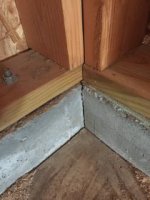
IMG_2274g.jpg

IMG_2280g.jpg
 
To avoid these ads, REGISTER NOW!

readhead

Well-known member
Joined
Dec 8, 2012
Messages
6,177
Location
Durango, Co.
That looks like more than shrinkage. I would dig down and see how far it goes. Perhaps have a third party come inspect and report.
 
OP
M

m123

Well-known member
Joined
Sep 28, 2016
Messages
47
Location
Midwest
I just looked and I don't have anything looking down into the wall form, just of the forms themselves. If I remember right there were two horizontal rows of 1/2" rebar, and I'm assuming they were tied to the other walls row of rebar at the corner. This was professionally done.
 

GMCGarage

Well-known member
Joined
Jan 31, 2017
Messages
1,264
Seal it up with some epoxy and monitor. You can put a crack width guage on it to see if it gets worse. Also you could measure the elevation of the top and see if it settles.

Did they do a pour stop there, or was it continuous?
 

matt_i

Well-known member
Joined
Mar 14, 2008
Messages
10,726
Location
SE Michigan
Imo if poured on a pad footer and you have horizontal rebar, then probably not a lot to worry about, just monitor.

Hopefully they bent a piece of bar around the corner with sufficient "grip" back to the straight wall sections but without pics its hard for anyone to speculate.
 

machsnell

Well-known member
Joined
Jun 12, 2010
Messages
942
Location
Northern Virginia
It looks like in the exterior pic it shifted. Is the outside wall still on a plane?

What is width of gap. Looks like more of a gap than shrinkage would create and rebar should have held that closer together.

If it were summer I would say lack of expansion joint on perimeter slab could have pushed that type of Crack. Right now in winter Concrete has contracted and will expand towards spring and summer.

Since it's your garage amd not a basement wall I wouldn't be too worried.

I would just caulk it up really well but to repair correctly you can bondo over Crack and install epoxy ******* every 2 feet on exterior over the Crack and squeeze in epoxy and you will "structurally" bond the concrete together again. Then grind off the bondo.

I would want to make sure it's not settling nor moving outward. It might be an illusion but it does look like it has moved out of plane?

Sent from my SM-G930V using Tapatalk
 

tlmartin84

Well-known member
Joined
Apr 23, 2012
Messages
1,085
Location
West Virginia
I can't imagine a crack opening up that wide with rebar in it...........

In order for that much separation, the rebar would have "slipped" out of the corner. I doubt they bent a bar and lapped it. Probably just tied it together at the corner.

View media item 68039
 
Last edited:
Joined
Jul 24, 2016
Messages
3,371
I can't imagine a crack opening up that wide with rebar in it...........

In order for that much separation, the rebar would have "slipped" out of the corner. I doubt they bent a bar and lapped it. Probably just tied it together at the corner.

View media item 68039

Absolutely correct. I'm betting they just butted the corners and good to go. Also, there's supposed to be rebar within 6 inches of the top of the stem wall. At this point, there's not a whole lot that can be done except grouting it.
 
Last edited:

LXCam

ALLIANCE MEMBER
Joined
Apr 23, 2013
Messages
19,113
Location
AZ
Count me in with Martin too. That's too large of a gap for just shrinkage. Is there any change to relation of plane other than separation? Such as rise or side shift that you can see.
 

wssix99

Well-known member
Joined
Mar 2, 2011
Messages
5,159
Location
Chicago, IL
My contractor says this is a normal shrinkage crack, and not to worry.

I agree with the above that this isn't "normal." I would be concerned and look to take action before this gets worse and things. (Water gets in there and freezes, etc.) This is also at the intersection of a load bearing wall and a non-load bearing wall, so I'd be concerned about settlement.

The first step is to dig and expose the whole crack. This will need to be done for any type of repair and without exposing the crack, your contractor (and anyone else that looks at it) will just be giving you guesses or flinging BS at you.

In addition to filling the void and waterproofing it, it can also be structurally pinned, if the rebar did slip or wasn't installed correctly. (This will be a lot less expensive than having to come back and jack the foundation or something like that at a later time.)
 

readhead

Well-known member
Joined
Dec 8, 2012
Messages
6,177
Location
Durango, Co.
My concern would be if this extends into the footing. Dig down to the footing and see if it is also cracked. If it is then that is an indication of unstable soil conditions. If that is the case then I hope you collected liability certificates from the dirt guy and concrete guy.
 

Ironcrow

Well-known member
Joined
Sep 30, 2005
Messages
1,169
Location
Arizona
I do corners like this (with chairs not a giant block):
 

Attachments

  • planter-6.jpg
    planter-6.jpg
    25.7 KB · Views: 148

bczygan

Well-known member
Joined
Nov 4, 2009
Messages
22,002
Location
DETROIT! Arsenal of Scrappers
Structural failure that will never get better.

It's a retaining wall and should have vertical and horizontal steel and been keyed into a pad footing with cont. steel.

Bill
 
OP
M

m123

Well-known member
Joined
Sep 28, 2016
Messages
47
Location
Midwest
Thanks everyone for their opinion. I took some more pictures, due to some of the questions.

The wall was poured as a continuous pour. There is a 16” footer that this 8” wall sits on, 4 foot down.

From the inside, it doesn't look like the wall has settled down or heaved up, its still level with the other wall. It just looks like it separated. The inside crack gap is much larger, I can fit a nickel or more in it, but maybe thats because its right in the corner.

On the outside, its not really a flush crack, its at cracked at an angle so it looks like its not on a plane, if thats what a lot of you are asking. But it's not way out of whack from what I can tell. I've got a quarter stuck in it on the picture, you can see the angle its cracked at.

I guess I need to dig down and see what the crack looks like farther down.

1.jpg

3.jpg

4.jpg

5.jpg
 
To avoid these ads, REGISTER NOW!

The Tool Tyrant

ALLIANCE MEMBER
Joined
Dec 19, 2011
Messages
2,182
Location
Bonita, Ca. (San Diego)
From what I can see, it surely looks out of plane (meaning, if you placed a straight edge on the face of the wall, both side of the crack would be touching the straight edge)
It looks to me that you would see a gap between the wall and the straight edge at the side toward the corner.
 

tlmartin84

Well-known member
Joined
Apr 23, 2012
Messages
1,085
Location
West Virginia
In all honesty, at this point there isn't a lot you can do about it. I wouldn't bother digging down if you see no horizontal shifting/settling. It isn't worth the effort.

What I would do is seal it to just be low ground level. I'm not sure what kind of contract you have, but I would explain to him that you are willing to leave it alone for now, but would like for him to put into writing that if it continues, he will come back and discuss repairs at that time.

You are lucky where it is (the corner). As an engineer, and a do-it-myselfer, I would dig down, drill some holes through the corner, and dowel it back together with some epoxy...........IF it appeared to move more.
 

Tejay

Well-known member
Joined
Dec 29, 2014
Messages
105
It could have been caused with uneven backfilling putting excess pressure on one side when it was still green or possibly even bumped by equipment during the process. Just thoughts!
 

wssix99

Well-known member
Joined
Mar 2, 2011
Messages
5,159
Location
Chicago, IL
On the outside, its not really a flush crack, its at cracked at an angle so it looks like its not on a plane

I would say this observation looks correct. If your contractor says that this is a shrinkage crack after looking at this, ask them how it could be one if the crack is off plane.

^ If they continue to go down the shrinkage crack theory, they will dig themselves in to a hole - so have them stand next to the foundation and maybe you won't have to get out your shovel???


You are lucky where it is (the corner). As an engineer, and a do-it-myselfer, I would dig down, drill some holes through the corner, and dowel it back together with some epoxy...........IF it appeared to move more.

There appears to be movement in the pictures above, so I'd say now is time for action; particularly before the house ages over a year and the contractor gets further away...
 

machsnell

Well-known member
Joined
Jun 12, 2010
Messages
942
Location
Northern Virginia
It could have been caused with uneven backfilling putting excess pressure on one side when it was still green or possibly even bumped by equipment during the process. Just thoughts!
True. If they compacted for interior slab within days of pouring the walls Concrete is still green. Especially in winter.

When did they pour slab? Before of after framing up garage?

Sent from my SM-G930V using Tapatalk
 

Franz1.0©

Banned
Joined
Feb 8, 2017
Messages
134
Concrete has strength in compression.
Steel has strength in tension.

POUR WAS DONE WRONG!
Rebar not properly installed.
As time goes on the crack will expand with freeze/thaw cycles.

Only viable repair is internal and external steel corners bolted together through the concrete wall.
 

tlmartin84

Well-known member
Joined
Apr 23, 2012
Messages
1,085
Location
West Virginia
I would say this observation looks correct. If your contractor says that this is a shrinkage crack after looking at this, ask them how it could be one if the crack is off plane.

^ If they continue to go down the shrinkage crack theory, they will dig themselves in to a hole - so have them stand next to the foundation and maybe you won't have to get out your shovel???


There appears to be movement in the pictures above, so I'd say now is time for action; particularly before the house ages over a year and the contractor gets further away...

If it is settlement...........it is not at this location. All movement seen here is lateral. He said himself there is no variance in height, and that the walls are still planar.
 

tlmartin84

Well-known member
Joined
Apr 23, 2012
Messages
1,085
Location
West Virginia
Oh, and I'm not saying just ignore it for a year or whatever. I am saying monitor it..... We have done dozens of consults on foundation repairs and failures. At this point this does not warrant an expensive fix.

I would REALLY just like to know how the bar was placed. If I were certain it had several rows of bar, I would leave it alone.
 

ssdave

Banned
Joined
Apr 11, 2015
Messages
2,913
Location
Eastern Oregon
I'm with tlmartin84 on this one. I won't speculate on why it's cracking, but my recommendation would be to monitor it. Unless it continues to get bigger or laterally displace, I'd not worry about it; if after monitoring for a few months it doesn't change, I'd epoxy it to keep water out and then just check it periodically.

I have a hard time believing any professional would do a **** splice at the corner, but stranger things have happened. It would be very informative to know what rebar is in that corner, and how it is placed.
 

73RR

Blank Email
Joined
Dec 13, 2016
Messages
300
Location
Central Ory-Gun
I have a hard time believing any professional would do a **** splice at the corner, but stranger things have happened. It would be very informative to know what rebar is in that corner, and how it is placed.

...and this is why it is so important to have a photo journal of construction projects....guessing after the fact is a waste of time.

I'd suggest placing a tattletale gauge across the crack to check for movement.
 

wssix99

Well-known member
Joined
Mar 2, 2011
Messages
5,159
Location
Chicago, IL
I'm with tlmartin84 on this one. I won't speculate on why it's cracking

Speculating is not very helpful in any circumstance but doing the homework to understand the facts would be very useful.


my recommendation would be to monitor it.

Given that the foundation is either 3-15 months old, what should the OP do to hold the contractors nuts to the fire so they will come back and fix the problem if things get worse?


I have a hard time believing any professional would do a **** splice at the corner, but stranger things have happened.

If this were the case, then we wouldn't need building inspectors. :)
 

tlmartin84

Well-known member
Joined
Apr 23, 2012
Messages
1,085
Location
West Virginia
Paragraph 2.

In all honesty, at this point there isn't a lot you can do about it. I wouldn't bother digging down if you see no horizontal shifting/settling. It isn't worth the effort.

What I would do is seal it to just be low ground level. I'm not sure what kind of contract you have, but I would explain to him that you are willing to leave it alone for now, but would like for him to put into writing that if it continues, he will come back and discuss repairs at that time.

You are lucky where it is (the corner). As an engineer, and a do-it-myselfer, I would dig down, drill some holes through the corner, and dowel it back together with some epoxy...........IF it appeared to move more.
 

ssdave

Banned
Joined
Apr 11, 2015
Messages
2,913
Location
Eastern Oregon
Given that the foundation is either 3-15 months old, what should the OP do to hold the contractors nuts to the fire so they will come back and fix the problem if things get worse?

I'd take a few pictures, send them to the contractor with a note that you've observed the problem, and as you've discussed with him, you're going to monitor for increased movement. I'd ask, as recommended above, that he acknowledge it is his problem in writing, and agree to fix it. If it doesn't move more in the next few months, I'd have the contractor come out and seal it and then continue to monitor.

Right now, if you were to try to get someone to come in and professionally analyze it, i don't think you'd get anywhere; they'd tell you to seal it and monitor for increased movement. Or, they might see something that we can't in the pictures. Hard to know without being there yourself.
 

tlmartin84

Well-known member
Joined
Apr 23, 2012
Messages
1,085
Location
West Virginia
I also know from experience asking a contractor to put something in writing speaks volumes for itself. One of two things will happen:

1. He agrees, puts it writing stands by his work. He knows more than we do about what's there and how well compaction, bar, etc was placed. Chances are nothing will come of it.

2. He refuses to. If he does, then my guess is he knows there is a problem.........
 

joes169

Well-known member
Joined
Sep 19, 2011
Messages
663
Location
WI
Structural failure that will never get better.

It's a retaining wall and should have vertical and horizontal steel and been keyed into a pad footing with cont. steel.

Bill

It's not a retaining wall by any realistic definition, it's a frost wall with equal fill on each side of it.

From what I can see, it's shrinkage crack and nothing more. I fail to see any other noticeable offset, and it certainly looks even to me, so I highly doubt there's any settling.

I've never understood why most poured wall contractors (around these parts atleast) don't put an effort into sawing or forming control joints in their walls, especially on basements. It would probably eliminate 90%+ of their call-backs by doing so. As a concrete contractor, I get called dozens of times a year to seems like to look at cracked poured walls.
 

wssix99

Well-known member
Joined
Mar 2, 2011
Messages
5,159
Location
Chicago, IL
Right now, if you were to try to get someone to come in and professionally analyze it, i don't think you'd get anywhere; they'd tell you to seal it and monitor for increased movement. Or, they might see something that we can't in the pictures. Hard to know without being there yourself.

It would indeed be hard to know anything without exposing the foundation. It's only 4 feet. There's no harm in sending the wife out there to dig it up, particularly while we're having this warm weather in the midwest and the ground is unfrozen.
 
To avoid these ads, REGISTER NOW!
Top Bottom