To avoid these ads, REGISTER NOW!

Vertical Mill Table Cleaning

RoninB4

Well-known member
Joined
Jul 22, 2020
Messages
3,539
Location
Under My House
Matt- If you have more first hand experience with the Clausing then your assessment would be better than mine. It looks like the machine has not been running in a while, perhaps due to problems, and the overall condition shows neglect. I don't advise buying a machine that can't be run under power for a first time buyer but that's JMO. I've no idea what replacement/repair costs would be.
 
To avoid these ads, REGISTER NOW!
OP
M

Mamrak76

Well-known member
Joined
May 9, 2017
Messages
139
Location
Crestwood Ky
I am buying the lathe I will worry about any problems on down the road. It is the right deal for me, this item is being sold by the bank not by someone who knows anything. That’s why the vfd was sold. The guy was there, saw it run with no problems.

I am having an issue with my mill. No matter what gear I am in, the brake (which works to stop the spindle) won’t hold the drawbar so I can tighten it up. I am not sure what I am doing wrong here... Any suggestions?
 

RoninB4

Well-known member
Joined
Jul 22, 2020
Messages
3,539
Location
Under My House
Don't know for sure on your machine. Search around for a manual or parts list.

Might be here:

https://www.wells-index.com/manuals

-The link Hank11 posted early on in this thread likely has information that would help. Don't know your model but it appears to be free information for downloading. If it's step pulley type head then removing the housing for inspection would be your first procedure. If it's a friction type brake it may be worn, out of adjustment, or in need of replacement. Time to get acquainted with the innards of your machine. Post findings.
 

macgyver37

Well-known member
Joined
Mar 7, 2013
Messages
609
Location
Pittsburg, Kansas
On the spindle brake, it is probably just worn out. They have a small pc of brake shoe material and it could be missing of worn off and down to the steel.

On my model 55 I can loosen and tighten the drawbar without having to use the brake, I use a long double box end wrench and use momentum to do the work. Rotate the wrench fast and stop quickly and the momentum of the spindle and pulleys most of the time will get it done for me.

Now when I first got my machine there was a B&S 9 to TG collet adapter that had been in the spindle for years. It was almost impossible to get it out.

I am a bit surprised low gear won't hold it, when I swap over to the low speed pulley, it is very hard to turn with the wrench. Is your belt tight?

Guess, I am not certain which model you have, is it a 40 or 55?
 
OP
M

Mamrak76

Well-known member
Joined
May 9, 2017
Messages
139
Location
Crestwood Ky
On the spindle brake, it is probably just worn out. They have a small pc of brake shoe material and it could be missing of worn off and down to the steel.

On my model 55 I can loosen and tighten the drawbar without having to use the brake, I use a long double box end wrench and use momentum to do the work. Rotate the wrench fast and stop quickly and the momentum of the spindle and pulleys most of the time will get it done for me.

Now when I first got my machine there was a B&S 9 to TG collet adapter that had been in the spindle for years. It was almost impossible to get it out.

I am a bit surprised low gear won't hold it, when I swap over to the low speed pulley, it is very hard to turn with the wrench. Is your belt tight?

Guess, I am not certain which model you have, is it a 40 or 55?

I have a 745. I have read the manual. When I am running the machine the brake works great to stop the rotating tool. It stops the spindle quickly. When the drawbar is tight the brake holds it and I can loosen it a turn or 2 then brake stops holding it and the collet just spins along with the drawbar no matter how hard I hold the brake. I can make a video if that helps.
 

justanengineer

Well-known member
Joined
Apr 5, 2011
Messages
7,722
Location
Motor City
Sounds like the spindle is locking as it should and the taper is releasing. Once friction between the spindle taper and collet/tool breaks free, you need to spin the collet/tool off the drawbar by hand bc the brake only locks the spindle, not the collet or drawbar. If the collet has been installed awhile or over torqued the threads could be mung’ed up. I’d spray liberally with monkey pee then see if you can get a strap wrench or other soft tool on the collet/tool and gently spin it off. Be very careful of cutting tools, they’re usually ridiculously sharp and/or jagged, and you don’t want blood on your new machine.

Sent from my iPhone using Tapatalk
 
Last edited:

RoninB4

Well-known member
Joined
Jul 22, 2020
Messages
3,539
Location
Under My House
On the BP's with R8 collet spindle there's a small key inside the spindle that always gets sheared off due to previous owners not taking the time to fit the collet to the key. Is there a spindle key inside the spindle of the Index? I haven't run an Index in decades and don't recall.
 
OP
M

Mamrak76

Well-known member
Joined
May 9, 2017
Messages
139
Location
Crestwood Ky
I think there is something up there. I stuck my finger up there and felt something. Also can’t get the quill feed working. Any ideas on how to troubleshoot it?
 

matt_i

Well-known member
Joined
Mar 14, 2008
Messages
10,726
Location
SE Michigan
Imo you should only mess with the quill feed when single point mill boring (boring head work) Throw/engage/mesh gears on a selector on the left side of the head out of neutral (while power is off) to get the round handwheel turning slowly. Then there's a spring-return knob on the right side that's something like a fricton-drive to feed the quill downward.

The collet should self-engage the taper but you need the spindle brake (lever at top left) to friction-bind the spindle and resist the torque of the drawbar. You just need medium tight on the drawbar. Some person in a shared shop tightens that thing like its a 1-1/8-7 thread at the end.
 

RoninB4

Well-known member
Joined
Jul 22, 2020
Messages
3,539
Location
Under My House
I think there is something up there. I stuck my finger up there and felt something. Also can’t get the quill feed working. Any ideas on how to troubleshoot it?

-If you have R8 collets, or any collet that has a key-way it needs to be lined up so the spindle key is engaged in the collet key-way. This is what prevents the collet from spinning if not on the taper. It is often ignored or badly damaged by those new/unfamiliar to milling machines. When installing a collet, feel for when the key-way locates on the key. Your may/may not already be too damaged to be of any use. If so, pull the draw bar, clean and lube with oil. While the draw bar is out, clean each collet internal thread thoroughly and then thread each collet on the draw bar until it threads on/off easily.

Following advice from Matt, you won't need the quill feed unless you're using a boring head with a single point cutter. Fix one problem at a time.
 
OP
M

Mamrak76

Well-known member
Joined
May 9, 2017
Messages
139
Location
Crestwood Ky
Ok I will check out the inside of the quill and see if it’s been damaged. I am suspecting it is now that I fully understand the design. That keyway set screw has to be the issue.
 

justanengineer

Well-known member
Joined
Apr 5, 2011
Messages
7,722
Location
Motor City
You don’t really need the set screw. Many folks remove them and simply twist the collet/tool relative to the drawbar by hand. Those folks usually are concerned about the taper slipping on a heavy cut and the set screw trying to drive the tool. I’m not one of them btw, just playing devils advocate. Typically the screw doesn’t cause spindle issues if it becomes deformed but it will tear out the collet/tool slot and can jam tools in the spindle.

Piggybacking on advice from above - don’t use the spindle feed to drill, only bore with it. They should be clutched in case of overloading but I wouldn’t tear up a machine testing it.


Sent from my iPhone using Tapatalk
 
OP
M

Mamrak76

Well-known member
Joined
May 9, 2017
Messages
139
Location
Crestwood Ky
Ok thanks everyone. I am now able to get the drawbar working correctly. I may just leave the key broken? Or should I fix it? Also I did get the quill feed working as well. Is there any benefit to having the quill key installed/repaired?
 

RoninB4

Well-known member
Joined
Jul 22, 2020
Messages
3,539
Location
Under My House
Is there any benefit to having the quill key installed/repaired?

-Benefit? Yes. It will ensure you don't tear up the collet when not aligning the slot with the key. It also means you won't have to hold the collet to install/uninstall a collet. That will depend upon whether there's enough of the key remaining that can be felt while installing a collet. A small "stub" of deformed key can still mar/damage a collet and throw the collet axis off. If the key has been completely wiped off then the damage is done to the point of not making a difference.

I've had to use many mills with the key being so damaged as to not being at all useful, it won't affect mill operation once the key (and collets) have been mutually damaged enough so that the key is wiped off.

Is it worth repairing? That depends upon whether you're willing to do the work or not. Only you can answer that.
 

laser3kw

Well-known member
Joined
Nov 17, 2012
Messages
7,276
Location
northen IL
I always stuck my finger in and felt for the key. Then I would insert the collet and rotate it to engage the key /key seat. It also allowed me to feel for any debris in the hole. As others mentioned, the key serves a useful purpose, especially when you are making heavy cuts or other high torque applications.
 

justanengineer

Well-known member
Joined
Apr 5, 2011
Messages
7,722
Location
Motor City
Keyways are never designed to drive anything, they’re weak as snot so don’t transmit torque well. Whenever you see a key you’ll also see a taper, bolted joint, or other friction driving feature. In this case the taper drives the collet. If the taper loosens/collet spins then the weak set screw is toast and will damage the collet before the spindle bc it’s softer.

The keyway’s only purpose is to save you a few seconds work with your second hand. You still need both hands to get the collet started on the drawbar - one to spin the drawbar and the other to hold the collet up against gravity. With a key/set-screw installed, you can drop your second hand once the threads engage, otherwise you just hold the collet until the taper engages. The only real time I’d say the key/set-screw is nice to have is if the collet threads are nasty/difficult to thread onto the drawbar or if you have a power drawbar. In the former, you’ll prob want to clean/repair/replace the tooling. In the later you’ll want the key so as to avoid holding the collet against the torque of a mechanically driven drawbar - potential hand injury if the threads catch or your finger fat gets pinched in the taper.

JMO but if one of our machines had a bad set screw I’d remove it and replace if readily available onsite, otherwise I wouldn’t miss it. That said, I’m not like some folks that go out of their way to intentionally remove perfectly good set screws and use the machine without - bc I’m lazy and have enough other work to do.


Sent from my iPhone using Tapatalk
 
Last edited:
To avoid these ads, REGISTER NOW!

Hank11

Well-known member
Joined
Aug 19, 2019
Messages
1,151
Location
Tennessee
Some folks remove the key to make changing collets faster. But if you spin the collet in the spindle a few times you might be sorry. A damaged taper in the spindle is a big repair.
 
OP
M

Mamrak76

Well-known member
Joined
May 9, 2017
Messages
139
Location
Crestwood Ky
Some folks remove the key to make changing collets faster. But if you spin the collet in the spindle a few times you might be sorry. A damaged taper in the spindle is a big repair.

I went ahead and ordered a new set screw set. Shouldn’t be too hard to replace. Will advise...

Also found out my mill in addition to having surface rust, also was greased. Now I need to figure out a solution to this as well
 

matt_i

Well-known member
Joined
Mar 14, 2008
Messages
10,726
Location
SE Michigan
Some folks remove the key to make changing collets faster. But if you spin the collet in the spindle a few times you might be sorry. A damaged taper in the spindle is a big repair.

Interesting. I take the key out on purpose to avoid the scenario of shearing/rolling the key so the collet is jammed hard in the spindle tube and the only recourse is sledgehammers to beat it out via the drawbar.

I'd rather take a slipped collet than a brinnelled set of spindle bearings plus a new drawbar, on any day of the week.

It doesn't seem very likely that the hardened taper and hardened collet are going to do much more than slip past each other and that's in the case of an extreme overload where something went badly wrong to cause a crash condition.
 

justanengineer

Well-known member
Joined
Apr 5, 2011
Messages
7,722
Location
Motor City
Also found out my mill in addition to having surface rust, also was greased. Now I need to figure out a solution to this as well

Pull apart what you can like the table and saddle, blast out the passages with compressed air, then pour diesel or WD through them to soften the remaining grease. Let it dry then add oil. If your mill has zerks like I suspect from the grease, you can either buy an oil gun or convert a grease gun to an oil gun and force oil through the passages to displace the grease.


Sent from my iPhone using Tapatalk
 
OP
M

Mamrak76

Well-known member
Joined
May 9, 2017
Messages
139
Location
Crestwood Ky
Pull apart what you can like the table and saddle, blast out the passages with compressed air, then pour diesel or WD through them to soften the remaining grease. Let it dry then add oil. If your mill has zerks like I suspect from the grease, you can either buy an oil gun or convert a grease gun to an oil gun and force oil through the passages to displace the grease.


Sent from my iPhone using Tapatalk

Do you have a recommendation on what type oil to use? My manual calls for vactra #2. Are there any cheaper alternatives?
 

matt_i

Well-known member
Joined
Mar 14, 2008
Messages
10,726
Location
SE Michigan
Do you have a recommendation on what type oil to use? My manual calls for vactra #2. Are there any cheaper alternatives?

Imo not the place to try to save money.

You have the oil as the "magic fluid" in the conundrum of a linear sliding way that's tight enough to mill without chatter and free enough to be easily moved by hand. The lubricant is what keeps it from wearing itself out, and a "way oil" is optimized to reduce stick-slip.

I would suggest take your lunch to work or skip eating out once and get a Costco rotisserie chicken instead and you'll have your gallon of Vac #2.
 
OP
M

Mamrak76

Well-known member
Joined
May 9, 2017
Messages
139
Location
Crestwood Ky
Imo not the place to try to save money.

You have the oil as the "magic fluid" in the conundrum of a linear sliding way that's tight enough to mill without chatter and free enough to be easily moved by hand. The lubricant is what keeps it from wearing itself out, and a "way oil" is optimized to reduce stick-slip.

I would suggest take your lunch to work or skip eating out once and get a Costco rotisserie chicken instead and you'll have your gallon of Vac #2.

Ok I ordered the genuine oil.
 

03ranger

Well-known member
Joined
Mar 4, 2010
Messages
260
Location
Wickenburg, AZ
For Referenance:

SCOTCHBRITE GRIT CHART


7445 - White pad, called Light Duty Cleansing - (1000) 1200-1500 grit
7448 - Light Grey, called Ultra Fine Hand - (600-800) 800 grit.
6448 - Green, called Light Duty Hand Pad - (600) 600 grit
7447 - Maroon pad, called General Purpose Hand - (320-400) 320 grit
6444 - Brown pad, called Extra Duty Hand - (280-320) 240 grit
7446 - Dark Grey pad, called Blending Pad (180-220) 150 grit
7440 - Tan pad, called Heavy Duty Hand Pad - (120-150)
(The values inside the parentheses is directly from 3M.)
 

laser3kw

Well-known member
Joined
Nov 17, 2012
Messages
7,276
Location
northen IL
For Referenance:

SCOTCHBRITE GRIT CHART


7445 - White pad, called Light Duty Cleansing - (1000) 1200-1500 grit
7448 - Light Grey, called Ultra Fine Hand - (600-800) 800 grit.
6448 - Green, called Light Duty Hand Pad - (600) 600 grit
7447 - Maroon pad, called General Purpose Hand - (320-400) 320 grit
6444 - Brown pad, called Extra Duty Hand - (280-320) 240 grit
7446 - Dark Grey pad, called Blending Pad (180-220) 150 grit
7440 - Tan pad, called Heavy Duty Hand Pad - (120-150)
(The values inside the parentheses is directly from 3M.)

Thanks for the chart! I need to buy some different colors!
:beer:
 

Snip

Well-known member
Joined
Jan 9, 2011
Messages
446
Location
Crossville, Tennessee
Semiprofessional machine restorer here. :D

First off, this is not rocket science. Most of these methods suggested will work, but some also get a little carried away.

First off: Don't worry about using actual Scotchbrite, like green or maroon. First off, the grit is so comparatively fine, that it would take heroic effort, and probably a steam-driven elbow, to take a measurable amount of metal off.

Second, the rust has already damaged the surface- and even light surface rust will cause deeper divots than the Scotchbrite will.

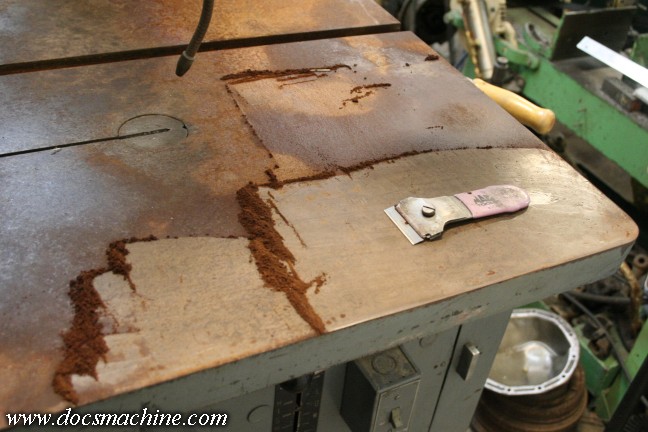
After many attempts at using everything from wire wheels to Naval Jelly, the simplest route, in my opinion, is first, get a small razor blade holder, and a small pack of single-edge, and just push the bulk of the rust off like you're scraping frost off a windshield.

saw09.jpg


The blades dull rapidly, swap out for fresh as needed.

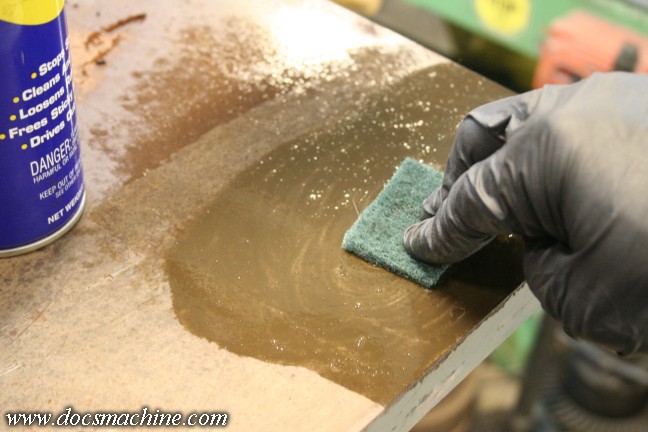
After the bulk is off, cut some Scotchbrite into small squares, and use some WD-40 (or your oil of choice) to scrub the new surface.

saw10.jpg


Again, the Scotchbrite wears out rapidly, replace as needed.

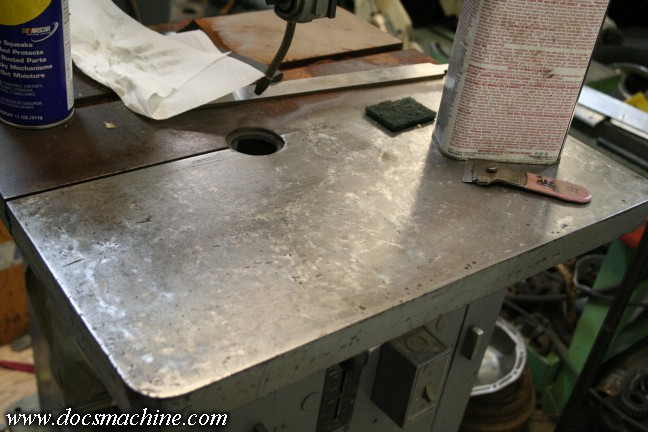
Wipe it clean, and you're pretty much done.

saw11.jpg


A light whetstone/oil stone also lubed with WD/whatever, lightly scuffed over the surface, will knock down any minor dings or tiny burrs from scratches.

That's really all you need.

Doc.


Doc's method ( thank you for sharing) is what i am using on my mill and it is working nice, razor scrape, maroon SB and PB Blaster for lube. Moved from Colorado to Tennessee and It has been sitting the trailer 7 months (not a good thing for it) waiting for the shop to get built. Just got it moved in and tried Doc's method, like it.
 
OP
M

Mamrak76

Well-known member
Joined
May 9, 2017
Messages
139
Location
Crestwood Ky
I found a used Bridgeport right angle head that after measuring will fit my mill. Should I buy it for $300? It looks almost new... but I don’t know if I have a need for it
 

RoninB4

Well-known member
Joined
Jul 22, 2020
Messages
3,539
Location
Under My House
I found a used Bridgeport right angle head that after measuring will fit my mill. Should I buy it for $300? It looks almost new... but I don’t know if I have a need for it

-The right angle heads are one of those attachments that I've always wanted but would seldom find a use for. In almost 40 years of shop work I've only had one or two occasions to use one. That doesn't mean you won't find a use for one but most other machinists/toolmakers (at that other site) have reported the same. Slots on the end of shafts, details inside a cavity where the quill won't fit, and machining on pieces laying horizontal on the table that are too tall to stand up are a few applications that come to mind.

If you don't see a regular application in the type of work you'll be doing I'd pass. Nice to have but expensive to have sitting on the shelf as a solution to a problem that never comes up. They're up for sale on a semi-regular basis from others that bought them and seldom found use for one. That's why this one looks almost new. JMO.
 

Plastikosmd

Well-known member
Joined
Nov 17, 2016
Messages
1,254
For 300$ sure
Even using it once, worth it to me.

Boring something when u are limited in the z axis, drilling or milling on end of long shaft that doesn’t fit your lathe etc as noted ^
 

justanengineer

Well-known member
Joined
Apr 5, 2011
Messages
7,722
Location
Motor City
Bridgeport made a whole series of those in different sizes. The larger ones are nice to have for the occasional use as mentioned but $300 is top dollar. Usually I see them advertised ~$100, so I’d suggest waiting for a deal. If/when you buy one be aware of the collet capacity - the smaller ones are TINY!


Sent from my iPhone using Tapatalk
 
Last edited:
OP
M

Mamrak76

Well-known member
Joined
May 9, 2017
Messages
139
Location
Crestwood Ky
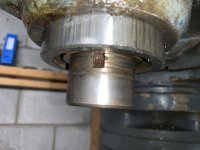
I tried to get my keyway repaired inside my quill. I could not figure out how to get to the set screw. With the nose removed this is all I could see. I read how supposedly you could remove the nose and get the whole thing to lower down to access it. I tried tapping on the drawbar but nothing happened.
The pic shows a ramp keyway but the set screw is above the brass ring.
Any suggestions?
 

Attachments

  • 65EDA955-3B5F-453D-B4F8-A62D6AAAB7C5.jpg
    65EDA955-3B5F-453D-B4F8-A62D6AAAB7C5.jpg
    103.4 KB · Views: 19
OP
M

Mamrak76

Well-known member
Joined
May 9, 2017
Messages
139
Location
Crestwood Ky
Bridgeport made a whole series of those in different sizes. The larger ones are nice to have for the occasional use as mentioned but $300 is top dollar. Usually I see them advertised ~$100, so I’d suggest waiting for a deal. If/when you buy one be aware of the collet capacity - the smaller ones are TINY!


Sent from my iPhone using Tapatalk

Do you have any idea how to change the keyway? I for some reason can’t get access to it...
 

Attachments

  • D004A72D-75C5-41D5-84C4-B3A62539FC9B.jpg
    D004A72D-75C5-41D5-84C4-B3A62539FC9B.jpg
    103.4 KB · Views: 10

23ford

Well-known member
Joined
Jul 26, 2014
Messages
517
Location
Turley America
I have used a soft rag and a good coat of Joe's hand cleaner with circular motions. it removes the crud grime and rust without harming the table. I used this on several saw tables and an indexing table thay all looked like new and you could see any maching marks from the factory.
 
OP
M

Mamrak76

Well-known member
Joined
May 9, 2017
Messages
139
Location
Crestwood Ky
I have used a soft rag and a good coat of Joe's hand cleaner with circular motions. it removes the crud grime and rust without harming the table. I used this on several saw tables and an indexing table thay all looked like new and you could see any maching marks from the factory.

Thanks I will try the hand cleaner
 
To avoid these ads, REGISTER NOW!
Top Bottom