To avoid these ads, REGISTER NOW!

Vertical pine ship lap installation.

Hondaracer2oo4

Well-known member
Joined
Feb 22, 2016
Messages
229
Location
Canterbury NH
I am getting ready to install vertical pine ship lap on my garage. I know I need to fur out nailing strips from the sheathing every two feet up the wall because they say the wall sheathing isn't enough to hold the siding. My question is about what to use for furring strips. I see some stuff says nails need to penetrate 1 1/2 inches. My plan was to use 1x2 or 1x3 rough cut but now I'm not sure because of the thickness. They are true 1 inch thick. Also would 2 inches be wide enough? I don't see why it wouldn't be. Thanks.
 
To avoid these ads, REGISTER NOW!

My Old Tools

Well-known member
Joined
Jun 4, 2014
Messages
5,424
Location
Hamrick Lake, TX
Why aren't you just nailing through to the studs instead of adding nailers? Early (pre 1940) buildings were shiplap inside and out with no sheathing.
 

K'ledgeBldr

Well-known member
Joined
Aug 22, 2011
Messages
1,925
Location
Johns Creek, GA
I am getting ready to install vertical pine ship lap on my garage. I know I need to fur out nailing strips from the sheathing every two feet up the wall because they say the wall sheathing isn't enough to hold the siding. My question is about what to use for furring strips. I see some stuff says nails need to penetrate 1 1/2 inches. My plan was to use 1x2 or 1x3 rough cut but now I'm not sure because of the thickness. They are true 1 inch thick. Also would 2 inches be wide enough? I don't see why it wouldn't be. Thanks.

Who is "they"? And what kind of sheathing?
 

ratdoggy

Well-known member
Joined
Mar 27, 2009
Messages
11,971
Location
Akron-Canton area OH
My wife and I watch "Fixer Upper" and we play a drinking game with the show...
Every time some one says "ship lap" we do a shot...
Never seem to stay conscious for the whole show
 

Randy in Maine

Well-known member
Joined
Nov 21, 2010
Messages
2,176
Location
The Beach
The entire interior walls of my 40x28x12 building is also vertical shiplap. Mine is attached directly to the 1/2" OSB (portion of my SIP panels) using 2" coil nails. I built an interior wall out of just 2x6s to run the plumbing and wiring behind and I just nailed into the studwall on both sides. Sometimes you have to use a chisel to "lever up" the boards as sometimes they are a little bowed.

I pre-finished mine with 2 coats of water based semi gloss poly. It was a fair amount of effort to do but came out really well.
 

EricP

Well-known member
Joined
Jan 30, 2014
Messages
136
Location
Alabama
I would screw the furring strips through the zip wall sheets and into the studs making sure the screws sink in the studs at least an inch. I'd use ring shank nails or screws to attach the pine to 1x2 furring strips.

My shop has bookshelf girts on three walls so I didn't have to use furring strips. On the interior wall I ran the boards horizontally. I'm using 2 1/2" screws into the 13/16" pine board into the girt or stud. I'm not done but do like the way it looks. Good luck.
 

Attachments

  • Img_0562.jpg
    Img_0562.jpg
    134.1 KB · Views: 210

K'ledgeBldr

Well-known member
Joined
Aug 22, 2011
Messages
1,925
Location
Johns Creek, GA
"They" is when you google vertical ship lap siding installation. The wall sheathing is 7/16 zip sheathing.


You don't need fur strips.

Just use a wide crown stapler- a staple every foot will be more than adequate to hold each board in place. Too bad it isn't T&G; then you could blind nail all of it.

The fur strips will create air gaps (good & bad)- mostly bad; harbors for pests.
 
OP
H

Hondaracer2oo4

Well-known member
Joined
Feb 22, 2016
Messages
229
Location
Canterbury NH
You mean staple through the lap on the board on the one side only? I don't know if I have heard any mention this method. What is the advantage to screwing the fur strips on instead if nailing?
 

EricP

Well-known member
Joined
Jan 30, 2014
Messages
136
Location
Alabama
You mean staple through the lap on the board on the one side only? I don't know if I have heard any mention this method. What is the advantage to screwing the fur strips on instead if nailing?

Nails should be fine. If you are going to hang heavy items screws would be my preference.
 

Git

Well-known member
Joined
May 18, 2008
Messages
6,894
Location
S Cal
I am getting ready to install vertical pine ship lap on my garage. I know I need to fur out nailing strips from the sheathing every two feet up the wall because they say the wall sheathing isn't enough to hold the siding. My question is about what to use for furring strips. I see some stuff says nails need to penetrate 1 1/2 inches. My plan was to use 1x2 or 1x3 rough cut but now I'm not sure because of the thickness. They are true 1 inch thick. Also would 2 inches be wide enough? I don't see why it wouldn't be. Thanks.


I *think* he is talking about using it on the exterior - note the 'on my garage' and 'siding'
 

lilredex

Well-known member
Joined
Apr 29, 2006
Messages
5,948
Location
Toronto
Here is what he has in mind for anyone not sure of what shiplap siding is.

http://drummssawmill.com/lumber-products/pine-siding/


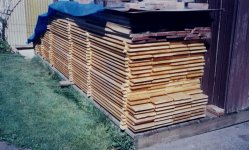
I covered up horizontal bevel siding on mine, with (1 X 10") channel siding made on the table saw. The stickers (1 X 2") shown in that pile were also run through the saw to bevel one side to provide a flat nailing surface for the new siding. The beveled furring strips were nailed to the studs and then the channel siding was nailed to the strips. 1 1/2" Ardox nails were used in both cases.

That was done more than twenty years ago, and all is still fine.
 

Attachments

  • Channel Siding 1A.jpg
    Channel Siding 1A.jpg
    144.4 KB · Views: 107
  • Channel Siding 1B.jpg
    Channel Siding 1B.jpg
    139.7 KB · Views: 109
OP
H

Hondaracer2oo4

Well-known member
Joined
Feb 22, 2016
Messages
229
Location
Canterbury NH
People really are having a TOUGH time with this concept. I will reiterate so everyone is on the same page. I am doing VERTICAL SHIPLAP EXTERIOR SIDING. Now that we have that squared away I believe that not many people outside of New England see this done or know what it is. Think barn look and you will understand what I am doing.
 

matt_i

Well-known member
Joined
Mar 14, 2008
Messages
10,722
Location
SE Michigan
I would do a little testing with GRK screws or finish nails, or a narrow crown (like 1/4") stapler. I think any of the above would work. The stapler will be fastest due to the pneumatic feature, the screws made by GRK will be slowest but will split the least due to their special drilling "point", and be stronger and never pull out. Finish nails could also be hand hammered but I trust their holding power the least. Dunno what your flavor is going to be.

A 1x2 seems a little light to be drving a nail thru, especially in the center of a 16" span. I would prefer the 1x3s...BUT...in my case I'd buy them at a lumber yard and not a home center. 99x out of 100, better, straighter wood from there. You probably need close to a "lift" of them anyway.
 
To avoid these ads, REGISTER NOW!
OP
H

Hondaracer2oo4

Well-known member
Joined
Feb 22, 2016
Messages
229
Location
Canterbury NH
So I will be using 1x3 or 1x2 rough cut( this means true dimensional lumber). Maybe 1x3 would be better since I could easily get 2 nails into every stud. As far as attaching the siding to the strips people ussually use galvy hand bangers. I was probably going to get stainless ring shanks for a pneumatic siding nailing and use them. Whatever I use I plan on face nailing.
 

Firebrick43

Well-known member
Joined
May 12, 2015
Messages
13,975
Location
West central Indiana
Most of the time ship lap is done horizontal on ballon framed buildings and it's a good application as the rabbet acts as a drip edge. Just to be clear as some people refer to board and batten siding as ship lap (which its not) and it is vertical on post and beam framing but ship lap could be to, not common here. Both of these are for open walled structures not sheathed and insulated ones.

You didn't mention if you are insulating, what type of sheathing, or heating but I am assuming it going to be heated and is sheathed in OSB. What you want to do should not really be done. No siding is water proof. Wind blown water, dew, and capillary action allow water behind the siding. Capillary action on vertical ship lap would be worse than it applied horizontal but on a timber framed barn with open walls it will dry out very quickly. If wood siding(really all siding) is place over sheathing it needs to have a rain screen. This is tar paper applied horizontally lapped top over bottom. Then vertical furing strips are screwed to where the studs are. A strip of tar paper covers the the furing strip and the siding is applied horizontally,nailed through the furing strip into the stud then thin long siding nails. This air channel allow natural convection (heat rises) currents to dry the wood evenly and any droplet moisture to run out the bottom. If one primes the back as well as paint the front moisture expansion/contraction in the wood is mitigated and the paint doesn't crack and peel nor does the OSB rot or the insulation become saturated. Also cupping is mitigated. To all the nay Sayers at this point look up tyvek failure and read some articles on fine home building or JLC.

So if your still with me we will move on to vertical intstall. If we just fir out the wall horizontally there is no natural convection as the siding is heated by the sun(hot air/water vapor goes up not sideways) and any dropplet water hits the strip and forces against either the sheathing or siding causing rot. This would still be better than attaching it directly to the sheathing as there would be some air movement sideways but not even or consistant.

I SUPOSE one could take and put two layers of furring strips, one vertical against the sheathing 1/2 thick and then a thicker piece screw through the strips and sheathing into studs for the siding to be attached to but then it starts getting shady structurally.

Wish you the best of luck. Also if you do end up doing it remember to put the outside edge of the rabbet down wind of your typical prevailing winds to lessen the water egress. Good luck. For longevity of the structure and your pocket book I wish you would consider putting it on horizontal. If it were an unsheathed/Unheated barn I would say have at it but I don't think it will end well
 
Last edited:

p_mori7

Well-known member
Joined
Mar 23, 2010
Messages
3,340
Location
Montreal, QC., Canada
Agree with above. Shiplap is done horizontally. Board & Batten is done vertically. Below pics are how I did mine. Notice 1x3 furring strips installed 2' on center. I used rough sawn hemlock. Look is reverse B&B. I had the boards milled so they would overlap to create the effect. Applied Behr 20yr opaque stain afterwards. Furring strips allow air circulation behind the boards and help keep building dry. Also help keep the Tyvek on over the winter when you don't have time or funds to install siding before the snow flies.


Last edited:
OP
H

Hondaracer2oo4

Well-known member
Joined
Feb 22, 2016
Messages
229
Location
Canterbury NH
Ok, I am with you. I certainly understand the need to allow any water that does make it around the siding laps to have somewhere to drain out to and have the ability to dry out. I see some commercially made membranes that you mechanically apply to the wall sheathing and then add your furring strips. I can't find any prices online for them though. I will call the lumber yard tomorrow and ask. I also believe that I wouldn't need much gap though. A 1/4 inch should be sufficient. If I place some type of material to keep the horizontal 1x3 nailers out 1/4 inch off the sheathing than that should be sufficient drainage and allowing good air flow behind the siding. The wall sheathing is 7/16 zip wall by the way with the seams taped. The garage will be heated as well.
 

KenC

Well-known member
Joined
Dec 20, 2009
Messages
2,576
If the interior is open, I'd rather put horizontal blocking between the studs every 24 inches. Then use a mesh type rain screen on the outside and nail the boards through the sceen, sheathing and into the blocking. a little more work but really solid and allows the water drainage needed.
 

Firebrick43

Well-known member
Joined
May 12, 2015
Messages
13,975
Location
West central Indiana
If the interior is open, I'd rather put horizontal blocking between the studs every 24 inches. Then use a mesh type rain screen on the outside and nail the boards through the sceen, sheathing and into the blocking. a little more work but really solid and allows the water drainage needed.

I like that👍🏻
 

CTyankee

Well-known member
Joined
Jan 13, 2013
Messages
3,792
Location
CT
Agree with above. Shiplap is done horizontally. Board & Batten is done vertically.

Maybe we are just talking semantics, but that's not my understanding. Shiplap can and is done vertically. It is also referred to as barn siding. Board and batten is vertical boards covered by another strip of wood at the joint. Hard to tell from the picture, but it doesn't look like yours is board and batten. :dunno:
 
OP
H

Hondaracer2oo4

Well-known member
Joined
Feb 22, 2016
Messages
229
Location
Canterbury NH
I think that some people are certainly unfamiliar with the vertical SHIPLAP barn board installation but I agree that a lot of times it is done on an open cavity that can dry out. I would not like to do the blocking method because of insulation being used which would make it difficult to install batt insulation and lots of thermal bridging. Horizontal furring strips are the commonly used product for vertical installation and I think I can easily solve the drainage by just standing the furring strips off the sheathing with maybe just a small piece of 1/4 Luan at each stud.
 

readhead

Well-known member
Joined
Dec 8, 2012
Messages
6,175
Location
Durango, Co.
It's done around here on high end homes but it requires a lot of detail work which makes it expensive to install. Space behind is essential. One of the builders uses furring strips with kerfs in the back for air movement. He also has the boards milled with a wider tongue and wider rabbit to account for the shrinking in width after installing.
 
Last edited:
OP
H

Hondaracer2oo4

Well-known member
Joined
Feb 22, 2016
Messages
229
Location
Canterbury NH
The kerfs that he cuts is only 1/16 blade width? What is the interval that he puts these kerfs at? I would think he would have to put a ton in them to get flow.
 

Firebrick43

Well-known member
Joined
May 12, 2015
Messages
13,975
Location
West central Indiana
I thought of relieving slots in the back of the furring strips but didn't suggest it due the complexity. I would think laying all the strips aside each other on a bench and using a router with a straight edge and 1/2" bit every 8"-12" would be better. But 1" wide 1/4" cdx would be easier. I wouldn't use Luan as much of it doesn't have waterproof glue. Some does but how do you know beside the boil test.
 
OP
H

Hondaracer2oo4

Well-known member
Joined
Feb 22, 2016
Messages
229
Location
Canterbury NH
Good point on the Luan. I don't believe that with a 1/4 air space created by Whatver product I use to space the fur strips away from the sheathing are going to ever get a chance to get soaked because of te good airflow but I agree better to go with a more water resistant product.
 

p_mori7

Well-known member
Joined
Mar 23, 2010
Messages
3,340
Location
Montreal, QC., Canada
Maybe we are just talking semantics, but that's not my understanding. Shiplap can and is done vertically. It is also referred to as barn siding. Board and batten is vertical boards covered by another strip of wood at the joint. Hard to tell from the picture, but it doesn't look like yours is board and batten. :dunno:

Well color me dumb !

I always thought shiplap had just the bottom edge of the board milled to overlap the top of the lower board. I looked at some images "on the Internets" and found that shiplap actually has top and bottom of the boards milled...exactly like what I installed on my garage...even found a profile similar to my boards (although mine were square milled for vertical installation, not radius milled for horizontal installation).


Also Board & Batten can have the Batten on the outside, or on the inside. When on the inside they call it "Reverse B&B" which is kinda how my garage looks.
 
Last edited:

coldh2o

Well-known member
Joined
May 21, 2013
Messages
1,414
Location
Ontario, Canada
Most of the time ship lap is done horizontal on ballon framed buildings and it's a good application as the rabbet acts as a drip edge. Just to be clear as some people refer to board and batten siding as ship lap (which its not) and it is vertical on post and beam framing but ship lap could be to, not common here. Both of these are for open walled structures not sheathed and insulated ones.

You didn't mention if you are insulating, what type of sheathing, or heating but I am assuming it going to be heated and is sheathed in OSB. What you want to do should not really be done. No siding is water proof. Wind blown water, dew, and capillary action allow water behind the siding. Capillary action on vertical ship lap would be worse than it applied horizontal but on a timber framed barn with open walls it will dry out very quickly. If wood siding(really all siding) is place over sheathing it needs to have a rain screen. This is tar paper applied horizontally lapped top over bottom. Then vertical furing strips are screwed to where the studs are. A strip of tar paper covers the the furing strip and the siding is applied horizontally,nailed through the furing strip into the stud then thin long siding nails. This air channel allow natural convection (heat rises) currents to dry the wood evenly and any droplet moisture to run out the bottom. If one primes the back as well as paint the front moisture expansion/contraction in the wood is mitigated and the paint doesn't crack and peel nor does the OSB rot or the insulation become saturated. Also cupping is mitigated. To all the nay Sayers at this point look up tyvek failure and read some articles on fine home building or JLC.

So if your still with me we will move on to vertical intstall. If we just fir out the wall horizontally there is no natural convection as the siding is heated by the sun(hot air/water vapor goes up not sideways) and any dropplet water hits the strip and forces against either the sheathing or siding causing rot. This would still be better than attaching it directly to the sheathing as there would be some air movement sideways but not even or consistant.

I SUPOSE one could take and put two layers of furring strips, one vertical against the sheathing 1/2 thick and then a thicker piece screw through the strips and sheathing into studs for the siding to be attached to but then it starts getting shady structurally.

Wish you the best of luck. Also if you do end up doing it remember to put the outside edge of the rabbet down wind of your typical prevailing winds to lessen the water egress. Good luck. For longevity of the structure and your pocket book I wish you would consider putting it on horizontal. If it were an unsheathed/Unheated barn I would say have at it but I don't think it will end well

Excellent information. One way to address the concern of air/moisture movement with furring strips is to install them on a 45 degree angle.
 
OP
H

Hondaracer2oo4

Well-known member
Joined
Feb 22, 2016
Messages
229
Location
Canterbury NH
This thread has certainly invoked some great thought and responses. I have definitely changed from my original approach for the better and I appreciate all the help. I like the 45 degree angles but I dont think I would like the nailing pattern look on the siding when it is face nailed. You would have nails running up the way at 45 degree angles.
 

Falcon67

Well-known member
Joined
Jun 11, 2009
Messages
18,371
Location
Merkel, TX
I've seen my grandfather do this, like a long time ago. So FWIW - he ran 1x4 or 1x6 strips horizontal on studs about eveyy 12" up the wall. Covered the wall with a layer (layered from bottom with overlap) 15 lb roofing felt, then nailed the siding to the strips.

He also did several "shop" type buildings with the same method, except the external "siding" was roofing shingles.
 
OP
H

Hondaracer2oo4

Well-known member
Joined
Feb 22, 2016
Messages
229
Location
Canterbury NH
Putting the roof felt ontop of the fur strips then siding ontop of that would keep water away from the sheathing but I really am not worried much about the zipwall holding up to a little moisture, I am worried about water getting around the siding and laying on the backside of the siding and not drying.
 

coldh2o

Well-known member
Joined
May 21, 2013
Messages
1,414
Location
Ontario, Canada
This thread has certainly invoked some great thought and responses. I have definitely changed from my original approach for the better and I appreciate all the help. I like the 45 degree angles but I dont think I would like the nailing pattern look on the siding when it is face nailed. You would have nails running up the way at 45 degree angles.

Good point on the face nailing.
 
To avoid these ads, REGISTER NOW!
Top Bottom