OP
Vertigo Cycles
Well-known member
A while back I cut out some body shapes with templates but they've been sitting without progress for months.
 IMG_1398 by Sean Chaney, on Flickr
On my birthday a few weeks ago, my wife worked from home to give me the day off from playing stunt teacher and rather than ride my bike, I took the time to make some progress on a bass. The bass was chosen because despite its size, it's the instrument my wife feels is most approachable. She taught herself how to play the ukulele a few years ago, started learning chords on one of my guitars this past year but sore fingers hasn't helped her motivation much. Hopefully she'll feel inspired to play this bass more often than the guitars.
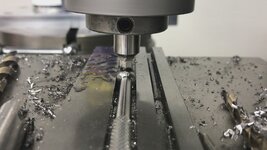
With no space to store a router sled, the path of least resistance is to cut carbon rod and truss rod channels on my mill. Only the table isn't quite long enough for a bass neck
 IMG_1541 by Sean Chaney, on Flickr
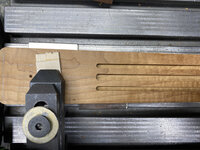
...so I stopped when I maxed out the travel...
 IMG_1540 by Sean Chaney, on Flickr
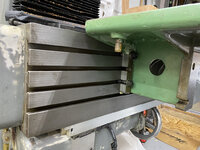
...what the Deckel lacks in size, it makes up for in versatility. The tables are removable and are keyed into the built-in vertical table. In this case, all that was needed was to slide the table to the right about six inches
 IMG_1542 by Sean Chaney, on Flickr
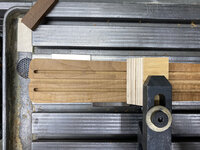
to complete the slots
 IMG_1543 by Sean Chaney, on Flickr
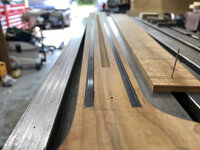
then the carbon rods are epoxied into place
 IMG_1545 by Sean Chaney, on Flickr
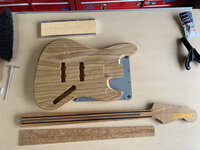
after slotting the fret board, marking out centerlines and cutting it it slightly oversized, it's ready to epoxy onto the neck.
 IMG_1546 by Sean Chaney, on Flickr
No photos of a lot of the little but important steps, most of which were done during a week long bout of insomnia. It's nice to be productive when I have to move silently through the house but I have to be careful because I'm much more likely to forget an important step....like creating some fallaway in the fretboard....which I forgot to do.
But I managed to get the frets in, as well as the dot inlays and with a borrowed spoke shave, I hogged off the majority of the waste on the neck
 IMG_1555 by Sean Chaney, on Flickr
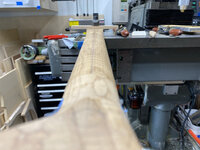
With some adhesive backed sandpaper on a slab of aluminum plate that I machined perfectly flat, I do a bit of sanding on the neck to ensure that there aren't any dips or ridges, without sanding so close to the heel or neck that I'd bork up the crisp transitions
 IMG_1557 by Sean Chaney, on Flickr
These carving knives are the most enjoyable tool I've ever used, period.
 IMG_1560 by Sean Chaney, on Flickr
transitions blended
 IMG_1561 by Sean Chaney, on Flickr
Yesterday I finish sanded the neck, drilled tuner holes, cut the arm bevel, belly bevel, some horn beveling for high fret access and then a little epoxy pore filling and then assembled it just so my kids could roll their eyes at yet another thing I've made and am excited about. At what age do they understand that turning a couple of slabs of wood into something is pretty great?
From here on out, there will be many hours of sanding, pore filling, sanding some more, sealing, sanding and then more sanding. Then shooting a little paint, clear and yet more sanding. I'm going to go ride my bike now, maybe wear the dog out in the process. Maybe have a BBQ with the neighbors tonight and then get started on that sanding.
IMG_1398 by Sean Chaney, on FlickrOn my birthday a few weeks ago, my wife worked from home to give me the day off from playing stunt teacher and rather than ride my bike, I took the time to make some progress on a bass. The bass was chosen because despite its size, it's the instrument my wife feels is most approachable. She taught herself how to play the ukulele a few years ago, started learning chords on one of my guitars this past year but sore fingers hasn't helped her motivation much. Hopefully she'll feel inspired to play this bass more often than the guitars.
With no space to store a router sled, the path of least resistance is to cut carbon rod and truss rod channels on my mill. Only the table isn't quite long enough for a bass neck
IMG_1541 by Sean Chaney, on Flickr...so I stopped when I maxed out the travel...
IMG_1540 by Sean Chaney, on Flickr...what the Deckel lacks in size, it makes up for in versatility. The tables are removable and are keyed into the built-in vertical table. In this case, all that was needed was to slide the table to the right about six inches
IMG_1542 by Sean Chaney, on Flickrto complete the slots
IMG_1543 by Sean Chaney, on Flickrthen the carbon rods are epoxied into place
IMG_1545 by Sean Chaney, on Flickrafter slotting the fret board, marking out centerlines and cutting it it slightly oversized, it's ready to epoxy onto the neck.
IMG_1546 by Sean Chaney, on FlickrNo photos of a lot of the little but important steps, most of which were done during a week long bout of insomnia. It's nice to be productive when I have to move silently through the house but I have to be careful because I'm much more likely to forget an important step....like creating some fallaway in the fretboard....which I forgot to do.
But I managed to get the frets in, as well as the dot inlays and with a borrowed spoke shave, I hogged off the majority of the waste on the neck
IMG_1555 by Sean Chaney, on FlickrWith some adhesive backed sandpaper on a slab of aluminum plate that I machined perfectly flat, I do a bit of sanding on the neck to ensure that there aren't any dips or ridges, without sanding so close to the heel or neck that I'd bork up the crisp transitions
IMG_1557 by Sean Chaney, on FlickrThese carving knives are the most enjoyable tool I've ever used, period.
IMG_1560 by Sean Chaney, on Flickrtransitions blended
IMG_1561 by Sean Chaney, on FlickrYesterday I finish sanded the neck, drilled tuner holes, cut the arm bevel, belly bevel, some horn beveling for high fret access and then a little epoxy pore filling and then assembled it just so my kids could roll their eyes at yet another thing I've made and am excited about. At what age do they understand that turning a couple of slabs of wood into something is pretty great?
From here on out, there will be many hours of sanding, pore filling, sanding some more, sealing, sanding and then more sanding. Then shooting a little paint, clear and yet more sanding. I'm going to go ride my bike now, maybe wear the dog out in the process. Maybe have a BBQ with the neighbors tonight and then get started on that sanding.