To avoid these ads, REGISTER NOW!

VFD Wiring

Which wire between VFD and Motor?


  • Total voters
    13
  • Poll closed .

Farmallboy15

Well-known member
Joined
Jan 31, 2018
Messages
71
Location
Ohio
I'm about ready to buy a VFD for my Bridgeport that I am refurbishing. For those of you with VFD's in your shop what kind of wire are you running between the VFD and motor / DC control switches?


The manuals suggest using shielded VFD cable and shielded control cable. I was planning on just running THHN inside of FMC. My power run is in EMT to a fused disconnect on the wall. My problem with the shielded is that it is ~$5/ft with a 20ft order minimum and I'm not sure it is necessary.


So what do you use: shielded cable or wire in pipe?
 

Attachments

  • IMG_1245.jpg
    IMG_1245.jpg
    91.7 KB · Views: 47
  • IMG_1298.jpg
    IMG_1298.jpg
    81.9 KB · Views: 48
  • IMG_1319.jpg
    IMG_1319.jpg
    83.3 KB · Views: 48
To avoid these ads, REGISTER NOW!

Aceman

Well-known member
Joined
Jan 28, 2007
Messages
2,513
Location
Eastern Oregon
Keep your low voltage control wiring in a separate conduit/flex and away from the high voltage power wiring and you will be fine to use thhn in pipe.

I've wired many different kinds of vfds in various control cabinets, and can't think of any issues I've had, as long as I maintained separation between the wiring.

If I was going long distances with the wiring, I would be more inclined to follow the manual to the letter and use shielded cable. Where you're only going a couple feet or so, it isn't going to matter.
 

MattT

Well-known member
Joined
Feb 20, 2010
Messages
3,201
I haven't seen any problems with thhn in correctly installed metallic conduit. It's what most industrial installations use for motors IME. Seen some SO cord installs cause iinterference problems.

On digital controls (switches) you might get away without shielded or you might not. Depends on the drive and the wire routing.

On 0-10v analog best to use shielded.
 

Bert_

Well-known member
Joined
Dec 24, 2016
Messages
9,690
Location
NW Iowa
Mostly I use TFFN which is mostly the same as THHN except in comes it #16 or #18. If your using the 0-10v input you might want to shield that but for the most part it's a non issue.
 

Stuart in MN

Well-known member
Joined
Sep 8, 2005
Messages
22,979
Location
Minneapolis
Shielded wire is a good idea for long runs, but since your VFD and motor will only be a few feet apart THHN should be fine.
 
OP
F

Farmallboy15

Well-known member
Joined
Jan 31, 2018
Messages
71
Location
Ohio
Thanks guys. I'll run THHN for the motor and shielded 18ga for the low voltage circuits. I figured the VFD cable was overkill but just wanted to make sure I wasn't crazy.
 
To avoid these ads, REGISTER NOW!

4cyclic

Well-known member
Joined
Sep 30, 2013
Messages
104
Location
Grand Isle, Vt
Mcmaster Carr has 10ft of motor shielded cable if you go that route. That's what I used for my lathe and mill just 2 weeks ago. Also shielded 18g control cables.

Good luck with your install.
 

walta

Well-known member
Joined
Jan 13, 2017
Messages
2,307
Location
Dutzow Missouri
The shield is only important if you care about radio reception near this tool. Steel conduit is as good as shielding.

Walta
 

Stuart in MN

Well-known member
Joined
Sep 8, 2005
Messages
22,979
Location
Minneapolis
Cable specifically designed for VFD use can also protect the motor and the drive itself from damage. Besides special shielding (it typically uses both braided and foil layers), it also has multiple ground conductors, the conductors are twisted together and not just straight, and the insulation is designed to resist damage from corona discharge.

Having said that, for an application like this where the VFD is close coupled with a low horsepower motor, and the motor is used on a relatively intermittent basis, it's not as critical.
 

RPH

Well-known member
Joined
Dec 17, 2006
Messages
4,190
Location
Michigan Thumb
Try to keep the three wires tightly bundled together. This will help with noise generation.
 

bjcouche

Well-known member
Joined
Sep 11, 2010
Messages
509
Location
Ohio
I would use THWN inside LFMC for a milling machine. The Liquid tight Flexible Metallic Conduit will prevent all that splashed coolant, crud, dirt, etc from making it's way into the conduit, and potentially down into a control cabinet... I use all liquid tight conduits in wet applications.. Be sure to run four conductors from the inverter to motor, 3 phases plus ground. Don't just rely on the conduit for the grounding.
If you are using the original 40+ year old bridgeport motor on the inverter, I would recommend installing a load reactor (inductor) between the inverter and motor. In industrial applications this is only done for extra long distances between motor and inverter. However, the inductor will slow the PWM rise time and minimize the amount of voltage overshoot at the motor. Newer motors have much better insulation systems. Old motors were never designed for inverter use and thus are more susceptible to this problem. The inductor is inexpensive insurance compared to a failed motor... Some of these bridgeport motors must be rewound at 5X the cost of a new standard motor because the old motor shaft is non standard.
 
OP
F

Farmallboy15

Well-known member
Joined
Jan 31, 2018
Messages
71
Location
Ohio
The Liquidtite metallic conduit probably isn't a bad idea. My enclosures and TECO VFD will be here early next week.

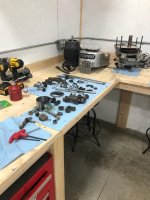
If you look close at my motor I already have a new Baldor motor that is inverter ready (new ebay surplus). I eliminated the old motor and variable pulleys due to a 600v motor and a worn keyway on the shaft. The drive is straight V-belt now with a slight overdrive. You can also see the adaptor plate I designed and had water-jet cut to adapt the Bridgeport pattern to all 145TC, 143TC, 184C, 182C & 56C C-face motors. If anyone wants details on the adaptor let me know.
 
To avoid these ads, REGISTER NOW!
Top Bottom