To avoid these ads, REGISTER NOW!

Vibrating concrete in small casting

Quickstep192

Well-known member
Joined
Aug 16, 2025
Messages
75
I’m making concrete castings using the mold in the attached picture.

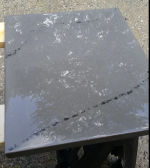
The second picture is the casting I just did.

I’m using countertop concrete.

During my last attempt, I clamped a vibrating palm sander upside down and held the mold on top of it as I poured the concrete. I got a casting that was relatively free of pock marks, but not perfect.

Any suggestions for a better method?
 

Attachments

  • IMG_6828.jpeg
    IMG_6828.jpeg
    799.9 KB · Views: 64
  • IMG_6933.jpeg
    IMG_6933.jpeg
    671.2 KB · Views: 63
To avoid these ads, REGISTER NOW!

PCustoms

Well-known member
Joined
Jul 23, 2011
Messages
22,524
Location
VT
Palm sander or sawzall (no blade!) is usually what I see.

I wonder if an oscillating tool would work?

Or a vacuum chamber?

You've made a lot of posts about this project, it still isn't clear how perfect of a casting you're looking to make. Have you considered concrete isn't the right material?

I'd at least be adding a plasticizer to get it smoother
 

kwb

Well-known member
Joined
May 1, 2009
Messages
1,771
Location
PNW
Palm sander probably doesn't have the umph.

Try a sawzall or air hammer.
 

Max78

Well-known member
Joined
Mar 13, 2021
Messages
228
Location
Tucson, AZ
That looks like a pretty darn good cast! not sure how to get a perfect surface on the mold side but few ideas come to mind.

You could try pouring a very thin and watered down first layer. Maybe even brush it on or something.

You could try post finishing, get some thin concrete and pour or brush it on the mold side of the cured part to fill the voids.

the other thing I'm not sure will work even, is can you pull a vacuum like they do with resins. That would help draw the air out of the mold and fill the voids. It looks small enough.

I'm not sure any amount of vibrating will get those tiny holes out.
 
OP
Q

Quickstep192

Well-known member
Joined
Aug 16, 2025
Messages
75
Thanks for the thoughts.

I know I’m being a little greedy with the quality. I’m pretty happy with with the current result, but if I can get all the surfaces perfectly smooth, I’m all ears for ideas.

I’m absolutely game for trying a different material and would welcome ideas on that too. I want the resulting cast to look like concrete, so concrete seem like the best way to go. And, the countertop concrete has plasticizer in it.

I’ve been mixing the concrete to a pourable consistency. I suppose I could make it a little soupier.
 

PCustoms

Well-known member
Joined
Jul 23, 2011
Messages
22,524
Location
VT
Thanks for the thoughts.

I know I’m being a little greedy with the quality. I’m pretty happy with with the current result, but if I can get all the surfaces perfectly smooth, I’m all ears for ideas.

I’m absolutely game for trying a different material and would welcome ideas on that too. I want the resulting cast to look like concrete, so concrete seem like the best way to go. And, the countertop concrete has plasticizer in it.

I’ve been mixing the concrete to a pourable consistency. I suppose I could make it a little soupier.

I don't get how you're getting porosity.

I used rapid set mortar and plasticizer and have 0 surface voids in 3 pours. The 4th I have voids, but only in areas I tried to "vein" the slab with colored mortar
 
OP
Q

Quickstep192

Well-known member
Joined
Aug 16, 2025
Messages
75
I don't get how you're getting porosity.

I used rapid set mortar and plasticizer and have 0 surface voids in 3 pours. The 4th I have voids, but only in areas I tried to "vein" the slab with colored mortar
How
I don't get how you're getting porosity.

I used rapid set mortar and plasticizer and have 0 surface voids in 3 pours. The 4th I have voids, but only in areas I tried to "vein" the slab with colored mortar
How tight is your mix?

I made mine just to the point of pourable. I think if it was a little looser, I might eliminate voids, but I didn’t want to make it too loose and compromise strength or have it shrink and crack during the cure.
 

PCustoms

Well-known member
Joined
Jul 23, 2011
Messages
22,524
Location
VT
How

How tight is your mix?

I made mine just to the point of pourable. I think if it was a little looser, I might eliminate voids, but I didn’t want to make it too loose and compromise strength or have it shrink and crack during the cure.

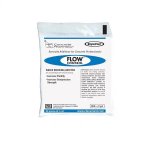
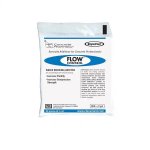
I added the max water per the instructions and a bag of flow control

1769877912317.jpeg

1769877939116.jpeg

My forms were masonite

Edit:

Wet polishing

1000003064.png
 

Attachments

  • 1769878154044.jpeg
    1769878154044.jpeg
    35.2 KB · Views: 42

PCustoms

Well-known member
Joined
Jul 23, 2011
Messages
22,524
Location
VT
or somehow make an attachment that can dip into to concrete?

I don't think your mold is deep enough to directly vibrate the concrete, but lots of ideas:

https://www.google.com/search?clien...f4QtKgLegQIFBAB&biw=432&bih=761&dpr=2.5&aic=0

Also, for $99, I need to get that HF ******** before I do any more projects next summer
 

carlaisle

Well-known member
Joined
May 14, 2022
Messages
370
Have you considered using plaster? It can be dyed if you need a color other than white.
 

kyrbz

Well-known member
Joined
Jan 30, 2012
Messages
1,309
Location
midwest US
For small concrete, plaster and resin casting projects I bought a cheap vibrating motor from Amazon that I attached to the bottom of a sheet of plywood that I put across sawhorses to make a vibrating table

Screen Shot 2026-01-31 at 5.09.58 PM.png
 
To avoid these ads, REGISTER NOW!

yhprum

Well-known member
Joined
Jul 27, 2006
Messages
1,385
Location
Brisbane Australia

PCustoms

Well-known member
Joined
Jul 23, 2011
Messages
22,524
Location
VT
I don’t really know if this would work for concrete, or if the volume of your part is large, but one method to remove bubbles in epoxy casting is to place the mixed epoxy in a jar, and apply a vacuum to the jar. All the bubbles are removed, and you’re ready to pour it into the mold.

Edit to add this: https://www.google.com/search?q=vac...B&sourceid=chrome-mobile&ie=UTF-8#lfId=ChxjMe

Can't believe no one mentioned that!

Or a vacuum chamber?

the other thing I'm not sure will work even, is can you pull a vacuum like they do with resins. That would help draw the air out of the mold and fill the voids. It looks small enough.
 

no704

Well-known member
Joined
Apr 27, 2016
Messages
5,209
making plaster moulds I found that adding a surfactant significantly helps with air bubbles. I tried several different flavors of dish soap. Ajax lemon flavor was by far the best! Anything with an oxyclean prevents hardening.
 

Firebrick43

Well-known member
Joined
May 12, 2015
Messages
14,015
Location
West central Indiana
Mix and degas the concrete in a vacuum pot before pouring it in the mold. This get most of the air out of the mix and then all you have to contend with is what is trapped when you pour the mix in

A super plasticizer additive helps it to flow better without out making the mix to wet and therefore weak
 

yhprum

Well-known member
Joined
Jul 27, 2006
Messages
1,385
Location
Brisbane Australia
I was thinking about the vacuum chamber idea, and I suppose a old pressure cooker pot could work for this. I used a mighty vac hand pump on smaller resin projects.
 

Uncle murph

Well-known member
Joined
Jan 28, 2021
Messages
1,462
Location
Harford county
I’m making concrete castings using the mold in the attached picture.

The second picture is the casting I just did.

I’m using countertop concrete.

During my last attempt, I clamped a vibrating palm sander upside down and held the mold on top of it as I poured the concrete. I got a casting that was relatively free of pock marks, but not perfect.

Any suggestions for a better method?
I use a worn out hammerdrill bit right against the form.5/8” works great.
 
OP
Q

Quickstep192

Well-known member
Joined
Aug 16, 2025
Messages
75
I was thinking about the vacuum chamber idea, and I suppose an old pressure cooker pot could work for this. I used a mighty vac hand pump on smaller resin projects.
I use an old pressure cooker for my vacuum pot, but it’s not big enough for this casting.

Any thoughts on what I could use to build a vacuum pot that approx 9 x 9 x 3? (On the cheap)

Do you think it’s necessary to reach full vacuum?
 

PCustoms

Well-known member
Joined
Jul 23, 2011
Messages
22,524
Location
VT
I use an old pressure cooker for my vacuum pot, but it’s not big enough for this casting.

Any thoughts on what I could use to build a vacuum pot that approx 9 x 9 x 3? (On the cheap)

Do you think it’s necessary to reach full vacuum?

Degas your mix in a smaller container, then carefully pour into the form....

Before you go through all that, plasticizer and full water.
 

no704

Well-known member
Joined
Apr 27, 2016
Messages
5,209
I use an old pressure cooker for my vacuum pot, but it’s not big enough for this casting.

Any thoughts on what I could use to build a vacuum pot that approx 9 x 9 x 3? (On the cheap)

Do you think it’s necessary to reach full vacuum?
SS chafing dish and a hunk of lexan with whatever for a gasket. No.
 

willymakeit

Well-known member
Joined
Apr 27, 2009
Messages
1,242
Location
Springfield Mo.
We used to bolt a washing machine motor to bench, weld a weight to one side of a pulley to make it out of balance. Worked well on man made marble countertops
 

Max78

Well-known member
Joined
Mar 13, 2021
Messages
228
Location
Tucson, AZ
If your mold corners are sealed get a flat sheet with a hole in it for the vacuum to attach to, get a rubber sheet to act as a gasket and pull a vacuum on the mold after the pour?
 

kyrbz

Well-known member
Joined
Jan 30, 2012
Messages
1,309
Location
midwest US
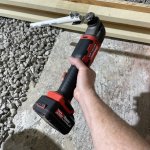
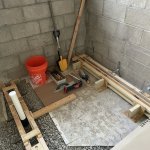
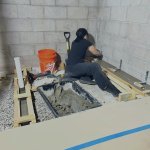
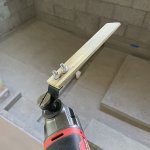
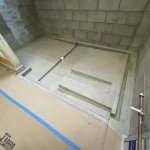
I recently had a project that my "real" concrete ******** seemed overkill for, so I gave the oscillating tool technique a try. I'd say it worked well with one exception. In all the youtube videos I watched, guys were using a piece of small pvc pipe attached to an oscillating tool blade. I tried using a piece of pvc like in the videos, but for what I was doing, a short stick attached to an old blade seemed to work better. With both pvc or a wood stick, I could see the concrete level drop when the tool was started, so they both worked at vibrating air out of the mix, but the pvc leaves a larger cavity in the concrete when you remove it from the concrete. The pvc also had issues like the tube flattening out or the bolt holes getting reamed out causing the pvc pipe to get loose. Some guys flattened the end of the pvc where it attached to the blade. I tried that and it made the pvc too flimsy and too much vibration. I'm not sure why they all use pvc in the vids I watched. A plain flat stick attached to a blade works much better. Number one, it's much easier to fab up a stick version than a pvc one. The wood stick version leaves a much smaller penetration in the concrete when you're vibrating, and lastly it doesn't require constant tightening or fiddling with. I'd also recommend a cobalt drill bit for drilling through the oscillating tool blade when you make a vibrating attachment and self locking nuts so it doesn't vibrate loose while using.

IMG_7154.jpeg

IMG_7156.jpeg

IMG_7193.jpeg

IMG_7261.jpeg

IMG_8099.jpeg

IMG_8109.jpeg

IMG_7833.jpeg
 
To avoid these ads, REGISTER NOW!
Top Bottom