To avoid these ads, REGISTER NOW!

Vinegar and rust

Ray-CA

Well-known member
Joined
Jan 6, 2007
Messages
3,451
Location
San Diego CA
I buy the dollar store vinegar and use that. Might have to try a vinegar bath with electrolysis on some larger pieces I have.

Ray
 
To avoid these ads, REGISTER NOW!

bargainhuntingking

Well-known member
Joined
Nov 22, 2013
Messages
434
Location
The Amazing Pacific Northwest
White vinegar is my go-to rust remover as well. Best part is, the rusty vinegar can be used as a wood stain. Works great on hardwoods like oak, if you want to try it on pine, you'll want to mix it with some old coffee grounds.

View media item 70377
View media item 82569
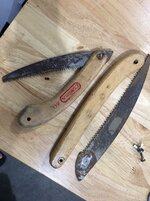


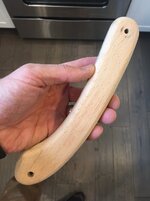
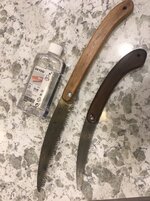
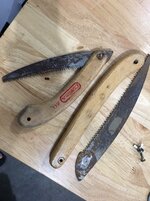
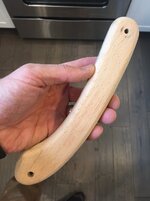
I tried your rust vinegar wood stain. Thanks for the tip! I had two folding saws from the ReStore and removed the blades, de-rusted them in Evaporust (5% vinegar works just as well), sanded the old varnished handles, applied just vinegar rust juice (from de-rusting a 5lb splitting wedge) on the big handle and felt it needed a richer stain, so for the smaller handle I added coffee grounds from my French press brew and let it soak for a couple of hours. Dried it then applied mineral oil followed by Johnson paste wax. The handles are smooth and leathery. Love the patina.

Before:
c2c55d14874c42f85740d3a8f9a0713c.jpg

After sanding:18320be3cd34631340b8255d39d96cec.jpg

Just dumped some coffee grounds in:306607bbfdb291163718d14460655651.jpg

With the stain:
a58019a204a2a0fe0dbc3b3e3afa0b1a.jpgd67e759496e5f64f622b469371d1b91b.jpg06616721cd10d441072391f2e13a14e8.jpg
 

Attachments

  • c2c55d14874c42f85740d3a8f9a0713c.jpg
    c2c55d14874c42f85740d3a8f9a0713c.jpg
    592.2 KB · Views: 0
  • 18320be3cd34631340b8255d39d96cec.jpg
    18320be3cd34631340b8255d39d96cec.jpg
    382.8 KB · Views: 0
  • 306607bbfdb291163718d14460655651.jpg
    306607bbfdb291163718d14460655651.jpg
    582.1 KB · Views: 0
  • a58019a204a2a0fe0dbc3b3e3afa0b1a.jpg
    a58019a204a2a0fe0dbc3b3e3afa0b1a.jpg
    471 KB · Views: 0
  • d67e759496e5f64f622b469371d1b91b.jpg
    d67e759496e5f64f622b469371d1b91b.jpg
    580.3 KB · Views: 0
  • 06616721cd10d441072391f2e13a14e8.jpg
    06616721cd10d441072391f2e13a14e8.jpg
    551.5 KB · Views: 1
Last edited:

GirchyGirchy

Well-known member
Joined
Nov 14, 2011
Messages
9,816
Location
Central Indiana
I used it to clean up a Leatherman Skeletool I'd accidentally left sitting in a bag of potting soil for a couple of years. Worked very well.
 

giants

Banned
Joined
Feb 15, 2019
Messages
605
Location
California
That is the down side of acid rust removers. They don't know when to stop. Evaporust only reacts with the rust. Electrolysis stops when the rust is gone and all the gunk is on the other electrode. Vinegar is still my favorite for cleaning up the green crud from leaking alkaline batteries. What looks like a total disaster comes right off with a q tip. Of course, the plating on contacts is already gone but a little dielectric grease keeps future oxidation in check.

Sent from my SM-G900V using Tapatalk

Someone else wrote that he lets the vinegar sit overnight, another a few days. Is there a typica amount of time to let the vinegar sit, or just check on the metal every so often to check its progress?
 
Last edited:

bargainhuntingking

Well-known member
Joined
Nov 22, 2013
Messages
434
Location
The Amazing Pacific Northwest
Overnight is a good ballpark, at room temps is best (not a cold garage). A few days if really rusty. I bet if you have an old crock pot or aquarium heater, keeping the object warmer would speed things up.

Here is a video of a guy who let some tools soak for 1.5 years:


And yes, moving it around and brushing it off periodically helps.

Back to the stain, is vinegar necessary? Or would just a pure coffee ground stew be adequate? I wonder if the extra acid from the vinegar helps the stain bond. For pure wood it’s likely no issue, but for wooden objects with metal (e.g. my folding saws above), the acidic vinegar may lead to chronic rusting where the vinegar impregnated wood contacts the metal.
 
Last edited:

bdbecker

ALLIANCE MEMBER
Joined
Nov 18, 2015
Messages
5,542
Location
Iowa
Someone else wrote that he lets the vinegar sit overnight, another a few days. Is there a typica amount of time to let the vinegar sit, or just check on the metal every so often to check its progress?

Depends on how much rust you're trying to clean up. For especially rusty stuff, I check the progress every day or two to see how well things are coming along. I might also use a stiff brush to clean the part a little to speed things along.

...Back to the stain, is vinegar necessary? Or would just a pure coffee ground stew be adequate? I wonder if the extra acid from the vinegar helps the stain bond. For pure wood it’s likely no issue, but for wooden objects with metal, the acidic vinegar may lead to chronic rusting where the vinegar impregnated wood contacts the metal.

Here's the rundown on the science behind it as I understand it. It should be noted that I'm not a chemist, so if I make a mistake, please correct me.

White vinegar is acetic acid diluted with water. If you were to apply straight white vinegar to wood, it would not achieve the intended result - it'll just look like unstained wood and smell like pickles. Interestingly enough, there are some companies experimenting with using acetic acid to treat wood for exterior use, but that's a whole different discussion.

What we want is iron acetate. The rusty vinegar we use to stain wood is iron acetate, and is what reacts with the tannins found in the wood. The amount of tannins in the wood will determine the final result.

Oak has higher levels of naturally occurring tannins, so it does not need the coffee/tea bath. However, if you wanted to "ebonize" a wood like oak, a coffee/tea bath could add additional tannins into the wood, resulting in a near-black finish. I've had pieces of oak with really high levels of tannins turn near-black on their own - it's interesting because you can't really predict how it will turn out ahead of time.

Pine doesn't have naturally occurring tannins, so there is nothing for the iron acetate to react with. If you put iron acetate onto pine without first doing a coffee/tea bath, the result is an orangish color - I've tried it. Therefore, we need the coffee/tea bath.

You can certainly stain wood using just coffee or tea (I've tried that as well) but the end result is not the same. A coffee finish just makes everything darker in color. When using rust vinegar, different parts of the wood have different levels of tannins, so you end up with lighter and darker areas all in the same board. Look at the middle board in this pic and you'll see what I'm talking about.

View media item 70377
I'm not sure how the rust vinegar would react with hardware, maybe someone who knows more about it can chime in. I haven't had any issues with corrosion using yellow zinc plated construction screws.
 

bargainhuntingking

Well-known member
Joined
Nov 22, 2013
Messages
434
Location
The Amazing Pacific Northwest
Thanks for the reply BD. Good explanation. Makes sense.

In the future I’ll try the coffee ground bath vs rust vinegar. Soaking for 2-3 hours really turned the light colored wood dark. I love it, but it will be easy to lose in the woods.

I probably should have dipped it in a baking soda bath after the vinegar stain to neutralize the acid before oiling and waxing. I suspect the thin blade metal will rust with prolonged contact with vinegar pickled wood.
 
Last edited:
To avoid these ads, REGISTER NOW!

Old Radar

Well-known member
Joined
Apr 17, 2019
Messages
2,754
Location
San Antonio, TX
As some above have noted, it will flash rust real quick. After I clean something, unless I intend to paint it within an hour or two, I will coat it with transmission fluid. It's cheap and prevents rust. If I need to paint it, I wash it with soap and water...then soak in lacquer thinner or acetone...that will remove any remaining oils....then paint.

What I do for pieces I don't intend to paint and don't want oily is to apply a coat or two of Johnson's Paste Wax.

I got some nice small single serving pans made of cast iron. I used vinegar to clean them. But I kept getting a black crud on the top.

As noted several times, vinegar is a mild acid, but still an acid. There are two kinds of "black crud" produced by soaking rusty steel in vinegar. The first is the thick black goo that is mixed with the brown bubbles--that's the "digested" rust that used to be on the metal. The second is a thin black film left on the steel after you rinse it off--that is the carbon that the steel has given up in the chemical reaction. A light wire brushing will expose the clean steel--but that carbon really sticks to your hands, under your fingernails and any into cuts or crevices you might have--so wear nitrile gloves!

Best part is, the rusty vinegar can be used as a wood stain. Works great on hardwoods like oak, if you want to try it on pine, you'll want to mix it with some old coffee grounds.

Interesting idea! I'll have to give it a try. I wonder if you can skip a step by soaking the metal and wood (like the handle of a saw) at the same time?

One other thing--someone mentioned using degreaser to rinse the steel after the vinegar soak. Degreaser should be used on the steel BEFORE soaking in vinegar. This ensures there are no oily deposits protecting the steel from the acid. Vinegar will eventually eat through the oil, but it will take longer and expose your non-greasy steel to the acid that much more.
 

bastel

Well-known member
Joined
Sep 23, 2019
Messages
162
Location
Saxony
Tried 25% acid vinegar base this summer. Diluted it a tiny bit. That eats through rust very quickly, one day is usually enough (at 30 °C). Also once forgot a jar with 2-3% vinegar and some metal for over a year, I cannot recommend to do that.
Note for temperature: an increase in temperature by 10K doubles or tripples many reaction speeds, so heating it up from 20°C to 80°C makes stuff happen in a minute that otherwise take an hour. The fumes are extreme then, though, you can only do that outside and with wind blowing :).
Boiling vinegar water might have a different effect, brown rust can be converted to black "noble" rust with boiling water, dunno what happens in a boiling vinegar solution.
The etched finish left by this process is nice for painting.
 

bastel

Well-known member
Joined
Sep 23, 2019
Messages
162
Location
Saxony
Where did you find 25% vinegar? Even the Walmart cleaning vinegar is only 9%.

Over here this is sold in super markets in little bottles, because you need to thin it to 5% to use it for food stuff.. Spent some dimes on a few bottles. Doesn't sound economically feasible, right? That's why it was an experiment. But to quickly derust small things it works great (heated up in the microwave ;). And you can also use paper towels, soak them in this stuff, apply to affected metal part and it works, good for surface rust. Especially heated up, but then the fumes in closed spaces are unbearable.
 
To avoid these ads, REGISTER NOW!
Top Bottom