To avoid these ads, REGISTER NOW!

Vinegar rust removal question.

AceofSpad3s

Well-known member
Joined
Oct 1, 2014
Messages
1,808
What type of mixture should I use. I tried 2/3 vinegar, 1/3 water and some salt and it kinda works but it is leaving a black oxide like coating after soaking in the solution.
 
To avoid these ads, REGISTER NOW!

IOWNJUNK

Well-known member
Joined
May 22, 2013
Messages
758
Salt? I don't know how well salt will remove rust. Straight white vinegar, the cheap stuff, toss whatever in there and leave it for about 3 days. Yes, it will be black when you take it out.
 

Kirbot

Well-known member
Joined
Sep 25, 2010
Messages
11,001
Location
New Jersey
x2
The black is expected. A soft wire brush, steel wool, scotch bright or anything like that takes it right off.
 

NJ Marty

Well-known member
Joined
Oct 20, 2014
Messages
1,157
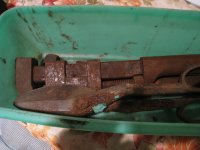
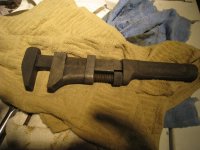
You might want to try Evapo-rust. I tried the vinegar but went to Evapo. Here is what happened after a 30 hour bath. I hear molasses also works great but the waiting would kill me.
 

Attachments

  • 001.jpg
    001.jpg
    138.8 KB · Views: 104
  • 015.jpg
    015.jpg
    146 KB · Views: 101
  • 016.jpg
    016.jpg
    139.6 KB · Views: 111

BD1

Well-known member
Joined
Mar 18, 2007
Messages
4,602
Location
north side
Vinegar straight is what I use on rusted tools and recycled horseshoes.
IF you have a chrome plated tool that has rust use caution. If it soaks too long it will remove the plating. It will remove zinc plating too.
 

jjjrmx5

Well-known member
Joined
Dec 30, 2010
Messages
3,431
Location
Cincinnati, OH
Straight white vinegar.

I buy it in gallon jugs for $2.38 at the grocer or far less in 5 gallon pails or 2 gallon six packs at costco or sams club.
 

Brad54

Well-known member
Joined
Jun 13, 2006
Messages
4,646
Straight vinegar, rinse and hit with a scrub brush while rinsing.
I've done lots of rusted car parts this way.

-Brad
 

Mohawk Dave

Well-known member
Joined
Oct 7, 2012
Messages
5,068
Location
SoCal
the apple cider vinegar works better than regular vinegar.

All Vinegar is messy and stinky.

I use vinegar for BADLY rusted stuff first, then hose off and transfer to Evaporust.....that way I don't use up my Evaporust in a hurry. It costs much more than vinegar.

I'll also wire wheel (if applicable to the piece) first, just to hasten the process.
 
Last edited:

Zeke

Well-known member
Joined
Aug 13, 2009
Messages
17,176
Location
Long Beach CA, the sewer by the sea.
Vinegar is great but you didn't leave it long enough and you have to work the part with a brush, steel wool, scraper or whatever now and then during the soak. Figure days, not hours.
 

rick carpenter

Well-known member
Joined
Jan 20, 2011
Messages
3,781
Location
Huntsville, East Texas
Ace: I've used straight vinegar, and yes it does leave a residue you scrub off. I've used molasses/water mix and it too leaves a residue you scrub off. Some threads can be found here where guys swear by adding salt to vinegar but I haven't tried that yet. If you use vinegar, when you take it out immediately either neutralize it with a base solution or douse it with wd40, then oil it. With molasses, clean it good and oil it.

When I've got an old tool and want it to stay looking old, I hit it with a dremel & a fiber wheel and/or a bench grinder & soft wire wheel. I spin socket extensions on my drill with a light touch of an oiled scotchbright pad then oiled wet&dry 400 or 600 grit paper.

Marty: Funny! :thumbup:
 
To avoid these ads, REGISTER NOW!

quattroJoe

Well-known member
Joined
Jan 9, 2014
Messages
586
Location
FL
I see some mention of a black residue left after using vinegar... how permanent is it if not removed right away? I've got a handful of impact sockets with the normal black finish that have some surface rust. If I give them the vinegar bath, then rinse/wipe/oil immediately, will the black residue effectively protect the spots where the rust formed (and the factory coating is presumably compromised?)
 

paddy1

Active member
Joined
Jul 5, 2014
Messages
43
Location
Ohio 45873
You can get white vinegar at Rural King for less than $2. Done a platform scale this summer, used 12 gallons vinegar/10 gallons water, knocked most of the rust off.
 

DennisH2014

Well-known member
Joined
May 29, 2014
Messages
120
I use a lot more water than I do Vinegar/CLR, probably 1:4 parts or so if I had to guess, works just fine, just give it some time. Not sure why you're getting the black oxide, I never do and I've used this method to clean hundreds of sockets & wrenches. My advice is scrub them a bit after letting them soak for a while (3 days to a week) and then immediately rinse with water, and dry with a microfiber cloth. Coat with oil (I use MMO) for extra protection!
 

wild cowboy

Banned
Joined
Mar 11, 2014
Messages
1,650
Location
Birmingham
FYI - lemon juice is stronger (lower ph) than vinegar and you can get a big bottle at the dollar store!

Electrolysis with a battery charger & washing soda is the best of all, because you don't remove any good intact metal.
 

cheechi

Well-known member
Joined
Feb 29, 2012
Messages
4,384
Location
Triad, NC
Vinegar (acetic acid) and rust (Iron(II) oxide) are a redox reaction. Commonly, people think since vinegar and bleach are both acids that any reaction is an acid/base reaction.

Typically you only get 5% acidity, I think cider vinegar is higher concentration hence the earlier comment it is more effective. Again it's not because it's more acidic, but because there's more acetate ion floating around in there. The presence of table salt in a 5% acetic acid solution would otherwise make a much stronger acid, HCl, the effective solution. But in this case, if the HCl was doing the work instead of acetic acid, you would get a different precipitate (that would be yellow), ie you would not get the black stuff but something different. It would also mean that tap water + table salt would be as good if not better at rust removal.

If you want more of the chemistry, since it's pointless to type much of it in the forum without subscripts it all just looks like a mess, you can read the wiki page; Reaction of scrap iron with acetic acid affords a brown mixture of various iron(II) an iron(III) acetates
 
Last edited:

User_Name

Well-known member
Joined
Jul 30, 2008
Messages
281
Location
Teegeeack
If you want more of the chemistry, since it's pointless to type much of it in the forum without subscripts it all just looks like a mess, you can read the wiki page; Reaction of scrap iron with acetic acid affords a brown mixture of various iron(II) an iron(III) acetates

Any thoughts or experience with EDTA? I've been toying with the idea for a while but haven't got around to ordering any yet.
edit: just found this, http://www.google.com/patents/US5468303 - might try a home brew.
 
Last edited:
To avoid these ads, REGISTER NOW!
Top Bottom