To avoid these ads, REGISTER NOW!

vintage air compressor

fommy100

Member
Joined
Apr 12, 2014
Messages
16
Hello

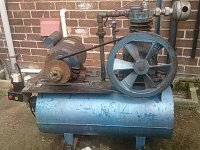
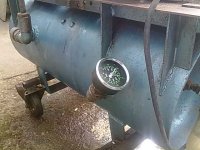
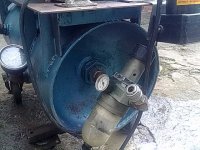
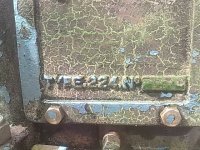
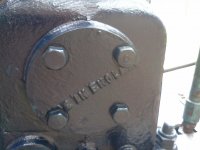
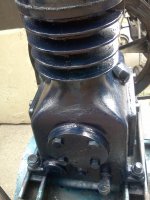
I just got this air compressor i wanted to know what make and model it was? and if i could use it to spray cars. I could not find any info on it.
 

Attachments

  • 09042014497.jpg
    09042014497.jpg
    57.3 KB · Views: 234
  • 09042014496.jpg
    09042014496.jpg
    52.9 KB · Views: 184
  • 09042014502.jpg
    09042014502.jpg
    43.1 KB · Views: 155
  • 09042014499.jpg
    09042014499.jpg
    42.8 KB · Views: 155
  • 09042014498.jpg
    09042014498.jpg
    49.9 KB · Views: 168
  • 09042014488.jpg
    09042014488.jpg
    57 KB · Views: 191
  • 09042014490.jpg
    09042014490.jpg
    66.5 KB · Views: 160
To avoid these ads, REGISTER NOW!

G_P

Well-known member
Joined
Jul 11, 2010
Messages
7,135
Location
Central CT
Pull one of the large fittings off the end of the tank an look inside. If its rusty as hell dont use that tank. If its not rusty run it. Obviously it has been used for quite a while so if it is not compromised by rust it is not going to randomly explode as long as you have a proper relief valve.
 

CJKaz

Banned
Joined
Jan 5, 2012
Messages
133
Location
PA
Home made by the looks of the welds. The tank is likely an old high pressure gas cylinder. The design with inverted heads is common in the chlorine & large refrigerant cylinder industries. Also used on steam locomotives in the air systems. Commonly called "ton cylinders". That one is smaller than the ones typically seen these days. Google "ton cylinder" for images.

If it is a repurposed gas cylinder, the wall thickness is likely much greater than required for a simple air compressor cylinder.

For your original question regarding painting cars, it is a likely undersized for long periods of spraying, like an entire car. Panel painting you'll likely be fine.
 
OP
F

fommy100

Member
Joined
Apr 12, 2014
Messages
16
Thank you for your help, can you tell me if i am right to think.......if its a 2 stage, constant run compressor?

And what is the difference between a constant run compressor and a compressor with a pump pressure switch?

Sorry about all the questions this is all new to me.
 

Bob C

Well-known member
Joined
Jul 17, 2012
Messages
572
Need better pics of the compressor pump. It most definitely is NOT a constant run compressor. It will use a pressure switch. it is a 50/50 duty cycle pump. Take more detailed pics of the pump for a better analysis of what it is and what it can do.
 
OP
F

fommy100

Member
Joined
Apr 12, 2014
Messages
16
Okay here's some pics the of compressor, hopefully someone knows what make and model it is.
 

Attachments

  • IMG134.jpg
    IMG134.jpg
    129.2 KB · Views: 62
  • IMG131.jpg
    IMG131.jpg
    142.4 KB · Views: 60
  • IMG132.jpg
    IMG132.jpg
    147.7 KB · Views: 89
  • IMG129.jpg
    IMG129.jpg
    145.4 KB · Views: 73
  • IMG130.jpg
    IMG130.jpg
    153.9 KB · Views: 77
  • IMG127.jpg
    IMG127.jpg
    144.9 KB · Views: 78
  • IMG126.jpg
    IMG126.jpg
    134 KB · Views: 69

Bob C

Well-known member
Joined
Jul 17, 2012
Messages
572
I doubt it is a two stage. It has no intercooler and both pistons look to be exactly the same size.

It looks as though they have a load genie on it to allow load/unload condition while it keeps running. this is NOT classified as a constant run compressor. Rotary screws fit that category. This is a piston (reciprocating) compressor.
 

Bob C

Well-known member
Joined
Jul 17, 2012
Messages
572
By the looks of things, your air filter shows compair/broomwade. Compair and Kellogg American are virtually one large company. BroomWade comes from England. BroomWade was bought by Gardner Denver. Somewhere in the distant past Compair and Broomwade may have been tied together but I Do not remember any ties between the two and I've been in the business over thirty years. It is possible the air filter is not original as the rest of the unit is cobbled together. It does not look like a Westinghouse, Brunner, Keystone, LeRoi, Dresser, Champion, Curtis, or antique Quincy. I believe it is either an old Kellogg or an ancient BroomWade pump. I've gone thru my antique Kellogg books and do not see a direct match. I have no BroomWade books.
 

stage20

Well-known member
Joined
Nov 5, 2013
Messages
3,722
Location
pcola FL
I doubt it is a two stage. It has no intercooler and both pistons look to be exactly the same size.

It looks as though they have a load genie on it to allow load/unload condition while it keeps running. this is NOT classified as a constant run compressor. Rotary screws fit that category. This is a piston (reciprocating) compressor.
Im on my phone but it sure looks like one cylinder is larger. You've been in the biz so don't listen to me
 

mygarageone

Well-known member
Joined
Oct 16, 2013
Messages
2,691
Location
Munising , Mich
The tank actually looks like an old boiler expansion water tank , not really designed for the kind of pressure of an air comp.
But itS hard to tell for sure.
 
OP
F

fommy100

Member
Joined
Apr 12, 2014
Messages
16
Okay my concern, is its safe to run? I don't see an air compressor pressure switch. to turn it off when it reaches pressure.

It has a safety mechanical valve that releases the pressure from the rear of the tank. that's all i can see.

Do i have to manually charge it to 115 lbs psi, then shut it off? It has a manual on off switch at the front.
 

Bob C

Well-known member
Joined
Jul 17, 2012
Messages
572
Im on my phone but it sure looks like one cylinder is larger. You've been in the biz so don't listen to me

A two stage system requires the air to be pressurized in the large cylinder and transferred to the smaller cylinder thru an intercooler tube or cast assembly. I see neither on this unit. A two stage system has the air filter on the large cylinder and the tank discharge tube coming off the smaller cylinder. Both are centered on the head here. This is typical for a single stage system.


The tank actually looks like an old boiler expansion water tank , not really designed for the kind of pressure of an air comp.
But itS hard to tell for sure.

I have seen a couple old Brunner compressors come thru the shop with these type tanks. They were so old they had flat belts on them like the Amish use. Tanks were stamped Brunner with dates. I believe they were genuine compressor tanks. I don't see any compressor info on this tank. Could go either way.
 

Bob C

Well-known member
Joined
Jul 17, 2012
Messages
572
Okay my concern, is its safe to run? I don't see an air compressor pressure switch. to turn it off when it reaches pressure.

It has a safety mechanical valve that releases the pressure from the rear of the tank. that's all i can see.

Do i have to manually charge it to 115 lbs psi, then shut it off? It has a manual on off switch at the front.


See the copper tube that goes to the top of the head?
Follow it down to that load genie. See the little round knob on the top of the genie? grab it and twist it counter clockwise a few turns. Run the compressor and see if it changes sound at around 115 to 125 psi? There is no way to know exactly what pressure it is supposed to pop at, but I would not allow it past 140. drain the tank and remove the mechanical valve. (Safety Valve). Look on the valve to see what pressure it says. That is its pop off pressure. What is that value?
 
Last edited:
OP
F

fommy100

Member
Joined
Apr 12, 2014
Messages
16
okay will give it a try in the morning, so what is the function of the load genie in relation to the compressor?

Sorry about all the questions, worked on cars and trucks for 20 plus years, this is uncharted territory for me.
 

Bob C

Well-known member
Joined
Jul 17, 2012
Messages
572
Lets assume the load genie releases at 100 psi. what should happen is as follows ...

Start compressor up with empty tank. Compressor runs and builds air. When pressure gets to 100 psi, the pressure overrides the spring inside the load genie and pushes some air up thru the copper tube onto the unloaders on top of the head. The unloaders push the intake valves open and hold them there so the compressor can't make any more pressure. The unit keeps running but makes no air at this point. As you use air from the tank, the pressure drops and eventually the spring in the load genie overrides the pressure in the tank, closes the port, and the air in the copper tube is exhausted allowing the unloaders to relax and the intake valves start sealing again to make more air pressure. This keeps going back and forth while the unit is on and I believe this is why you do not have a pressure switch and only have an on/off switch.
 
To avoid these ads, REGISTER NOW!
OP
F

fommy100

Member
Joined
Apr 12, 2014
Messages
16
okay the safety valve is rated for 115lbs at the back of the compressor, i adjusted the genie, and no such luck. I dismantled it and the pipe from the genie to the head was full of gunk which i cleaned out with solvent.

My question is, if the safety valve is rated for 115lbs psi, what do i set the genie at? The same pressure or a little less at 110lbs psi?
 

Sneeze357

Banned
Joined
Jan 31, 2014
Messages
123
My question is, if the safety valve is rated for 115lbs psi, what do i set the genie at? The same pressure or a little less at 110lbs psi?

About 5-10 PSI under should be good. You could do up to 115, but the closer you are to the set pressure, the easier it is to blow off. If you slightly bump it might release.
 

LS6 Tommy

Well-known member
Joined
Dec 27, 2013
Messages
26,162
Location
Northern NJ
That is definitely not a two stage. It's British, so I'm out of the loop for what brand it may be...

Tommy
 

Bob C

Well-known member
Joined
Jul 17, 2012
Messages
572
After you set the load genie, look the tank over to see if there is a square plate welded to it. I'm curious if it is a certified tank. The plate size is about 4" by 4". If you have a plate, tell us the number after the letters "MAWP" and tell us the year the tank was made.
 
OP
F

fommy100

Member
Joined
Apr 12, 2014
Messages
16
okay ive finally got the genie set to 110 lbs psi, you hear the compressor note change and it does not pressurize. You can hear the air escaping throw, the air cleaner, the pressure drops to about 25lbs psi before the compressor kicks in again.

My question is this normal? Should it drop that far?
 

Bob C

Well-known member
Joined
Jul 17, 2012
Messages
572
okay ive finally got the genie set to 110 lbs psi, you hear the compressor note change and it does not pressurize. You can hear the air escaping throw, the air cleaner, the pressure drops to about 25lbs psi before the compressor kicks in again.

My question is this normal? Should it drop that far?

No. You have the differential too wide.

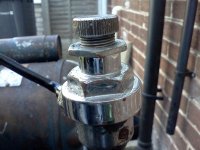
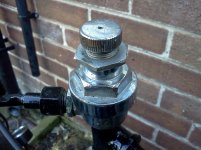
Can you take a couple close up pics of the load genie?

There are several configurations to set the kick in/kick out and the differential. Pics would help me.

Usually a load genie is set to something like 110-125 or 100-115 or 150-175. See the idea here?
 
OP
F

fommy100

Member
Joined
Apr 12, 2014
Messages
16
Okay heres the pictures of the load genie. hope it helps.
 

Attachments

  • 014.jpg
    014.jpg
    132 KB · Views: 19
  • 012.jpg
    012.jpg
    135.3 KB · Views: 26
  • 015.jpg
    015.jpg
    136.5 KB · Views: 20
  • 016.jpg
    016.jpg
    135.4 KB · Views: 22
  • 011.jpg
    011.jpg
    136.4 KB · Views: 21

Bob C

Well-known member
Joined
Jul 17, 2012
Messages
572
ok, from what I see, in pic #4, not the top round knob, but the hex right under it ... Does it screw up and down?

It looks as if the hex nut is the differential, and the top knob is the High/low setting.
 
OP
F

fommy100

Member
Joined
Apr 12, 2014
Messages
16
okay the big hex nut goes up and down, but the tread is only maybe a 1/4 inch to 1/2 inch. When i dismantled the genie the was a rubber gasket that, the brass set spring sat up on top of. Is this normal? The very top nut has a bleed hole for air release.
 

Attachments

  • lll 001.jpg
    lll 001.jpg
    136 KB · Views: 7
  • lll 002.jpg
    lll 002.jpg
    146.4 KB · Views: 12

Bob C

Well-known member
Joined
Jul 17, 2012
Messages
572
*** I'm referring to the hex nut directly under the round knob, NOT the giant hex nut at the bottom.*** The one under the knob does thread in ... Right?


I would think there would be a flat washer between the spring and the rubber so the sharp edge of the spring doesn't cut into the rubber diaphragm, but its possible its normal. I'm pretty certain the hex nut is the differential. Try this ...

Drain the tank. Set the hex nut down tight and back it off one full turn. mark it and write down what you did to it. next run the unit and use only the round knob to try to set the high kick out pressure to 110. If you can get it to kick out at 110, then watch to see where it kicks back in at. Record the pressure at kick in. Stop compressor. drain tank.

Set the hex nut just two full turns in. (Far away from bottoming it out). mark it and write down what you did to it. next run the unit and use only the round knob to try to set the high kick out pressure to 110. If you can get it to kick out at 110, then watch to see where it kicks back in at. Record the pressure at kick in. Stop compressor. drain tank.

Tell me the numbers in both situations. This should determine which adjustment is which setting.
 
Last edited:
OP
F

fommy100

Member
Joined
Apr 12, 2014
Messages
16
okay did as instructed high cut out set to 110lbs psi. first adjustment dropped to 25lbs psi. second adjustment dropped to 25lbs psi.


It looks like the hex nut might be a locking nut for the cut out. would the differential adjustment be in the cylinder head?


would you recommend i replace the load genie with a modern new one?
 
OP
F

fommy100

Member
Joined
Apr 12, 2014
Messages
16
okay just for fun i removed the rubber gasket, ran it and adjusted it to 110lbs psi. it unloaded and then kicked back in at 100lbs psi... success.

Now i need to figure out why i cant get any air adjustment through the regulator at the front of the compressor for the air line pressure, it only goes up to 40lbs psi. No matter how much you adjust the control.
 

Bob C

Well-known member
Joined
Jul 17, 2012
Messages
572
WHOO HOO! Congrats on the success! I'll go back and look over the regulator pics.
 

Bob C

Well-known member
Joined
Jul 17, 2012
Messages
572
Regulator looks like a Dixon brand. I could be wrong but either way, two things to start with.
1.) Make sure it is installed to the tank properly. Regulators have a direction installation. Either there will be and arrow on it indicating the correct direction of airflow or it will say "IN" and "OUT". It must be installed so that "IN" is connected to the tank.
2.) Make certain the gauge is working properly.
 
OP
F

fommy100

Member
Joined
Apr 12, 2014
Messages
16
okay finally striped the regulator down, and cleaned it with solvent and wd40 over night, installed it now able to adjust the line pressure to 70lb. jobs a good em. Thanks for all you help Bob C. Your a star.
 

Bob C

Well-known member
Joined
Jul 17, 2012
Messages
572
You are welcome. One question from curiosity ... Is 70PSI all the higher you can adjust the pressure or is that where you want it? The regulator should allow almost all of the tank pressure when you dial it in all the way.
 
OP
F

fommy100

Member
Joined
Apr 12, 2014
Messages
16
Yes i can adjust it up to a 110lbs psi. the compressor came out really good. Thanks for all your help.
 
To avoid these ads, REGISTER NOW!
Top Bottom