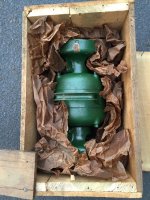
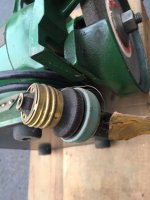
I've never seen a plug like this.
That's an Edison-style swivel attachment plug. They were used in lieu of blade-type plugs and receptacles.
Before the late-1920s, it was very common for homes to have very few, or even absolutely no wall outlets for blade-type plugs, especially in basements and garages.
What most rooms had was a pendant-style lamp socket hanging from the ceiling.
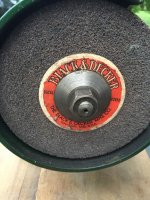
So, let's say your grandpa (or in most cases here, your great or great-great grandpa) wanted to plug in his new Black & Decker grinder.
He'd have unscrewed the lamp from the ceiling pendant and added a two-fer or three-fer "Y" adapter, then screwed the lamp back into one of the now two or three sockets so he could still see what he was doing.
Then he'd screw the Edison swivel plug into one of the free sockets, and voilà, power to his new grinder, while the light dimmed a little bit in the process.
Like so:
There were two styles of Edison attachment plugs--swivel, and non-swivel.
The one you have is a swivel style. If you use the metal ring to turn the plug, the cord remains free and does not twist with the plug, thereby preventing kinks and wear on the cord. The fixed-style Edison attachment plug allowed the cord to turn with the plug, which could cause kinks and wear on the cord and lead to unsafe conditions. The photo above shows a swivel style on the left and a fixed style (with cord cut off) in the middle.
If you want to keep the grinder in its original configuration and be able to plug it into a regular wall receptacle, you can still get the adapter 2nd from right:
But CAUTION, that's an ungrounded 2-wire circuit, so you either need to check the existing wiring very closely before powering it, or add a separate ground wire for testing purposes, and make certain you're powering it with a GFCI protected circuit.