To avoid these ads, REGISTER NOW!

Vintage Reed Vises?

RedOak

Well-known member
Joined
Feb 6, 2010
Messages
97
My apologies if this is an old topic, but I'm fairly new to vintage vises. so here goes...

I recently watched a very informative YT video comparing some old vises; namely, Hollands and Reed, which are both out of Erie, PA. In short, the guy who made the video surmised that Hollands (and older vise maker} cast the bodies of the vises for Reed, but that's pretty much where the similarities ended. After he took both the Hollands 14 1/2 and the Reed 105R apart, one could easily see that Reed put a bit more care into the clamping mechanism and, just as importantly, gave the owner the ability to lubricate the vise's guts.

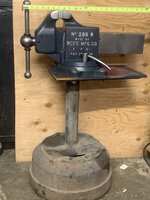
It's just one ol' vet's opinion, but, whether he intended to or not, the video's creator sold me on the old Reed vises...so my question for the board is if anyone can explain the difference(s) between the various vintage Reed vises? For example, what is the difference beyween a Reed 105 and a 105R? Why are some vintage Reed vises labeled as 1XX and others as 2XX? For instance, what is the difference between a Reed 105 and a 205?

The video I mentioned really has me thinking about hunting down a good vintage made in the USA Reed vise, but I'd really like to know more about them before spending our hard-earned on one.

Thank you very kindly for your time and Merry Christmas!
 
Last edited:
To avoid these ads, REGISTER NOW!

RTM

Well-known member
Joined
May 13, 2019
Messages
13,089
Location
SF Bay Area
Here’s an early Reed catalog. 1xx are stationary, 2xx are on a swivel, etc.


I don’t recall what the R difference is.


Lots of Reed threads here, use the magnifying glass top right to search for them.
 

WoodenDisasterMaster

Well-known member
Joined
Jun 15, 2022
Messages
54
My apologies if this is an old topic, but I'm fairly new to vintage vises. so here goes...

I recently watched a very informative YT video comparing some old vises; namely, Hollands and Reed, which are both out of Erie, PA. In short, the guy who made the video surmised that Reed cast the bodies of the vises for Hollands, but that's pretty much where the similarities ended. After he took both the Hollands 14 1/2 and the Reed 105R apart, one could easily see that Reed put a bit more care into the clamping mechanism and, just as importantly, gave the owner the ability to lubricate the vise's guts.

It's just one ol' vet's opinion, but, whether he intended to or not, the video's creator sold me on the old Reed vises...so my question for the board is if anyone can explain the difference(s) between the various vintage Reed vises? For example, what is the difference beyween a Reed 105 and a 105R? Why are some vintage Reed vises labeled as 1XX and others as 2XX? For instance, what is the difference between a Reed 105 and a 205?

The video I mentioned really has me thinking about hunting down a good vintage made in the USA Reed vise, but I'd really like to know more about them before spending our hard-earned on one.

Thank you very kindly for your time and Merry Christmas!
Off the top of my head, I think the R's major thing is double swivel locks. 10x is faxed base, 20x is swivel, I'm not sure there is a 30x if there is they are rare. 40x indicates swivel base and swivel jaw. If the 3 series does exist, I would hazard to guess that it is fixed base and swivel jaw. Now there's what I know to be the major differences, I'm sure there's plenty more but AFAIK that's the gist. If I'm wrong I have no doubt that information will be forthcoming shortly. Hope this helps.
 

Packard V8

Well-known member
Joined
Mar 16, 2009
Messages
7,380
Location
Spokane, WA
Erie was also the home of the best cast iron cookware; both Griswold and Wagner had huge factories there; the rest of the story from Vintage Machinery:

In 1887 a new business was established in Erie, Pa., to manufacture natural gas burners under contract to the Griswold Manufacturing Co. In 1890 that business incorporated as the Hollands Manufacturing Co.,

Early in their existence Hollands began making plumber's vises and then machinist's vises; they grew to become one of the leading U. S. vise manufacturers of the 20th century. They were purchased by Erie Tool Works in 1959. Their brand names were Hollands and Keystone.

jack vines, who's been to Erie, but has no plans to return.
 

TailGunner3000

Well-known member
Joined
Sep 5, 2019
Messages
362
Location
New Jersey
The deciphering of the Reed numbering system is pretty straightforward:

The first number determines the vise characteristics
1XX - Fixed Base-Fixed Jaw
2XX - Swivel Base-Fixed Jaw
3XX - Fixed Base-Swivel Jaw
4XX - Swivel Base-Swivel Jaw

The second Number is the type of vise
X0X - Machinist Vise
X1X - Filers Vise
X2X - Coachmakers Vise

The third number is the jaw width in inches...pretty self-explanatory

Some vise have either an R or an A after the number. These serve to differentiate model styles as they were redesigned at various points of time. I believe the R stands for "rigidity" as the catalogs of the time describe the vises as "high rigidity" or the like and some people believe the A stands for "advanced." But the reasons for that don't really matter as they just serve to identify new styles.
 
OP
R

RedOak

Well-known member
Joined
Feb 6, 2010
Messages
97
Based on quite a bit of reading and viewing, I agree that the difference between a 1XX and a 2XX Reed vise is that the former indicates a fixed mounting base and the latter indicates a swiveling base. I was unaware of the significance of the second digit, so thanks to @TailGunner3000 for that information.

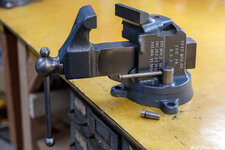
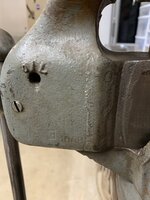
I already knew that the third digit in the vintage Reed vises indicate jaw width, but the "R" that follows certain models, based on my research, indicates certain "revisions." First, the nose that the handle passes through on the R vises was changed from the "meatball" style to the "hockey puck" style. In addition, the R models have two separate OIL ports machined into them. One is for oiling the hardened steel square cut threads on the lead screw and the other is for oiling the threaded adjustable collar in the dynamic (moving) jaw assembly. Based on my research, the static jaw casting on the R models have tight tolerance machined ways that accept a hardened and machined steel nut that is held in place by a fairly substantial (and adjustable) machined steel pin assembly.

I'm no vintage vise expert, by any means, but my research to this point is clearly showing that the old US-made Reed "R" type vises were very well designed. By the way, I found an old Reed catalog, from 1983, that has their various stationary machinists' vises labeled as 1XXN, which adds a bit more mystery to the naming conventions of Reed model numbers.
 
Last edited:

firingsquad

Member
Joined
Feb 13, 2021
Messages
9
Location
RI
I just finished restoring this ole' girl not too long ago, I love the old Reed's
 

Attachments

  • untitled-1941.jpg
    untitled-1941.jpg
    638.2 KB · Views: 226
  • untitled-1933.jpg
    untitled-1933.jpg
    575.5 KB · Views: 205

WoodenDisasterMaster

Well-known member
Joined
Jun 15, 2022
Messages
54
Based on quite a bit of reading and viewing, I agree that the difference between a 1XX and a 2XX Reed vise is that the former indicates a fixed mounting base and the latter indicates a swiveling base. I was unaware of the significance of the second digit, so thanks to @TailGunner3000 for that information.

I already knew that the third digit in the vintage Reed vises indicate jaw width, but the "R" that follows certain models, based on my research, indicates certain "revisions." First, the nose that the handle passes through on the R vises was changed from the "meatball" style to the "hockey puck" style. In addition, the R models have two separate OIL ports machined into them. One is for oiling the hardened steel square cut threads on the lead screw and the other is for oiling the threaded adjustable collar in the dynamic (moving) jaw assembly. Based on my research, the static jaw casting on the R models have tight tolerance machined ways that accept a hardened and machined steel nut that is held in place by a fairly substantial (and adjustable) machined steel pin assembly.

I'm no vintage vise expert, by any means, but my research to this point is clearly showing that the old US-made Reed "R" type vises were very well designed. By the way, I found an old Reed catalog, from 1983, that has their various stationary machinists' vises labeled as 1XXN, which adds a bit more mystery to the naming conventions of Reed model numbers.
so here's an r with a meatball not a puck. ...
 

Attachments

  • 35F1731C-0C11-4292-BB21-E71859A0D257.jpeg
    35F1731C-0C11-4292-BB21-E71859A0D257.jpeg
    684.7 KB · Views: 205

WoodenDisasterMaster

Well-known member
Joined
Jun 15, 2022
Messages
54
Interesting it doesn’t appear to have “OIL” over dynamic jaw hole and is it missing the screw for holding the split nut.
I will say that vise saw some serious use before I got it, for about 50 years, then spent another 40 outside rotting. I sold it to a guy in Kentucky. It does have a set screw holding the split nut. But the oil above the hole. Cannot recall.
 
OP
R

RedOak

Well-known member
Joined
Feb 6, 2010
Messages
97
Very nice vintage Reed 204R you have there @moorett !

Any thoughts on fixed Reed vises versus swiveling models?
 

moorett

Active member
Joined
Jun 12, 2016
Messages
33
Location
Texas
I prefer the swiveling models, especially since Reed perfected this feature with the locking teeth. I don't swivel it much and would happily purchase a non-swivel in the right condition. BTW the date on my 204R is stamped into the dynamic jaw in MMYY format. It is October 1968. Looking for a 214R currently.
 

Attachments

  • IMG_6075.jpeg
    IMG_6075.jpeg
    595.8 KB · Views: 141

Grandpasaurus

Member
Joined
Dec 18, 2021
Messages
23
Speaking of Reed vises, I came across this picture on an auction/estate sale site in my area. I'm going to head down Saturday and see what they want for it. I asked if it was seized and was told it moves freely.
1698319334232.png
 

Attachments

  • 1000001282.jpg
    1000001282.jpg
    888 KB · Views: 73
  • 1000001281.jpg
    1000001281.jpg
    784 KB · Views: 100

Grandpasaurus

Member
Joined
Dec 18, 2021
Messages
23
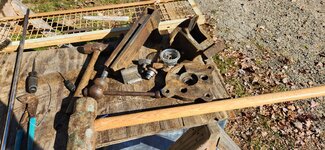
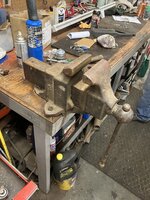
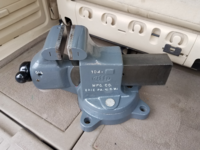
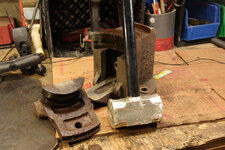
OK, I seem to have developed an addiction to old bench vises. Got the Reed 204 today at the estate sale. The swivel base was there. Tag said $35 and they were firm. Gave them the $35 for it. Needs a good cleaning, but it turns over and runs. The only thing that looks out of place is the nut on the end of the handle. Pictures attached. The last one is in honor of my father, who could fix anything. His motto was "If it doesn't move, don't force it. Get a bigger hammer."
One question: how do I tell exactly when this bad boy was made?
 

Attachments

  • read 204-1.jpg
    read 204-1.jpg
    791 KB · Views: 89
  • reed 204-3.jpg
    reed 204-3.jpg
    741.8 KB · Views: 90
  • reed 204-8.jpg
    reed 204-8.jpg
    1,012.3 KB · Views: 96

Mike'smeatshop

Well-known member
Joined
Apr 1, 2023
Messages
1,273
OK, I seem to have developed an addiction to old bench vises. Got the Reed 204 today at the estate sale. The swivel base was there. Tag said $35 and they were firm. Gave them the $35 for it. Needs a good cleaning, but it turns over and runs. The only thing that looks out of place is the nut on the end of the handle. Pictures attached. The last one is in honor of my father, who could fix anything. His motto was "If it doesn't move, don't force it. Get a bigger hammer."
One question: how do I tell exactly when this bad boy was made?
That is a nice find. Seems to be healthy but a little dirty. Good score even for $35.00.
 
To avoid these ads, REGISTER NOW!

rpf207

New member
Joined
Dec 17, 2023
Messages
3
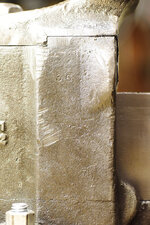
Hi, first post here. Bought a reed 105 today. I’ve been in need of a rugged fixed vise and one popped up. Knew nothing about reed vises until I bought it. Wanted to know how old it was and eventually wound up here.

EDIT: ive edited out my misunderstanding, sorry about that. It is a reed 105, but the stamping had me confused. There is under each jaw a “200” stamped, and underneath the “200” on the jaw that goes in and out is stamped a “51”. Trying to figure out what this means
 

Attachments

  • IMG_2401.jpeg
    IMG_2401.jpeg
    887.8 KB · Views: 79
Last edited:

jfk-usaf

New member
Joined
Dec 23, 2023
Messages
1
My apologies if this is an old topic, but I'm fairly new to vintage vises. so here goes...

I recently watched a very informative YT video comparing some old vises; namely, Hollands and Reed, which are both out of Erie, PA. In short, the guy who made the video surmised that Hollands (and older vise maker} cast the bodies of the vises for Reed, but that's pretty much where the similarities ended. After he took both the Hollands 14 1/2 and the Reed 105R apart, one could easily see that Reed put a bit more care into the clamping mechanism and, just as importantly, gave the owner the ability to lubricate the vise's guts.

It's just one ol' vet's opinion, but, whether he intended to or not, the video's creator sold me on the old Reed vises...so my question for the board is if anyone can explain the difference(s) between the various vintage Reed vises? For example, what is the difference beyween a Reed 105 and a 105R? Why are some vintage Reed vises labeled as 1XX and others as 2XX? For instance, what is the difference between a Reed 105 and a 205?

The video I mentioned really has me thinking about hunting down a good vintage made in the USA Reed vise, but I'd really like to know more about them before spending our hard-earned on one.

Thank you very kindly for your time and Merry Christmas!
I know this is old but found this.
 

Attachments

  • IMG_0548.jpeg
    IMG_0548.jpeg
    479.1 KB · Views: 124

rpf207

New member
Joined
Dec 17, 2023
Messages
3
Here’s a picture of the date stamp on my vise. Is it really February of 1900?
 

Attachments

  • IMG_2484.jpeg
    IMG_2484.jpeg
    762.7 KB · Views: 107
  • IMG_2485.jpeg
    IMG_2485.jpeg
    653.6 KB · Views: 104
Last edited:
Beerhippie

Well-known member
Joined
Oct 13, 2023
Messages
9,677
Location
Far NE Oregon
I've posted this elsewhere, but what the heck?

I restored this battle-scarred veteran over the last few days. Finished it up with a few coats of BLO on Saturday. It's a "converted" 404 1/2--it's now a 104 1/2 as the base is missing. The pivot jaw lock pin is improvised from an old square-head bolt.

53507002526_bd92e265b8_b.jpg

53507158508_f47f9f4927_b.jpg

53507426845_94d2a44389_b.jpg

Numbers:

53506284577_ec6ec72d70_b.jpg

53507172761_40ffe241d6_b.jpg

53507002531_45e78070c6_b.jpg

The upper number is an assembly number to keep the individually-fitted parts together--hence the presence on the bottom of the swivel jaw. The lower number is the date: July of 1911!

The hardest part of the job was the swivel jaw. It took a real hammer to break that loose:

53505464898_c1699c0cec_b.jpg

One nice thing about the battle-scarred condition: I can use it without any worries. Shelf queens have no place in my shop.
 
Last edited:

Beerhippie

Well-known member
Joined
Oct 13, 2023
Messages
9,677
Location
Far NE Oregon
Baby got some bling since my last posting:

53673119690_0a8e0438f1_b.jpg

Made from off-cuts of 2" copper pipe. I like the copper non-marring jaws so much I rarely remove them. I also have them on my more used Asian rotating-jaw vise.
 

genog

Well-known member
Joined
Sep 4, 2021
Messages
1,995
Location
Silicon Valley
I also have a 205
I'm a Big Fan of Reeds!
Some guy on YouTube doesn't need to sell me on them :ROFLMAO:

Parker, Prentiss, Hollands, Wilton, Rock Island, Morgan, Columbian, Athol, Erie, American Scale, et al. are certainly good vises too
Real good
And to that effect, I left out a bunch more good ole Made in the USA vises....
He won't have to sell me on any of those either :ROFLMAO:
And most importantly, you won't go wrong with any of them
reed205b.jpg
 

Mike'smeatshop

Well-known member
Joined
Apr 1, 2023
Messages
1,273
I also have a 205
I'm a Big Fan of Reeds!
Some guy on YouTube doesn't need to sell me on them :ROFLMAO:

Parker, Prentiss, Hollands, Wilton, Rock Island, Morgan, Columbian, Athol, Erie, American Scale, et al. are certainly good vises too
Real good
And to that effect, I left out a bunch more good ole Made in the USA vises....
He won't have to sell me on any of those either :ROFLMAO:
And most importantly, you won't go wrong with any of them
reed205b.jpg
That is a gem. What would you think the weight of the 4c would be? Photos don't really do justice a tool like those.
 

RayBob58

Well-known member
Joined
Jan 1, 2015
Messages
282
Location
St. Louis, MO
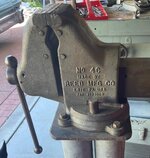
I just wanted to share a photo of the Reed 203 I rustored this week. Never found a date code, but I'm told that alot of the early vises didn't have one. It's got 4 mounting bolts without standoffs, and a single swivel lock. Single piece cast nut. Works like new, now. I've had it 20+ years.
 
Last edited:
Beerhippie

Well-known member
Joined
Oct 13, 2023
Messages
9,677
Location
Far NE Oregon
I just wanted to share a photo of the Reed 203 I rustored this week. Never found a date code, but I'm told that alot of the early vises didn't have one. It's got 4 mounting bolts without standoffs, and a single swivel lock. Single piece cast nut. Works like new, now. I've had it 20+ years.
Does it have a patent date? Mine is pre-patent and still has a date stamp--it's faint but visible on both jaws.
 

Ry24000

Active member
Joined
Apr 26, 2024
Messages
28
Location
CarWA
I think there are some pretty good explanations of Reed vises over the years. Seems the transition between R and no R was a long one. One Youtuber explained that the nut on the R was forged if it had the Hockey puck style screw. With the meatball lead screw some R series lead screw nuts were cast, and some were forged. No way to know exactly what you get.
I did look at a 104 1/2 which usually comes with a 3 hole base was a 4 hole, but didn't have the oil holes or adjustment thrust washer/split nut. Probably an early transition period vise.
Maybe post some pictures of these transition period Reeds and dates?
 

amvenhaus

Member
Joined
Jul 3, 2025
Messages
14
Does anyone have the swivel jaw pin dimensions for a Reed 404-1/2R? Does Reed use 3 degree taper per side? I have the dimensions from a 404-1/2 not R series. Are they the same?
 
To avoid these ads, REGISTER NOW!
Top Bottom