To avoid these ads, REGISTER NOW!

Vintage Sun Distributor Tester ID help wanted

OldIronLover

New member
Joined
Jul 8, 2009
Messages
4
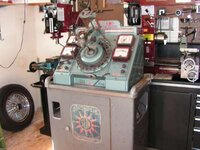
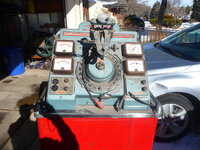
I have a older Sun Distributor tester that I would like to determine the model and possibly get access to a manual. It is a cabinet style 6 volt machine. It has a 6 volt battery charger in the cabinet. It appears to have all the badges on it but no model number. It has the apparently optional RPM dwell unit and the vacuum advance unit.P1250343.JPG
 
To avoid these ads, REGISTER NOW!

engineer2

Well-known member
Joined
Dec 13, 2009
Messages
11,814
Location
Chicago burbs
Here too:
 

mikegt4

Well-known member
Joined
Sep 12, 2005
Messages
3,274
Location
sw ohio
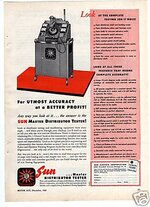
I have a similar one although it's in pieces, a stalled project. Mine is a 1950's era tester, I found a ink stamp dated in 1958. I am not sure that they classified them by model, just a "Master Distributor Tester". I assume "Master" signifies that it had all the best and whistles available at the time. One of the photos claims a model #104A. These photos I picked up off the web over the years.
 

Attachments

  • SUN.jpg
    SUN.jpg
    29.7 KB · Views: 41
  • SUN1948_GJ21930.jpg
    SUN1948_GJ21930.jpg
    19.2 KB · Views: 32
  • 140A Distributor Machine.jpg
    140A Distributor Machine.jpg
    125.1 KB · Views: 34

MBfreak

MEMBER EMERITUS
Joined
Dec 10, 2010
Messages
2,301
Location
Linkoping , Sweden
Mogandave.
Thanks for the info.
My experience from classic US cars is only from repairing their radios, going back as far as a 1936(?) Lincoln V12.
And so far, all have been 12 V , with negative earth. Of ourse, some of the cars may have been conerted from 6 to 12 V?

Ola
 
To avoid these ads, REGISTER NOW!

mogandave

Well-known member
Joined
Nov 4, 2021
Messages
3,052
Location
Bangkok
I think up until the mid-fifties most all US cars were 6V. My F-100 was positive ground which I think was pretty common as well.

12V conversions were pretty common as were inverters that would allow you to run 12V negative ground tape players and whatnot.
 

firebirdparts

Well-known member
Joined
Jun 8, 2016
Messages
10,637
Location
Kingsport, TN
All points distributors are 6V. That's what everybody is forgetting. If you put a points distributor in that machine, it'll work. You need to measure dwell and the advance curves, and you just don't need 12V to do that.
 

Ricky Joe

Well-known member
Joined
Sep 15, 2013
Messages
2,452
Location
Roanoke, Va.
All points distributors are 6V. That's what everybody is forgetting. If you put a points distributor in that machine, it'll work. You need to measure dwell and the advance curves, and you just don't need 12V to do that.
I don’t think distributors are sensitive to voltage, before electronic ignition systems. So even 1960s/early 70s points distributors can be tested on a six volt system.
 

RPH

Well-known member
Joined
Dec 17, 2006
Messages
4,190
Location
Michigan Thumb
I don’t think distributors are sensitive to voltage, before electronic ignition systems. So even 1960s/early 70s points distributors can be tested on a six volt system.
This is why the ballast resistor is installed in series with the run switch position. In start position 12 vdc is applied to boost coil output during start.
Points have a tendency to burn up on 12 vdc if run all the time. Coils another item that is voltage sensitive in some applications.
 

Ricky Joe

Well-known member
Joined
Sep 15, 2013
Messages
2,452
Location
Roanoke, Va.
When doing conversions, I always replaced the coil. The condenser never got a second thought, and I never had any problems from that. I would guess that if you didn’t replace the coil that it might send too much voltage to the points, resulting in burning them up.
 

warbird1

Member
Joined
Oct 24, 2021
Messages
10
Points are not voltage sensitive; Coils are... you have to use a balanced system, coil, ballast resistor and condenser.
 

Ricky Joe

Well-known member
Joined
Sep 15, 2013
Messages
2,452
Location
Roanoke, Va.
Points are not voltage sensitive; Coils are... you have to use a balanced system, coil, ballast resistor and condenser.
I’m going to respectfully disagree about the condenser. So long as it can handle the current, it doesn’t matter whether the voltage is six or twelve, or twenty-four. All it has to do is collect current and release it. There is no such thing as a separate condenser based on voltage.
 

RPH

Well-known member
Joined
Dec 17, 2006
Messages
4,190
Location
Michigan Thumb
They allow a spot for the current flow at the moment of opening, anytime electrons are flowing they want to continue to flow, that is an arc.
Condenser are capacitors. We all know they have voltage specifications. 12 vdc is not the concern. Interesting though if the condenser is the wrong value it can cause arcing on the points. Depending which point had the deposit pointed which way the capacitor had to move value wise.
 
To avoid these ads, REGISTER NOW!
Top Bottom