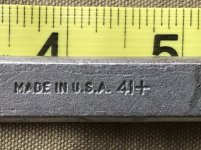
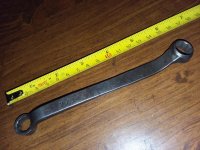
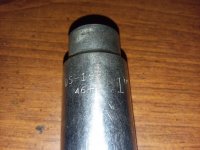
I'm fairly certain that until the WrightGrip wrenches came out, most Wright open end wrenches had hexagonal gullets.
Dave,
Do you have examples?
All,
Does anyone have
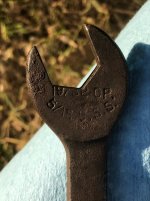
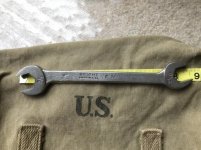
any examples of Wright Tool and Forge manufactured DOE wrenches
other than the same wrench that both AA and now Todd have in their collections?
I'm not saying they don't exist, but it's odd that they are so uncommon. I can't find any on the net.
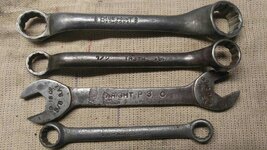
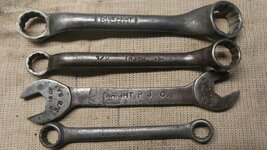
First pic is a comparison of the Wright with 1927 Cornwell, the second is 1928.
I haven't found any consistency or pattern in time with respect to the shape of the heads on early hand forged Cornwell wrenches where they meet the shank, Todd. Sometimes they are ground and finished there with a more rounded head, sometimes very shallow round, and sometimes almost squared off, irrespective of codes. It's almost as if it was up to the personal fancy of who was on machine that day!
I don't have any of my other Cornwell DOE wrenches posted, but I posted a set of pre-AW marked Angle Wrenches in the DOE thread
here, if anyone wants to look at more examples. They have a slightly more rounded head.
What's interesting is some of the other examples of early Wright wrenches on AA.
Granted, these aren’t DOE wrenches, but they are wrenches with open ends, hand forged, and grinded into shape the same way the heads on early Cornwell (and apparently Wright) DOE wrenches were made.
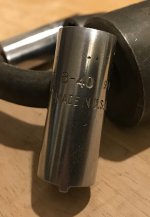
For example, look at this Wright tappet wrench, which has a squared off head, just like we see with many crudely made Cornwell heads.
Now let's shift gears a little.
AA has no Wright catalogs earlier than 1957, and no evidence of a Wright date code system other than the obvious and straightforward numerical system in use from 1940 through 1960, and the letter code (1961=A, 1962=B, etc) after that. And yet, when describing Todd's wrench, they attribute the "-O" to an unknown date code system. They do the same for a "-V" and a "-W" that appear on other early WRIGHT wrenches (tappets). But apparently don’t see any similarity to the same dash letter codes (-A to -G, 1927 to 1933) used by Cornwell.
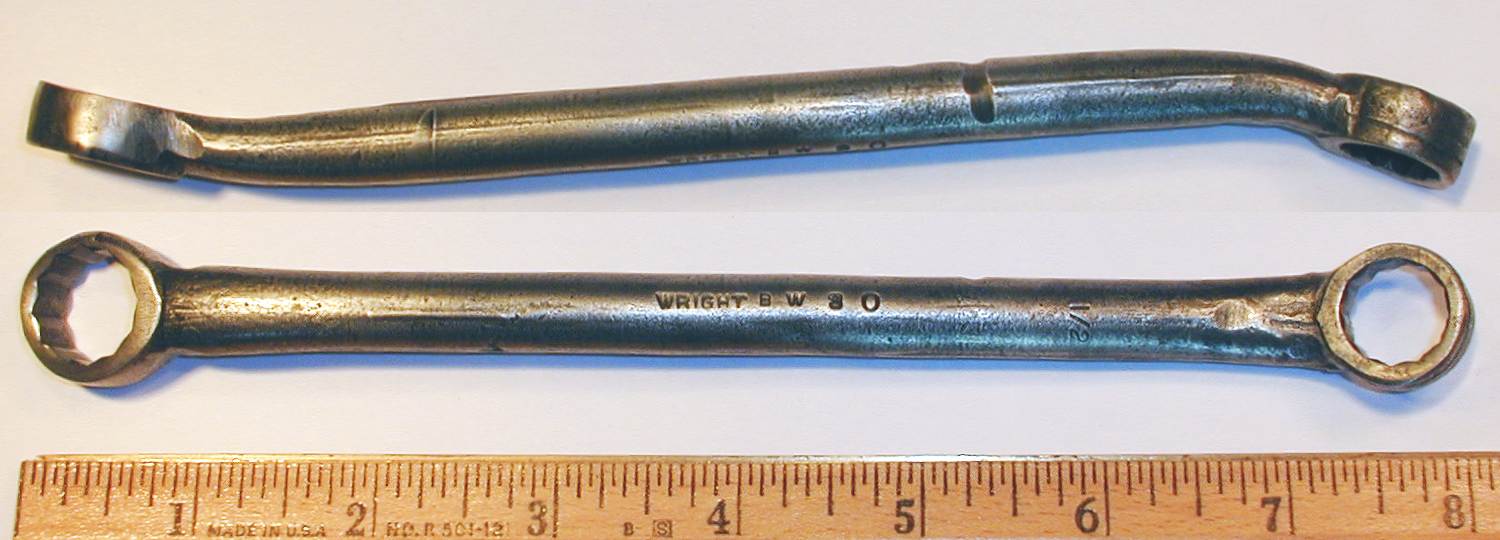
Now here is a WRIGHT box wrench, bearing the same phonetic model numbering scheme ("BW" for box wrench) used by Cornwell.
Granted, it's round shanked, and Cornwell was making flat shanked DBE's. But the use of the same scheme is very curious. To me, anyway. Apparently not to AA, which makes no mention of the similarity.
It's not enough to convince me, but it all seems too much to be a coincidence.

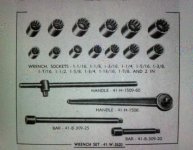
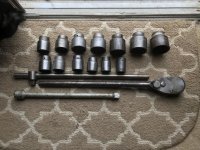

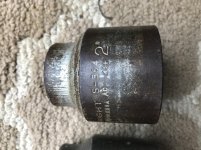
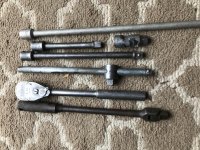
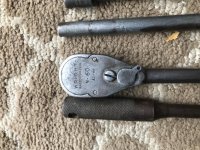
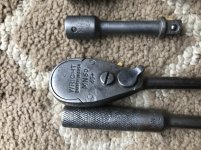
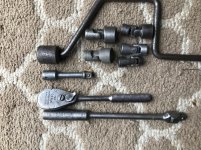
 , I don't believe I have any Wright tools to contribute, but along for the ride