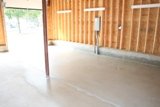
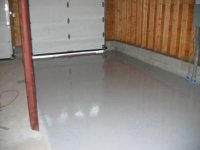
What is involved in diamond grinding the floor? There is a shine on parts of the floor indicating too smooth of a surface.
This super slick shiney floor comes from a curing compound / sealer, which is what you do not want. I think the fine folks here are indeed saying you got a trowel or a machined finish in lieu of a broom type looking finish (thus the shiney look). If you have a slab placed with no surface curing compound or sealer (no matter what type of finish), there is no need to do any scarifing. Concrete is porous enough to adhere a top coat. With any liquid compound, it will adhere and penetrate to a degree through capillary action. In my opinion, I'd not worry a bit about prepping the floor, other than to clean it and make sure it's dry to air. Concrete will always be in a hydration process (curing), for many years to come. After 30 - 90 days, most of the hydration has served it's purpose. The continuing hydration is just the chemical process itself (by design), serving no further significant purpose.
By the same token and topic, it would not hurt the floor at all to scarify it. I say this only from working as InJunere for more than several years in the power industry in construction of concrete floors and walls. $0.02
To answer your question, diamond grinding is renting a floor grinder with diamond (or hard embedded grains of material) impregnated discs (for the hardness of the disc) and roughing up the surface.
Everyone here has good information. It's a matter of preference and decision.