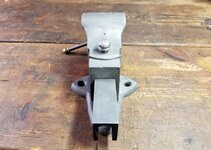
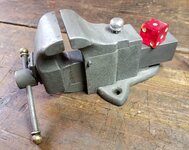
Can anyone identify the maker of this unmarked vise? The jaws are 1 7/8 in wide with steel cast in place faces and the vise is 3 1/16 inch high. The nut is cast brass. Also, there must be a piece missing at the back of the body where there is an empty channel and a threaded hole. Any ideas? The swivel jaw mechanism is the only one I have seen like it. A steel pin passes through a groove around the central pillar under the swivel jaw. I am attaching pictures. Thanks.

You are using an out of date browser. It may not display this or other websites correctly.
You should upgrade or use an alternative browser.
You should upgrade or use an alternative browser.
Vise Identification
- Thread starter Old Prof
- Start date


four.cycle
Well-known member
Hello @Old Prof and welcome to the site!
you might have better luck posting those photos here in THIS thread
keep this link handy at all times!
and this one!
you might have better luck posting those photos here in THIS thread
keep this link handy at all times!
and this one!
Woods_Wanderer
Well-known member
It looks like a jeweler's vise, swivel jaw looks like a Parker. Very collectable, though this one is missing the original collar and possibly has a dynamic jaw repair as well.
akasrick
Well-known member
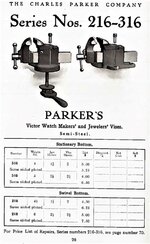
Without me looking around any further...possibly Prentiss. A cut from a 1896 catalog shows it close but it has an "eyebrow" over the screw's handle. Plenty of pictures on the vise spreadsheet.Can anyone identify the maker of this unmarked vise? The jaws are 1 7/8 in wide with steel cast in place faces and the vise is 3 1/16 inch high. The nut is cast brass. Also, there must be a piece missing at the back of the body where there is an empty channel and a threaded hole. Any ideas? The swivel jaw mechanism is the only one I have seen like it. A steel pin passes through a groove around the central pillar under the swivel jaw. I am attaching pictures. Thanks.

akasrick
Private Lugnutz
Well-known member
Shiftless
Well-known member
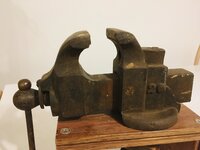
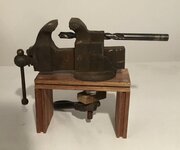
Lugz is right. That tiny little vise is rare indeed. I used to have one very similar with a hole for an anvil horn or ?? in the back. You can see the provision for an attachment with the old set screw still present. I put a drill bit in to show the through hole.It's a Parker "Victor" No. 316. It's only the second one I have ever seen. No channel or threaded hole in the back.
Attachments
-
 DB4352D1-CB25-49BC-8BA3-A115A0FFB820.jpeg436 KB · Views: 28
 -
 96104863-13E5-40C6-ABE5-A9E4CBAB71FC.jpeg540.4 KB · Views: 21
 -
 972DCB3F-2000-4EE4-8A2B-D12D0263F711.jpeg525 KB · Views: 18
 -
 3EC9BD65-44DC-47B1-A025-DADC0A5A8CD1.jpeg510 KB · Views: 19
 -
 C84BF5D4-93BC-4556-990D-DAEFC6E4852A.jpeg540.2 KB · Views: 18
 -
 188635A9-6D3A-44F1-8F77-2A673A3E9269.jpeg562.8 KB · Views: 19
Last edited:
Hats off to you. I have been puzzled for years. Since the Prentiss varieties have the square anvil peg/plate, maybe someone milled the slot and threaded a hole to fashion a similar feature here. Another mystery is that the dynamic jaw had been broken from the slide and welded before I got it. I presume that from the same "accident" the swivel jaw groove broke out (visible in my last photo). I can only presume that the vise got overtightened at some time but I can't imagine a jeweler dong that. I will now repair that. Another difference from your photos is that the brass swivel sliding handle for the main screw do not have the "collars" but rather look like spheres turned down flush to the axial pin part. After looking at your pictures, I noticed a number "8" stamp mark on top of the housing between the back of the swivel jaw and the back channel. It is from a stamp, and it is 2.6 mm high. No such mark anywhere on the swivel jaw. All my Prentiss varieties have dual stamps on the swivel jaw base and the mating surface of the housing, presumably to keep matched machine parts together for assembly. Thanks again.It's a Parker "Victor" No. 316. It's only the second one I have ever seen. No channel or threaded hole in the back.
akasrick
Well-known member
You've made a decision!
Since you're thinking of doing re- repairs.


Neet vise you have!
akasrick
Since you're thinking of doing re- repairs.
Neet vise you have!
akasrick
Private Lugnutz
Well-known member
Thanks. It came mounted on a jeweler's bench I bought at a flea market. When I noticed that the vendor - an old furniture guy, not an old tools guy, was completely ignoring the vise during the haggling, I ignored it even more!Hats off to you.

Credit where credit is due, it was identified as a Charles Parker No. 316 by a brilliant GJ member named @Fierljeppen who no longer posts here. (Running into a No. 216 with the swivel base would be too much to ask for in one lifetime!I have been puzzled for years.
)I saw that. I like the way the collar flourish on the spindle retention balls matches the same collar flourish on the swivel jaw pin. You noted, however, that the spindles in the ad I posted (from 1912) are not illustrated with collars, right? They look like yours. Plain ball ends. Yours might be closer to 1912. Whether the collars were earlier (my hunch) or later, I don't know.Another difference from your photos is that the brass swivel sliding handle for the main screw do not have the "collars" but rather look like spheres turned down flush to the axial pin part.
Private Lugnutz
Well-known member

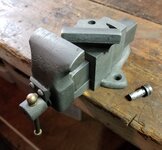

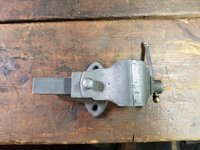
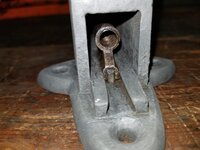
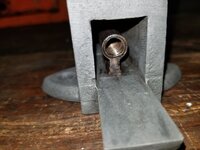
Thanks. It would seem that the main vise body carries the differences. The distance from the back of the swivel jaw piece to the base of the vertical channel is 11/16 inch in mine The channel is 1/8 inch deep. So if the channel was not original, the total spacing there would have been 13/16 inch. Yours seems less from your photos. The back portion of the top has been milled off with the result that the top of the vise body is all milled with two different layers of flat. The back vertical profile of the main vise body is vertical on yours and mine cuts back in toward the dynamic jaw side. This inward flaring surface is cast and not milled in. At the bottom, this is 0.34 inch in from a vertical line down from the back edge. In mine the cross pin hole that holds the swivel jaw locking pin in the body goes completely through the body and the pin has a "button" head on the end. The pin protrudes 0.025 inch. Yours looks to project be more and has no button head. Looking at the back side of the main body cavity, the dovetail slide sides for the nut do not project out beyond the main body in mine. However, there is evidence of metal removal in that area, as the removal did not actually clear the base level. This is consistent with someone trimming off these slides post casting. It is hard to tell, but they probably were cast like yours, as yours seem to project out. They end about 0.027 inch in from the bottom of the flared in sides. The nut retaining pin hole center is about 0.307 inch back from the flared in sides. It is easier to measure this distance from the bottom, it is 1.395 in from the back edge of the rear mounting tab tip. The sides of the main vise body constitute two parallel sections. The back portion is 1.182 inch side to side and the front is 1.385 inch. These differences are transitioned with a flat bevel that is 0.380 inch in width along the surface of the bevel. Yours has more of a rounded transition it seems. So there you have it, at some point in time, the body mold pattern got changed. Who knows which preceded the other.