
To avoid these ads, REGISTER NOW!

Vise restoration troubles

Robvulaj

Active member
Joined
May 14, 2022
Messages
39
What would you do in this situation. I started restoring a craftsman vise (506-51801). I was fairly rutsted so i took it apart and put in an electrolysis bath then wire wheeled to get what was left and the loose paint. I decided to try and remove the jaws after that to clean and paint everything nicely. Well i immediately broke the tip off a snapon screwdriver i was using. Tried with some ******/acetone mix penetrating, then some heat and an impact screwdriver. Turned the tip of the impact bit into and S shaped bit.. and moved onto the last resort.. my drill press. Drilled out the screw head and poped the jaws off finally. YAY... heres where i messed up. I proceded to drill out the rest of the screw with a 1/4 bit. I figured i would tap the next size up and be good to go. Well the next size up (5/16" - 24) flat head is as wide as the whole face of the jaw. I should have left them where they were.. now i think my best option is to make new jaws and drill and tap 1/4 28 holes for the right sized bolts... If anyone have a better idea please tell me.

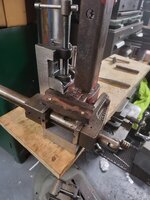
Heres some pictures of the exceptionally sketchy setup i used to drill the holes out. Its a Drill press vise holding up a float lock vise with setup blocks i had to prop up everything from tipping over.
 

Attachments

  • 20230607_225839.jpg
    20230607_225839.jpg
    690 KB · Views: 125
  • 20230607_234828.jpg
    20230607_234828.jpg
    672.2 KB · Views: 117
  • 20230607_225904.jpg
    20230607_225904.jpg
    511.1 KB · Views: 107
  • 20230608_000704.jpg
    20230608_000704.jpg
    738.6 KB · Views: 124
To avoid these ads, REGISTER NOW!

Mr. Wonderful

Well-known member
Joined
Jan 15, 2018
Messages
1,776
Location
Pacific Northwest
What would you do in this situation. I started restoring a craftsman vise (506-51801). I was fairly rutsted so i took it apart and put in an electrolysis bath then wire wheeled to get what was left and the loose paint. I decided to try and remove the jaws after that to clean and paint everything nicely. Well i immediately broke the tip off a snapon screwdriver i was using. Tried with some ******/acetone mix penetrating, then some heat and an impact screwdriver. Turned the tip of the impact bit into and S shaped bit.. and moved onto the last resort.. my drill press. Drilled out the screw head and poped the jaws off finally. YAY... heres where i messed up. I proceded to drill out the rest of the screw with a 1/4 bit. I figured i would tap the next size up and be good to go. Well the next size up (5/16" - 24) flat head is as wide as the whole face of the jaw. I should have left them where they were.. now i think my best option is to make new jaws and drill and tap 1/4 28 holes for the right sized bolts... If anyone have a better idea please tell me.

Heres some pictures of the exceptionally sketchy setup i used to drill the holes out. Its a Drill press vise holding up a float lock vise with setup blocks i had to prop up everything from tipping over.
I will start this by saying I am no machinist. I had a similar problem where I tried to drill out a broken off jaw screw. I drilled off center. What i wound up doing was going up to a larger hole like you did. I threaded it and put a new bolt in and cut it off flush. I was then able to correctly drill the original hole size into the cut off bolt. I hope that helps or at least makes sense.
 
OP
R

Robvulaj

Active member
Joined
May 14, 2022
Messages
39
Did you locktite the bigger bolt in or somethig before you cut it?
 

RoninB4

Well-known member
Joined
Jul 22, 2020
Messages
3,587
Location
Under My House
-You've ruined the existing threads in the hole but perhaps you can still use the original size it came with. There's no real benefit to going up a size with vise jaws. Jaw fasteners are only there to keep the jaw from falling off, even a 6-32 would have been sufficient. If the fastener head for 5/16 is too wide then tap the holes for 3/8 (if there's room for it) insert some all thread or whatever you have. You'll want to bottom the thread so the insert locks at the bottom of the hole for when you drill/tap the insert for the original size fastener. You can now use whatever the original size was without altering the jaw. Use some thread locker, high strength for the insert but only medium strength for the jaw fasteners. I'm a retired toolmaker and this is a common practice for circumstances like this.
 

rust in the eye

Well-known member
Joined
Oct 2, 2017
Messages
2,798
Location
Chicagoland
It looks to me like you drilled clean through one of the jaws with the 1/4", destroying the bevel, no?
Weld up the holes, re-drill and use helicoils on the vise body. These are low stress fasteners so no need for any super strength or precision. Looking at your photos the holes don't look precisely placed to begin with.
 

Shiftless

Well-known member
Joined
Mar 9, 2014
Messages
14,553
Location
East Bay SFO
Several good ideas in the above posts.
I think the moral of this story is to stop when appropriate. I have faced that situation many times with various vises. Unless the jaw inserts are really worn out or badly damaged, or a guy really enjoys the challenge, the best approach with badly stuck screws is to leave them in place, mask them off, and paint around them.

I usually first soak jaw plate screws with penetrating oil. Then try unscrewing by hand. Then try my M12 impact. If that doesn’t work, before giving up I sometimes try using the vise itself and clamp a screwdriver bit between the jaws and try turning the bit with a wrench.
If that doesn’t work, I mask off the jaw and paint around it.
 
OP
R

Robvulaj

Active member
Joined
May 14, 2022
Messages
39
Yeah the only reason i was going up a size was, like you said i made the hole too big. I didnt realize the 5/16 head was too big. I think i will try this out. Thanks for the help
 
OP
R

Robvulaj

Active member
Joined
May 14, 2022
Messages
39
Several good ideas in the above posts.
I think the moral of this story is to stop when appropriate. I have faced that situation many times with various vises. Unless the jaw inserts are really worn out or badly damaged, or a guy really enjoys the challenge, the best approach with badly stuck screws is to leave them in place, mask them off, and paint around them.

I usually first soak jaw plate screws with penetrating oil. Then try unscrewing by hand. Then try my M12 impact. If that doesn’t work, before giving up I sometimes try using the vise itself and clamp a screwdriver bit between the jaws and try turning the bit with a wrench.
If that doesn’t work, I mask off the jaw and paint around it.
Yeah, pretty much exactly the steps i took before drilling it out. I def should have stopped there tho
 
OP
R

Robvulaj

Active member
Joined
May 14, 2022
Messages
39
It looks to me like you drilled clean through one of the jaws with the 1/4", destroying the bevel, no?
Weld up the holes, re-drill and use helicoils on the vise body. These are low stress fasteners so no need for any super strength or precision. Looking at your photos the holes don't look precisely placed to begin with.
Nooo those jaws were VERYYY hard i didn't even scratch them. You can see in the photo of just the jaw on the table, the 2 pieces of the heads that poped out after. The 1/4 bit i used was the size of the threads. For the heads i used a a drill bit that was almost as big as the hear itself i dont remember the exact size tho.
 

Shiftless

Well-known member
Joined
Mar 9, 2014
Messages
14,553
Location
East Bay SFO
I once had success removing an M5 Phillips head style jaw plate screw by drilling a 5/64 inch hole maybe 1/4 inch deep and then using the smallest size screw extractor.
But, as I was reminded the second time I tried doing that, those extractors are quite brittle and can snap off inside the little hole if you twist too hard even though I was using the proper tap wrench and was careful to keep it aligned.
 
To avoid these ads, REGISTER NOW!

Shiftless

Well-known member
Joined
Mar 9, 2014
Messages
14,553
Location
East Bay SFO
In the future, we should all remember to examine the screw heads carefully. Yours had flat head screws which of course are simple. Some of the vises that Sears sold back in the day were cast in Japan and had jaw plates installed using JIS screws which as you may or may not know look a lot like Phillips head but require a different screwdriver.
 

1982fxr

Well-known member
Joined
Jan 7, 2012
Messages
10,012
Location
Phoenix
I cleaned a few of those style up years ago. Toughest paint removal I've ever come across.

Lots of patience with the propane torch to get those jaws screws out too. Cool results but damn.
 

Wolley

Well-known member
Joined
Jun 24, 2022
Messages
420
Location
Maine
Turn down the head off the larger screws. Or maybe a low head Allen cap screw
 

rust in the eye

Well-known member
Joined
Oct 2, 2017
Messages
2,798
Location
Chicagoland
Nooo those jaws were VERYYY hard i didn't even scratch them. You can see in the photo of just the jaw on the table, the 2 pieces of the heads that poped out after. The 1/4 bit i used was the size of the threads. For the heads i used a a drill bit that was almost as big as the hear itself i dont remember the exact size tho.
Then no trouble, helicoil
 

ecotec

Well-known member
Joined
Oct 5, 2010
Messages
5,457
Creative destruction… I have been there, man. You are not alone.

I would go with the Helicoil suggestion.

I think that a manual impact and a hammer would have been your best option.
 
Last edited:
OP
R

Robvulaj

Active member
Joined
May 14, 2022
Messages
39
Creative destruction… I have been there, man. You are not alone.

I would go with the Helicoil suggestion.

I think that a manual impact and a hammer would have been your best option.
I used mapp gas to heat it up for a while then used a manual impact. It bent the bit into an S shape after enough trys. Ive never used helicoil before, do they sit flush after they are inserted? Also this is a hollow casting i could feel it as my bits broke thru the holes. Can you still use a helicoil on that? I dont have any experience with them or the tool to insert helicoils, i have seen them for sale cheap at auctions near me but, At this point im going to try Roninb4's suggestion and locktite some allthread in there and drill and tap new holes
 

RoninB4

Well-known member
Joined
Jul 22, 2020
Messages
3,587
Location
Under My House
-A lot of people like Helicoils, I'm not of them. They can and have been used with success but for fasteners that get removed now and then the coil almost always backs out with it even though I was careful with tapping and used the insertion tool to break off the tang. I've always used the other threaded inserts (Time Cert, EZ Lock, etc.) or I'll just make one. My preferred method is to enlarge the hole and press in a bushing which gets welded in and surface finish so you can't tell there's an insert. This is a very common practice in machine shops.

If the vise is hollow a Helicoil isn't a good choice IMO. Better to screw in some all-thread with Loc-Tite, and bottomed in the hole so there both a chemical and mechanical lock to the insert. Then drill/tap for the original fastener after the thread locking agent cures. Pressing in a non-threaded bushing may crack the casting if this is hollow. Threading in an insert will create much less stress. Hope this helps.
 
OP
R

Robvulaj

Active member
Joined
May 14, 2022
Messages
39
-A lot of people like Helicoils, I'm not of them. They can and have been used with success but for fasteners that get removed now and then the coil almost always backs out with it even though I was careful with tapping and used the insertion tool to break off the tang. I've always used the other threaded inserts (Time Cert, EZ Lock, etc.) or I'll just make one. My preferred method is to enlarge the hole and press in a bushing which gets welded in and surface finish so you can't tell there's an insert. This is a very common practice in machine shops.

If the vise is hollow a Helicoil isn't a good choice IMO. Better to screw in some all-thread with Loc-Tite, and bottomed in the hole so there both a chemical and mechanical lock to the insert. Then drill/tap for the original fastener after the thread locking agent cures. Pressing in a non-threaded bushing may crack the casting if this is hollow. Threading in an insert will create much less stress. Hope this helps.
Well this has been a great learning experience for me, thanks for your help. I "fixed" it. Its ugly but it works. I made a couple more mistakes but im glad i made them on this 30 dollar vise and not a more expensive project.

Let me explain my mistakes for anyone else reading to hopefully no make the same. The first problem is i became lazy after how much time i spent on it last night. After i got the holes plugged with bolts and locktite i cut the excess off with my bandsaw and took it to my belt sander to flatten. This is a mistake, i should have taken my time to remove the rust with a wire wheel and file the nubs down slowly by hand. I took off a little too much on one side its probably not noticeable to someone else but it bothers me. My second mistake was trying to drill the new holes by hand. I have the equipment and i decided to be lazy and try to do it by hand instead. I used a transfer punch to mark where i needed the holes but the drill walked on me ever so slightly and the scews dont sit 100% tight to the back of the jaw. But its like 99% there and when i put it back together and tightened the vise as tight as i could there was no movement. I should have fixtured it to my mill table, used a center drill and actually measured and placed the holes. I dont have an angle plate tho and fixturing it upright to drill is not that simple otherwise.. Its a 30 dollar vise tho not a kurt, its not inherently accurate vise anyway im happly i learned a few lessons.
 

Attachments

  • 20230608_230025.jpg
    20230608_230025.jpg
    607.2 KB · Views: 47
  • 20230609_003032.jpg
    20230609_003032.jpg
    619.5 KB · Views: 55

RoninB4

Well-known member
Joined
Jul 22, 2020
Messages
3,587
Location
Under My House
Well this has been a great learning experience for me, thanks for your help. I "fixed" it. Its ugly but it works. I made a couple more mistakes but im glad i made them on this 30 dollar vise and not a more expensive project.
-It's often repairs on low dollar items that prompt us to take shortcuts that come back to bite us on the ****. Done that too. I try to remind myself that the repair I'm attempting will put something back in service for many years/decades IF (and only IF) I do it right. When it doesn't come out 100% I can hear a sarcastic voice in my head saying "Oh yeah that was a professional repair" and it bugs me that I could/should have done better work and not taken the lazy shortcut. Lesson for future reference. As you said it's not an expensive vise and perhaps this repair will remind you when you do get a better vise. You did ok, don't beat yourself up too much if you learned something.
 

larry_g

Well-known member
Joined
Apr 28, 2007
Messages
16,889
Location
oregon
To late to help on this one but for future reference;
Get a set of left handed drill bits. I've had real good luck in having them grab and turn out a broken bolt.
If you have a lathe, make a bushing that fits the counterbore on the OD and fits the drill bit on the ID.
If you know the thread size, use a drill bit no larger than the tap drill size for that thread.

lg
no neat sig line
 

BTL-A4

Well-known member
Joined
Feb 28, 2018
Messages
1,255
Location
Santa Clarita
I restored a vise and had the same issue with the screw heads being too big. I could not find anything like what was in there. So, I bought some screws and turned down the heads on a lathe.
I've also seen people drill out the hole, plug it with a rod and re-drill and tap it the right size.
 
To avoid these ads, REGISTER NOW!
Top Bottom