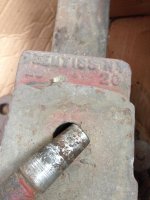
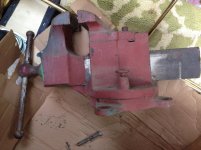
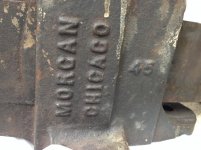
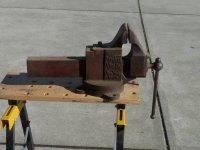
I recently picked up a pair of vises that i'm looking to restore. For all the experts out there, what is the advantage of electrolysis vs just wire wheeling the metal bare? I assume you have to wire wheel anyways to get the paint and grime off. The ones I picked up, a Prentiss 20 and Morgan Chicago 45, aren't in too bad of condition. The swivels both move on the Prentiss.


You are using an out of date browser. It may not display this or other websites correctly.
You should upgrade or use an alternative browser.
You should upgrade or use an alternative browser.
Vise restoration, wire wheel vs electrolysis
- Thread starter jrobb316
- Start date

Fretters
Well-known member
Subtlety is the answer. Electrolysis does absolutely nothing to the good surface metal but simply loosens/converts all of the unwanted **** on it, so how enthusiastically you remove the erroneous coating once it comes out of the tank is upto you. Anything from brass to stiff wire wheels or brushes will clean it, plus pan scourers etc. Wire wheels are a bit harsh IMHO. Brass is obviously subtlest, if you go that route.
Personally, I'm an electrolysis type. Some might look at my stuff when I'm done and think it looks half done, (I like to leave my metal looking as old as possible but without the actual rust), whereas some like the bright and sparkly, just left the factory yesterday type appearance. It all depends on what finish you want. Each to their own, so to speak.
Personally, I'm an electrolysis type.
Some might look at my stuff when I'm done and think it looks half done, (I like to leave my metal looking as old as possible but without the actual rust), whereas some like the bright and sparkly, just left the factory yesterday type appearance. It all depends on what finish you want. Each to their own, so to speak.drivesitfar
Well-known member
JRobb: great question and great vises to restore after you figure out the best method. here is a great thread with a lot of questions and answers about Electrolysis that both Fretters, I and others have put together.
http://www.garagejournal.com/forum/showthread.php?t=237752&highlight=electrolysis
you might want to read it so you'll get a few more answers.
i do know that i asked Fretters just the other day how he gets over greased parts clean and he uses a rag to take the bulk off. then a cleaner rag with some kerosene to clean it up before it goes in the Electrolysis or gets a new coat of clean grease. as far as i have heard Electrolysis removes rust and maybe paint, but grease isn't one of the materials it removes.
Wire wheeling works great for some and different types of wheels will be easier on the metal. some of the guys in the Block grinder thread have 3 or more grinders set up with all different wheels so they can go from one to the next without having to change wheels.
as i said in your PM you have a couple very nice vises and the Prentiss might even be original paint because i bought a Coachmakers Prentiss #26 that has the same color on it.
http://www.garagejournal.com/forum/showthread.php?t=237752&highlight=electrolysis
you might want to read it so you'll get a few more answers.
i do know that i asked Fretters just the other day how he gets over greased parts clean and he uses a rag to take the bulk off. then a cleaner rag with some kerosene to clean it up before it goes in the Electrolysis or gets a new coat of clean grease. as far as i have heard Electrolysis removes rust and maybe paint, but grease isn't one of the materials it removes.
Wire wheeling works great for some and different types of wheels will be easier on the metal. some of the guys in the Block grinder thread have 3 or more grinders set up with all different wheels so they can go from one to the next without having to change wheels.
as i said in your PM you have a couple very nice vises and the Prentiss might even be original paint because i bought a Coachmakers Prentiss #26 that has the same color on it.
Attachments
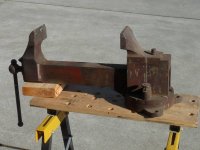
For me, I use both.I will disassemble and give any greasy or oily parts a scrub with this de-greaser or similar.
http://www.supercleanbrands.com/products#15
Then all the rusty bits go in the electrolysis tub.Don't be afraid to leave them in for a couple of days or more if needed to bust loose all the rust.After that I hit everything with a wire brush to remove all residues that remain.That might be a wire wheel on an arbor or the angle grinder, or even a manual brush, depending on shape being cleaned.I always spray with denatured alcohol while brushing also.
I guess my best tip is to give the electrolysis tank time to work.I've had very good luck getting some tightly rusted assemblies apart using this method.
Rich
http://www.supercleanbrands.com/products#15
Then all the rusty bits go in the electrolysis tub.Don't be afraid to leave them in for a couple of days or more if needed to bust loose all the rust.After that I hit everything with a wire brush to remove all residues that remain.That might be a wire wheel on an arbor or the angle grinder, or even a manual brush, depending on shape being cleaned.I always spray with denatured alcohol while brushing also.
I guess my best tip is to give the electrolysis tank time to work.I've had very good luck getting some tightly rusted assemblies apart using this method.
Rich
balane
Well-known member
I've tried pretty much every method and the system I use now is as follows. If the vise has a lot of rust I start with electrolysis. Then I use paint stripping gel, I just brush it all over and let it sit for an hour or so. I give it a bath with soapy water and scrubbing in a tub in the back yard. If it needs more stripping, such as a lot of different paint coats were applied or if it's just stubborn, then I repeat the stripping and scrub bath until most of the paint is gone. I finish it up with a quick media blast and then prep the metal for paint.
I've used all sorts of wire wheels in the past, and they work fine, but I like the finished product better if I do the above method.
In my opinion, do what you want and what you like to get it to bare metal. You aren't going to hurt the vise.
Edit: I wanted to add that for the machined surfaces, such as the sides of the slide, I use a die grinder with scotch discs. I might start these surfaces with very fine sandpaper disks should they just have a ton of **** on them. I'll always finish with scotch pads though.
.
I've used all sorts of wire wheels in the past, and they work fine, but I like the finished product better if I do the above method.
In my opinion, do what you want and what you like to get it to bare metal. You aren't going to hurt the vise.
Edit: I wanted to add that for the machined surfaces, such as the sides of the slide, I use a die grinder with scotch discs. I might start these surfaces with very fine sandpaper disks should they just have a ton of **** on them. I'll always finish with scotch pads though.
.
Last edited:
Chasbec
Well-known member
JRobb: I'm definitely not an expert but I am working on a similar project right now. My first vise was done with wire wheel and abrasive drums on a 4" angle grinder. That was a smaller (4") vise and wasn't in very bad condition. I spent many hours and a lot of elbow grease using that method but ended up getting good results. I was a bit worried about wearing down the raised lettering, but if it did, it's not noticeable (at least to me).
I'm now working on a very big, very rusty hulk of a vise with seized jaws. After seeing how much effort went into cleaning up the first one, I decided that electrolysis was the only way to go with this project. I you're interested, here's the thread for the current project:http://www.garagejournal.com/forum/showthread.php?t=257436
I'm now working on a very big, very rusty hulk of a vise with seized jaws. After seeing how much effort went into cleaning up the first one, I decided that electrolysis was the only way to go with this project. I you're interested, here's the thread for the current project:http://www.garagejournal.com/forum/showthread.php?t=257436
Depends on the vise or item in question. Lots of rusted nooks and crannies is better suite to electrolysis. Flat areas or other non curvy features are easily knocked down by a wire wheel either on a bench grinder or a cup brush. At times I'm a bit impatient and just go straight for the angle grinder. 
I also have a vise sitting in the e tank right now. Rusted solid, here's to hoping it will free up. I too am **** about what goes into the tank, everything gets a good pressure wash with dawn, quick wire brush then into the tank.
For what you have there, I would maybe put the morgan in the tank, but not the prentiss. That prentiss looks pretty clean at least by my used vise standards.
I also have a vise sitting in the e tank right now. Rusted solid, here's to hoping it will free up. I too am **** about what goes into the tank, everything gets a good pressure wash with dawn, quick wire brush then into the tank.
For what you have there, I would maybe put the morgan in the tank, but not the prentiss. That prentiss looks pretty clean at least by my used vise standards.
Outlawmws
Well-known member
I'm also primarily an E tank guy because the nooks and crannies defeat most wire wheel efforts. Bullet type vises are often the exception and it simply had fewer nooks.
An E tank will also usually remove the paint, especially spray bomb repaint jobs.
Heavy grease, clean off as usual, but residual light stuff will also come off with the E tank Soda solution.
Both have there place, but I prefer the E-tank overall.
An E tank will also usually remove the paint, especially spray bomb repaint jobs.
Heavy grease, clean off as usual, but residual light stuff will also come off with the E tank Soda solution.
Both have there place, but I prefer the E-tank overall.
Thanks for the tips guys. When I said wire wheel I was referring to a wire cup attachment on a die grinder, nothing too extreme Now i'm on the hunt for a 6" vise. I found a Snap-on one for $225 (lowest he will go) but I don't know if I want to spend that much.
Now i'm on the hunt for a 6" vise. I found a Snap-on one for $225 (lowest he will go) but I don't know if I want to spend that much.Thanks for the tips guys. When I said wire wheel I was referring to a wire cup attachment on a die grinder, nothing too extreme
I use a cup brush (non twisted) in a 4.5" grinder and a coarse and fine wire wheel on a bench grinder. I guess a die grinder would work pretty well, maybe just not as easy to control as the other options.
PCO6
Well-known member
I start with pressure washing, followed by dipping in phosphoric acid and then a light wire and/or scotch pad wheeling. If I need to remove the paint I will sandblast it or use paint remover.
View media item 42188
View media item 42189
View media item 42190
View media item 42191
View media item 42188
View media item 42189
View media item 42190
View media item 42191
Chasbec
Well-known member
Wow! Great results PCO6! Very nice.
Waggoner72
Well-known member
I used electrolysis first on mine on each part. Then I used the wire wheel on my bench grinder to further clean the parts up for paint. Here's how it turned out for me.
Before


After wire wheel
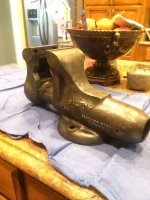

Finished
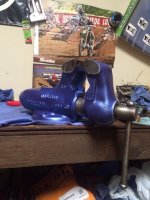
Before
After wire wheel
Finished
Dust Devil
Well-known member
PCO6
Well-known member
Thanks Chasbec.
Dust Devil - Funny that you say that. The original colour was the turquoise that you see after it came out of the phosphoric acid bath. Normally I would paint it the original colour but in this case I don't even know what brand this vice is so I figured I'd change the colour. It would have looked good in the original colour but I'll be selling it at a British car flea market. What could be better than a red vice with "Made in England" on the side.
Here it is assembled ...
View media item 42192
Here is a Record No. 6 that went through the same process ...
View media item 34048
Dust Devil - Funny that you say that. The original colour was the turquoise that you see after it came out of the phosphoric acid bath. Normally I would paint it the original colour but in this case I don't even know what brand this vice is so I figured I'd change the colour. It would have looked good in the original colour but I'll be selling it at a British car flea market. What could be better than a red vice with "Made in England" on the side.
Here it is assembled ...
View media item 42192
Here is a Record No. 6 that went through the same process ...
View media item 34048
Dust Devil
Well-known member
I used electrolysis first on mine on each part. Then I used the wire wheel on my bench grinder to further clean the parts up for paint. Here's how it turned out for me.
Looks awesome.
IMO the electrolysis or phosphoric acid then a good wire wheeling makes anything old and rusty look badass again.
Dust Devil
Well-known member
PC06 has vice resto down. Solid work.
Chasbec
Well-known member
PC06 has vice resto down. Solid work.
Totally agree and Waggoner's work looks great too.
