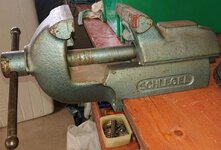
The Bison is unusual for the "inverted" dovetail compared to the rest, it swivels (very unusual) and has a totally enclosed lead screw.
Regular german design did not rotate the lead screw, instead using a tube with a nut so even though exposed, grinding dust or weld splatter did not damage it (it's just a tube, the fixed lead screw is inside of it). Bison enclosed it because they wanted it to swivel. Basically, this means they used up more space higher up, under the jaws, and the enclosure for the lead screw is actually also the structural support for the fixed jaw.
I'm also not certain if the inverted dovetail is a great idea. I have seen such vises with broken guides from hammer damage. I can't recall the same for the German style dovetail.
Really nice thing about the Bison is that the guide is adjustable, so you should be able to take out all of the slack. This is not common on other such vises.
German style vises were mounted to the table with one screw from the top and two from the front. This ensured a very rigid connection and perfect aligment on the table every time. I think the advantage of such a vise compared to a moving front jaw design is in how rigid it is. You shouldn't hammer on vises, but with this style you also don't need to worry too much, the front jaw is very strong, the forces travel really neatly into the table, and the moving jaw is fully supported... For the amount of material used, the design is just very "compact". A Reed and other US style vises are really great vises but I think you can achieve the same rigidity with far less material with such a dovetail design. That's my reasoning for why they exist. Also, you're usually limited from clamping larger than ~50-60mm thick tall stuff as the front jaw is at a fixed distance from the table. To be honest, doing that kind of stuff is kind of a niche thing anyway. You can also have the vise at the side of the table, and as long as the table is very stout (like the usual old metalworking tables here - steel frame and sometimes even bolted to the ground), you can do pretty much anything with such a vise.
Here's how a typical vise on a German workbench looks like: