To avoid these ads, REGISTER NOW!

Voltage Between Grounds on Different Circuits

olds70supreme

Well-known member
Joined
Mar 7, 2008
Messages
694
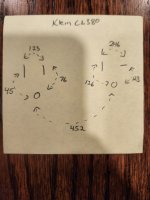
I checked voltage between grounds on a 120V circuit and a 220V circuit and found a 45V difference. I was expecting zero. Both circuits are used frequently w/o obvious issue (breakers tripping, etc...). What does this indicate and what are steps I should do to track down the problem?
 
To avoid these ads, REGISTER NOW!
OP
O

olds70supreme

Well-known member
Joined
Mar 7, 2008
Messages
694
See attachment for voltage readings between different contact points as well as the meter type.
 

Attachments

  • outlets.jpg
    outlets.jpg
    538.8 KB · Views: 110

Chuckster in NJ

Well-known member
Joined
Jan 26, 2010
Messages
2,275
Location
Hunterdon County NJ
Loose ground or neutral.……… Clean and check the ground connections at the water pipe and or the ground rod would the first step and then re-check the voltages.

BTW! I would bet you have a failing neutral connection at the utility connection.
 

mm08822

Well-known member
Joined
Jan 13, 2012
Messages
5,847
Location
NJ
See attachment for voltage readings between different contact points as well as the meter type.
Do both circuits come out of the same panel?
Where were these readings taken relative to the panel(s)?

The 240v circuit looks fine. I would focus on the 120v circuit connections. Focus on the bonding location first and follow it out towards the measurement location even if it takes you through a sub-panel to get there.
 
OP
O

olds70supreme

Well-known member
Joined
Mar 7, 2008
Messages
694
Both circuits come from the same garage subpanel that is fed from the house, maybe 70 wire-feet from the panel.

For what it's worth another outlet on a separate 120V circuit in the same garage tests normally. I'll test more outlets tomorrow after work.


BTW! I would bet you have a failing neutral connection at the utility connection.
What do you see that indicates that?
 

mm08822

Well-known member
Joined
Jan 13, 2012
Messages
5,847
Location
NJ
Both circuits come from the same garage subpanel that is fed from the house, maybe 70 wire-feet from the panel.

For what it's worth another outlet on a separate 120V circuit in the same garage tests normally. I'll test more outlets tomorrow after work.
Ok, follow that branch circuit from sub panel outward. Look for damaged cable and corroded terminations.
 

wyliesdiesels

Well-known member
Joined
Aug 14, 2012
Messages
19,983
Location
Modesto, CA
Loose ground or neutral.……… Clean and check the ground connections at the water pipe and or the ground rod would the first step and then re-check the voltages.

a bond to plumbing or the GEC to rods would have absolutely nothing to do with a difference in potential on a ground wire on a receptacle


BTW! I would bet you have a failing neutral connection at the utility connection.

that would not cause a difference in potential on EGCs. you would see high and low voltage on 120v circuits but the ground wire potential would not be lower than the neutral wire potential. remember they go to the same bar in the main service panel.
 
Last edited:

Etchase

Well-known member
Joined
Nov 10, 2017
Messages
1,957
Location
Hawaii
I’ve seen a 60v difference on neutral in a commercial building. Whole factory was running fine.
 

gte718p

Well-known member
Joined
Mar 12, 2009
Messages
3,950
No, you checked the voltage between a NEUTRAL on the 240V side and the GROUND on the 120V side. Big difference.

in the US three wire 220 is two hots and a ground. That should be ground on both. Four wire has a neutral.

The more interesting problem is on the 120 volt side. Those are completely hosed. Neutral to ground should not have potential. Less than 4 volts is normal and is basically noise/induced. I concur with the earlier assessments that you have a loose or corroded neutral or ground.
 

rooster59

Well-known member
Joined
Nov 16, 2014
Messages
934
Location
Land of the Pines
Kill power to the sub panel. Inspect for corrosion and tighten every wire connection in the sub panel, grounds, neutrals, & hots. Check the voltages. Solve it? Use an extension cord to a 3rd outlet and check all the voltages, should give clues if still problems. If problems corrosion / tighten connections on your outlet(s). You get the idea. You may have to go to the main panel and check the connections from the main to the sub.
 

Codyboy

Well-known member
Joined
Jan 31, 2019
Messages
1,617
Location
S.E. TEXAS
There should be no potential difference on grounds.
Is the 240 circuit only using 240 or is the ground being used as a neutral?
What is plugged into it ?
 

cgrutt

Well-known member
Joined
Mar 4, 2016
Messages
8,152
What else is on that same circuit (lighting, other outlets, appliances)? Sounds like a bad neutral and load (on the return path) is being split between it and ground. Check for loose or broken connections on neutral all the way back to panel (including any other boxes along the path). What's in panel? Any shared grounds and commons on the common and neutral busses? Is the breaker partially tripped or bad? Use an extension cord on a known good outlet to take readings between neutral and ground should be zero (or close to it) voltage drop until you find bad connection. Unplug any devices that may be on same circuit. Bad common or ground within device could be causing problem (reading the high neutral through circuit within device). I bet its just a loose neutral somewhere on that circuit.

Also are there any three-way switches (lighting) on that same circuit? If so check wiring and integrity of switches.

ETA I think the 45v that you see between outlets is the same as the one between neutral and ground on the 120v circuit. Similar to using extension cord on known good outlet to take readings. The 220v circuit is likely good. Problem appears to be on 120v side. Take measurements between the hot and neutral leads on 120v outlet to the 220v outlet. Similar to what you did with grounds. This will use the 220v circuit as a known good reference. You should have 0v between hot and hot (the hot thats on same phase as the 120v) and 120v between neutral (120v side) and hot (220v) side. But you're likely going to see same results as within the 120v because the neutral is high on that side. Trace neutral back along circuit until it measures correctly and you will have found starting point of where problem lies. Good luck.
 
Last edited:
To avoid these ads, REGISTER NOW!

wyliesdiesels

Well-known member
Joined
Aug 14, 2012
Messages
19,983
Location
Modesto, CA
No, you checked the voltage between a NEUTRAL on the 240V side and the GROUND on the 120V side. Big difference.

wrong. the receptacle on the right is a NEMA 6-20r, there is no neutral. he did indeed test from ground to ground on the receptacles
 

cgrutt

Well-known member
Joined
Mar 4, 2016
Messages
8,152
there is no issue with the neutral wire since OP got a normal voltage reading between hot and neutral
I don’t think this is correct looks like return path is split with sum of the H-N and H-G equaling the H total potential. Loose or broken neutral may cause this.

ETA I do agree there is something going on with ground as well there should be 120v at that outlet between H-G. Possible shared N & G on buss in panel (not fully bonded from corrosion or loose connection?).
 
Last edited:

wyliesdiesels

Well-known member
Joined
Aug 14, 2012
Messages
19,983
Location
Modesto, CA
Kill power to the sub panel. Inspect for corrosion and tighten every wire connection in the sub panel, grounds, neutrals, & hots. Check the voltages. Solve it? Use an extension cord to a 3rd outlet and check all the voltages, should give clues if still problems. If problems corrosion / tighten connections on your outlet(s). You get the idea. You may have to go to the main panel and check the connections from the main to the sub.

you cant just tighten all the connections. you have to properly torque them otherwise you can cause an issue where the lug may not be tightened correctly causing a loose connection. properly torquing an already terminated wire means removing the wire from the lug, cutting off the smash section, and then torquing the lug with a calibrated torque wrench or screwdriver.
 

wyliesdiesels

Well-known member
Joined
Aug 14, 2012
Messages
19,983
Location
Modesto, CA
I don’t think this is correct looks like return path is split with sum of the H-N and H-G equaling the H total potential. Loose or broken neutral may cause this.
then tell me how hot to neutral on the 120v receptacle reads 123v? if the neutral was bad (loose/broken) you wouldnt be getting 123v between hot and neutral.... the neutral is fine.... it's an issue with the ground wire as indicated by the low voltage readings between ground and hot and the high voltage readings between ground and neutral on the 120v receptacle and the ground on the 240v receptacle.

remember, the grounds on both receptacles should go to the same ground bar, so there should be no potential between them. since there is, it indicates the ground wire is high resistant. the neutral doesnt come into play at all here since the grounds wires SHOULD be at the same potential.
 

cgrutt

Well-known member
Joined
Mar 4, 2016
Messages
8,152
then tell me how hot to neutral on the 120v receptacle reads 123v? if the neutral was bad (loose/broken) you wouldnt be getting 123v between hot and neutral.... the neutral is fine.... it's an issue with the ground wire as indicated by the low voltage readings between ground and hot and the high voltage readings between ground and neutral on the 120v receptacle and the ground on the 240v receptacle.

remember, the grounds on both receptacles should go to the same ground bar, so there should be no potential between them. since there is, it indicates the ground wire is high resistant. the neutral doesnt come into play at all here since the grounds wires SHOULD be at the same potential.
I edited my post I do agree there is something going on with the ground. I think it also may involve neutral as well possibly where they are connected at panel. There shouldn't be 45v between N and G either. That should be 0 potential as they too are ultimately bonded (should be anyway). The way Im thinking about it OP is measuring 120 between H and N which seems fine. But I think the return path on that N terminal may be split between N and G.
 

wyliesdiesels

Well-known member
Joined
Aug 14, 2012
Messages
19,983
Location
Modesto, CA
I edited my post I do agree there is something going on with the ground. I think it also may involve neutral as well possibly where they are connected at panel. There shouldn't be 45v between N and G either. That should be 0 potential as they too are ultimately bonded (should be anyway). The way Im thinking about it OP is measuring 120 between H and N which seems fine. But I think the return path on that N terminal may be split between N and G.

there is 45v potential between ground and neutral because the ground has a bad connection. The neutral is fine since we have 123v between it and hot. you cant have a good neutral and a bad neutral at the same time.
 

cgrutt

Well-known member
Joined
Mar 4, 2016
Messages
8,152
Could it be a bad outlet? Would be interested to see same voltage measurements on the 120v side with the outlet disconnected.
 

BurtEggley

Well-known member
Joined
Oct 8, 2024
Messages
849
also, keep in mind that voltage can appear normal until a load is applied to that circuit. And, in some instances a few amps can arc over corrosion and make it appear less, or vs versa. The only fix is to inspect all the connections and be sure they are 100% good. If it continues after that, inspect wires for rodent or critter damage.

I am too old and stiff to be crawling in the attic. My electrician is young and flexible still. When we had the insulation out to replace and upgrade it to R50 after 40+ years, I paid my friend to walk around in the attic and inspect all the visible wires for any damage. We know of two parties in rural settings who lost their homes to fires caused by critters. It does happen. Abnormal resistance in wiring absolutely needs to be dealt with. It isn't just an inconvenience.
 

theoldwizard1

Well-known member
Joined
Feb 22, 2011
Messages
43,076
Location
SE MI
I checked voltage between grounds on a 120V circuit and a 220V circuit and found a 45V difference.
First, you will NEVER have truly ZERO volts difference. More than 50(?) mV and I would be concerned.

Second, some meters are notorious for reading "ghost voltages". What you want is a meter with a low impedance/low-Z setting. You can make you own by placing a resistor of about 3k ohms across the leads.

Neutral to ground should be in the same range.
 

American Locomotive

Well-known member
Joined
Jan 8, 2017
Messages
10,928
Location
Rhode Island
The ground on the 120v outlet is not connected. It's floating at ~45v above neutral. Hence why between neutral and 120v ground you get 45v, and why between 240v ground and 120v ground you get 45v. It's also why you only get 76v measuring between hot and ground . 76v+45v = 121v.

Broken ground wire or loose screw on the 120v outlet somewhere.
 

Codyboy

Well-known member
Joined
Jan 31, 2019
Messages
1,617
Location
S.E. TEXAS
Are you having issues OP? Why the concern?
You Ms painted a pic and said here it is!

As has been said some voltmeters will read wonky **** even when no shot is wonky.

Do you even know how to use a VOM properly and know how to actually troubleshoot an issue?
I'm guessing not but you haven't given much info past the op and one post.
Much speculation here in the replies.

I suggest starting over at the beginning and flow up on suggestions.

It's like the posts where someone ask a question and posts a Pic of some close up picture that no one can discern. "Yep its a piece wood with a knot about midway down. "
 

Copymutt

Well-known member
Joined
Sep 3, 2016
Messages
3,381
Location
Colorado
How many of us clean the oxidation off our ground rod connections or even keep the soil moist where the ground rod is driven😒. A lot of theory goes out the window.
 
OP
O

olds70supreme

Well-known member
Joined
Mar 7, 2008
Messages
694
Appreciate everybody who had suggestions. Everybody who suggested a bad/loose ground was correct. Following cgrutt's advice I worked my way back testing outlets on that circuit until I found a good one. I found a ground wire inside that box that pulled out of the wire nut when I pulled the outlet out of the box. I replaced the wire nut put it back together and everything tests good now.
 

wyliesdiesels

Well-known member
Joined
Aug 14, 2012
Messages
19,983
Location
Modesto, CA
Glad you found it and it was easy fix. Looks like @LopezBart and @wyliesdiesels were right about ground I was thinking neutral was also involved. So the 45v and 75v readings were just induced and picked up by your meter on floating ground. Learn something new everyday!
yup induced voltage. the wizard was spot on in post #31

thats also why klassnel said to connect a light bulb to it. it wont light up and the voltage will "disappear".

this is why its good to have a solenoid type tester in addition to a digital multimeter
 
To avoid these ads, REGISTER NOW!
Top Bottom