Floor treatment is in progress. The final steps should be complete within the next few days.
The final combination of products I decided to use were the Taupe acid stain from Eagle I. F. P. (along with their Etch & Clean and Neutralizer/Degreaser) and a densifier (Lithi-Tek 4500) and penetrating sealer (Siloxa-Tek 8510) from Ghostshield. I also picked up an acid pump sprayer, a deck scrub brush (A.K.A. acid brush), masking materials and requisite PPE.
Total materials cost was just shy of $1,400. That works out to about $1.17/sq. ft. I hope to have enough left-over densifier and sealer to do the exterior surfaces as well, but that wasn't part of the initial calculation so it would be a bonus.
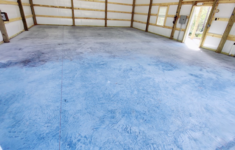
This is the "before" shot after moving everything out and sweeping (several times!) The foreground in direct sunlight looks a lot more blue in this photo that real life. Color toward the back wall is more accurate.
For the Etch & Clean I started with a 15'x20' section and quickly found out that that was too large. Some areas dried before I could get to them with the scrub brush. I moved on with more manageable sections, 10'x15' while the first dried fully. I ended up going back over the first section to remove the white residue left behind.
I ran a roll of duct tape around the skirt board and posts then added some splash protection with rosin paper. I would have preferred wax or film backed paper and at half the width. But this is what was in stock and did the job well enough.
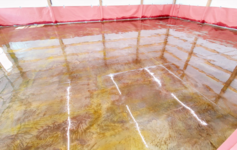
This is the look minutes after application of the acid stain. I used exactly 2 gallons diluted 1:1 with water to cover 1,200 sq ft. Following instruction on the label, we let it sit for 6 hours to do it's thing.

This is still mid-process, after the first round of neutralizing and rinsing, but dry areas give a general idea of the results. I was a little surprised with the depth and variation, but not disappointed!
The physical labor required to get it cleaned and residue-free was also more than expected. We could have used two or three more people to help and have been much less sore at the end of the day, but I would not have guessed that going in.
The densifier was applied once everything was dry again. While the label indicates 700-1000 sq ft coverage for each gallon of concentrate, with all the variables involved and the risk of over-application in mind I ended up getting the whole area covered with less than one gallon of concentrate. The porosity is relatively low I suspect. Distilled water was used for diluting to the right use ratio which supposedly maximizes the performance.
I'll add a final "after" shot once the sealer is on and everything is finally dry and done.