socalboy
Member
So, today as I went to retrieve some food out of the microwave, my hand happened to brush against the chrome trim on the wall oven while simultaneously touching the metallic door open button on the microwave, and I was greeted with a jolting electric shock!
After calming down for a few seconds and finishing my lunch, I grabbed my multimeter and discovered that the chassis of the wall oven was at 120V potential to ground (including the chassis of the microwave). The question was, why?
Background
A couple of years ago we bought this new-to-us house here in San Diego; it was built in 1971. We bought it just before it went into foreclosure, so we got it for a steal, but as-is, with the understanding that we would need/want to invest some of the savings into repairs/upgrades/remodeling. And we are in the process of doing just that.
A month or so ago I was doing some due diligence in preparation for having a new central HVAC system installed. I remembered from our initial home inspection that there were some potential wiring issues in the attic/crawlspace above the kitchen ceiling near the HVAC lines, so removed the access panel and poked my head up there to look around and take notes on what might need to be repaired or rewired. There was a ton of debris and filth up there so while I had it open I did some light cleaning, took notes, and closed it back up.
The next day we noticed that the electric wall oven, whose wiring ran through that attic/crawlspace, was acting up. At first we thought it wasn't working at all, but we finally realized that the indicator lights for "power on" and "heating element on" no longer illuminated under normal circumstances. The timing seemed like more than a coincidence with poking around the attic space the day before but I looked over the wiring up there and it appeared undisturbed and firmly connected. We chalked it up to the oven being very old and (mostly) got used to no longer having indicator lights.
A couple weeks ago, I was opening the microwave and thought I felt a brief shock as I touched the oven frame, but it was so fleeting and weak that I wasn't certain and didn't take any action. Until today.
Who thought this was a good idea?
Getting shocked today was the last straw so I decided to try to get to the bottom of why the oven chassis was hot. I turned off the power at the breaker, pulled the oven out of the wall, and started tracing the circuit back along its path to the panel.
What I found made me want to just rip it all out and start over. To my eye there are countless issues and I am but an amateur at this. I will try to briefly describe it here.
The electrical path from the panel to the wall oven is as follows:
1. 50A double pole breaker in the panel
2. Two hot conductors (#6 THWN?) stranded Cu, one red, one blue, from the breaker, out the bottom of the panel and underground through metallic conduit, emerging at the other side of the house at the...
3. ... A/C disconnect. From there we find 3 x #8 THHN/THWN stranded Cu, all having white insulation, exiting out the side of the disconnect housing and up the exterior kitchen wall. Two of these wires are under each of the line-side lugs of the disconnect with the feed from the panel. The third, with green tape over the end of the white insulation, is the lone wire connected to a ground lug(?) in the disconnect. We currently have no air conditioner so there are no other wires in the disconnect.
4. Those three #8 run up the exterior kitchen wall in metallic conduit, through an LB and into the kitchen attic through a few more feet of horizontal metallic conduit, which ends in a square metal j-box, hereafter referred to as j-box #1. Where they are spliced to...
5. ... black jacketed NM-B #8-3G solid Cu cable. This is 3 conductor + ground cable, both the white and bare conductors are wire-nutted to the wire coming from the ground lug(?) in the disconnect. The other two conductors of the NM-B are connected to two line side conductors coming from the disconnect.
6. The NM-B is run about six feet across the attic space where it is then openly spliced (outside of any j-box or fixture) to grey-jacketed 8-8-8-8 SER XHHW solid Al cable, which runs down through the ceiling and into the cabinets, terminating in a metal octagonal j-box in the open cabinet space behind the freestanding microwave.
7. In the octagonal j-box, hereafter referred to as j-box #2, the SER cable is wire-nutted to what appears to be some sort of armored cable whip from the oven containing four #14 solid Cu conductors (two hot, neutral, ground).
Hopefully you're still with me. But really, who thought all of this was a good idea?
Measurements
I took a variety of voltage and continuity measurements. Most were as expected: line-line around 240V, line-"neutral" around 110-120V, line-"ground" around 110-120V, "ground"-"neutral" around zero (these are wire-nutted together in j-box #1). I found continuity between all the metal conduit/disconnect housing and other nearby grounded objects: ground bonding wire for nearby pool equipment, nearby cold water pipe, nearby steel gas pipe, etc. I did not find any continuity between the oven chassis and the oven leads while searching for a short inside the oven.
Unexpected readings included:
Since everyone at GJ loves pics, see attached and:
Index to Pics
1. The microwave and wall oven under discussion
2. Oven nameplate: GE model JRP03G0J3BG, 4.8 kW @ 120/240V
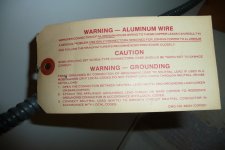
3. Warning tag attached to oven armored cable whip. Not sure that the installer read this.
4. Inside the access cover on back of oven where armored cable whip enters from bottom
5. J-box #2 in cabinet opening behind the microwave. Wire labels added be me for easier reconnection (it was dark in there). The j-box did at least have a cover which was removed before the photo was taken. This space is not filled by anything except the freestanding countertop microwave. Yes, all that cabling is unprotected (and runs through the cabinet above in the same manner).
6. Close-up of j-box #2, with wire nuts removed. Difference in wire gauge and material apparent. Not sure that those are Al/Cu wire nuts. What's up with that fitting on the SER cable where it enters the box, is that appropriate?
7. Combo meter/panel, on the exterior of the garage (had to work that in somewhere)
8. The two conductors (red/blue) that power the oven, at the bottom of panel as they enter conduit on the way to the A/C disconnect.
9. Breakers in the panel. The one under discussion is the 50A in the bottom right.
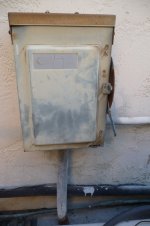
10. The A/C disconnect on the kitchen exterior wall. Conduit from panel comes up from underground.
11. Only markings I found on the disconnect. Cutler-Hammer 4199H1
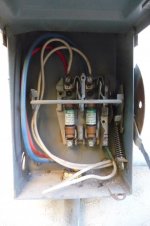
12. Inside of the A/C disconnect. 60A fused, as mentioned we currently have no A/C system. Blue/red line wires from panel feed through to oven. White conductor with green taped end in the bottom right feeds both the neutral/ground wires of the oven.
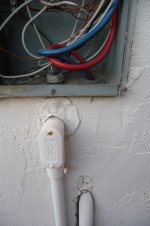
13. Conduit from the A/C disconnect entering the kitchen attic space and into j-box #1. J-box cover has been removed. Spliced to black #8 NM-B cable; bare ground and white NM-B conductors are both connected to "ground" wire from the A/C disconnect. Ignore the SER cable in the background, it's not connected to anything.
14. #8 NM-B cable in the kitchen attic spliced to the SER cable which runs down into the cabinetry. This is how I found it; there are no j-boxes over here. That mess of #12 Romex splices on the right is another problem now uncovered that needs to be corrected.
Questions/Help
1. Is the ground lug(?) in the A/C disconnect normally bonded to anything or is it isolated? From my observations it does not seem to be connected to the housing of the disconnect nor any other ground source. I presume in normal use, it would be connected to a ground conductor coming from the panel and then connected to ground on the load?
2. Looking inside j-box #2 where the oven leads meet the rest of the feed, you might think that we have a four-wire feed, after all there are four conductors both entering and exiting the j-box. However, tracing back the wiring path, it seems that we may really only have a two(!) wire feed, with both the ground and neutral being "faked" by being the only wire connected to the ground lug(?) in the A/C disconnect. The oven requires at least a three-wire feed. Does this sound right?
3. Is there any circumstance under which this "design" could be considered safe?
4. Of course until now I never measured the voltage potential between my oven chassis and reference ground, might it have been electrified all along considering this wiring arrangement and we just got lucky?
5. Does it seem likely that the recent oven indicator light malfunctioning is either the cause or effect of the oven chassis becoming electrified? Is this just coincidence?
For now, I put everything back together and switched off the breaker for this circuit at the panel. Should I even bother to try to do anything with this mess (so we can have a working oven again) or do I just need to have an electrician start over and get everything re-wired properly as part of our bigger repair/remodeling efforts?
Any and all comments welcome. Help and feedback most appreciated, my girlfriend is now afraid to touch anything metallic in the kitchen.
Tom
After calming down for a few seconds and finishing my lunch, I grabbed my multimeter and discovered that the chassis of the wall oven was at 120V potential to ground (including the chassis of the microwave). The question was, why?
Background
A couple of years ago we bought this new-to-us house here in San Diego; it was built in 1971. We bought it just before it went into foreclosure, so we got it for a steal, but as-is, with the understanding that we would need/want to invest some of the savings into repairs/upgrades/remodeling. And we are in the process of doing just that.
A month or so ago I was doing some due diligence in preparation for having a new central HVAC system installed. I remembered from our initial home inspection that there were some potential wiring issues in the attic/crawlspace above the kitchen ceiling near the HVAC lines, so removed the access panel and poked my head up there to look around and take notes on what might need to be repaired or rewired. There was a ton of debris and filth up there so while I had it open I did some light cleaning, took notes, and closed it back up.
The next day we noticed that the electric wall oven, whose wiring ran through that attic/crawlspace, was acting up. At first we thought it wasn't working at all, but we finally realized that the indicator lights for "power on" and "heating element on" no longer illuminated under normal circumstances. The timing seemed like more than a coincidence with poking around the attic space the day before but I looked over the wiring up there and it appeared undisturbed and firmly connected. We chalked it up to the oven being very old and (mostly) got used to no longer having indicator lights.
A couple weeks ago, I was opening the microwave and thought I felt a brief shock as I touched the oven frame, but it was so fleeting and weak that I wasn't certain and didn't take any action. Until today.
Who thought this was a good idea?
Getting shocked today was the last straw so I decided to try to get to the bottom of why the oven chassis was hot. I turned off the power at the breaker, pulled the oven out of the wall, and started tracing the circuit back along its path to the panel.
What I found made me want to just rip it all out and start over. To my eye there are countless issues and I am but an amateur at this. I will try to briefly describe it here.
The electrical path from the panel to the wall oven is as follows:
1. 50A double pole breaker in the panel
2. Two hot conductors (#6 THWN?) stranded Cu, one red, one blue, from the breaker, out the bottom of the panel and underground through metallic conduit, emerging at the other side of the house at the...
3. ... A/C disconnect. From there we find 3 x #8 THHN/THWN stranded Cu, all having white insulation, exiting out the side of the disconnect housing and up the exterior kitchen wall. Two of these wires are under each of the line-side lugs of the disconnect with the feed from the panel. The third, with green tape over the end of the white insulation, is the lone wire connected to a ground lug(?) in the disconnect. We currently have no air conditioner so there are no other wires in the disconnect.
4. Those three #8 run up the exterior kitchen wall in metallic conduit, through an LB and into the kitchen attic through a few more feet of horizontal metallic conduit, which ends in a square metal j-box, hereafter referred to as j-box #1. Where they are spliced to...
5. ... black jacketed NM-B #8-3G solid Cu cable. This is 3 conductor + ground cable, both the white and bare conductors are wire-nutted to the wire coming from the ground lug(?) in the disconnect. The other two conductors of the NM-B are connected to two line side conductors coming from the disconnect.
6. The NM-B is run about six feet across the attic space where it is then openly spliced (outside of any j-box or fixture) to grey-jacketed 8-8-8-8 SER XHHW solid Al cable, which runs down through the ceiling and into the cabinets, terminating in a metal octagonal j-box in the open cabinet space behind the freestanding microwave.
7. In the octagonal j-box, hereafter referred to as j-box #2, the SER cable is wire-nutted to what appears to be some sort of armored cable whip from the oven containing four #14 solid Cu conductors (two hot, neutral, ground).
Hopefully you're still with me. But really, who thought all of this was a good idea?
Measurements
I took a variety of voltage and continuity measurements. Most were as expected: line-line around 240V, line-"neutral" around 110-120V, line-"ground" around 110-120V, "ground"-"neutral" around zero (these are wire-nutted together in j-box #1). I found continuity between all the metal conduit/disconnect housing and other nearby grounded objects: ground bonding wire for nearby pool equipment, nearby cold water pipe, nearby steel gas pipe, etc. I did not find any continuity between the oven chassis and the oven leads while searching for a short inside the oven.
Unexpected readings included:
- (with all oven wiring connected to power source) ~120V between the ground lug(?) in the A/C disconnect and other nearby ground bonds
- (with oven wiring whip disconnected from jbox #2) ~2-3V between the ground lug(?) in the A/C disconnect and other nearby ground bonds, and a lack of continuity there
- (with oven ground conductor disconnected, but oven line + neutral connected) ~52V oven chassis to
reference ground
Since everyone at GJ loves pics, see attached and:
Index to Pics
1. The microwave and wall oven under discussion
2. Oven nameplate: GE model JRP03G0J3BG, 4.8 kW @ 120/240V
3. Warning tag attached to oven armored cable whip. Not sure that the installer read this.
4. Inside the access cover on back of oven where armored cable whip enters from bottom
5. J-box #2 in cabinet opening behind the microwave. Wire labels added be me for easier reconnection (it was dark in there). The j-box did at least have a cover which was removed before the photo was taken. This space is not filled by anything except the freestanding countertop microwave. Yes, all that cabling is unprotected (and runs through the cabinet above in the same manner).
6. Close-up of j-box #2, with wire nuts removed. Difference in wire gauge and material apparent. Not sure that those are Al/Cu wire nuts. What's up with that fitting on the SER cable where it enters the box, is that appropriate?
7. Combo meter/panel, on the exterior of the garage (had to work that in somewhere)
8. The two conductors (red/blue) that power the oven, at the bottom of panel as they enter conduit on the way to the A/C disconnect.
9. Breakers in the panel. The one under discussion is the 50A in the bottom right.
10. The A/C disconnect on the kitchen exterior wall. Conduit from panel comes up from underground.
11. Only markings I found on the disconnect. Cutler-Hammer 4199H1
12. Inside of the A/C disconnect. 60A fused, as mentioned we currently have no A/C system. Blue/red line wires from panel feed through to oven. White conductor with green taped end in the bottom right feeds both the neutral/ground wires of the oven.
13. Conduit from the A/C disconnect entering the kitchen attic space and into j-box #1. J-box cover has been removed. Spliced to black #8 NM-B cable; bare ground and white NM-B conductors are both connected to "ground" wire from the A/C disconnect. Ignore the SER cable in the background, it's not connected to anything.
14. #8 NM-B cable in the kitchen attic spliced to the SER cable which runs down into the cabinetry. This is how I found it; there are no j-boxes over here. That mess of #12 Romex splices on the right is another problem now uncovered that needs to be corrected.
Questions/Help
1. Is the ground lug(?) in the A/C disconnect normally bonded to anything or is it isolated? From my observations it does not seem to be connected to the housing of the disconnect nor any other ground source. I presume in normal use, it would be connected to a ground conductor coming from the panel and then connected to ground on the load?
2. Looking inside j-box #2 where the oven leads meet the rest of the feed, you might think that we have a four-wire feed, after all there are four conductors both entering and exiting the j-box. However, tracing back the wiring path, it seems that we may really only have a two(!) wire feed, with both the ground and neutral being "faked" by being the only wire connected to the ground lug(?) in the A/C disconnect. The oven requires at least a three-wire feed. Does this sound right?
3. Is there any circumstance under which this "design" could be considered safe?
4. Of course until now I never measured the voltage potential between my oven chassis and reference ground, might it have been electrified all along considering this wiring arrangement and we just got lucky?
5. Does it seem likely that the recent oven indicator light malfunctioning is either the cause or effect of the oven chassis becoming electrified? Is this just coincidence?
For now, I put everything back together and switched off the breaker for this circuit at the panel. Should I even bother to try to do anything with this mess (so we can have a working oven again) or do I just need to have an electrician start over and get everything re-wired properly as part of our bigger repair/remodeling efforts?
Any and all comments welcome. Help and feedback most appreciated, my girlfriend is now afraid to touch anything metallic in the kitchen.
Tom