To avoid these ads, REGISTER NOW!

War Finish??

Noworries

Banned
Joined
Dec 8, 2019
Messages
230
Location
Southern California
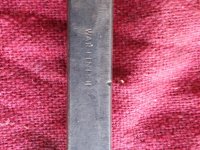
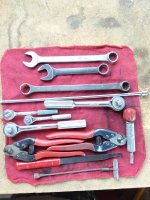
Picked up a toolbox literally filled with tools, looks like nothing newer than the 80's. Here is a few pics of the most interesting things... among the old proto and snapon stuff were theese things... had never heard of p&c, took me a minute to figure out what that cable thing was.. laughed when i saw the 14" 1/4 extension but what really intetested me was the plomb wrench stamped "war finish". Figured this was the place to get the low down...
 

Attachments

  • 20200521_161815.jpg
    20200521_161815.jpg
    134.2 KB · Views: 232
  • 20200521_163708.jpg
    20200521_163708.jpg
    123.1 KB · Views: 209
  • 20200521_171145.jpg
    20200521_171145.jpg
    154.6 KB · Views: 186
  • 20200521_171207.jpg
    20200521_171207.jpg
    159.9 KB · Views: 187
To avoid these ads, REGISTER NOW!

Lesserstore

Well-known member
Joined
Mar 18, 2020
Messages
866
Location
Texas
Between 1942-45 lots of companies made tools with lower quality finishes from simple plain steel, blued finish, cadmium and zinc plating. Plomb used cadmium and plain finish.
 
OP
N

Noworries

Banned
Joined
Dec 8, 2019
Messages
230
Location
Southern California
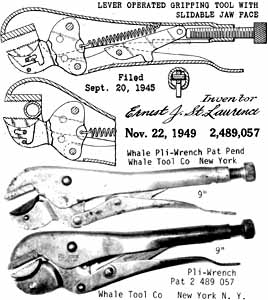
All trade sold those in 2 different sets that i know of..3 haws and that 5 jaw set..i bought a 3 jaw set back in the early 80s...now i suppose i have both sets..alco i forgot about these kinda cool pliers..the bottom jaw shifts..my finger is covering the name..anyone know what they are?
 

JR 42

Well-known member
Joined
Nov 2, 2013
Messages
966
Location
Sunny Seattle
The Vintage Tools forum here has a ton of info on Plomb war finish (WF) tools if you can make a search option work for you. war finish, or wf site:garagejournal in google will probably be less frustrating than using vBulletin search.

Eta, WF also can refer to Wright Field, which is a different ball of wax for WWII- era tools.
 
Last edited:
To avoid these ads, REGISTER NOW!
OP
N

Noworries

Banned
Joined
Dec 8, 2019
Messages
230
Location
Southern California
Thanks for that info..i shall search it out. I suppose the "lesser quality finish" used during the war accounts for so many of that era tools lookikg so shabby
 

JR 42

Well-known member
Joined
Nov 2, 2013
Messages
966
Location
Sunny Seattle
There was less time and man (lady) power spent on finishing steps, and limitations on steel alloy elements (chromium, vanadium, molybdenum, etc.) and finish (chrome, nickel, copper) elements, so I don't think the war era tools represent the best of what the contracting manufacturers could offer. The tools helped get the job done, though, so it all worked out.

That said, I've grown to like a black oxide finish on an unpolished wrench, I've got some Wright and Armstrong stuff I enjoy using and hope to grab some Proto some day as well. Just don't drop them, or work at night.
 
Last edited:

Made in USA

Well-known member
Joined
Feb 18, 2020
Messages
74
Location
In a van down by the river

Pli-Rench by Whale Tool Corp. of NY, NY.

http://www.datamp.org/patents/displayPatent.php?pn=2489057&id=34400
34400-1.jpg
 

r_olson_06

Well-known member
Joined
Feb 12, 2012
Messages
4,138
Location
SD
The "war finish" Plomb was a civilian production during WWII metal restrictions era.
The WF Plombs were a government production for a WWII contract.

War finish is far more rare than WF as a whole

Looking for a Plomb 3061 Pebble Open End.
 

metlmunchr

Well-known member
Joined
Sep 10, 2011
Messages
1,280
A lot of the machine tools built during WW2 had brass tags riveted to them stating "Finish in accordance with War Production Board standard no. xxxxx"

I've got 2 Monarch lathes, a 20 x 72 and a 22 x 80, that were delivered to a Southern Railway maintenance shop in Spartanburg SC in September 1945. Probably among the earliest post war deliveries of machine tools for non military use.

While these machines don't have WPB tags, it's obvious they were built with the intent of delivery for war use. There's no filler anywhere that's normally used to smooth casting surfaces for the usual slick finish on a new machine. The handwheel spokes are all painted orange as are the shafts on the gear change and clutch levers, all of which were typical war production colors not used on civilian machines.

The overall paint job is a very thin coat of a dark green that was Southern's primary equipment color. Likely sprayed at the request of the railroad in place of the normal machinery gray, and just enough coverage to keep the cast surfaces from rusting.

That maintenance facility was changed from general maintenance to strictly rebuilding boxcar bodies and doors in the mid 50's. As a result, both lathes as well as the rest of the machine shop equipment sat unused for the next 40 years until I bought them at auction in the mid 90's. I assume that's the only reason the original finish survived, as most stuff like that in the normal industrial setting would've had at least half a dozen coats of paint slopped on over the years in general "spruce ups" of the facility.
 
To avoid these ads, REGISTER NOW!
Top Bottom