
You are using an out of date browser. It may not display this or other websites correctly.
You should upgrade or use an alternative browser.
You should upgrade or use an alternative browser.
Was going through my pliers drawer and found this
- Thread starter eschoendorff
- Start date


Oldtuleguy
Well-known member
- Joined
- Nov 4, 2017
- Messages
- 10,461
Just pliers
nbpt100
Well-known member
I always wondered why are they called water pump pliers? 100's of applications. They are just slip joint pliers.
I always wondered why are they called water pump pliers? 100's of applications. They are just slip joint pliers.
They look kind of like an old fashioned water pump. The kind you actually had to pump to produce flow before electricity was available or common.
OP
eschoendorff
Well-known member
Just pliers
Kinda what I figured. They’re not bad as just pliers and can hang with today’s offerings
Private Lugnutz
Well-known member
In 1962, which is when these are date-coded, yes, they can be considered "just slip-joints" with an angle or offset pattern head, with multiple applications. In the pre-war era reaching right through wartime and a little beyond, they were referred to as "water pump pliers" in catalogs and in garages, because what they were originally created and intended for was to remove and install the packing gland nuts on water pumps.I always wondered why are they called water pump pliers? 100's of applications. They are just slip joint pliers.
Prior to the advent of adjustable pliers with an angle or offset head and jaw sizes anywhere from 1/4" up to a capacity of 1-1/2", mechanics had to carry a dozen water pump wrenches with different size open ends from 1/4" to 1-1/2", to service a water pump.
If you look in old catalogs from the 1920's (and they persisted well into the 1940's despite the advent of water pump pliers), you will see water pump wrenches. They were single open ends, thin, with a narrow handle and a wide mouth with hardly any jaw. They didn't need to be strong. Just wide.
All the major mfgrs made and/or sold them. Including Snap-on. And for awhile in the 40's, most mfgrs, including Snap-on, were selling, by name, both water pump wrenches and water pump pliers.
OP
eschoendorff
Well-known member
In 1962, which is when these are date-coded, yes, they can be considered "just slip-joints" with an angle or offset pattern head, with multiple applications. In the pre-war era reaching right through wartime and a little beyond, they were referred to as "water pump pliers" in catalogs and in garages, because what they were originally created and intended for was to remove and install the packing gland nuts on water pumps.
Prior to the advent of adjustable pliers with an angle or offset head and jaw sizes anywhere from 1/4" up to a capacity of 1-1/2", mechanics had to carry a dozen water pump wrenches with different size open ends from 1/4" to 1-1/2", to service a water pump.
If you look in old catalogs from the 1920's (and they persisted well into the 1940's despite the advent of water pump pliers), you will see water pump wrenches. They were single open ends, thin, with a narrow handle and a wide mouth with hardly any jaw. They didn't need to be strong. Just wide.
All the major mfgrs made and/or sold them. Including Snap-on. And for awhile in the 40's, most mfgrs, including Snap-on, were selling, by name, both water pump wrenches and water pump pliers.

Private Lugnutz
Well-known member

Click here to see water pump wrenches in the 1929 Snap-on catalog.
Click here to see water pump pliers in the 1932 Snap-on catalog.
And here is an early Bonney water pump wrench and a Williams water pump wrench with the name on it. Williams took the same almost flare nut like or line wrench like approach as Snap-on. Bonney, Plomb, and many others just went with the basin throats.
Attachments

OP
eschoendorff
Well-known member
Those catalogs are cool. I could spend a lot of time on that site!
Click here to see water pump wrenches in the 1929 Snap-on catalog.
Click here to see water pump pliers in the 1932 Snap-on catalog.
And here is an early Bonney water pump wrench and a Williams water pump wrench with the name on it. Williams took the same almost flare nut like or line wrench like approach as Snap-on. Bonney, Plomb, and many others just went with the basin throats.
OP
eschoendorff
Well-known member
Oldtuleguy
Well-known member
- Joined
- Nov 4, 2017
- Messages
- 10,461
In 1962, which is when these are date-coded, yes, they can be considered "just slip-joints" with an angle or offset pattern head, with multiple applications. In the pre-war era reaching right through wartime and a little beyond, they were referred to as "water pump pliers" in catalogs and in garages, because what they were originally created and intended for was to remove and install the packing gland nuts on water pumps.
Prior to the advent of adjustable pliers with an angle or offset head and jaw sizes anywhere from 1/4" up to a capacity of 1-1/2", mechanics had to carry a dozen water pump wrenches with different size open ends from 1/4" to 1-1/2", to service a water pump.
If you look in old catalogs from the 1920's (and they persisted well into the 1940's despite the advent of water pump pliers), you will see water pump wrenches. They were single open ends, thin, with a narrow handle and a wide mouth with hardly any jaw. They didn't need to be strong. Just wide.
All the major mfgrs made and/or sold them. Including Snap-on. And for awhile in the 40's, most mfgrs, including Snap-on, were selling, by name, both water pump wrenches and water pump pliers.
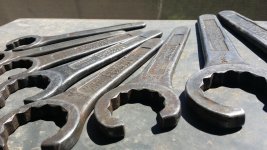
Just posted these on blue point thread. 1928 29 waterpump wrenches, all replaced by your darn pliers! They were cool though.
Attachments

Stuart in MN
Well-known member
I always wondered why are they called water pump pliers? 100's of applications. They are just slip joint pliers.
Water pump pliers were originally designed for tightening or removing water pump packing nuts. Think of well water pumps and the like, not automotive water pumps.
d42jeep
Well-known member
I remember around 1965 buying packing string for the water pump on my ‘29 Model A Ford because tightening no longer stopped the seepage. After installing the packing, I tightened the gland nut with water pump pliers. Doesn’t get too much more automotive than that.
-Don
-Don
ddawg16
Well-known member
I have one of those.....It's about 40 years old....one of the first tools I ever got....kinda worn out....but I still use it.
Wow....just thinking about old tools....I have a Blackhawk screwdriver with bits my dad gave me when I was 16....I have all of the original bits except one...it my be 56 years old.
Wow....just thinking about old tools....I have a Blackhawk screwdriver with bits my dad gave me when I was 16....I have all of the original bits except one...it my be 56 years old.
WagonHo!
Well-known member
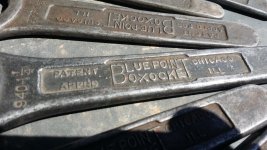
How do you pronounce that “Boxocke”? Is it box-ox?
Oldtuleguy
Well-known member
- Joined
- Nov 4, 2017
- Messages
- 10,461
I think it is pronounced box socket?
Private Lugnutz
Well-known member
You apparently replied without reading other replies. See post #6.Water pump pliers were originally designed for tightening or removing water pump packing nuts.
OP
eschoendorff
Well-known member
Those pliers are excellent for pinching you palm between the handles when they slip off an object
Yes, they are. But when they’re the closest pliers of the type to me when I need them, they’ll do. My all time favorite pliers of the type are the French-made FACOM. Always work painlessly. Slim, strong and comfy. But that’s for another thread.
nbpt100
Well-known member
Yes, they are. But when they’re the closest pliers of the type to me when I need them, they’ll do. My all time favorite pliers of the type are the French-made FACOM. Always work painlessly. Slim, strong and comfy. But that’s for another thread.
Yes and I like my Knipex that will not allow the handles to fully close thus preventing that pinch of the palm.
Thanks for the history less to all who shared. Interesting.
Billy Jack
Well-known member
Thanks for the history, Lugz.
I've got a bunch of these from 6" to 16", some Snap On and a few Channellock. My late father was a dealer mechanic in the 50's and 60's. From the time I was a toddler handing him tools, "water pump" pliers was the only term I knew. I never asked him why.
Now I know.
Bill
I've got a bunch of these from 6" to 16", some Snap On and a few Channellock. My late father was a dealer mechanic in the 50's and 60's. From the time I was a toddler handing him tools, "water pump" pliers was the only term I knew. I never asked him why.
Now I know.
Bill
WagonHo!
Well-known member
I think it is pronounced box socket?
Yeah ok make sense now, dident see the t on the end there.